
September 25, 2026 · 15 min read
How to Start Freelancing With No Experience: Build Proof, Not Years
Clients do not hire years of experience; they hire evidence that you can do their job. How to pick a skill someone will pay for, manufacture honest proof, package it on one page with a first price, find the first clients, handle the admin minimum and follow a realistic 90-day plan.
You can start freelancing with no experience, but not with no evidence. Clients do not hire years; they hire the belief that you can deliver the thing they need, and that belief comes from seeing work like theirs that you have already done. So the path is: pick one skill someone will pay for, make three or four pieces of honest proof that you can do it, put them on one page with a clear offer and a first price, then tell the people who already know you before you go anywhere near a marketplace. The rest of this guide walks through each step, including the parts most "start freelancing" articles skip.
It covers the whole start-up path. If you only need the portfolio itself, our guide to building a portfolio with no experience goes deeper on that one piece.
"No experience" usually means "no proof"
Read the top answers on any r/freelance thread asking this question and one line keeps coming back, in various wordings: you have to be able to show potential clients that you can actually do the work. It is usually posted as a reason to give up. It is really a job description.
A small business owner hiring a freelancer has a problem — a website that does not convert, a launch with no copy — and is spending their own money to make it go away. They are not running a graduate scheme; they want someone who can, as another thread put it, hit the ground running. What reassures them is not "3 years' experience" but work that makes them think: this person has solved something close to my problem before.
That is good news, because experience takes years and proof does not. A self-initiated project with a clear brief, a pro-bono job for a local charity, a process you rebuilt at your current job — none of these are "experience" in the employment sense, and all of them are proof. The rest of this guide is about making that proof honestly and then putting it where buyers will see it.
One warning: much of the advice on this query is sold by people who earn from teaching freelancing, and it promises speed. Some people land a first job quickly because they already had the right network; others take months. Nobody publishes a trustworthy average, and we will not invent one.
First, a skill someone will pay for
Here is the part that gets fudged: freelancing with no skill is not a thing. "No experience" is fixable. "No skill" means there is nothing to sell yet, and the honest first step is to learn one. The related searches — how to start freelancing with no skills, as a student, as a teenager — mostly land here.
The useful test is not "what is in demand?" but "what do I already half-know that a business would pay to have done?" Most people have more than they think:
- Writing — if you have written reports, grant applications, a well-read blog or long clear emails that people act on, you are closer to paid copywriting or editing than you think.
- Design — if you make the posters for your club or redesign slide decks because you cannot bear the default ones, that is a start on graphic design.
- Technical work — if you built a site for a friend, automated something in a spreadsheet or taught yourself to code, that is a start on web development or operations work.
- Admin and subject knowledge — the person who organises the chaos at work is close to virtual assistance; tutoring and translation lean on knowledge you already have.
If none of those fit, learn one skill properly before you sell it. How long that takes depends on the skill, your hours and your starting point, so there is no standard timeline. The sign you are ready is not a certificate: it is finishing a small, realistic project on your own, to a standard a stranger could judge, without a tutorial open. Courses help; finished projects get you hired.
Pick one skill to lead with, even if you can do several. "I do websites, logos, social media and video" reads as "I have not decided yet". You can widen later; our piece on whether freelancers should niche down covers when that makes sense. For a first offer, narrow is easier to explain and easier to prove.
Five honest ways to manufacture proof
Once you have the skill, you need three or four pieces of work that show it. There are five sources, and they are not equally strong. The weakest proof is work only you have judged; the strongest is work a real client paid for and was happy with.
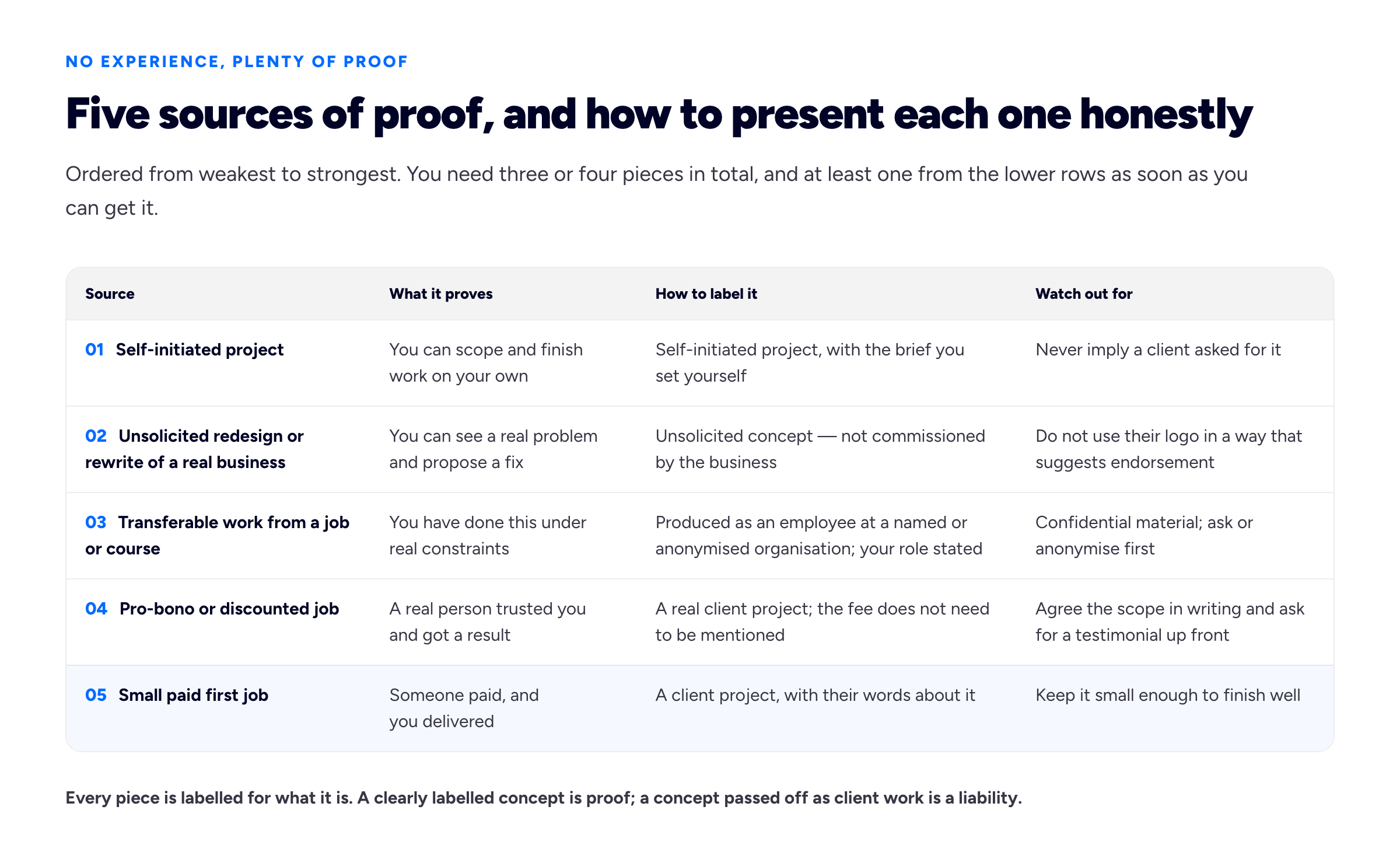
The label column matters as much as the work. A reader who discovers that a "client project" was never commissioned stops believing everything else on the page.
1. Self-initiated projects
Write yourself a brief as if a client had sent it — who the business is, what problem they have, what done looks like — and then do the work to that brief. A copywriter might write a full email onboarding sequence for an invented meal-kit company. A developer might build a booking page for an imaginary physiotherapy clinic that actually works. The brief is what turns an exercise into proof, because it lets a reader judge whether you solved the problem, not just whether the result looks nice.
2. Unsolicited concepts for real businesses
Redesigning a real café's cluttered menu or rewriting a real plumber's homepage is persuasive because the problem is visibly real. Label it as an unsolicited concept, every time, in words on the page. Do not imply the business commissioned or approved it, and be careful with their logo and name. Sometimes the owner sees it and hires you; do not count on that, and do not pester them if they do not reply.
3. Transferable work from a job or course
If you already did this kind of work as an employee or a student — the newsletter you ran, the dashboard you built, the rebrand of a society — that is your strongest early proof, because it was done under real constraints with real stakeholders. The catch is confidentiality. Anything under a non-disclosure agreement, anything with customer data and anything your employer would object to seeing in public stays out, or is anonymised and rebuilt with dummy content. When in doubt, ask. State your role precisely: "I wrote the copy; the design was the in-house team's" is more credible than a vague "we".
4. Pro-bono or discounted work, done deliberately
Working free or cheaply can be a sensible trade for a first real client, but only on terms. Agree the scope in writing before you start — what you will deliver, how many rounds of changes, by when — so a favour does not turn into six weeks of unpaid revisions. And ask for the thing you are really being paid in, up front: a short testimonial and permission to show the work, if they are happy with the result. Local charities, community groups and friends' early-stage businesses are the usual candidates. Our guide to asking clients for testimonials has wording that does not feel awkward.
5. A small paid first job
The best proof is a real client who paid, and it does not have to be large. A single landing page or a one-off data clean-up that you finish very well is worth more than a large job you struggle through. It often comes from the pro-bono client's recommendation or from someone in your network.
Package it: one page, three case studies, one offer
Proof in a folder on your laptop does nothing. It needs a page a client can open from a message, on a phone. At this stage that page needs only four things.
- A line that says what you do and for whom. "I write website copy for independent physiotherapy and wellness clinics" beats "creative wordsmith passionate about storytelling". The first tells a clinic owner in one read that you are for them.
- Three case studies. Not ten. Each one short: the problem, what you did, and the result or the reasoning. Our guide to writing a portfolio case study has the structure; with no client results yet, the reasoning — why you made the choices you made — does the persuading.
- A clear offer. One or two packages described in plain words, so a client knows what they would actually be buying. "A five-page website copy rewrite, delivered in two weeks, with one round of changes" is an offer. "Get in touch to discuss your needs" is not.
- One way to contact you. An email address or a form, visible without scrolling far.
A marketplace profile is not a substitute, because it belongs to the platform and sits among near-identical rivals; we cover the trade-offs in do freelancers need a website. If you want something up this week without paying, a free portfolio website on a subdomain is enough — the point is a link you can send, not a perfect site.
Your first price
New freelancers tend to guess what a client will tolerate, and guess low. Start instead from what you need to earn per working hour once the unbilled time — finding work, proposals, admin — is counted. That is your floor. Then quote per project where you can, so the client compares your price with the outcome rather than with someone cheaper on a marketplace.
Being new is a reason to keep first projects small, not a reason to charge a trivial amount. A very low price attracts clients who choose on price, and those are the clients most likely to push the scope and argue the invoice. Our full guide to how much to charge as a freelancer works through the floor calculation, the pricing models and what to say when someone asks your rate.
Where the first clients come from
Most people start with the platforms because they feel less exposing than telling people they know. They are also where you are least visible and competing hardest.
Warm network first
Former colleagues, managers, classmates, friends who run businesses, the people you know through clubs or volunteering. Send individual messages — not a broadcast — saying what you now do, for whom, with the link to your page, and asking if they know anyone who might need it. You are not asking them to hire you; you are asking them to keep you in mind. People who already trust your reliability skip the hardest part of the decision. Our guide to getting your first freelance clients covers this, communities and cold outreach in depth.
Then platforms, with realistic expectations
Upwork, Fiverr and similar marketplaces do bring buyers to you, and some freelancers build real businesses there. They also come with trade-offs you should know before you rely on them. You compete with a very large pool of sellers, often on price. New profiles have no reviews, and reviews drive visibility. And both platforms take a cut of your earnings and, on Upwork, charge for the credits used to submit proposals. Fee structures change, so read each platform's own current fee page before you set your prices there, rather than trusting a figure in a blog post — including this one.
The balanced approach is to treat a marketplace as one channel alongside your own page, not instead of it. On Upwork, that means a small number of proposals to jobs you are genuinely a strong fit for, rather than volume; our guide to writing a freelance proposal that wins applies directly. On Fiverr, where buyers come to you, it means a narrow gig with a clear deliverable and a price you can sustain once the platform's cut is taken.
The admin minimum
You do not need a registered company or an accountant to take a first job. You do need three things from the first paid project.
A written agreement
Even a short email both of you reply "agreed" to is better than nothing. It should say what you will deliver, by when, for how much, how many rounds of changes are included, when you will be paid, and who owns the work once it is paid for. Our freelance contract essentials lists the clauses that prevent the most common disputes.
A proper invoice
Send an invoice with your details, the client's details, a number, a date, what was delivered, the amount, the payment terms and how to pay. Clients' finance teams often cannot pay without one. Our free invoice generator produces one in a few minutes without an account, and our guide on how to get paid on time covers deposits and chasing late payment.
Money set aside for tax
As an employee, tax was taken before you saw your pay. As a freelancer, it usually is not, and the first tax bill is a nasty surprise for people who spent everything. Rules vary a great deal by country, so check your own tax authority's guidance. In the US, the IRS says the self-employment tax rate is 15.3% — 12.4% for Social Security and 2.9% for Medicare — and you must file Schedule SE if your net earnings from self-employment were $400 or more. That is on top of income tax. The IRS also says individuals generally have to make estimated tax payments through the year if they expect to owe $1,000 or more when they file. The simple habit that protects you anywhere: move a fixed share of every payment into a separate account the day it arrives, and do not touch it.
A realistic 30/60/90-day plan
This assumes you already have a sellable skill and some hours a week alongside a job or study. If you are still learning the skill, run this plan after that, not instead of it. The milestones are about what you do, not what you earn, because effort is under your control and a first client's timing is not.
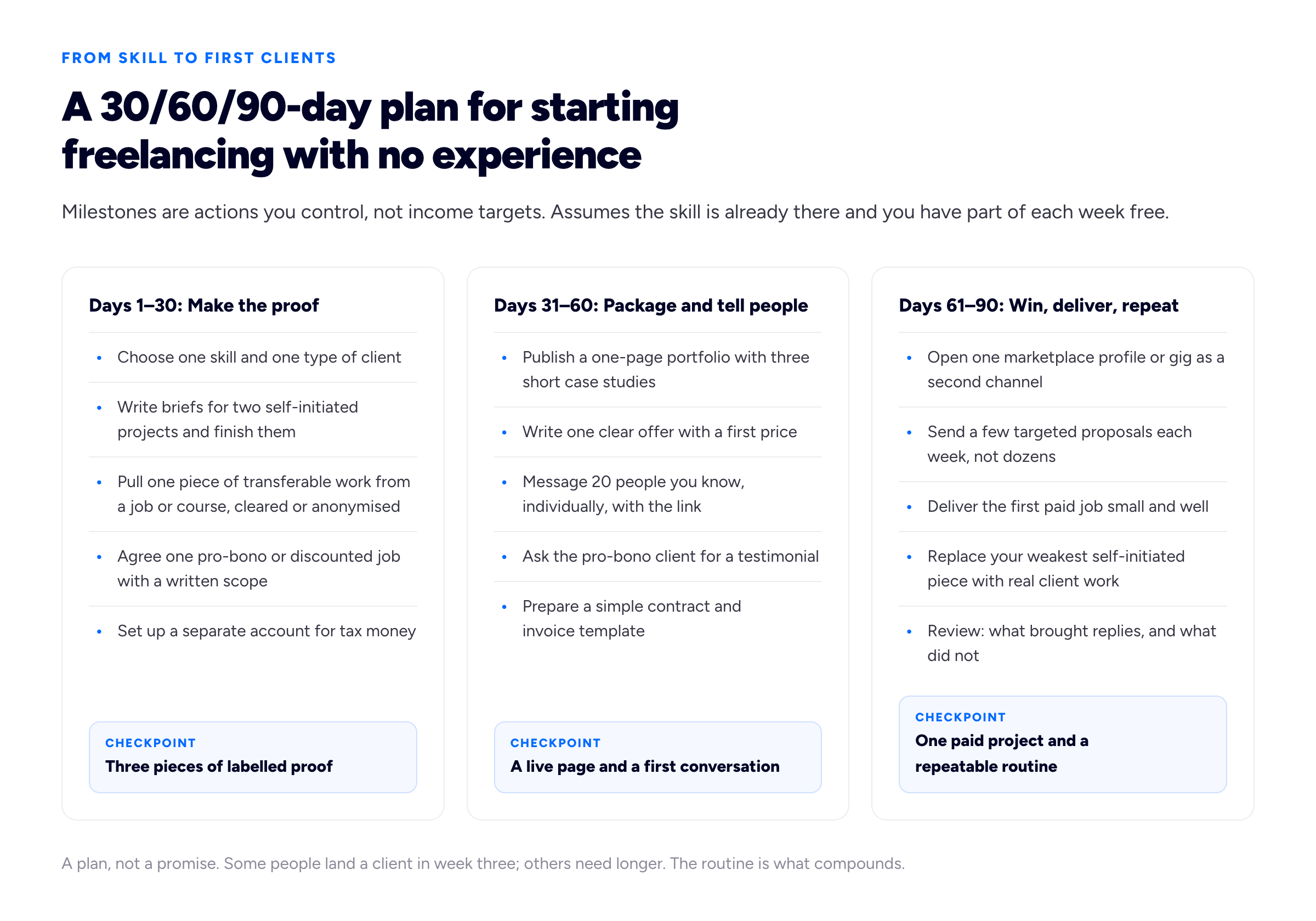
The checkpoints are deliberately modest. If you hit them sooner, move on; if you do not, the fix is usually more proof or more direct conversations, not a better logo.
The twenty messages in the second month are the step most people skip, and the one most likely to produce the first job. At day ninety, look at where replies came from and spend more time there. If nothing has come from anywhere, the usual causes are an offer too vague to say yes to, or proof that does not look like the client's problem.
Frequently asked questions
Can I do freelancing without experience?
Yes, if you have a skill someone will pay for and proof that you can apply it. Clients care much less about how long you have been doing something than about whether they can see work like theirs you have already done. Self-initiated projects, clearly labelled concepts, transferable work from a job or course and a small pro-bono job can all stand in for a client history until you have one. What you cannot do is freelance with no skill at all; in that case the first step is learning one.
How do I start freelancing for beginners?
Pick one skill and one type of client. Make three or four pieces of honest proof, put them on a one-page portfolio with a clear offer and a first price, and tell the people you already know, individually. Add a marketplace as a second channel. From the first paid job, use a written agreement and a proper invoice, and set tax money aside.
What is the best freelance job for beginners?
The one closest to a skill you already have. A former teacher will usually get further, faster, as a tutor or course writer than by learning web development from scratch, because they already have proof and a network of people who know their work. Writing, design, web development, virtual assistance, bookkeeping support, translation and tutoring are all common starting points, but no category is "best" in the abstract; the best one is the one you can prove soonest.
Can I make $1000 a month freelance writing?
Some freelance writers earn that and a great deal more; many earn less, especially early on, and plenty stop before they get there. We could not find a trustworthy published figure for what beginner writers typically earn, so we will not quote one. What decides it is arithmetic you can do yourself: how many clients, at what price, how often. Four clients each paying a modest fee for one piece a week gets you a long way; one client paying marketplace minimums does not. Aim first for a price you can sustain and one client who comes back, then add a second. Treat anyone who promises a figure by a date as selling something.
How we put this guide together
The five proof sources, the order of the path, the one-page portfolio shape and the 30/60/90-day plan are our own recommendations, not an industry standard, and we have tried to say so where it matters. The sourced facts are the US tax figures, which come from the IRS pages linked below and apply only to the US; other countries' rules differ.
We deliberately left out several kinds of claim that fill other articles on this topic: percentages of freelancers who earn a given amount, average times to a first client, beginner hourly rates by skill and "most in-demand skills" rankings. We could not trace any of them to a published method we trusted, and a figure you cannot check is worse than none when you are deciding whether to leave a job. We also did not quote marketplace fee percentages, because they change; read each platform's current fee page before you price there.
Sources: the IRS pages on self-employment tax (the 15.3% rate, its Social Security and Medicare parts, and the $400 Schedule SE threshold) and estimated taxes (the $1,000 rule and the four payment periods), both read on 28 September 2026. The paraphrased reader views come from public threads on the r/freelance community on Reddit, read the same day.
The meal-kit company, the physiotherapy clinic, the café and the other businesses used as examples are invented for illustration and describe no real client.
Related reading: a portfolio with no experience, getting your first freelance clients, how much to charge, writing a proposal that wins and freelance contract essentials.
More from the blog
July 5, 2026 · 13 min read
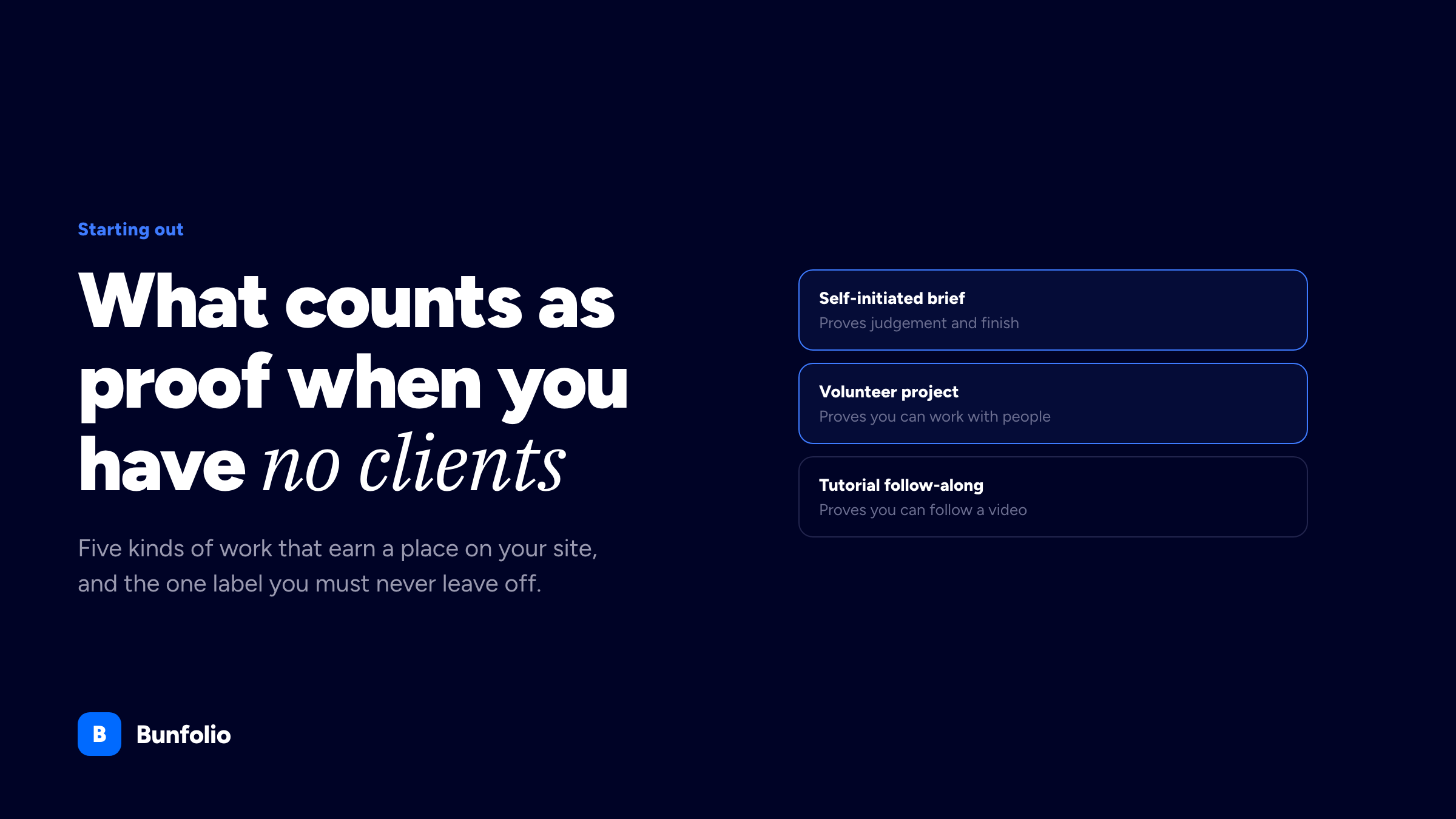
How to Build a Portfolio With No Experience
Five kinds of work that count as evidence when nobody has hired you, the one labelling rule you cannot break, and a two-week plan that ends with a site that is actually live.
October 2, 2026 · 15 min read
How to Start a Cover Letter: Greetings, Opening Lines and Examples
Start with your details and the date, a greeting to a named person or "Dear Hiring Manager", then an opening that names the role, gives one specific hook and says why this employer. Greetings compared...
October 1, 2026 · 16 min read
Freelancing Tips: 29 Practical Habits From First Client to Tax
The freelancing habits that prevent most problems before they start, grouped by stage from setting up to looking after yourself. Each of the 29 tips comes with a concrete action, a template line you c...