
November 3, 2026 · 19 min read
How to Start a Photography Business, Step by Step
Choose a niche someone pays for, turn it into two or three packages, and build each price from your own costs and hours. Then the legal and tax setup, the contract and deposit, one workflow from enquiry to archive, the best way to deliver photos to clients, and the numbers to track in year one.
To start a photography business, choose one kind of photography that a specific client pays for, turn it into two or three fixed packages, and price each one from your real costs and hours rather than from what someone else charges. Then set up the business itself: pick a structure (most people start as a sole proprietor or sole trader), register with your tax authority, open a separate bank account, insure your kit and your liability, and use a written contract with a deposit for every booking. Finally, build a delivery routine you can repeat, from the first enquiry to an online gallery the client downloads from, and track a handful of numbers from the first job so you know by the end of the year whether the business works.
This guide is the business side. If you are still learning the craft or choosing kit, start with our guide to becoming a freelance photographer; for the site that shows your work, see our guide to the photography portfolio website.
The short version, in eight steps
- Pick a niche with a buyer: "headshots for small professional firms", not "I shoot everything".
- Write two or three packages that say how long, how many edited images, how they are delivered, by when and how they may be used.
- Build the price from the bottom up: yearly costs plus the pay you need, divided by the jobs you can realistically sell.
- Set up the business: structure, registration, tax, a separate account and insurance, following your own country's rules.
- Use a contract and take a deposit. No date is held without both.
- Run one workflow for every job, from enquiry to archive.
- Find the first five clients directly.
- Track your numbers from job one.
Throughout, we follow Maeve Quinlan, an invented portrait photographer setting up Larchmere Studio, also invented, as a part-time business alongside a job.
Choose a niche you can sell, not just one you enjoy
Liking a kind of photography is a fine start, but a business needs someone who pays for it, often enough, whom you can reach. Put your candidate niche through four questions. They are our tests, not an industry standard, and each can be answered in an afternoon.
- Who pays? Name the buyer precisely. "Couples" is a buyer; "marketing managers at small firms" is a buyer; "people who like nice photos" is not.
- How often do they buy? A couple books a wedding photographer once. A firm needs headshots every time it hires. Repeat buyers are the cheapest clients you will have, because you only win them once.
- How do they find a photographer? Search, a venue's supplier list, a colleague's recommendation. If you cannot say, you cannot market to them.
- Can you name twenty of them? If you can list twenty real potential buyers within reach, the niche is concrete enough to start. If you stall at four, it is too narrow or out of reach.
Maeve loves weddings, but they scored badly on the second and fourth tests: one booking per couple, sold a year ahead, mostly through planners she did not yet know. Business headshots scored better on every count. She could list thirty small professional firms in her town from a local directory, and every new hire meant another session. She chose headshots and team days, and kept weddings as a second-shooter sideline. Our guide on whether freelancers should niche down covers when to narrow further and when it is safe to widen.
Turn the niche into packages
A package is a fixed bundle: a session of a set length, a set number of edited images, a delivery method and deadline, and a licence saying how the client may use the pictures. Packages make you easier to buy from, because the client compares two or three clear options instead of asking for a quote, and easier to run, because every job of a type follows the same steps. For each package, write down:
- Time: how long you are on site, and whether travel is included.
- Images: how many edited images the client receives or chooses from a proof gallery. Avoid promising "all the images": it commits you to editing frames that should never leave your computer.
- Editing: what "edited" means (correction on every image, retouching on a set number) and how many rounds of changes are included.
- Delivery: the gallery, the file formats and the turnaround in working days.
- Usage: where and for how long the client may use the images. A website headshot and a national advertising licence are different products, even if the shoot takes the same time; our freelance photographer guide explains copyright and licensing.
- Add-ons: extra images, faster delivery, prints, a second location, priced in advance so you never invent a figure on the phone.
Maeve's three were an individual session (thirty minutes, three retouched images), a team morning (up to eight people, two retouched images each, one consistent background) and a team day with environmental portraits. She expected most firms to choose the middle one, so she designed it first.
Build the price from your costs and time
We are not going to give you a going rate. Published "average rates" rarely say where their numbers come from, they vary enormously by niche and area, and copying one tells you nothing about whether it covers your costs. Work out your own floor first, then look at what photographers in your niche and area publish, and decide where you sit.
- Add up your yearly costs: equipment wearing out (what your kit cost divided by the years it will last), software, insurance, website and gallery service, backup storage, travel, studio hire, accounting help and marketing.
- Decide the pay you need from the business in a year, before tax.
- Count the real hours per job. The shoot is often the smaller part. Add the enquiry, preparation, travel, setting up, culling, editing, delivery, invoicing and follow-up.
- Estimate how many jobs you can actually sell in a year, not how many fit in a diary, allowing for quiet months, holidays and marketing time.
- Divide costs plus pay by jobs. That is the floor for an average job; larger and smaller packages scale from it.
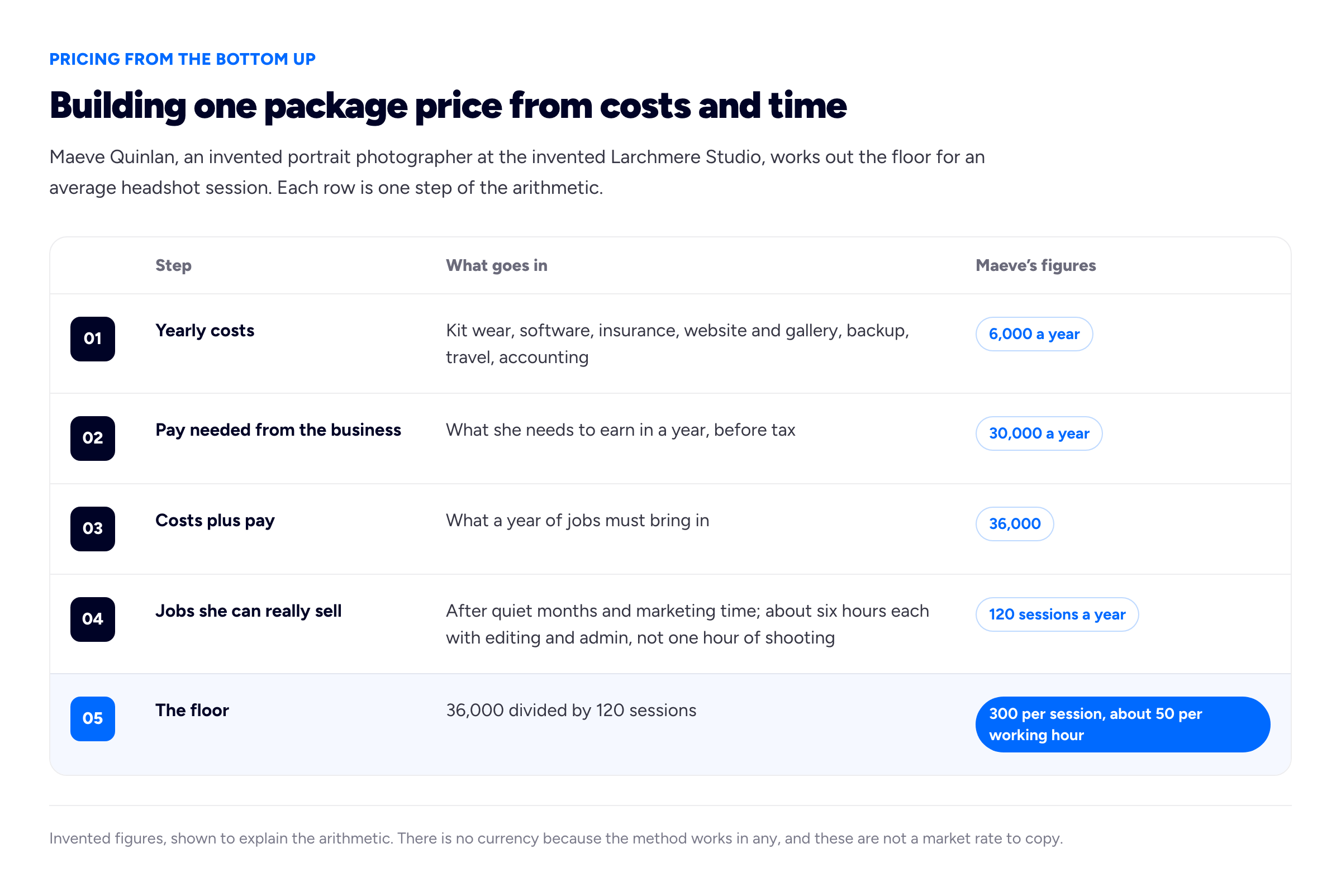
Maeve's arithmetic, with invented figures. The floor is what an average job must bring in for the year to work, not the price she has to charge.
Two things usually happen the first time someone does this. The hours per job turn out to be several times the shooting time, and the jobs you can sell turn out to be far fewer than the diary suggests. Both push the floor up, and both explain why underpriced photographers end up busy and broke at once. If your floor sits well below what established photographers in your niche publish, you have probably undercounted hours; if well above, cut costs, sell more jobs or move to buyers who spend more per job. Our guide to how much to charge as a freelancer walks through the same arithmetic in more depth.
The legal and admin setup
The rules depend entirely on where you work: country and, in the US, state, county and city. What follows is a map of what to look at, with official sources for the US and UK. It is not legal or tax advice; an accountant or local small-business advice service can tell you what applies, and that conversation is worth having before your first paid job rather than after your first tax bill.
Choose a business structure
Most photographers start with the simplest structure. In the US, the Small Business Administration says that if you do business without registering as another type, "you're automatically considered to be a sole proprietorship", and that you "can be held personally liable for the debts and obligations of the business". A limited liability company (LLC) generally protects you from that personal liability, with state forms and fees. The SBA's guide to choosing a business structure compares the options.
In the UK, the usual start is a sole trader, and GOV.UK's page on setting up as a sole trader says sole traders are "personally responsible for all of the debts of the business". A limited company separates the business from you but brings more paperwork. Other countries have their own equivalents, with the same trade-off. For a small, part-time start the simple structure is common, and you can change later; what matters is choosing deliberately, with insurance and contracts limiting what can go wrong.
Register the business and its name
If you trade under a name that is not your own, such as Larchmere Studio, check whether it must be registered. The SBA's page on choosing your business name says a DBA, or trade name, gives no legal protection by itself, but "most states require you to register" it, and requirements "vary by business structure as well as by state, county, and municipality". Local licences or permits may also apply, so check your city or council website.
Register for tax and set money aside
Nobody deducts tax from a client payment for you. In the UK, GOV.UK says you must register for Self Assessment as a sole trader "if you earn more than £1,000 in a tax year". In the US, the IRS says sole proprietors and other individuals "generally have to make estimated tax payments if they expect to owe tax of $1,000 or more when their return is filed", across four payment periods (estimated taxes), and self-employment tax applies on top of income tax, as our freelance photographer guide explains. Sales tax or VAT may also apply depending on where you are and what you turn over. Our recommendation: move a fixed share of every payment into a separate savings account the day it arrives, and ask an accountant what share suits your first year.
Keep the money and the records separate
Open a separate bank account for the business even if the law does not require one; bookkeeping becomes reading one statement. Keep a receipt for every purchase and an invoice for every job. GOV.UK says self-employed people must keep records "for at least 5 years after the 31 January submission deadline of the relevant tax year" (how long to keep your records); the IRS's general rule is three years, with longer periods in specific situations (how long should I keep records).
Insure the kit and the liability, and get releases
Ask a broker about equipment cover (including away from home), public liability (someone trips over your light stand) and professional indemnity (a client says your work, or a lost file, cost them money). Some venues and corporate clients ask for proof of liability cover before you are allowed on site, so arrange it before your first booking. If a recognisable person or private property appears in an image used to promote or sell something, you will usually need a signed release, and you want clients' permission to show their photos in your portfolio. Make both part of the booking; the freelance photographer guide covers releases in more detail.
Contracts and deposits
Every paid job needs a written agreement before you hold the date. Our guide to freelance contract essentials covers the clauses that prevent most disputes. Photography adds a few of its own:
- The session: date, times, location and what happens if the client runs late.
- Deliverables: the package, number of edited images, formats, delivery method and turnaround.
- Usage and copyright: who owns copyright, what the licence allows, and whether you may show the images in your portfolio.
- Payment: the total, the deposit, when the balance is due, and whether the gallery is released before or after it is paid.
- Cancellation and rescheduling: what happens to the deposit if the client cancels or moves the date, and what happens if you are ill.
- File retention: how long the gallery stays online and how long you keep the files.
Take a deposit when the date is booked. It confirms the client is serious and pays for the work you turn down for that slot. Whether you can keep it after a cancellation depends on your contract and on consumer law where you work, so word that clause carefully rather than assuming a deposit is automatically non-refundable. Then invoice the balance properly; our guide to how to write an invoice lists what every invoice should carry, and getting paid on time covers chasing a late one.
From booking to delivery: one workflow for every job
The difference between a hobby and a photography business is not the camera. It is one routine that every job goes through, so nothing depends on your memory in a busy week. Write it down once and follow it even for small jobs.
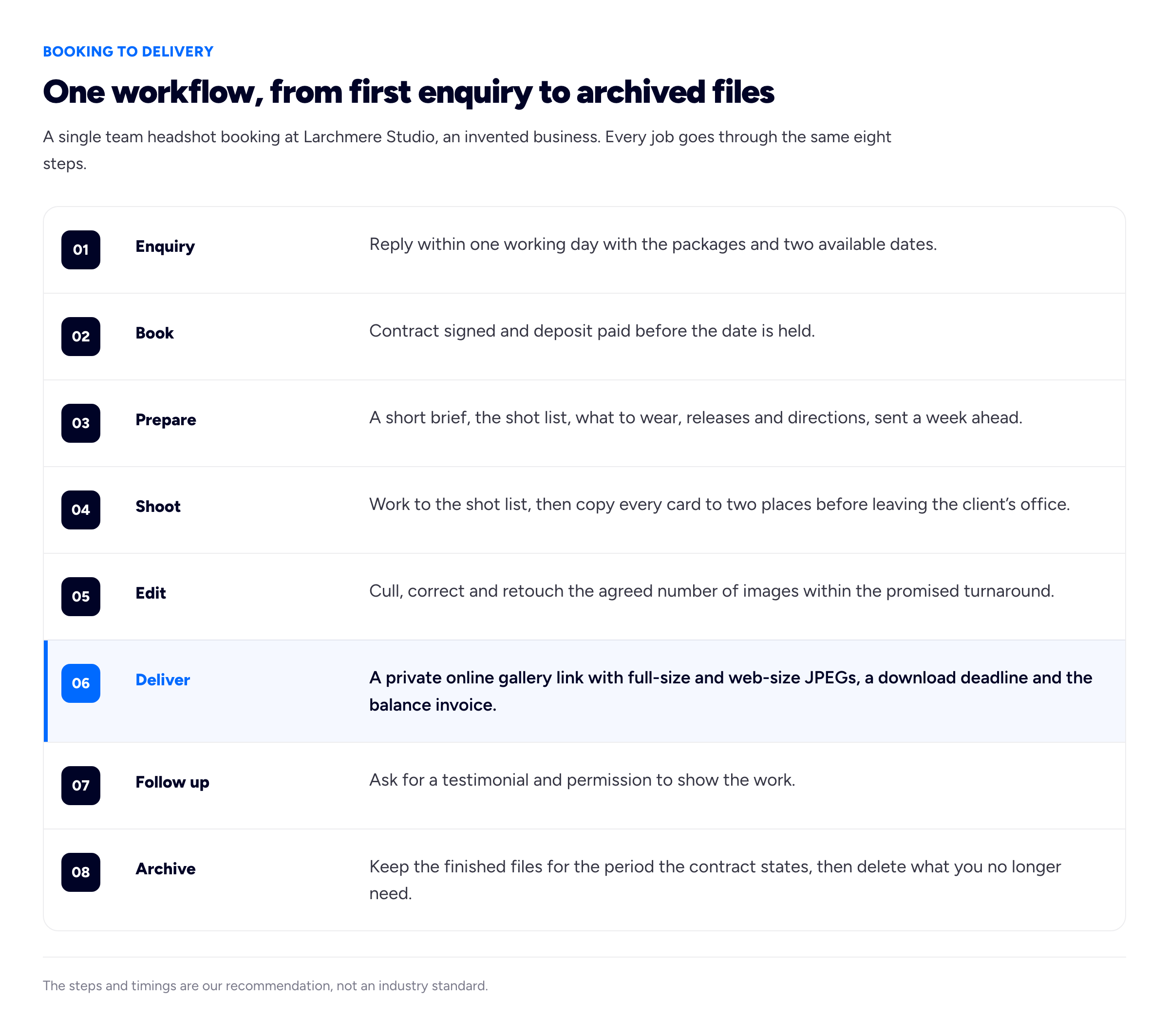
Eight steps, every job. The delivery step is the one clients remember, so it is the one to get right first.
Before the shoot, on the day and in the edit
Answer enquiries within a working day with your packages and two or three dates. Once the contract is signed and the deposit paid, send a short preparation note: what to wear, how long it takes, where to go, what you need from them, and any release to sign. For business clients, ask who will choose the final images; it saves a week of emails. On the day, work to the shot list, then copy the cards to two places before you leave and to a third, off-site copy once home. Losing a client's images is one of the few mistakes a small photography business struggles to recover from. In the edit, cull first, correct the whole set, then retouch only what the package includes, and track the time: editing is where hours per job quietly grow.
How to share and deliver photos to clients
The best way to deliver photos to clients, in our view, is a private online gallery: a link the client opens in a browser, where they see every image at a good size, mark favourites if choosing, and download the files themselves. Dedicated client-gallery services do this, and many photography website builders include one. It works on a phone, can be passworded, lets a business client forward one link to colleagues, and can expire on a date you set. The other ways to share photos with clients all work, with trade-offs:
- A file-transfer or cloud-storage link: fine for a business client who just wants the files, poor for choosing images, because thumbnails are small and there is no way to mark favourites.
- A USB stick or prints: a keepsake some portrait clients like. Offer it as an add-on to the gallery, not a replacement; sticks get lost.
- Email attachments: only for one or two web-sized images. Large files bounce or get compressed.
Whatever you use, get the files right:
- Format: JPEG, which almost every client can open, in a full-resolution version for print and a smaller web version, so nobody uploads a huge file to a company site.
- Colour: sRGB unless the client's printer asks otherwise; most screens and browsers assume it, and other colour spaces can look dull on screen.
- Raw files: say in the contract whether you supply them. Most portrait photographers do not, because a raw file is unfinished and the edit is part of what the client pays for; if a commercial client needs them, price an add-on.
- Names: for a team shoot, the person's name and a number, not the camera's file number.
- Instructions: one short paragraph saying which version to use where, how long the gallery stays live and how to ask for changes.
Send the balance invoice with the gallery link, or release downloads once it is paid, as your contract says.
How long to keep the files
Put a retention period in the contract: how long the gallery stays online, and how long you keep finished files afterwards. Clients who know the gallery closes download promptly. Portraits are personal data in many places. The UK regulator, the ICO, puts it plainly: "You must not keep personal data for longer than you need it", and its guidance on storage limitation explains how to set retention periods; other countries have their own privacy rules. Keep the finals for the period you promised and delete rejects you no longer need. Business records follow your tax authority's rules, which are a separate obligation.
Getting your first paying clients
The first clients rarely come from posting and waiting. They come from asking specific people: your own network (individual messages, not a group post), the suppliers who meet your clients first (venues, planners, recruiters, estate agents) and businesses whose current photos are visibly weak.
Maeve wrote to fifteen firms on her list whose team pages had mismatched, dated or missing headshots. Each message was three sentences: what she noticed, what a team morning would include, and a link to her portfolio. Bastian Holloway, an invented office manager at a small architecture practice, replied within a week; they had just hired two people and the team page already looked uneven. That first team morning gave her a real commission for the portfolio, a testimonial and an introduction to the practice's accountant, who had the same problem.
Before you send anything, have somewhere to send people: a simple site with your best work in the niche, your packages with a starting price, and a clear way to enquire. A free site on Bunfolio is one option; any fast page you control will do. Our guide to getting your first freelance clients has outreach messages to adapt, and how to ask clients for testimonials covers asking at the right moment, straight after delivery.
The first-year numbers to track
You need a spreadsheet with one row per enquiry and one per job, started on day one. By month six it will tell you more about your business than any advice can. These are the numbers we recommend:
- Enquiries per month, and where each came from, so you do more of the marketing that works and stop the rest.
- Booking rate: the share of enquiries that become paid jobs. Low with plenty of enquiries points at price, reply speed or packages; high with few enquiries points at marketing.
- Average sale per job, add-ons included. If it stays below your floor, the year will not add up however busy you are.
- Hours per job, split into shooting, editing and admin, against the estimate you priced from.
- Effective hourly rate: what a job paid, minus its direct costs, divided by all its hours. This tells you which package or client type is worth having.
- Costs against plan, monthly, because subscriptions creep.
- Repeat and referral work, which should grow through the year in a niche with repeat buyers.
- Days to payment on each balance invoice.
Look once a month and ask one question: what should I change next month? After a year, Maeve's sheet showed that team mornings paid far better per hour than individual sessions, because the setup was done once and the editing was consistent. She raised the individual price and pushed the team package harder. Our freelancing tips cover the habits that help once the work arrives.
Frequently asked questions
Do I need a licence to start a photography business?
It depends on where you are. In the US, requirements vary by state, county and city and may include registering a trade name and a local business licence; start with the SBA's guides, then check locally. In the UK, you register as a sole trader or company with the tax authority, and some locations need permits. Drone work usually has its own rules.
Should my photography business be an LLC or a sole proprietorship?
Many photographers start as a sole proprietor (US) or sole trader (UK) because it is simplest, then change as the business grows. An LLC or limited company generally separates business debts from your personal assets but adds paperwork and cost. An accountant can tell you which suits your situation.
What is the best way to deliver photos to clients?
A private online gallery with downloads: the client sees every image at a good size, marks favourites, downloads full-resolution and web-sized JPEGs, and can share one link with colleagues. Set an expiry date and say it in your contract.
How do I share photos with clients privately?
Use a gallery or file link that is not publicly listed, password-protect it where the service allows, and send it only to the client. Do not post client images publicly, including in your portfolio, without permission.
Should I give clients the RAW files?
Most portrait photographers do not, because raw files are unfinished and the edit is part of what the client pays for. Say in your contract whether they are included, and price them as an add-on if a commercial client needs them.
How long should I keep client photos?
As long as your contract says, and no longer than you need. Set one period for the online gallery and another for your archive, tell clients both, and delete what you no longer need. Business records follow your tax authority's rules.
How we put this guide together
Bunfolio builds portfolio websites for freelancers, photographers among them. Most of this guide is our recommendation: the four niche tests, the package checklist, the pricing method, the contract additions, the eight-step workflow, the delivery advice on formats, colour and raw files, and the first-year numbers are our judgement, not a published industry standard.
Where we state facts about law and tax, we have quoted and linked the primary source we read: the US Small Business Administration on business structures and business names; GOV.UK on setting up as a sole trader and keeping records; the IRS on estimated taxes and record keeping; and the ICO on storage limitation. These rules differ by country and, in the US, by state and city, so we point to the official source rather than guessing. Nothing here is legal or tax advice.
We have left out the figures that usually decorate this topic, such as average photographer rates, typical start-up costs or how many new photography businesses survive, because we could not trace any to a published method, sample and date. The numbers in the pricing diagram are invented to show the arithmetic and are not a rate to copy. Everyone named here is invented: Maeve Quinlan, Larchmere Studio and Bastian Holloway, along with the unnamed architecture practice and its accountant.
Related reading: how to become a freelance photographer, the photography portfolio website, how much to charge as a freelancer, freelance contract essentials, how to write an invoice and getting your first freelance clients.
More from the blog
October 2, 2026 · 15 min read
How to Start a Cover Letter: Greetings, Opening Lines and Examples
Start with your details and the date, a greeting to a named person or "Dear Hiring Manager", then an opening that names the role, gives one specific hook and says why this employer. Greetings compared...

September 29, 2026 · 16 min read
How to Become a Freelance Writer: A Realistic Step-by-Step Path
A realistic path into freelance writing: choose one kind of writing and one type of client, write three honest samples with no clips, and put them on a one-page portfolio. Includes a sample cold email...
September 25, 2026 · 15 min read
How to Start Freelancing With No Experience: Build Proof, Not Years
Clients do not hire years of experience; they hire evidence that you can do their job. How to pick a skill someone will pay for, manufacture honest proof, package it on one page with a first price, fi...