
July 12, 2026 · 22 min read
Should You Niche Down as a Freelancer?
Three axes you can specialise on, how far along the spectrum is far enough, and the honest cases — thin markets, early careers, volatile sectors — where staying broad is the better call.
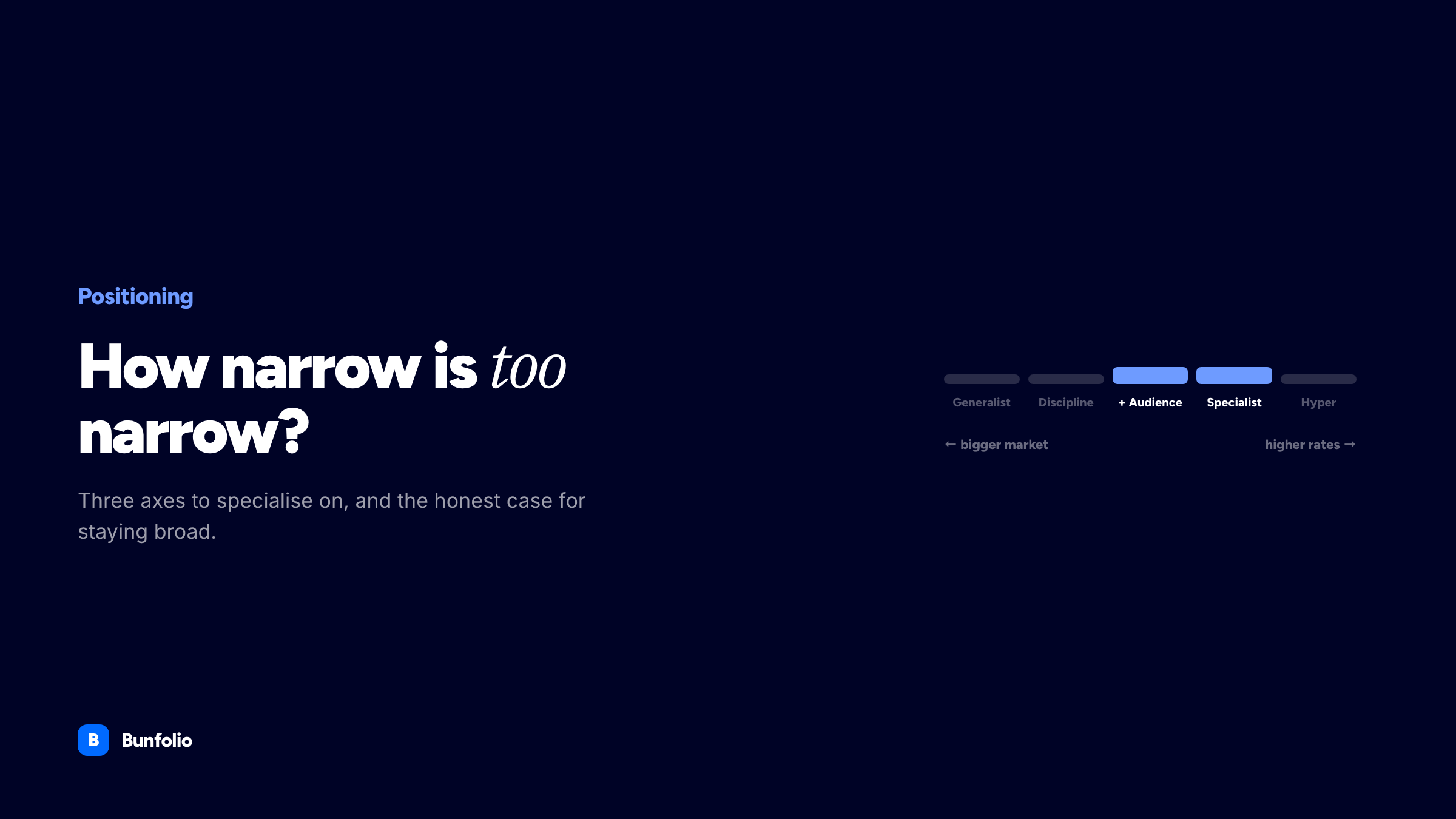
Sooner or later someone tells you to niche down. Usually it arrives as an instruction rather than an argument — pick a lane, own a category, stop being a generalist — and it is delivered with the confidence of settled science. The advice is mostly right. The confidence is not.
The honest version is conditional. Specialising is the single cheapest improvement most freelancers can make to how they are perceived, priced and remembered. It is also genuinely the wrong move for some people at some moments: in a thin local market, in your first year when you have no evidence about what you are good at or what you can stand, in a sector that could contract quickly, and for anyone whose enjoyment of the work depends on it changing every few months. Advice that never says "not yet" or "not you" is marketing, not advice.
This guide covers what niching actually is — a claim about who you are for, not a rule about what you accept — the three different axes you can specialise along, why a narrow claim outperforms a broad one, how far along the spectrum you should actually go, the situations where staying broad is the better call, how to choose a niche from evidence you already have rather than from a brainstorm, how to test one for a month before you rebrand anything, what changes on your portfolio when you do, and how to change your mind later without losing what you built.
What "niching down" actually means
The word does most of the damage. "Niche" sounds like a restriction — a smaller box, fewer options, a door closing behind you. That framing is why so many freelancers resist it, and the resistance is rational if that is what it meant.
It is not what it means. Niching is a decision about what you advertise. It changes the sentence at the top of your site, the projects you lead with, the language you use in outreach, and the kind of enquiry that finds you. It does not change what you are capable of, it does not appear in your contracts, and it does not stop you taking a well-paid job that sits outside it. A niche is a claim, not a licence.
Here is the whole difference in two sentences. "I'm a web developer" describes a skill you possess. "I build booking systems for physiotherapy clinics" describes a problem someone has. The first sentence makes the reader do work — they have to imagine whether you would be any good at their particular thing. The second sentence does the work for them. Every advantage of specialising follows from that one shift.
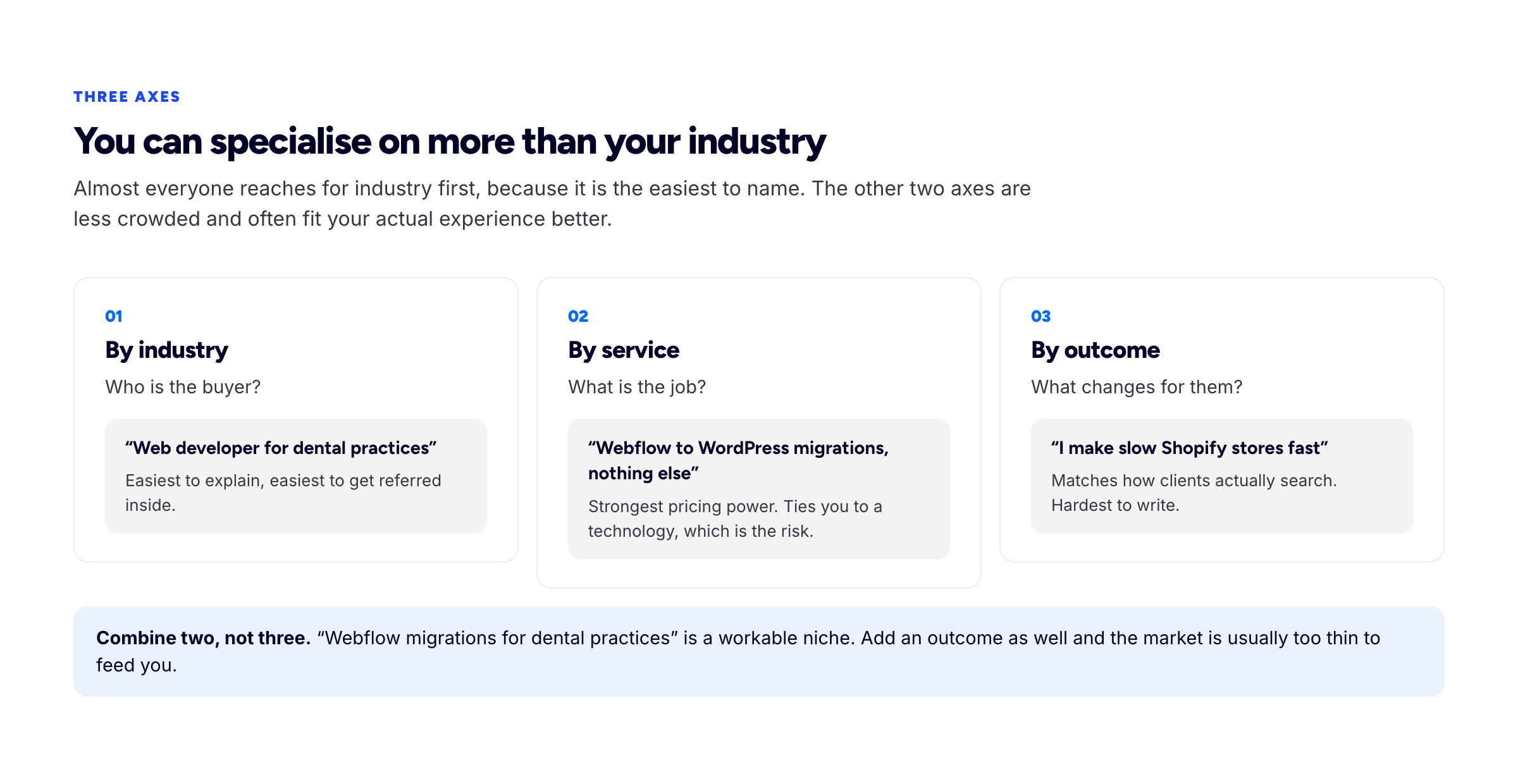
Three axes. Most people only ever consider the first one.
By industry — who you serve
The familiar one. "Web developer for dental practices." You keep the full range of your skill and narrow the audience. This is the axis people default to, partly because it is easy to explain and partly because it is the only one most advice mentions.
Industry niches compound faster than the others. You learn the sector's vocabulary, its regulations, its seasonal rhythms and its standard objections. By the fourth dental practice you know what the booking software is, what the compliance constraints are, and what every one of them will ask about patient data before they ask about the design. That accumulated context is the thing clients are actually paying extra for.
By service — what you do
"Webflow to WordPress migrations, nothing else." Here the audience stays wide open and the offer narrows to a single repeatable job. Anyone in any sector with that specific problem is a prospect.
Service niches are the fastest to establish, because the claim is verifiable in a way an industry claim is not. Nobody has to trust your judgement about the dental sector; they just have to believe you have done this exact migration before. They are also the easiest to systematise — the same checklist, the same tooling, the same three questions in the first call — which is what makes them profitable on fixed price rather than hourly.
By outcome — what changes for the client
"I make slow Shopify stores fast." This is positioning by the result rather than the discipline, and it is the least used of the three because it takes the most nerve. You are no longer selling a category of labour, you are selling a change in someone's situation.
Outcome niches sell the best, when they are true. They map exactly onto how the buyer already thinks — nobody wakes up wanting a front-end developer, they wake up annoyed that their store takes six seconds to load. They also carry the most risk, because you have made an implicit promise and you have to be able to keep it. Do not claim an outcome you cannot point to twice.
Combining axes — two is the sweet spot
You can pair any two of these, and pairing is usually where the good positioning lives. Industry plus service: "Webflow to WordPress migrations for law firms." Service plus outcome: "site speed audits that get you under two seconds." Industry plus outcome: "I make dental practice sites that fill the appointment book."
Combining all three is where people get into trouble. "Shopify speed optimisation for independent bookshops in the north of England" is a beautifully specific sentence describing a market that will not feed you. Each axis you add multiplies the narrowing, and three narrowings applied at once usually leaves a pool too small to produce steady work. Two axes, held firmly, is the shape that works for most people.
Why a narrow claim beats a broad one
The mechanism is worth understanding, because if you only know that niching "works" you will apply it in the wrong places. There are three separate things going on and they are not equally strong.
Referability
This is the biggest one and it is nearly always undersold. Most freelance work comes through people, and people can only refer you if they can remember what you do in a form short enough to say out loud.
"I know a good developer" is a weak referral. It arrives with no context, competes with everyone else the listener knows, and is only offered when someone explicitly asks for a developer. "I know someone who does the Shopify speed thing" is a strong referral, because it fires unprompted — the moment anyone in the room complains about a slow store, your name is the obvious response. A niche installs a trigger in other people's heads. Breadth installs nothing.
The same applies to your own network's memory of you. Ten people who vaguely know you do "digital stuff" will send you nothing. Ten people who know precisely what you do will each send you something eventually.
Recognition and search language
People search for their problem in their own words, not for your job title. The person with a failing migration types the name of the migration. The clinic owner types the thing clinics need. Those searches are low volume and almost nobody has written for them properly, which makes them winnable in a way that "freelance web developer" never will be.
A niche hands you that language for free. Your pages can carry the exact phrasing a specific buyer uses, and your case studies can be titled after the problem rather than the client. That is the whole of the strategy we set out in our portfolio SEO guide — you do not beat the marketplaces on head terms, you win the queries where the searcher has already diagnosed themselves.
Being the obvious choice, not the compromise
When a client shortlists three generalists, they are comparing broadly similar options and the comparison collapses to price and availability. That is a market you can only win by being cheaper or free sooner. When a client finds one person whose entire site is about their exact problem, they are not running a comparison at all. They are checking whether you are available.
That is where the pricing effect comes from, and it is worth being precise about it rather than reaching for a percentage. Specialising does not magically make your hours worth more. It moves you out of a comparable market into a much less comparable one, and price sensitivity lives almost entirely in comparability. It also makes you faster at the specific job, which means the same fee covers fewer days — which is the actual route to a better hourly return, and why this connects directly to how you set your rates. Charging more is easier when there is nothing sitting next to you on the page.
How far to go: the specialisation spectrum
Niching is not a switch. It is a slider, and the interesting question is not whether to move it but how far.
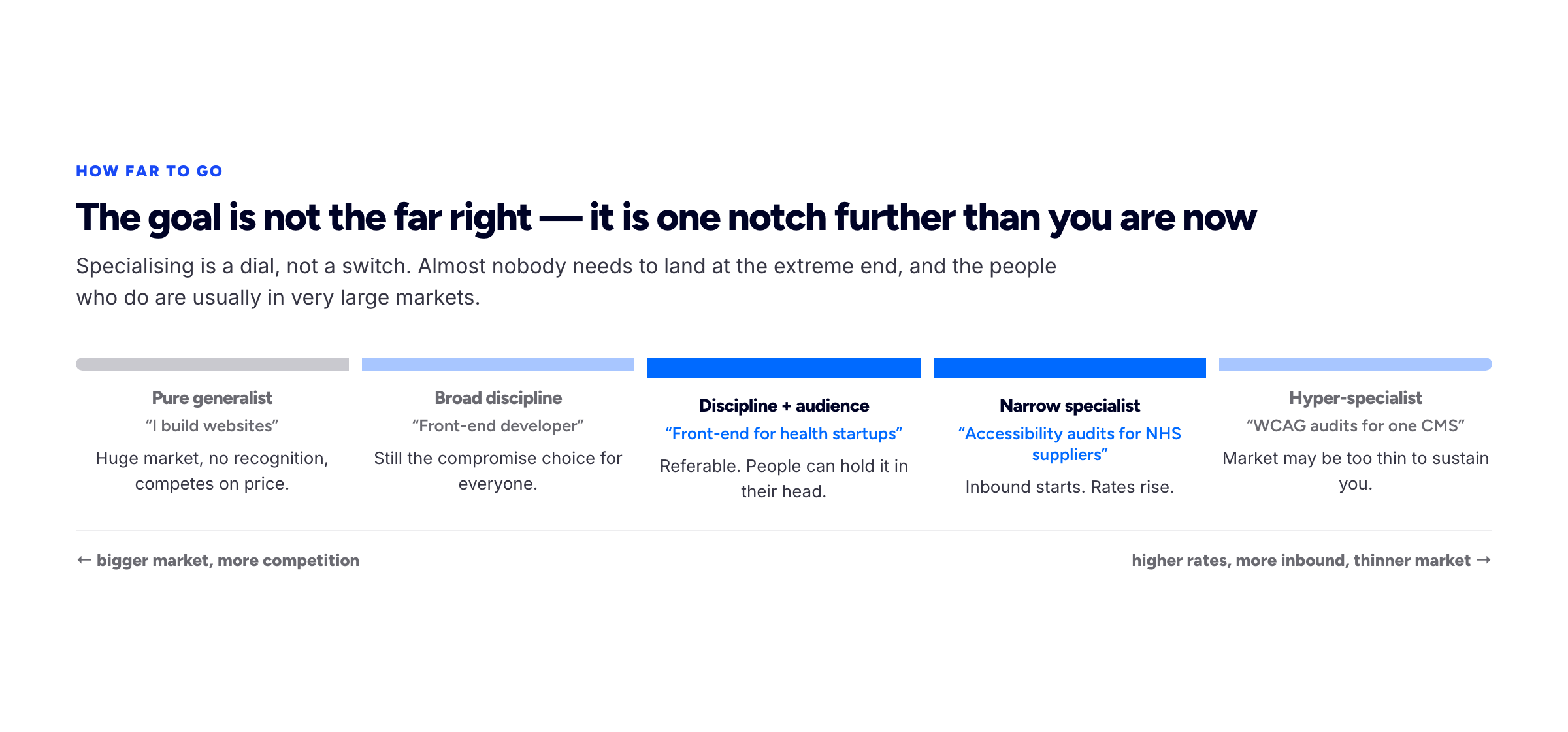
The goal is not the far right. It is one notch further right than you are now.
At the far left is the pure generalist — "I do websites, apps, branding, whatever you need." Enormous market, almost no pricing power, and no reason for anyone to remember you. Then a broad discipline: "front-end developer." Still very large, still highly comparable, still competing mostly on availability.
The middle-right is where most of the value sits. Discipline plus audience — "front-end developer for healthcare products" — is enough specificity to be memorable and searchable while leaving a market large enough to sustain a full calendar. One notch further, the narrow specialist — "I rebuild patient-facing booking flows" — has real pricing power and meaningful inbound, because there are few enough alternatives that finding you feels like luck to the buyer.
Past that is the hyper-specialist, and this is where the advice usually stops being honest. Market size does not shrink gently as you narrow; it falls away. At some point there are simply not enough buyers with that exact problem in a year to fill your year, and you have traded a healthy business for an impressive sentence. Hyper-specialisation works when the problem is expensive enough that a handful of engagements pays for twelve months. If your niche's typical project is worth a week of your time, you need a lot of them, and you need a market wide enough to produce them.
So the practical instruction is not "get as narrow as possible." It is: move one notch to the right of where you are now, and see what happens. One notch is reversible, cheap and almost always an improvement. Three notches at once is a bet.
When not to niche down
This is the section most articles on this topic leave out, and it is the reason a lot of freelancers take the advice, suffer for it, and conclude that positioning is nonsense. There are real situations where staying broad is the correct call.
Your market is thin and local
If you serve clients within driving distance of a town of eighty thousand people, the pool of buyers is fixed and small. Narrowing it by industry can leave you with a handful of realistic prospects, all of whom already have someone. The freelancer who is "the person in this town who does websites" has a genuinely defensible position that a niche would destroy.
The fix, if you want the benefits anyway, is to niche on service or outcome rather than industry and go remote with it. Geography and industry are both narrowings; applying both usually leaves nothing.
You are early, and you have no data
Choosing a niche in your first six months means choosing it from imagination. You do not yet know which work you are unusually fast at, which clients you can bear, which sectors pay on time, or what you will still enjoy after the twentieth one. Committing early is not decisive, it is guessing with extra steps.
Take a wide range of work deliberately for a while and treat it as paid research. Keep notes. The niche you would have picked on day one is very rarely the one the evidence points to a year later. Everything about finding your first clients is easier when you are not also filtering out most of the market on a hunch.
Your sector could contract
Some industries move together. When budgets tighten in a sector, they tighten for everyone in it at once, and a freelancer wholly embedded in that sector has no other pipeline. If your candidate niche is a single volatile industry — one heavily exposed to funding cycles, regulation, or a single dominant platform — understand that you are concentrating your risk as well as your reputation.
That is not a reason to avoid it. It is a reason to keep a second, quieter line of work alive, and to prefer an outcome or service niche that transfers across sectors when one of them stalls.
You would be miserable
Worth saying plainly. Some people do this work because every project is different. If doing the same migration forty times a year would make you want to stop freelancing altogether, a niche that maximises your rate and destroys your motivation is a bad trade, and no amount of positioning theory outweighs it.
There is a middle path: specialise on the service or outcome, and let the industries vary. You get the repeatability that makes you fast and the variety that keeps you interested.
Breadth is genuinely your product
A small number of freelancers are hired precisely because they cover the whole job — the person who can do the brand, the site, the copy and the launch for a founder who does not want to manage four contractors. That is not a failure to specialise. It is a specialisation in being the single point of contact, and it should be positioned as one rather than apologised for.
Choosing a niche from evidence, not from a brainstorm
Most people choose a niche by sitting down with a blank page and thinking about it. That produces aspirational answers — the sector you find interesting, the work you wish you were doing — which is exactly the wrong input. You already have better data.
The last ten jobs exercise
Write down your last ten paid engagements. For each one, note four things, honestly:
- Did it go well? Delivered close to scope, client happy, no lingering resentment on either side.
- Were you fast? Not "did you enjoy it" — did it take you noticeably less time than you expected, because you had done something like it before.
- Did it repeat or refer? Did that client come back, or send someone else.
- Would you take it again tomorrow? The one-second gut answer, before you rationalise it.
Now look for rows with three or four marks. There will usually be a cluster of two or three jobs that share something — the same sector, the same type of deliverable, the same underlying problem. That cluster is your candidate niche, and it has a property that a brainstormed niche does not: someone has already paid you for it and been pleased.
Speed is the most underrated column. The work you are fastest at is the work where your accumulated experience is doing real economic work, and it is where fixed pricing turns from risk into margin.
Sanity-check the demand side
A cluster in your own history is necessary but not sufficient. Three quick checks before you commit:
- Can you name twenty potential buyers without straining? Real organisations, not categories. If you cannot get to twenty, the market may be too thin to support you.
- Do these buyers spend money on this already? Someone with an urgent problem and no budget line for it is a hard sell regardless of your positioning.
- Do they gather anywhere? A trade association, a subreddit, a conference, a newsletter, a LinkedIn cohort. A niche whose members never encounter each other cannot produce referrals, which removes the biggest single benefit.
The sentence test
Write the claim as one sentence a stranger could repeat accurately after hearing it once. If it needs a clause of explanation, it is too complicated to be referred. If it could describe two hundred other freelancers, it is too broad to be remembered. "I make slow Shopify stores fast" passes. "I deliver holistic digital experiences for growth-stage brands" fails both halves.
Test the niche before you rebrand anything
The expensive mistake is treating a niche as an identity change — new site, new name, new email signature, everything torn down and rebuilt around a claim you have not yet tested. Test first. Three weeks of evidence is worth more than three days of design.
Write one landing page. Not a new site — one page, on your existing site, addressed entirely to the niche. The problem in their language, what you do about it, one relevant piece of work, and a way to get in touch. Nothing else on your site has to change.
Produce one case study that fits the niche. Take the closest project you have already done and rewrite it around the niche's problem rather than around your process. If you cannot find one, that is information: you may be positioning around work you have not actually done enough of.
Do a month of deliberate outreach. Twenty to thirty specific, personalised approaches to organisations that match the niche, pointing at the landing page. This is the real test, and it is fast. You are looking for three signals: do people reply more often than to your general outreach, do the conversations start further along, and do they argue less about price.
If all three improve, commit. If nothing changes, you have lost a month and gained a case study — and you should look at whether the problem you named is one your buyers actually feel, or one you merely find interesting. This kind of small, cheap probe is the same discipline that makes cold outreach work at all, which we go into in getting your first freelance clients.
What changes on your portfolio when you niche
Once the niche survives the test, four things on your site change. They are small edits with a disproportionate effect, and none of them require a redesign.
The hero line. This is the whole thing, really. The sentence at the top of your site moves from describing your job title to naming your buyer's problem. "Freelance developer, London" becomes "I rebuild booking flows for healthcare products." Nothing else you change will matter as much, which is why we treat the hero as the single highest-leverage element in the portfolio guide.
Project order. Your three most niche-relevant projects go first, regardless of which ones you are proudest of. A visitor decides whether you are for them in the first screen and a half; a brilliant project in the wrong category spends that attention proving you are a generalist.
The services list. Cut it down. A services section listing nine things reads as availability; one listing three reads as focus. Anything you will still happily accept but no longer advertise simply comes off the list — it does not need a home on the page.
Which case study you write next. Write up the work that best demonstrates the niche, even if it was a smaller or less glamorous job than the alternative. One case study aimed precisely at a buyer beats three aimed at nobody.
Off-site, the same edit propagates: the same sentence goes on your LinkedIn headline, your email signature, and the first line of any outreach. Consistency is what makes a claim stick.
The fear of turning work away
This is the objection underneath every other objection, and it deserves a direct answer rather than reassurance.
A niche describes what you advertise. It does not describe what you are permitted to accept. There is no contract, no register, no committee. If you position yourself around booking flows for clinics and a former client offers you a well-paid marketing site next month, you take it. You do not have to mention it on your site, and the client who found you through the niche will never know.
What actually happens in practice is quieter than the fear. The enquiries outside your niche do not stop — your existing network keeps sending you what it always sent you. What changes is the enquiries from strangers, which become fewer and much better qualified. The pattern we hear from freelancers who have specialised is consistent: less inbound volume, more inbound worth answering.
And be honest about what "turning work away" usually means. The work a niche filters out is disproportionately the work that was going to be badly matched, badly priced and badly scoped — the enquiry from someone who found you in a list and is contacting six people. Losing those is the mechanism working.
Do not niche on a technology
One specific mistake is common enough to deserve its own warning. Positioning yourself around a tool — a framework, a platform, a plugin, a particular no-code product — feels like specialising, and it produces work quickly while that tool is ascendant. Then the tool changes, gets acquired, gets replaced, or simply stops being what people build with, and your entire position evaporates at a speed you do not control.
Buyers persist; technologies do not. Clinics will need to fill appointments in ten years. Bookshops will need to sell online. Whatever is currently the standard way to build those things almost certainly will not be. A niche anchored to a buyer or an outcome survives a technology shift as a tooling change. A niche anchored to a technology does not survive it at all.
The workable version is to lead with the buyer or the outcome and let the technology be the evidence. "I build booking flows for clinics — currently in whatever the sensible stack is" ages well. "I am a specialist in this particular platform" is a position with an expiry date you did not set.
Changing your niche later
People treat the choice as permanent, which is the main reason they never make it. It is not permanent. Freelancers change position every few years, and the transition costs far less than the fear suggests.
The reason it is cheap is that almost nothing you built is niche-specific. Your skill transfers entirely. Your reputation for being reliable and easy to work with transfers entirely. Your testimonials mostly transfer, because they are usually about how you work rather than what sector the client was in. What you lose is the accumulated sector knowledge and some of the referral triggers you installed in other people's heads — real losses, but recoverable in months, not years.
Do it the same way you tested the first one. Add the new positioning alongside the old, run a landing page and a month of outreach, and only retire the old claim when the new one is producing. Overlapping for a quarter costs you nothing but a slightly untidy website. Ripping out a working position before its replacement is proven is how people end up with a quiet six months.
Frequently asked questions
Should freelancers niche down straight away?
Usually not in the first six months. You need evidence about which work you are fast at, which clients you can tolerate and which sectors actually pay, and you can only get that by doing a range of work. Take varied jobs deliberately, keep notes on how each one went, and let the pattern choose the niche around the time you have ten engagements to look at.
What is the difference between a specialist and a generalist freelancer?
In terms of skill, often nothing. The difference is what they advertise and therefore how they are encountered. The generalist is compared against other generalists and competes on price and availability; the specialist is found by people who have already diagnosed their problem and is compared against very little. Most specialists still do generalist work — they simply do not lead with it.
How do I choose a freelance niche if nothing stands out?
Look at speed rather than passion. The work you finish noticeably faster than you expected is where your experience is compounding, and it is a better predictor of a viable niche than what you find interesting. If several types of work tie, pick the one whose buyers are easiest to find and reach — a niche you cannot contact is not a niche.
Will niching down let me charge more?
Usually, through two mechanisms rather than magic. You become less comparable, which is where most price sensitivity lives, and you get faster at the same job, which improves your effective rate even at a flat fee. Neither is guaranteed and neither is instant. We would not put a number on it, and you should be wary of anyone who does.
Can I have two niches at once?
You can, and plenty of people run one while transitioning to another. What does not work is presenting both equally on the same page, because a visitor reads two claims as no claim. Give each its own landing page and its own outreach, and keep the site's main hero pointed at whichever one you want more of.
What if I pick the wrong niche?
You change it, and it costs far less than you expect. Your skills, your reliability and most of your testimonials move with you; the losses are sector knowledge and some referral momentum. Test the replacement alongside the current position for a quarter before retiring the old one, and the switch is barely visible from the outside.
How we put this guide together
Bunfolio builds portfolio sites for freelancers, so this guide comes from what we see on the freelance sites built on it — which hero lines are specific and which are interchangeable — and from the positioning questions freelancers ask us while setting theirs up. The method here, particularly the last-ten-jobs exercise and the one-month test before rebranding, is what we would do ourselves.
Every example in this post is invented to illustrate the shape of a claim, not to describe a real freelancer or a real market. The dental practices, the Shopify stores and the booking flows are stand-ins; substitute your own.
We have deliberately quoted no statistics. This topic in particular attracts confident percentages — rate increases of some exact figure after specialising, proportions of clients who prefer specialists, and similar — and as far as we can tell those numbers trace back to no identifiable study, only to each other. Repeating them would make this guide less trustworthy rather than more. Every claim here about what works is presented as our judgement, and the conditional advice — including the sections on when not to niche at all — reflects that we think the one-sided version of this advice does real harm to people in thin markets and early careers.
More from the blog
August 23, 2026 · 24 min read
How to Get Paid on Time as a Freelancer
The payment terms that prevent a late invoice, and the five-rung escalation ladder for chasing one — from a neutral nudge on day one to a formal letter before action.
July 16, 2026 · 25 min read
How Much to Charge as a Freelancer: Rates, Fees and the Floor
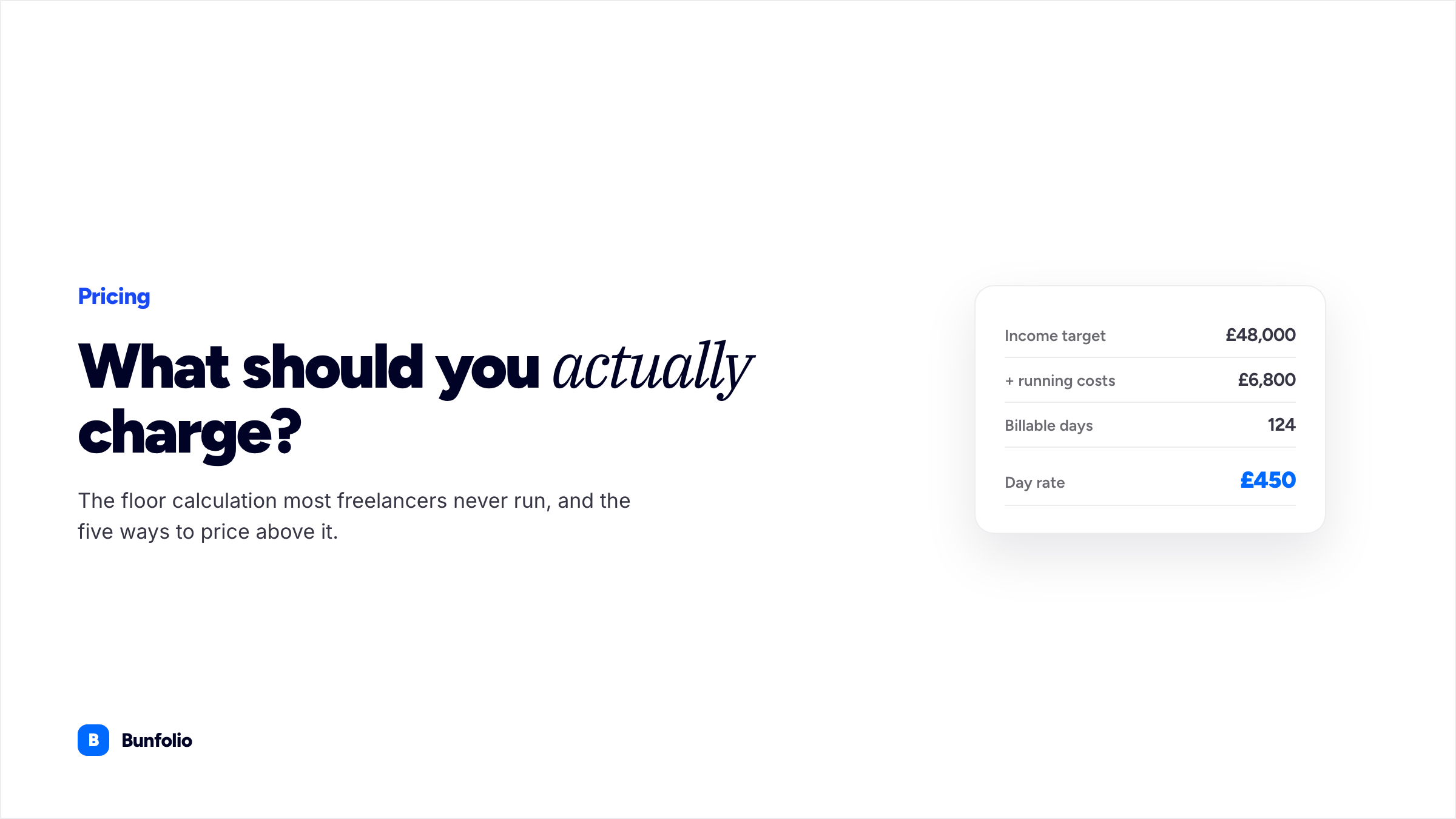
The floor calculation that tells you the least you can charge without going backwards, the five pricing models and who carries the risk in each, and how to raise your rates on clients you already have...
July 10, 2026 · 18 min read
Do Freelancers Actually Need a Website? An Honest Answer
Written by a company that sells websites, so it starts with the freelancers who genuinely do not need one. What a site does that a profile structurally cannot, the minimum version worth publishing, an...