
August 12, 2026 · 22 min read · Updated October 5, 2026
Marketing Portfolio Examples: How to Show Results You Can Prove
A marketing portfolio is an evidence problem, not a gallery problem. The five parts of a single entry, how to write a result an experienced reader believes, and what to do about the numbers you are not allowed to publish.
Most of the marketing portfolio examples that circulate online were built by people whose work photographs well — a brand designer with a logo grid, a studio with a showreel, an illustrator with fifty images and no explaining to do. That is not the job you have. Your work is a campaign brief, a nurture sequence, a spreadsheet of keyword clusters, a dashboard behind a login, and a launch that eleven people contributed to. There is no artefact to photograph, and a good deal of what you did is either confidential, credited to a team, or only meaningful with context that takes three paragraphs to give.
So the useful version of this guide is not a list of attractive sites to imitate. The marketing portfolio examples below are written out in full, entry by entry, so you can see what makes one believable and copy the structure rather than the look. A marketing portfolio is an evidence problem, not a gallery problem. The question the person reading it is holding is narrow and slightly sceptical: did you actually cause the result you are claiming, and would you cause something like it here. Everything below is about answering that in writing, with the material you are genuinely allowed to use.
Why marketers find this harder than designers do
Four constraints are worth naming properly, because most advice on how to make a marketing portfolio quietly assumes none of them apply.
The artefact is invisible. A designer shows the thing. You shipped an email that lives in a sending platform, a paid campaign that stopped running in March, a landing page since redesigned, a content programme spread across forty URLs. Screenshots of these are weak evidence — anyone can screenshot an email — so the burden falls on description.
The credit is shared. A product launch involves product marketing, a designer, a writer, a paid team, an agency and someone in sales. Claiming the launch is dishonest; claiming nothing is career-limiting. The whole skill is describing your slice precisely enough that a reader believes you rather than suspects you.
Results need context to mean anything. "Increased conversion rate by 40%" is not a fact, it is a fragment of one. Forty per cent of what, from what baseline, over what period, at what traffic volume, against what seasonal comparison, and was anything else changed at the same time. Experienced readers know this, which is why they discount uncontextualised percentages almost to zero.
You may not be allowed to publish the numbers. Revenue, customer counts, acquisition cost, list size and pipeline are commercially sensitive at most companies and explicitly confidential at some. That is solvable — there is a section on it below — but it means the naive answer, "just show your results", fails on contact with reality for a lot of people.
None of these are reasons to skip having a portfolio. They are reasons the portfolio has to be written rather than assembled.
What one marketing portfolio entry actually needs
Every strong entry we have seen does the same five things. The order matters less than the completeness: a reader who finishes an entry without knowing what you personally did, or what the number was measured against, will not trust it however good the writing is.
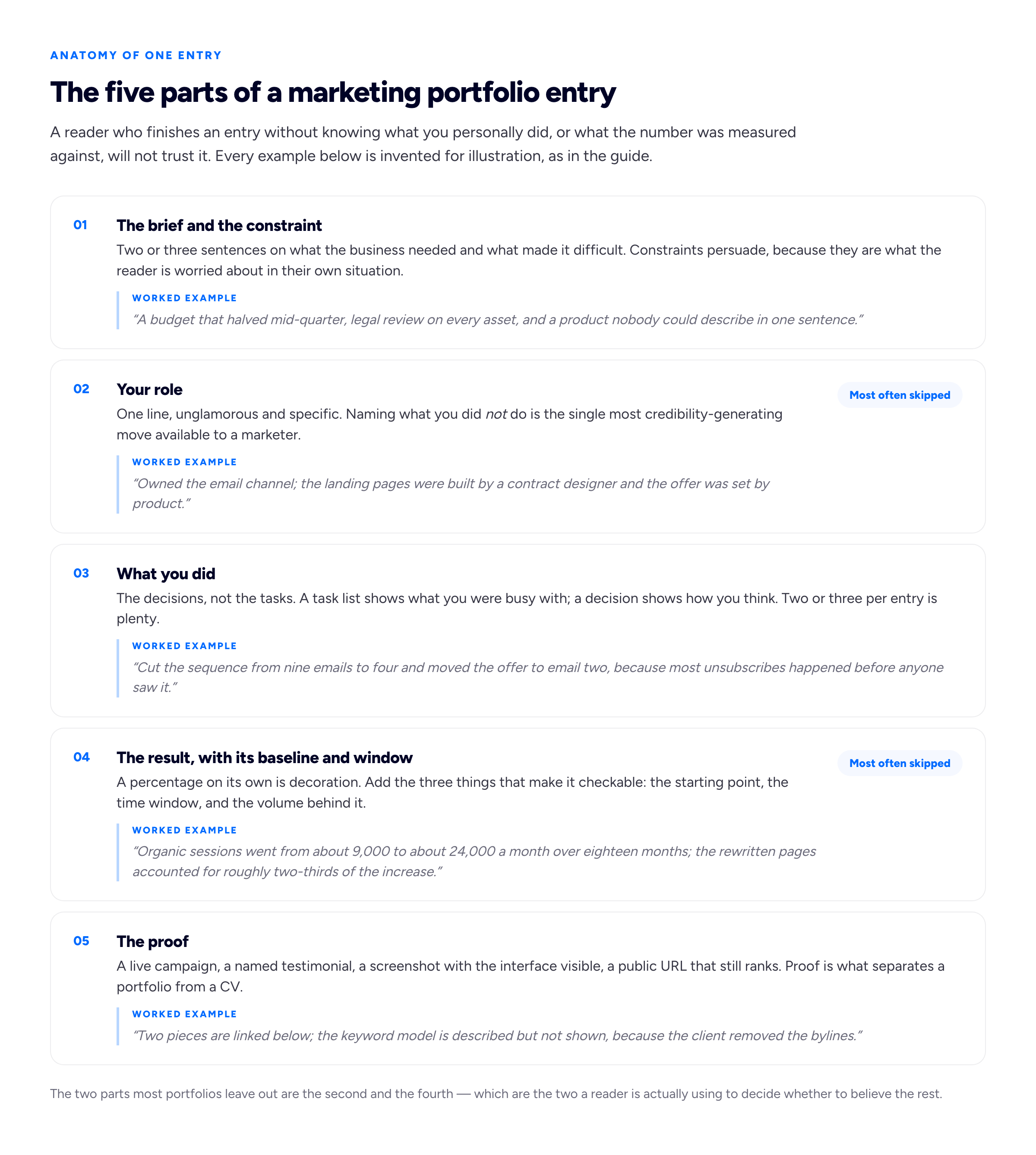
The parts most portfolios skip are the second and the fourth, which are the two the reader is actually using to decide whether to believe the rest.
The brief and the constraint. Two or three sentences on what the business needed and what made it difficult. Constraints are the most persuasive thing on the page, because they are what the reader is worried about in their own situation: a budget that halved mid-quarter, legal review on every asset, a product nobody could describe in one sentence, a sales team that ignored anything marketing sent them.
Your role. One line, unglamorous and specific. "Owned the email channel; the landing pages were built by a contract designer and the offer was set by product." Naming what you did not do is the single most credibility-generating move available to a marketer, because it shows that when you do claim something, you mean it.
What you did. The decisions, not the tasks. "Sent twelve emails" is a task list. "Cut the sequence from nine emails to four and moved the offer to email two, because most unsubscribes happened before anyone saw it" is a decision, and it shows how you think. Two or three per entry is plenty.
The result, with its baseline and window. Covered in the next section, because it is where nearly everyone loses the reader.
The proof. A link to the live campaign, a named testimonial, a screenshot with the interface visible, a public URL that still ranks. Proof is what separates a portfolio from a CV. If you have none for an entry, say so plainly rather than hoping nobody notices.
How to write a result so an experienced reader believes it
Here is the test to apply to every number on your site. Could a knowledgeable, mildly sceptical reader recalculate roughly what happened from what you have written. If not, the number is decoration.
A percentage on its own fails that test immediately. "Grew organic traffic 300%" could mean four hundred sessions became sixteen hundred over two years while the company also tripled its publishing budget and acquired a competitor. That is not a lie, but it is not evidence either. The fix is almost always three additions: the starting point, the time window, and the volume.
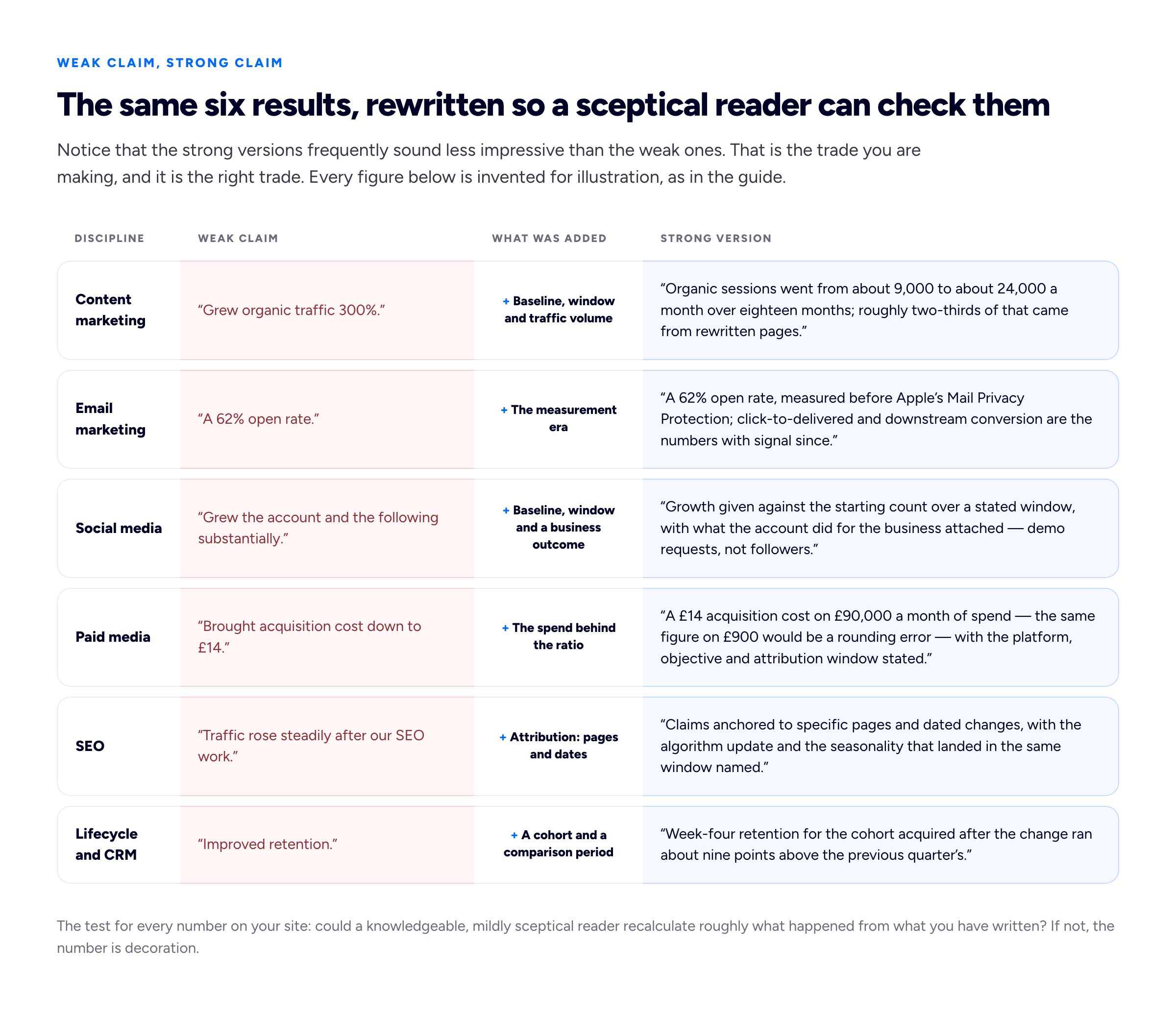
Notice that the strong versions are frequently less impressive-sounding than the weak ones. That is the trade you are making, and it is the right trade.
Two more habits are worth adopting. State what else changed: "we also moved from a two-step to a one-step form that month, so the two effects are not cleanly separable" costs you nothing and buys a great deal, because the reader was going to wonder anyway. And give the measurement method when it is not obvious — last-click, a holdout group, a comparison against the same period last year. Anyone senior enough to hire you knows the difference, and knows that a marketer who does not mention one probably used the flattering option.
Handling numbers you are not allowed to publish
Plenty of good work sits behind a confidentiality obligation, and the answer is not to omit the entry. It is to change what you report.
Index to a baseline of 100. Instead of "monthly recurring revenue from the channel went from £84,000 to £127,000", write "indexing the starting month at 100, the channel finished the year at 151". The shape of the result survives, the sensitive figure does not appear, and any reader who works with data recognises the convention immediately.
Give ranges and orders of magnitude. "A list in the low hundreds of thousands", "a media budget in the mid five figures a month", "a mid-market software company with roughly two hundred staff". These tell the reader whether you have operated at their scale, which is the real question behind most portfolio reading.
Report the mechanism instead of the magnitude. Sometimes you can say nothing numeric. You can nearly always say what changed and why: "the win came from removing the gated PDF and letting the comparison page rank; traffic was similar afterwards but the sales conversations started earlier". A reader who understands marketing finds that more convincing than a percentage anyway.
Anonymise the client but stay specific about everything else. "A large B2B client" is worthless. "A UK insurance broker with a 60-person direct sales team, selling a product with a nine-week consideration cycle" is nearly as useful as the name. Check that the combination does not identify them anyway. Our guide to showing confidential work covers the permission conversation, including what to ask a former employer for and when.
One thing not to do: inventing a plausible-looking number because the real one is off-limits. It will eventually be asked about in an interview, and there is no recovery from that conversation.
Marketing portfolio examples by discipline, and what the evidence looks like
The disciplines differ more in what counts as proof than in how they are written. Every example below is invented for illustration.
Content marketing portfolio examples
You have the best raw material here, because the artefact is public. Link the actual pieces rather than pasting screenshots of your own articles. Beyond the writing, what a hiring manager wants is evidence that you understood distribution: which pieces were made to rank, which were made for the sales team to send, how you decided what to write, and what you stopped writing.
An invented entry: "Ran the blog for a payroll software company for eighteen months. Cut publishing from eight posts a month to three and moved the budget into rewriting the twelve pages already ranking on page two. Organic sessions went from about 9,000 to about 24,000 a month over that period, and the rewritten pages accounted for roughly two-thirds of the increase. Two pieces are linked below; the keyword model is described but not shown, because the client removed the bylines."
Email marketing portfolio
An email marketing portfolio is the one that most needs rebuilding from scratch, because the sends are not public and the platforms give you nothing shareable. Screenshot the email as it actually rendered, on mobile, with the subject line, preview text, audience size band and send context in the caption. Then show the sequence as a diagram rather than twelve separate images — the logic is the work.
Report open rates carefully and say which era the number is from. Apple's Mail Privacy Protection changed what an open means, and quoting a 62% open rate without acknowledging that tells the reader something about you. Click-to-delivered and downstream conversion are the numbers with signal. It also helps to show you know the compliance ground: the FTC's CAN-SPAM compliance guide for US commercial mail, and Article 6 of the GDPR for the lawful basis behind an EU list, are the primary sources rather than the blog posts summarising them.
Social media marketing portfolio examples
The trap here is the wall of nice-looking posts. Anyone can produce nice-looking posts; the reader wants to know whether you can produce them repeatedly, on a schedule, in a voice that is not yours, with a result attached. Show three things: a representative set of posts with their performance visible, the content system behind them (pillars, cadence, approvals, how you handled a bad week), and one piece of evidence that the account did something for the business — subscribers, applications, demo requests, a lift in branded search. Where social is the whole of what you sell rather than one channel among six, the longer version of this is in our guide to a social media manager's portfolio.
Follower counts are the weakest available metric and everyone knows it; growth on a stated baseline over a stated window is defensible. If you ran creator or influencer work, note that disclosure was handled to the standard in the FTC endorsement guides — the sort of detail that separates a professional from an enthusiastic amateur.
Paid and performance
This is where a portfolio can be genuinely quantitative, and where sloppiness is most punished. Give spend alongside every efficiency claim: a £14 acquisition cost on £900 of spend is a rounding error, and the same figure on £90,000 a month is a career. State the platform, the objective, the attribution setting and the window. Show creative alongside the numbers, including the losing variants — a reader learns more from "these three concepts failed and here is what we concluded" than from a page of winners.
SEO
SEO portfolios live or die on whether the reader believes you caused the movement, and a rising traffic chart proves nothing on its own because it coincides with everything else the company did. Anchor claims to specific pages and specific changes, date the changes, and be honest about algorithm updates and seasonality landing in the same window. Technical work is easiest to evidence because it is verifiable: a crawl before and after, an indexation count, a fix a reader can check against Google's own documentation. If the portfolio site itself needs to rank, our portfolio SEO guide covers that separately.
Lifecycle and CRM
The least glamorous discipline and the one where a good entry stands out most, because so few people write them. The evidence is a diagram: the lifecycle map before, the map after, and a note on which stage you attacked and why. Retention results need cohorts to mean anything — "week-four retention for the cohort acquired after the change ran about nine points above the previous quarter's" is a real claim; "improved retention" is not.
A complete marketing portfolio example, written out
Fragments are easier to agree with than to copy, so here is one whole entry in the five-part shape, followed by the top of the page it would sit on. The company, the people and every number are invented.
The entry: a trial-to-paid email sequence
Brief and constraint. A project-management tool for small architecture practices had a 14-day free trial and a weak conversion to paid. The constraint: no developer time for the quarter, so nothing in the product could change. Whatever happened had to happen in email.
Role. I owned the trial email sequence: the plan, the copy and the testing. The designer on the brand team built the template, and the offer (a discount on annual plans) was set by the founder before I joined.
What I did. Three decisions. I cut the sequence from nine emails to five, because the data showed most trials went quiet after day four and the later emails were reaching almost nobody. I replaced feature tours with one task per email, each ending in a link straight to the screen where that task is done. And I moved the annual-plan offer from the last day of the trial to day ten, when people still had time to decide.
Result, with baseline and window. Trial-to-paid conversion went from about 6% to about 9% across the eight weeks after launch, compared with the eight weeks before, on roughly 1,100 trials in each period. Nothing else in the funnel changed in that window, but it was a before-and-after comparison rather than a holdout test, and the second period included a trade show that may have brought in warmer leads. I would not claim the whole three points for the emails.
Proof. Mobile screenshots of all five emails, with subject lines and send days in the captions. A diagram of the old and new sequence side by side. A two-line testimonial from the founder, with her name and permission to publish.
Notice what makes that entry believable: the size of the sample, the window, the admission about the trade show, and the clear line between what the writer did and what the founder decided. A reader can argue with it, which is exactly why they believe it.
The top of the page
The entries need a short frame above them, so a reader knows within a few seconds whether to keep going. For the same invented marketer, it might read:
Lifecycle and email marketer for B2B software. I turn free trials and sign-ups into paying customers, mostly without needing developer time. Five years in-house at two SaaS companies; freelance since 2024. Below: three campaigns with the numbers, what I owned, and what I would do differently.
Then the entries, strongest first, then a short about section, then one clear way to get in touch. That is the whole site. If you are looking at other marketers' portfolios for ideas, judge them by the same test as your own: can you tell what the person did, against what baseline, and how you would check it? Most attractive examples fail that test, and the plain ones that pass it are the ones worth copying.
Agency, in-house and freelance portfolios are different documents
A digital marketing agency portfolio sells a repeatable process and a team, so it can lead with logos and breadth. It still needs two or three deep case studies, because a logo strip proves you have clients and nothing else. The named individual matters less; the delivery model and reporting cadence matter more.
An in-house marketer's portfolio is read by a hiring manager comparing you to four other candidates and mostly trying to work out what you personally own. Depth beats breadth. Three entries showing your judgement in one discipline will outperform nine shallow ones, and the role line matters more here than anywhere.
A freelance or consultant portfolio is read by a buyer deciding whether to hand you money and a login. They want the same problem solved before, a sense of what working with you is like, and something that reduces their risk — a testimonial with a real name on it, a clear scope, a stated way of working. The guide to a freelance portfolio that wins clients covers the parts of the site that are not case studies.
When you have nothing you are allowed to show
This is the honest position for many junior marketers, career changers, and anyone leaving a company that owns everything they produced. Four answers work.
Your own channel as the artefact. A newsletter you write, a small site you rank, an account you grow from zero. The strongest option available, because everything about it is verifiable and entirely yours — the strategy, the numbers, the failures. Six months of a real newsletter with 400 subscribers is more persuasive than an invented campaign for a fictional brand.
Teardowns of public campaigns. Take something you can see from outside, reconstruct the likely brief, analyse what it does and what you would test. This demonstrates judgement without claiming results, which is exactly the right claim for someone who has none yet. Say clearly that you had no involvement.
Real work for a small organisation. A charity, a friend's business, a community group. Small, real and measurable beats large, imagined and unmeasurable. Agree before you start that you may publish the outcome.
Spec work, labelled as spec. A full campaign plan for a real brand, done unprompted. Useful only if honestly labelled and only alongside one of the above, because nobody can tell whether it would have worked.
The bad answer is presenting coursework or a certification exercise as if it were client work. It is transparent to anyone who has hired before. Building a portfolio with no experience goes through this in more detail.
Where the portfolio lives, and how to structure it
You want a marketing portfolio website rather than a PDF or a deck. A deck cannot be linked from an application, updated after you send it, or found by someone searching your name. A live URL does all three, and is itself small evidence that you can put something on the internet.
The structural question is whether each campaign gets its own case-study page or everything sits on one long page. A rough rule: if entries need more than about 300 words each, give them their own pages — marketing entries usually do, because the context is the point. With three or four short entries, one page reads better than a menu of thin ones. That trade-off is worked through in one-page versus multi-page portfolios, and how many projects to include covers the count.
Whatever marketing portfolio template you start from, do not spend a fortnight choosing it. The share of hiring decisions influenced by your colour scheme is small; the share influenced by whether your results are legible is large. Bunfolio exists partly for that reason — you sign in, fill in the content, and get a live site on a subdomain with no design project attached — but the argument holds for any tool that lets you publish today. If you already have a full LinkedIn profile to import from, the first draft costs an afternoon rather than a weekend.
A realistic build plan
Roughly a week of evenings, in this order.
- Inventory first. List every campaign and programme from the last three years. Write nothing yet. Mark each one: can I name the client, can I publish numbers, do I have proof, was my role substantial.
- Pick four. Choose for range of problem type and strength of evidence, not for how impressive the logo is. A well-evidenced small project beats a famous one you cannot describe.
- Gather proof before writing. Screenshots, live URLs, exports. Do it now — access disappears when you leave a job, and asking a former manager is far easier in the first month than the sixth.
- Write one entry properly using the five parts, and expect it to take two hours. The rest go faster once you have found the voice.
- Do a numbers pass. Read only the figures. Delete or repair every one lacking a baseline, a window or a volume.
- Do a credit pass. Read only the verbs. Change every "we" that should be "I" and every "I" that should be "we".
- Ask for two testimonials while the work is recent — asking clients for testimonials covers the wording that gets a reply.
- Publish, then improve. An unfinished site that is live beats a perfect one that is not.
Then revisit it every quarter, while you still remember the numbers. The commonest failure in marketing portfolios is not bad writing; it is a two-year gap and a person who can no longer recall whether the figure was 22% or 31%, and who therefore writes neither.
Frequently asked questions
What is a good marketing portfolio example?
One where every entry says what the business needed, what you personally owned, the decisions you made, the result against a stated baseline and time window, and a piece of proof a reader could check. The full email example above shows that shape. A good-looking page with logos and big percentages but no baselines is not a good example, however polished it is.
What should a marketing portfolio include?
Three to six entries chosen for the job you want next, a short statement at the top saying what kind of marketer you are and for whom, a brief about section, and a clear way to contact you. Each entry needs the brief and constraint, your role, what you did, the result with its baseline and window, and proof. Testimonials with real names help, especially for freelancers.
How do I make a marketing portfolio with no experience?
Build something of your own and measure it: a newsletter, a small site, a social account. Add a teardown of a public campaign, clearly labelled as analysis rather than work you did, and one small real project for a charity or local business with permission to publish the results. The section on having nothing you are allowed to show goes through each option.
Can I include work covered by an NDA?
Often you can include the entry while leaving out what the agreement protects. Index sensitive figures to a baseline of 100, give ranges instead of exact numbers, describe the client by sector and size rather than name, and ask the former employer or client what they are comfortable with. If the agreement rules out even that, leave the entry out rather than bending it.
Should a marketing portfolio be a website or a PDF?
A website, with a PDF only if an application asks for one. A website can be linked from an application, updated after you send it and found by someone searching your name. Keep any PDF as an export of the same entries, with the site's address on the first page.
How we put this guide together
Several of the frameworks here are our own recommendations rather than established practice, and it is worth saying which. The five-part entry anatomy — brief and constraint, role, what you did, result with baseline and window, proof — is Bunfolio's structure, not an industry standard. So is the indexed-baseline convention for confidential figures, the discipline-by-discipline view of what counts as evidence, and the "could a sceptical reader recalculate this" test applied to every number. These come from working with freelancers and marketers building portfolios on Bunfolio, and from the recurring pattern in what persuades a buyer and what makes them quietly close the tab: uncontextualised percentages and unclaimed credit do the most damage, and naming your constraints does the most good.
Where a factual claim is made, it is attributed to a primary source rather than a summary. The email compliance points come from the FTC's CAN-SPAM Act compliance guide and Article 6 of the General Data Protection Regulation; the disclosure point in the social section from the FTC endorsement guides; the SEO section treats Google Search Central's SEO starter guide as the document a technical claim should be checkable against. Everything else — the ordering, the build plan, the advice on spec work — is judgement, and you should weigh it as such.
We have deliberately not quoted a figure for what share of marketers keep a portfolio, how many hiring managers ask for one, or how long anyone spends reading one. Numbers of that kind circulate widely and we could not trace any of them to a primary study we were willing to stand behind, and an invented statistic inside a guide about honest reporting would be worse than the gap. Every campaign, client, sector and number used as an example above is invented for illustration — the payroll software blog, the insurance broker, the indexed revenue figure, the architecture-software email sequence and its founder testimonial, and the rest. They show the shape of a good entry; they do not report anything that happened.
Related reading: more portfolio website examples, how to write a portfolio case study for the long-form version of a single entry, the copywriter portfolio if the copy itself is what you sell, showing confidential work in a portfolio for the permission conversation and the redaction rules, and building a portfolio with no experience if you are starting from nothing you are allowed to publish.
More from the blog
October 6, 2026 · 26 min read
What Is a Portfolio Website? Definition, Types and Examples
A portfolio website is a site you own that shows samples of your work. Here is the plain definition, what a personal portfolio means, the eight different kinds of portfolio and who asks for each, what...
October 2, 2026 · 15 min read
How to Start a Cover Letter: Greetings, Opening Lines and Examples
Start with your details and the date, a greeting to a named person or "Dear Hiring Manager", then an opening that names the role, gives one specific hook and says why this employer. Greetings compared...
September 27, 2026 · 22 min read
How to Write a Letter of Presentation (With 6 Examples)
A letter of presentation is what Spanish, Italian and Portuguese speakers call a cover letter, and it also means a letter introducing yourself or your services to a prospective client. What each meani...