
August 22, 2026 · 22 min read
Social Media Manager Portfolio: Proving Work You Do Not Own
Your best posts sit on a client's account, unattributed, and can be deleted without notice. How to gather evidence before you lose the login, which metrics survive a sceptical reader, and how to show the operating system instead of ten pretty grids.
Nearly every other freelance discipline gets to keep a copy of its work. A designer has the artwork. A developer has the repository. A writer has the document. A social media manager has a login they no longer possess, to an account they never owned, containing posts that a new marketing director can delete on a Tuesday afternoon without telling anyone.
That is the actual problem, and it is why most advice on how to make a social media portfolio is useless. It tells you to show your best posts. Your best posts are not yours, half of them were approved into a shape you did not choose, the analytics that prove they worked sit behind a client's password, and the account you spent two years building now says something in a font you would never have picked. You are being asked to evidence work that is simultaneously invisible, unattributed and revocable.
So this guide is about evidence rather than aesthetics. What you are allowed to screenshot, what you have to ask permission for, which numbers survive scrutiny and which ones quietly damage you, how to describe a client you cannot name, and how to show the operating system you built rather than a wall of nice-looking grids. The general skeleton of a portfolio site — hero, work, about, contact — is covered in our guide to a freelance portfolio website that wins clients, and this post does not repeat it.
Three constraints nobody mentions
The work is on rented land. Everything you made lives inside a platform, attached to an account owned by someone else, governed by terms you did not sign. A client can revoke your access the day the contract ends. A brand can rebrand and archive two years of grid. A platform can deprecate a format — that is not hypothetical, it has happened repeatedly to whichever short-form or ephemeral product was fashionable three years ago. If your portfolio strategy is "I will link to the account", your portfolio has a dependency you do not control.
The credit is invisible by design. Good social media management is anonymous. The whole point is that the brand appears to be speaking, in a voice that is not yours, and nothing anywhere records that you wrote it. There is no byline, no commit history, no credit on the artwork. A prospective client looking at a post you wrote has literally no way to tell you wrote it, which means the burden of proof is entirely on your description, and your description is the thing a sceptical reader is inclined to discount.
The results are contaminated. An account grows for many reasons at once: a product launch, a press mention, a paid budget you did not control, a founder who went viral independently of you, an algorithm change that briefly favoured your format, a competitor imploding. Any experienced buyer knows this, so a bare growth number does not read as an achievement. It reads as a claim awaiting a follow-up question, and if you cannot answer that question well, the number has cost you more than it earned.
None of that is a reason to skip the portfolio. It is the reason the portfolio has to be written like a case, with the evidence gathered deliberately, rather than assembled like a gallery.
Gather the evidence while you still have the login
This is the single most valuable habit in the discipline, and it costs about twenty minutes a month. Access disappears the day a contract ends, and asking for exports afterwards puts a client in the awkward position of doing you a favour that involves their commercial data. Ask while you are useful to them.
Do this on a schedule, not at the end:
- Export the analytics monthly, as CSV where the platform allows it and as screenshots where it does not. Native insights typically only retain a rolling window — some are measured in weeks — so a number you did not capture is a number that no longer exists anywhere.
- Screenshot standout posts in situ, with the performance panel visible, at the time. Reconstructing this later means a post that has since been deleted, an interface that has since been redesigned, or a metric the platform has since renamed.
- Keep your own working artefacts. The content calendar, the pillar document, the brief you wrote, the voice guide, the approval workflow, the reporting template. These are yours in a way the posts are not — you authored them — and they turn out to be the most persuasive material you have.
- Keep the before state. Screenshot the account as you found it, on day one. In two years this will be the only proof that the thing you inherited looked like that.
- Log the decisions. A dated line whenever you change something: "moved carousels to Thursday", "cut posting from daily to four a week", "stopped the meme pillar, engagement was high and enquiries were nil". This is the raw material for every case study you will ever write about the account.
On permission: default to asking in writing before you publish anything with a client's name, interface or numbers on it. Your contract may already settle it — a lot of agency and retainer agreements assign the content and stay silent on portfolio use, which is not the same as forbidding it. The right time to raise it is at the start, as a clause, not as a favour at the end. Our guide to showing confidential work in a portfolio covers the wording and what to do when the answer is no.
Why follower count is the weakest number you can lead with
Follower count is the metric every buyer has learned to distrust, for the good reason that it is the easiest one to move dishonestly and the loosest one to attribute. It also measures the wrong thing: an audience is an input, and your client is buying an output.
The specific trap is the growth headline. "Grew this account 400%." A knowledgeable reader immediately asks four questions, and you should answer all four before they are asked: from what to what, over what period, and what else was happening. Four hundred per cent from 500 followers to 2,500 over eighteen months, during which the company also ran its first paid campaign and its founder was interviewed on a large podcast, is a fine result described dishonestly. Four hundred per cent stated alone is a number that shrinks the moment anyone touches it.
What replaces it is not one better metric but a ladder of them, ordered by how close each sits to money.
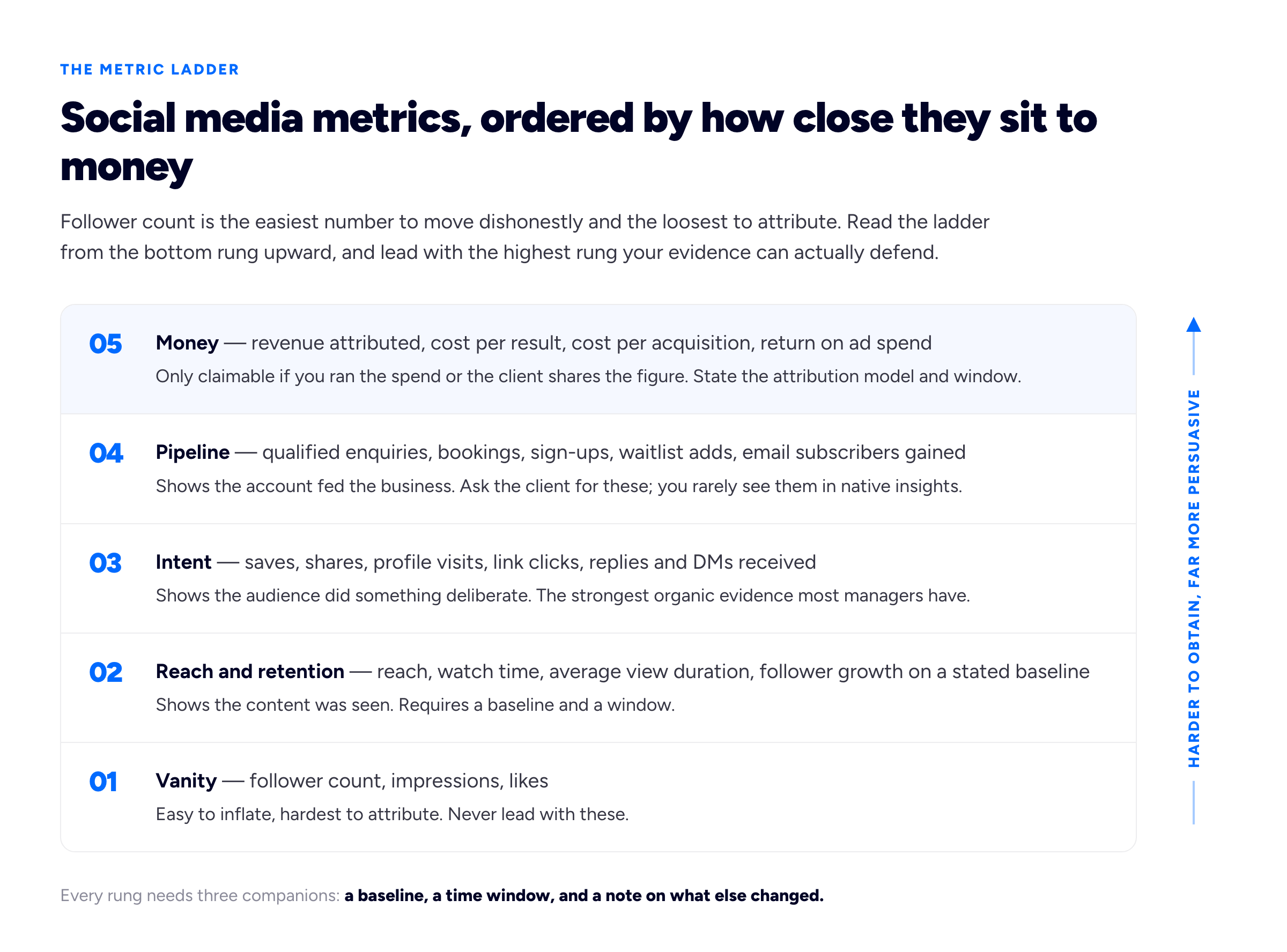
Lead from the highest rung you can genuinely evidence, and say plainly where the number came from.
A few of these deserve specific handling. Saves and shares are the most underused honest metrics in the discipline — they are deliberate acts, they are hard to fake at any scale, and they correlate with the content being useful rather than merely arresting. Replies and inbound DMs are excellent evidence for community work and almost nobody shows them, partly because redacting them properly takes effort. Cost per result is the number that separates people who have run budgets from people who have not, and it needs the spend beside it: a £4 cost per lead on £300 of spend is noise, and the same figure on £30,000 a month is a business.
When the pipeline numbers live in a client's private dashboard and you cannot show the screen, report the figure with its source stated — "the client reported roughly 60 enquiries a month attributed to the channel by the end of the engagement, against a handful before" — or index to a baseline of 100 so the shape survives without the commercial figure. Both are honest. Screenshotting a CRM you were given access to for a different purpose is not. The same logic that governs marketing portfolio results generally applies here with extra force, because social metrics are unusually easy to select flatteringly.
Anonymising a client you cannot name
You will often be allowed to describe the work but not to name the brand. That is workable, and the failure is always the same: people anonymise the interesting parts and keep the boring ones. "A client in the e-commerce space" tells a reader nothing. The name was never the useful information — the shape of the business was.
Keep everything except the identity. "A direct-to-consumer skincare brand, roughly 40,000 followers, single founder, no in-house creative, selling a £38 product with a long consideration cycle for the category" is nearly as useful as the name and gives away nothing a competitor could act on. A reader is trying to work out whether you have operated at their scale and in their kind of constraint, and every one of those details answers that.
Three cautions. Check the combination does not identify them anyway — sector plus city plus follower count plus a distinctive campaign is often a single search away from a name, and a client who finds themselves recognisable in your anonymised case study will be more annoyed than if you had simply asked. Do not show a screenshot with the handle, the profile picture or the distinctive visual identity visible while describing the account as anonymous; that is not anonymisation, it is a puzzle. And if you have permission to name them, take it — a named client with a testimonial attached outperforms three anonymous ones, because the reader can verify one of them.
Show the operating system, not ten pretty grids
Here is the difference between a portfolio that gets a reply and one that does not. A grid of attractive posts proves you can make an attractive post. Every applicant proves that. What a buyer is actually nervous about is different and more boring: can you do it every week, in someone else's voice, through an approval process, when the founder is unresponsive and the product photography is bad and it is December.
So show the machinery. These artefacts are yours, they cannot be deleted by a client, and hardly anybody publishes them:
- The content pillars, with the reasoning. Not "Education, Inspiration, Behind the scenes" — that is every deck ever made. "Four pillars: ingredient explainers, which drove saves; founder answers to DM questions, which drove replies; customer results, which drove profile visits; and product, capped at one in five posts because the audience punished anything heavier."
- A real week or month of the calendar, with platforms, formats, times and owner columns. Redacted where needed, but recognisably a working document rather than a diagram made for the portfolio.
- The approval and escalation workflow. Who drafts, who approves, how long they get, what happens when they miss it, what you are allowed to publish without sign-off. This one detail tells an experienced client you have been through the pain before.
- Community management rules. Response time targets, tone in a complaint, the line at which something goes to the client, what you never respond to. If you have handled a genuinely bad day, describe the handling without dramatising the incident.
- The reporting template. One anonymised monthly report. It shows a prospective client exactly what they will receive, which quietly removes a large part of their risk.
The posts still matter — show a representative set, not your ten best, because a set that is uniformly spectacular reads as cherry-picked. Six to nine posts, including a couple of ordinary ones that did their job, is more convincing than a highlight reel.
One campaign, end to end
A portfolio of fragments is weaker than a portfolio with one campaign followed all the way through. Open exactly one, and structure it so the reader can see the reasoning as well as the outcome.
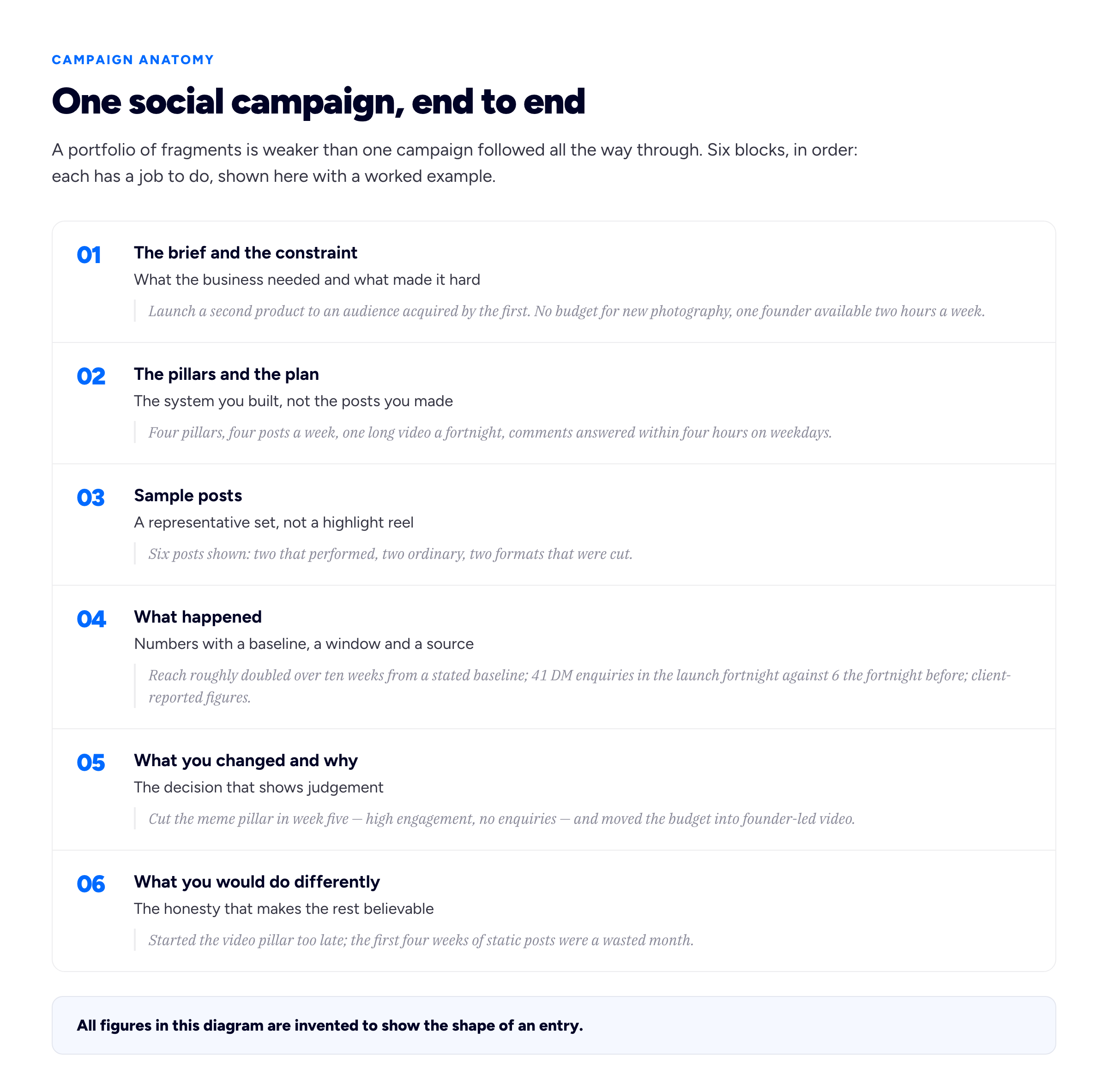
The two blocks nearly everyone omits are the fifth and the sixth, which are the two doing the persuading. Every number in that example is invented.
The fifth block is where you demonstrate the thing that is genuinely hard to fake: that you read your own data and acted against your own preferences. A campaign narrative in which the plan worked exactly as written reads as marketing. A campaign in which you killed a pillar you liked because it produced applause and no enquiries reads as a professional. If you want the long-form version of this structure, our guide to writing a portfolio case study gives word budgets for each section.
Platform-specific proof
Different work needs different evidence, and being explicit about which discipline you actually practised is one of the fastest trust signals available.
Short-form video versus static. If you make video, the portfolio has to contain video, playing, not a thumbnail with a play triangle drawn on it. Host or embed a handful of clips and put the retention story beside them: hook, average view duration, and what you changed about the first two seconds after the first three underperformed. Video is also where the "we did not shoot this" question lives — say who filmed, who appeared, who edited and who wrote. If the founder shot everything on a phone and you scripted and edited, that is a perfectly respectable claim, stated.
Community management and DMs. The least-shown and most-differentiating category. Redact hard — names, avatars, handles, anything identifying a member of the public — and show the pattern rather than the person: the response you use for a complaint, a genuinely awkward thread handled well, your median response time and how you hit it. Say whether you were also handling support, because a lot of social roles quietly are and clients need to know if you can.
Paid versus organic, stated explicitly. This is the one where vagueness reads worst, because the two are different jobs and everybody in the field knows it. Say which you ran, what the budget was, what the objective was set to, and what the attribution window and model were. If your organic case study happened alongside a paid campaign someone else ran, say that too — it is the exact confound a reader is worried about, and naming it yourself converts a weakness into a credibility signal.
One genuinely useful property of paid social: a good deal of it is publicly verifiable. Ads running on Meta's platforms are searchable by advertiser in Meta's Ad Library, which means creative you ran for a client may be publicly documented in a place neither of you controls. That is worth knowing in both directions — as a source of proof you can point at, and as a reason not to describe a campaign in terms the public record contradicts.
The screenshot problem
Screenshots are the entire visual language of this portfolio, and most people take them badly.
Real screenshots beat device mockups. A phone frame with your post inside it is a design decoration; an actual capture with the platform's own interface, the real handle, the timestamp and the engagement counts visible is evidence. The interface is doing the authenticating. When you strip the chrome away and place the image in a stylised frame, you have converted a document into a picture of a document.
Keep the identifying furniture legible. Handle, date, format, and the numbers if you are showing them. A screenshot cropped so tightly that only the image survives proves nothing at all, and readers notice — it looks like something with a reason to be cropped.
Capture at full resolution and do not re-compress. Screenshots are mostly small text, and small text is exactly what heavy JPEG compression destroys. Capture on the device at native resolution, keep it lossless where the text is dense, and export at the size the page actually displays so the file is not needlessly large. A blurry analytics panel is worse than no analytics panel, because it looks like it is hiding a number.
Redact deliberately, and visibly. Solid blocks, not blur — blur has been reversed often enough that it is no longer a serious redaction, and it looks tentative. Remove any member of the public entirely: names, avatars, handles, profile photographs in a comment thread. Remove commercially sensitive columns from any dashboard. Leaving one revenue figure visible in the corner of a screenshot is the commonest way freelancers breach an agreement they intended to honour.
A mockup is legitimate in exactly one situation: presenting a concept that was never published, clearly labelled as unpublished. That is a proposal, not a result, and labelling it as such costs you nothing.
Disclosure, and results you did not produce
Two integrity questions come up in this discipline more than any other, and getting them visibly right is itself a professional signal.
Disclosure in the samples themselves. If your portfolio contains sponsored, gifted or affiliate content — either work you produced for a brand partnership or creator content you commissioned — the disclosure obligations attached to those posts are a matter of published regulator guidance, not opinion. The FTC's endorsement guides and its Disclosures 101 for social media influencers are the primary sources for US audiences, and they are specific about disclosures being clear, conspicuous and hard to miss rather than buried in a hashtag block. Other jurisdictions have their own equivalents; find yours rather than assuming. Showing a sample where the disclosure is plainly visible tells a prospective client you will not create a compliance problem for them, which is worth more than an extra thousand impressions.
Never present a result you did not produce. The temptations are specific and worth naming: a post that went viral for reasons unrelated to your work, a growth curve that began before you started, an account you contributed to for one month out of twelve, a campaign someone else strategised and you scheduled. State your slice. "I ran organic across two platforms; paid was handled by an agency and the creative direction was the client's" costs you a sentence and buys you the reader's trust for everything else on the page. Naming what you did not do is the most credibility-generating move available in a discipline where nobody can verify what you did.
When you have no client work yet
This is the ordinary starting position, and social media is one of the few fields where the honest solution is genuinely strong: run your own account as the case study. Everything about it is verifiable, everything is attributable to you, nothing can be redacted, and you can publish the numbers because they are yours. Pick a niche, set yourself a real objective that is not follower count — email subscribers, enquiries, a small product sold — and run it for ninety days with the same discipline you would give a client. Then write it up using the same six blocks, including the failures.
The second option is a self-set brief for a real business, clearly labelled as unpublished: pick a company whose social is bad, write the audit, build the pillars, produce two weeks of content and state plainly that none of it ran. Useful as a demonstration of thinking, worthless as a demonstration of results, and dangerous only if presented ambiguously.
The third is the best one if you can get it: real work for a small organisation — a community group, a local trades business, a charity — agreed in advance that you may publish the outcome. Small and real beats large and imagined every time, and it tends to turn into your first paid referral. Our guides on building a portfolio with no experience and getting your first freelance clients go further into both.
What does not work is a portfolio of aesthetic mock-ups for imaginary brands. It is the default output of every social media course and every reviewer has seen a hundred of them.
Putting the page together
Structurally, this portfolio wants to be a site rather than a PDF or a slide deck, for the mundane reason that it needs to be linked in a DM, updated after you send it, and found when someone searches your name. Three or four opened-up campaigns, a page of systems artefacts, a representative post set, and an about page that states which platforms and which disciplines you actually practise. If you have not settled your rates, decide them before you publish rather than after the first enquiry — our guide to what to charge as a freelancer works through it.
Do not spend three weeks on the build. The share of hiring decisions influenced by your site's colour scheme is small; the share influenced by whether your evidence is legible is enormous. Bunfolio exists partly for that reason — sign in, fill in the content, get a live site — but the point holds whatever you use. Publish the version you have this week and improve it with the next campaign.
Frequently asked questions
How do you create a social media portfolio from scratch?
Start with the evidence, not the design. List every account and campaign you have worked on, and mark each one for whether you can name the client, publish numbers, and prove your role. Pick three or four with the best evidence, write each up as brief, system, samples, result and what you changed, then build the simplest possible site around them. The writing takes far longer than the building, and it is what does the work.
What should a social media portfolio include?
Three things beyond the posts. A representative sample set rather than a highlight reel; the operating system behind it — pillars, calendar, approval workflow, community rules, reporting template; and at least one piece of evidence that the account did something for the business, such as enquiries, sign-ups or cost per result. The systems artefacts are the part almost nobody shows and the part clients are most reassured by.
How do you make a social media portfolio with no experience?
Run your own account as the case study with a real, non-vanity objective for ninety days, and write it up honestly including what failed. Add real work for one small organisation if you can get it, agreed in advance that you may publish the outcome. Self-set briefs for brands you do not work with are acceptable as evidence of thinking, provided they are clearly labelled as unpublished concepts.
Should I include follower growth numbers?
Only with a baseline, a time window and a note on what else was happening — a percentage on its own invites the question that undoes it. Prefer metrics closer to the business: saves, shares, replies, inbound enquiries, sign-ups, cost per result. Follower count is the number a buyer trusts least, because it is the easiest one to move without producing anything of value.
Can I show work for a client I cannot name?
Usually yes, if you anonymise the identity and keep the shape. Describe the sector, size, audience size band, product price point and constraint, and remove the handle, profile picture and any distinctive visual identity from screenshots. Check your contract first, check the combination of details does not identify them anyway, and ask in writing where there is any doubt.
Do I need a website, or is a Canva deck or PDF enough?
A deck is fine as an attachment for a formal pitch, but it should not be the only version. A live URL can be pasted into a DM, updated after you send it, found by someone searching your name, and used as a link in your own profiles — none of which a PDF does. Keep a deck if your clients ask for one; make the site the destination. Where a bio field allows only one URL, our free links page gives you a single address carrying the site, your profiles and your email.
Do I have to disclose sponsored posts shown in my portfolio?
The posts themselves needed clear and conspicuous disclosure when they ran, under the applicable regulator's rules — in the US, the FTC's endorsement guides. Showing samples where that disclosure is plainly visible is a point in your favour rather than a blemish, because it tells a prospective client you will not create a compliance problem. If a sample lacks disclosure, do not quietly show it; it advertises the wrong thing about you.
How many campaigns should I show?
Three or four opened up properly, plus a representative set of individual posts. Beyond that a reader stops believing you edited the set, and editing is part of what you are selling. Depth on one campaign, followed all the way from brief to what you would change, beats breadth across eight.
How we put this guide together
Bunfolio builds portfolio sites, so we spend a lot of time reading what freelancers publish and where those pages lose a reader. The frameworks here are our own recommendations rather than industry standards, and you should weigh them as judgement: the metrics ladder and its ordering, the six-block campaign structure, the "gather evidence monthly while you still have the login" habit, the argument that systems artefacts outperform post grids, and the advice on anonymising a client while keeping the shape of the business. They come from the recurring pattern in what makes a buyer reply and what makes them close the tab — uncontextualised growth percentages and unclaimed credit do the most damage, and naming your constraints and your slice of the work does the most good.
We have deliberately cited no engagement-rate benchmarks, no "average" reach figures, no percentages for how many brands hire freelancers or how long anyone spends reviewing a portfolio. This matters more in social media than in almost any other field, because the space is saturated with confident numbers of exactly that kind, circulated between blog posts, none of which we could trace to a primary study we would be willing to stand behind. An invented statistic inside a guide about honest reporting would be worse than the gap, so the gap stays.
Where a factual claim is made, it points at a primary source. The disclosure obligations come from the FTC's endorsement guides and Disclosures 101 for social media influencers, which are the documents themselves rather than summaries of them; readers outside the United States should find their own regulator's equivalent rather than assuming the rules transfer. The point about paid creative being publicly documented refers to Meta's Ad Library, which you can check yourself. Platform analytics retention windows and interface details change frequently, so we have described them in general terms and pointed you at capturing your own data rather than trusting any figure we could quote today.
Every client, campaign, sector and number used as an example above is invented for illustration — the skincare brand, the reach figures, the enquiry counts, the cost-per-lead comparisons and everything in the two diagrams. They exist to show the shape of a well-evidenced entry. They do not report anything that happened, and no example copy here should be reused as a claim about real work.
Related reading: marketing portfolio examples for the wider evidence problem across marketing disciplines, how to write a portfolio case study for the long-form version of a single campaign, showing confidential work in a portfolio for the permission conversation, and how to ask clients for testimonials for the proof you cannot generate yourself.
More from the blog
October 5, 2026 · 16 min read
How to Become a Freelance Photographer: From Good Photos to Paid Work
A practical path from "I take good photos" to paid freelance work: choosing a niche, the kit you actually need, and building a portfolio before you have clients. Plus the business basics photography a...
September 30, 2026 · 16 min read
What Is Freelancing? A Plain-English Guide to Freelance Work
Freelancing is selling a skill to several clients one job at a time instead of working for one employer. How a freelancer differs from an employee, contractor or gig worker, one freelance job from enq...
September 26, 2026 · 18 min read
What Is a Freelance Artist? How the Work, Pay and Rights Actually Work
A freelance artist is paid by the job, not by a salary, and keeps the copyright unless they sign it away. How freelancing differs from commission, in-house and gallery work, where the money comes from...