
October 23, 2026 · 19 min read
UGC Portfolio: What Brands Scan For Before They Reply
A gallery of creator sites cannot tell you why one got a reply. What brand marketers look for in a UGC portfolio, how to build one with zero brand deals, and the page and pitch email that get the click.
Search for UGC portfolio examples and you get galleries: creator sites screenshotted and lined up so you can compare colour schemes. What they cannot tell you is what actually decides whether a brand replies — what the person on the other end looks for when they open your link, and in what order. A gallery shows you that other creators have pages. It does not show you why one got a reply and another was closed after four seconds.
So this guide works from the other side of the inbox. A user-generated content creator makes paid, ad-ready video and photo for brands to run on their own channels — their ads, product pages and social accounts — usually without the creator's own audience being involved at all. That makes the portfolio an odd document. It is not a media kit, because your follower count is close to irrelevant. It is not a showreel, because nobody is hiring you for cinematography. It is a set of samples that lets a marketer predict, quickly, whether your next video will work as an ad for their product. Everything below follows from that.
Two invented creators run through the examples: Sofia Reyes-Tan, who is starting from nothing, and Kwame Ollennu, who has a handful of paid jobs and is pitching an invented brand called Saltmere Skincare.
Who is actually watching
The person who opens your link is rarely a fan. More often it is someone whose job is to keep a paid social account fed with new creative: a performance marketer, a creative strategist, a founder who runs their own ads, or an agency buying content for several clients. They are not asking whether they like you. They are asking whether, if they put your video in front of cold traffic next week, people will stop scrolling, understand the product and believe it.
The buyer is testing creative, often several variations at once, and wants people who produce usable variations reliably. They also usually arrive with a product in mind, so "lifestyle, beauty, tech, fitness, food, pets, travel" reads to a skincare marketer as someone who has never thought about skincare in particular. Breadth reads as a lack of fit, not as range.
What a brand marketer scans for
None of what follows is a published standard. It is our reading of how creative buyers evaluate a sample, built from the decisions the work forces on them. In rough order:
The hook, before anything else
The opening second or two of each video is judged hardest, because it decides whether an ad gets watched at all. A good hook is a reason to keep watching that is relevant to the product: a question the customer is already asking, a visible problem, a surprising before-and-after, a strong opinion. If your samples open with "Hi guys" or with you silently picking the product up off a table, the marketer has learned what your ads will open with.
Make it easy to see. At least one sample should show the same video with two or three alternative hooks cut onto the same body. That one sample tells a buyer more about your usefulness than any description, because swapping hooks is exactly how much of this creative gets tested.
Niche fit
The second question is whether you look and sound like the product's customer. Skincare buyers want to see skin, routines and bathroom shelves; kitchen gadget buyers want a kitchen that looks used. They will look at your face, setting, voice and the products you chose, and notice if every sample is for a different category. Choose one or two niches you can credibly inhabit and fill the page with them.
Format range within the niche
Range matters, but range of format, not category. The common UGC formats do different jobs: a talking-to-camera testimonial, an unboxing or first impression, a product demonstration, a problem-and-solution story, a voiceover over hands-only B-roll, a comparison, a routine sequence. Six videos in one niche across four formats tell a buyer you can fill a testing calendar.
Delivery quality and believability
This is not production value. It is whether the basics are clean enough to run without fixing: clear audio without music underneath, a face lit well enough to read on a phone, the product in focus when it matters, and text kept clear of the edges where platform buttons sit. Muddy audio is noticed fastest, because it cannot be fixed in the edit. And the format depends on the viewer accepting you as a real customer, so over-rehearsed delivery and claims copied from the product page both count against you. Show that you can say a brand's points in your own words.
Raw and polished: show both, and label them
Brands buy UGC in two broad shapes. Raw means the footage itself — a few takes, alternative hooks, B-roll — handed over for the brand's editor to cut. Polished means a finished video with cuts, captions and pacing, ready to upload. Buyers with in-house editors often want only raw; others want a finished ad and nothing to do.
A portfolio of only edited videos leaves the first kind of buyer guessing what your unedited footage looks like. So include at least one sample shown both ways: the finished video, and beside it a short compilation of the raw clips it was cut from, each clearly labelled. It proves your raw footage is usable and shows you know the two are different deliverables.
Mention, too, that you deliver clean versions without burned-in captions or music. Brands frequently add their own captions, use licensed music from their ad platform, or translate the text. One line removes a question.
Deliverables, formats and aspect ratios
Buyers think in deliverables, and trust a creator who already speaks that language. Vertical video is the default for most paid social placements: TikTok's auction in-feed ad specifications list 9:16 vertical as recommended, alongside 16:9 horizontal and 1:1 square, each with a minimum resolution. Other platforms publish their own specs and change them, so check the current page for whichever placement a brand names.
Our recommendation for a short "what you get" list on your page:
- Aspect ratio: 9:16 as standard, square or horizontal on request. Film with room around the subject so a reframe is possible.
- Hooks: how many alternative openings you include per video. Two or three is a common offer.
- Versions: with and without captions, with and without music.
- Raw footage: whether it is included or priced separately.
- Length: the durations you typically deliver, such as 15, 30 or 60 seconds.
- Turnaround and revisions: time from receiving the product to delivery, and rounds of changes included.
None of these numbers is a rule. The point is that a buyer can compare you with the other creators on their shortlist without writing to ask.
Usage rights, whitelisting and Spark Ads, explained neutrally
This is the part most portfolios avoid and most buyers ask about first, so put a short, plain explanation on your page. You are not trying to sound like a lawyer, only to show you know the terms exist and will name them in a quote. Nothing here is legal advice, and agreements vary by country and brand.
Usage rights
A contract should say what the brand may do with the video. The usual variables are where it can run (organic posts only, or paid ads too), for how long, in which territories, and whether the brand may cut it into new versions. Paid use and longer terms are generally priced higher, because the video does more commercial work. A line such as "quotes include usage — organic or paid, and term — agreed per project" is enough.
Whitelisting and partnership ads
"Whitelisting" is the industry's informal word for a brand running ads from the creator's own account, under your name and profile picture. On Meta's platforms this runs through partnership ads, which Meta's partnership ads documentation describes as letting a brand "run Facebook and Instagram ads from a creator or other partner's handle". It needs your permission. The appeal for the brand is that an ad from a person's account can read as less like an ad; the cost to you is your name on a paid campaign you do not control, so it is normally priced and time-limited separately.
TikTok Spark Ads
TikTok's equivalent is Spark Ads, which its help centre calls "a native ad format that allows you to leverage organic TikTok posts" — see About Spark Ads. To let a brand boost a video posted on your account, you generate an authorisation code from that video's ad settings in the app and send it to them; TikTok's guide to creating Spark Ads says the creator selects a duration of 7, 30, 60 or 365 days. Menus change, so check the current page before walking a client through it.
On the page, one sentence does it: "Usage for organic and paid placements, plus whitelisting via Meta partnership ads and TikTok Spark Ads codes, each for an agreed period." A buyer reading that knows you will not be surprised by their contract, or give away a year of paid usage by accident.
Disclosure
If your samples include sponsored posts from your own account, they needed disclosure when they ran. In the US, the FTC's Disclosures 101 for social media influencers says that for video "the disclosure should be in the video and not just in the description", and treats free or discounted products as a financial relationship. Samples where disclosure was handled properly reassure a buyer. Outside the US, look up your own regulator's guidance rather than assuming these rules transfer.
Building a portfolio with zero brand deals
Every UGC creator starts with an empty page, and the standard answer — spec videos — is right, as long as you do it honestly. A spec video is a sample ad you make, unpaid and uncommissioned, for a product you bought or already own. It is a portfolio piece, not a job, and must be presented as one.
Sofia Reyes-Tan wants skincare and haircare work. She starts with what is already on her bathroom shelf — a cleanser she has used for a year, a hair oil, a sunscreen — and plans six videos across four formats:
- A talking-to-camera testimonial for the cleanser, opened on a problem her target customer would recognise.
- The same testimonial with two alternative hooks, shown as three short versions.
- A hands-only demonstration of the hair oil with voiceover.
- An honest first impression of the sunscreen.
- A morning routine sequence filmed as B-roll with on-screen text.
- The routine again as raw footage: the uncut clips, labelled as such.
That is a credible portfolio. It sits in one niche, covers the formats skincare buyers commission, shows hook variations and raw footage, and every product is one she has really used, which is why the delivery sounds believable. Three rules keep it honest:
- Label it. Every spec video carries a plain line directly under it: "Spec sample — not commissioned by the brand." Buyers expect spec work from newer creators and respect it; they do not respect discovering it.
- Do not imply a relationship. No brand logos in a "brands I've worked with" row, and no "my campaign for…". Describe the product, not a partnership.
- Do not invent claims. Say what you noticed using the product. Avoid medical or performance claims you cannot stand behind, particularly in skincare and supplements.
When paid jobs arrive, replace spec pieces one at a time, keeping the format spread. Two or three commissioned videos among well-made spec samples is a strong page.
How many videos, and the page structure
Six to nine videos is our recommendation. Fewer and a buyer cannot judge consistency across formats; more and they stop believing you chose the set, and choosing is part of the skill. The general argument is in our guide to how many projects to put in a portfolio, and it applies more strongly to video, where every extra sample is another thirty seconds you are asking a stranger to spend.
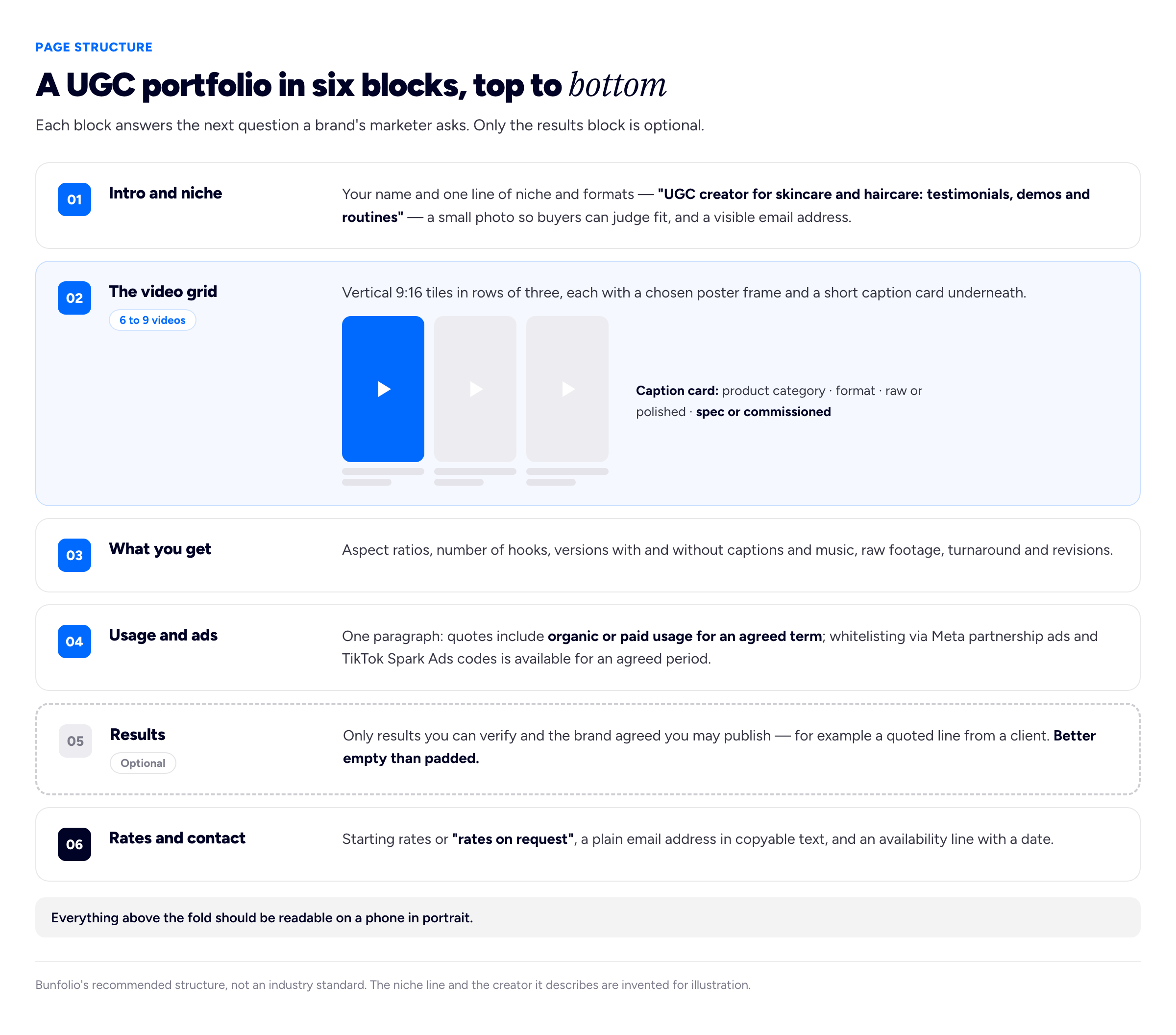
Six blocks, in the order a buyer asks the questions. The results block is the only optional one, and it is better empty than padded.
Intro and niche
One line that says what you make and for whom, a small photo so the buyer can judge fit, and an email address visible without scrolling. "UGC creator for skincare and haircare — testimonials, demos and routines" does more than a paragraph about a passion for storytelling.
The videos
Lead with the sample whose hook is strongest and niche fit most obvious, not the most recent. Keep each caption card short. For a commissioned piece you may not name, describe it instead: "commissioned, haircare brand, problem-and-solution, 30s".
Results, only if you can verify them
UGC creators rarely see performance data. The brand runs the ads and owns the dashboard, and need not share anything, so this is the section most often padded and least trusted. Our rule: show a result only if the brand shared it and agreed you could publish it, and say so. A short client quote saying a video was reordered or extended is honest evidence. If you have nothing verifiable, leave the section out.
Rates, or "rates on request"
Both are legitimate. A starting rate filters out buyers who could never afford you; "rates on request" lets you price usage and whitelisting per project, which can move a quote a long way. A common middle path: a starting price for one video with organic usage, and "paid usage and whitelisting quoted per project" beneath it.
Contact
A plain email address in copyable text, not only a form, and an availability line with a date so the buyer knows the page is live.
Make the video load fast
Nine videos make a heavy page, and a buyer opening it on a phone between meetings will leave before the third one loads. Embedding is covered in detail in our guide to a video editor portfolio website; the short version for UGC:
- Embed from a video host rather than uploading MP4 files to your page. Hosts serve a version suited to the visitor's connection; a single file does not.
- Choose every poster frame. It is the first thing a buyer sees of each video. Use your face or the product, ideally the hook moment, never a blurred transition.
- Load lazily. Only the first row needs to load when the page opens.
- Do not autoplay a grid. Nine videos playing at once makes a page slow and unreadable.
- Use vertical players for vertical video. A 9:16 video in a 16:9 box is mostly black bars and a tiny face.
Then test it on your phone over mobile data, not your laptop on broadband.
A caption card for every sample
The most useful habit on a UGC page is giving every video the same small set of facts. It lets a buyer compare samples at a glance, and it does the labelling — spec or commissioned, raw or polished — that keeps the page honest.
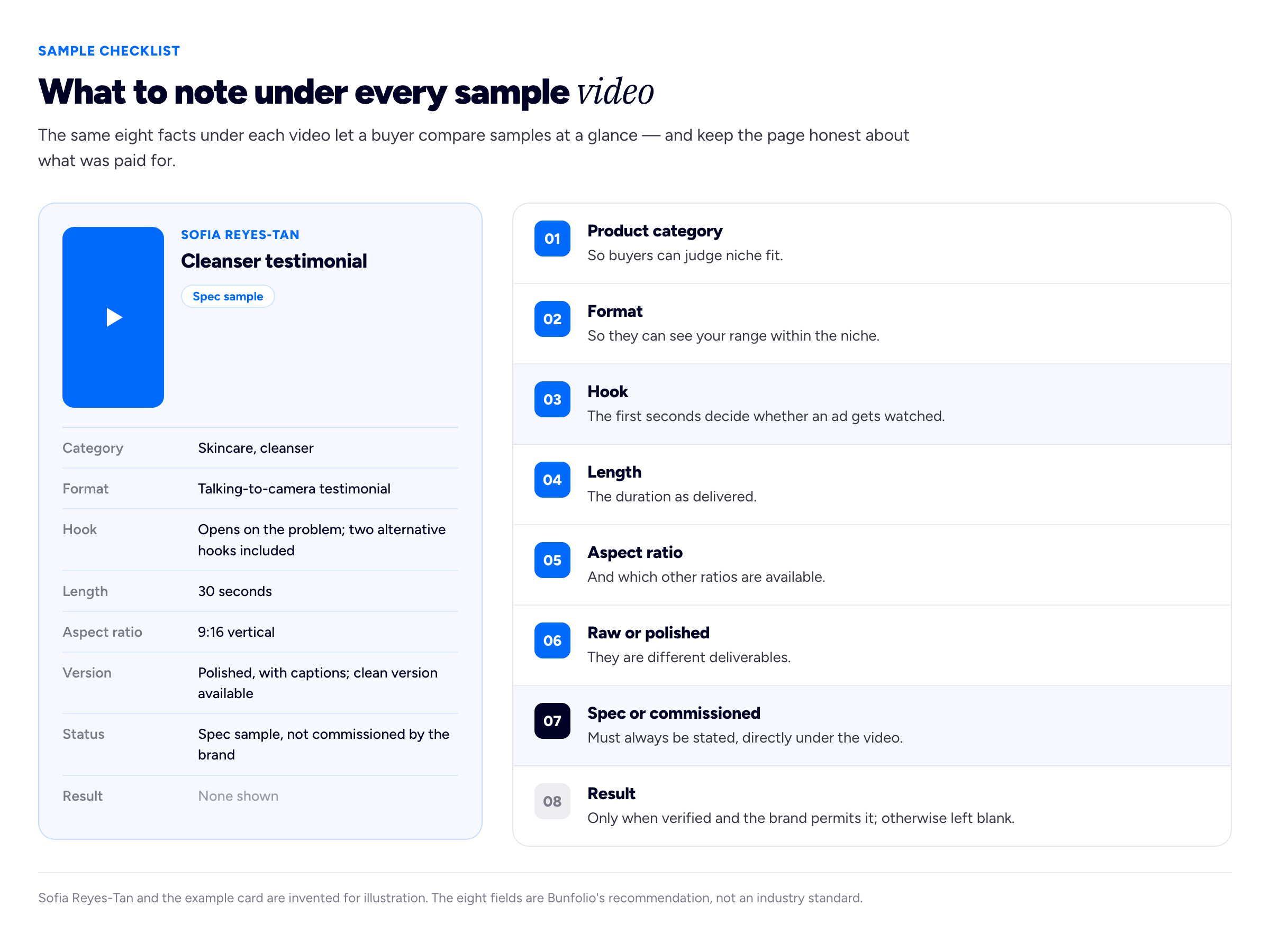
The same eight facts under every video. The spec label is not optional, and the result field is allowed to say nothing.
Where to host it
There is no single right answer, and the creator pages that rank for these searches are built on very different tools:
- A Canva website. Fast if you already design in Canva, and it can look polished. But it is a design tool rather than a site builder, so structure, loading and phone layout depend on how carefully you build it, and the address is a Canva subdomain unless you connect a domain.
- A Notion page. Free, quick and easy to update. It reads as a document rather than a site, video embeds can be clunky, and you have little control over how it looks or loads.
- A link-in-bio page. Ideal as the one link in a social profile, but there is little room for caption cards, deliverables or usage terms. Our free links page tool does this job, best pointing at a fuller page.
- A portfolio site. The most room for the full structure on one page, and an address that looks like a business; the cost is set-up time, or a subscription on some builders. Bunfolio is one option, a free portfolio site on a subdomain built from a form. Others work too; the structure matters more than the tool.
Some agencies ask for a PDF to attach to an internal brief, so keep one as a backup. Make the live page the destination: it can be updated after you send the link, and a PDF cannot.
The pitch email that points at it
The email exists to get one click, so it should be short, specific to the brand, and link to one page. Kwame Ollennu has five paid jobs behind him, mostly men's grooming, and wants to pitch Saltmere Skincare, which has just launched a moisturiser aimed at men without a routine. He writes to the brand's growth marketer:
Subject: UGC for the new Saltmere moisturiser — routine-free angle
Hi there,
I make UGC for men's grooming brands, mostly testimonials and quick demos for paid social. Your moisturiser launch is pitched at men who have never had a routine, which is exactly who I make videos for.
Two samples closest to what you'd need: a 30-second "I don't do skincare" testimonial with three hook variations, and a hands-only demo with voiceover. Both are on my portfolio, with deliverables and usage terms: [link]
I deliver 9:16 with clean versions and raw footage, and I'm open to whitelisting if it fits your plan. Happy to quote for two or three videos.
Kwame
The subject names the product and an angle, not "Collaboration opportunity". The first line says what he makes and for whom, and the second shows he has looked at the launch. He points at two specific samples rather than "my portfolio", uses the buyer's vocabulary — hooks, clean versions, raw footage, whitelisting — without explaining it, and ends with a small next step rather than a request for a call.
Just as useful is what he leaves out: no follower count, no attachment, no paragraph about his journey, and no claim that past videos "went viral" or "converted", because he cannot show the data. As in our social media manager portfolio guide, the buyer is sceptical of numbers they cannot check and reassured by evidence that you understand their work.
Frequently asked questions
What should a UGC portfolio include?
An intro line naming your niche and formats, six to nine sample videos with a short caption card under each, a list of what you deliver (aspect ratios, hooks, versions, raw footage, turnaround), a sentence on usage rights and whitelisting, rates or "rates on request", and a plain email address. Results belong on the page only when a brand has shared them and agreed you may publish them.
How do I make a UGC portfolio with no brand deals?
Make spec videos for products you have bought or already use, in the niche you want work in, across several formats. Label every one clearly as a spec sample not commissioned by the brand, do not use brand logos in a way that implies a partnership, and do not repeat claims you cannot stand behind. Replace spec pieces with paid work one at a time as it arrives.
How many videos should be in a UGC portfolio?
Six to nine is our recommendation: enough to show consistency across formats, few enough that the buyer believes you chose them. Keep other good work in reserve and send the relevant pieces when a brand in that category asks.
What is the difference between usage rights and whitelisting?
Usage rights cover what the brand can do with the video itself — organic or paid, for how long, where, and whether it can be edited. Whitelisting means the brand runs ads from your account, under your name, through tools such as Meta partnership ads or TikTok Spark Ads codes. They are separate permissions and usually priced separately.
Do I need a big following to do UGC?
No. The brand runs the content on its own channels, so your audience size is largely beside the point and buyers judge the samples. A following can matter if a brand wants to whitelist your account, but it is not the basis of the work.
How we put this guide together
Bunfolio builds portfolio sites for freelancers, and we read a lot of creator pages to see where they lose a reader. The frameworks here are our own recommendations rather than industry standards, and you should weigh them as judgement: the order in which we say marketers scan a sample, the six-to-nine video range, the six-block page structure, the eight-field caption card, the "results only if verified" rule and the shape of the pitch email. They come from what the work asks of a buyer — predicting whether your next video will run as an ad — rather than from a survey.
We have deliberately cited no figures for typical UGC rates, how much paid usage adds to a quote, how long a buyer spends on a portfolio, or how many seconds a hook has to work. Numbers like those circulate widely in creator advice and we could not trace any of them to a primary source we would stand behind.
Where we state a platform fact, it points at the platform's own documentation. The 9:16, 16:9 and 1:1 in-feed specifications are from TikTok's auction in-feed ads page; the description of Spark Ads is from TikTok's About Spark Ads, and the 7, 30, 60 or 365-day authorisation durations from its guide to creating Spark Ads. The partnership ads description is quoted from Meta's partnership ads documentation, and the disclosure quotation from the FTC's Disclosures 101 for social media influencers. Platform menus and specifications change often, so check the current page before relying on any of them, and treat nothing here as legal advice about a contract.
Every person, brand and piece of example copy above is invented for illustration: Sofia Reyes-Tan, Kwame Ollennu, Saltmere Skincare, the products on the shelf, the pitch email and everything in the two diagrams. They show the shape of a good page and a good pitch, and do not describe any real creator, brand or job.
Related reading: social media manager portfolio for proving work that lives on a client's account, video editor portfolio website for the detail of embedding and poster frames, and how many projects to put in a portfolio for the argument for a tight selection.
More from the blog
September 9, 2026 · 19 min read
Motion Design Portfolio: What Studios Look At Before the Reel
A showreel proves something moved well. It cannot prove you designed it, timed it, or built any of it — and on a five-craft job the silence reads as a claim to all of it. Why style frames outrank the...
August 30, 2026 · 17 min read
Freelance Scope Creep: How to Catch It Before It Costs You
Scope creep is rarely one big demand — it is six small reasonable requests you never priced. The clauses that prevent the argument, and the exact messages to send when a client asks for more.
August 18, 2026 · 31 min read
Freelance Client Red Flags: What to Check Before You Sign
Most warning signs are an inexperienced buyer rather than a bad one. Which ones a single conversation fixes, which ones mean walk away, and how to decline without burning the relationship.