
October 25, 2026 · 18 min read
What to Wear to an Interview: Read the Dress Code First
Wear what the team wears on a good day, one notch smarter, in clean clothes you can walk and sit in. How to find out an employer's real dress code before the day, what one notch above means sector by sector, what shows on a video call, what to avoid, and how to dress well on a budget.
Wear what the people already doing the job wear on a good day, one notch smarter, in clean, well-fitting clothes you have worn before and can sit, walk and gesture in without thinking about them. For most office jobs that means smart separates (plain trousers or a skirt, a collared shirt or a plain top, a jacket you can take off) rather than a full suit. For banks, law firms and anywhere formal and client-facing, it means a suit or the equivalent. For tech, start-ups and creative work, it means a tidy version of the team's own casual. If you cannot find out what the team wears, aim for smart-casual with a jacket: it is the outfit you can adjust in the room, up or down, in about ten seconds.
That is the whole answer, and it is our recommendation rather than a rule anybody publishes. The rest of this guide is the part most pages skip. They hand you two outfit lists, one for men and one for women, and leave you to guess which company you are walking into. The more useful skill is reading the actual dress code of the actual employer before the day, which takes about twenty minutes. We follow an invented candidate, Tamsin Achterberg, preparing for an interview with Lucian Oduya at Haverleigh Partners, an invented property and planning consultancy, because a mixed workplace like that shows the method better than a bank or a start-up would.
The short version
- Find out, do not guess. Staff photos, the interviewer's own profile and one question to the recruiter tell you more than any general list.
- Go one notch above the team. Not three notches. If they wear hoodies, you wear a good knit or a plain shirt, not a suit.
- Comfort is part of the outfit. Shoes you can walk a site in, layers for a room that is too hot or too cold, nothing you need to adjust while you talk.
- Clean, pressed and fitted beats expensive. Nobody can see the price; everybody can see a crease or a stain.
- Your religious and cultural dress is professional dress. Wear it.
Why the usual outfit lists do not help much
The standard advice treats "interview clothes" as one category, then splits it by gender. That ignores sector, because the right outfit for a trainee solicitor and for a developer at a twelve-person start-up are not close. It has nothing to say to anyone who does not fit either column, and it quietly implies that a headscarf or a turban is something to be worked around. And it ignores the one source that settles the question: what the employer's own people wear.
What interviewers check, as far as clothes go, is smaller than the lists suggest. They want to see that you took the meeting seriously, that you understand roughly how the place works, and that nothing about your appearance will distract from what you say. A clean outfit pitched slightly above the house style satisfies all three. A more expensive one satisfies none of them better.
How to read a company's real dress code before the day
Give this twenty minutes the week before, not the night before, so you have time to borrow or buy something if the answer surprises you. The first sources are quick; the last is the most reliable.
1. The careers page and its photos
Look at the candid shots, people at desks, in meetings, on site, rather than the posed leadership portraits, which are nearly always smarter than a normal Tuesday. Note jackets or none, collars or none, trainers or leather shoes. A careers page is marketing, so treat it as the upper bound of how smart people dress, not the average.
2. The team page and recent news
Team pages show the department you would join, and news posts about project launches or charity days show people in an ordinary working week. Tamsin found two photos on Haverleigh Partners' news page: the planning team on a site visit in high-visibility vests over knitwear and walking boots, and two partners presenting to a council committee in suits. The firm is formal in front of clients and practical everywhere else.
3. The interviewer's own profile
If you know the interviewer's name, their professional profile photo hints at their personal register. People dress up for profile pictures, so it is not a dress code, but if Lucian Oduya's photo shows an open collar and no tie, you can take a tie as optional.
4. The format of the interview
Re-read the invitation. A site tour means shoes you can walk on gravel in. A trial shift in a kitchen or shop often comes with instructions on what to wear, so follow them. A presentation to a panel means you will be standing and visible from head to toe.
5. Ask the recruiter or whoever booked you
This is the most reliable source and the one people avoid, because it feels like admitting you do not know. It is a normal question, and recruiters would rather you asked than arrived wrongly dressed. Fold it into a practical message so it reads as preparation rather than worry. Tamsin replied to the scheduling email:
Hi, thank you for confirming Thursday at 10:00. Two quick questions so I can prepare properly. Will the interview include any time on site, and is there anything I should bring or wear for that? And is there a usual dress code in the office, so I can match it?
Many thanks,
Tamsin Achterberg
The answer was that the second half was a short walk round a nearby scheme, and that the office was "smart-casual, most people wear a jacket for client meetings". That settled her outfit in a sentence. If you are working through an agency recruiter, ask them the same thing; they have usually placed people there before.
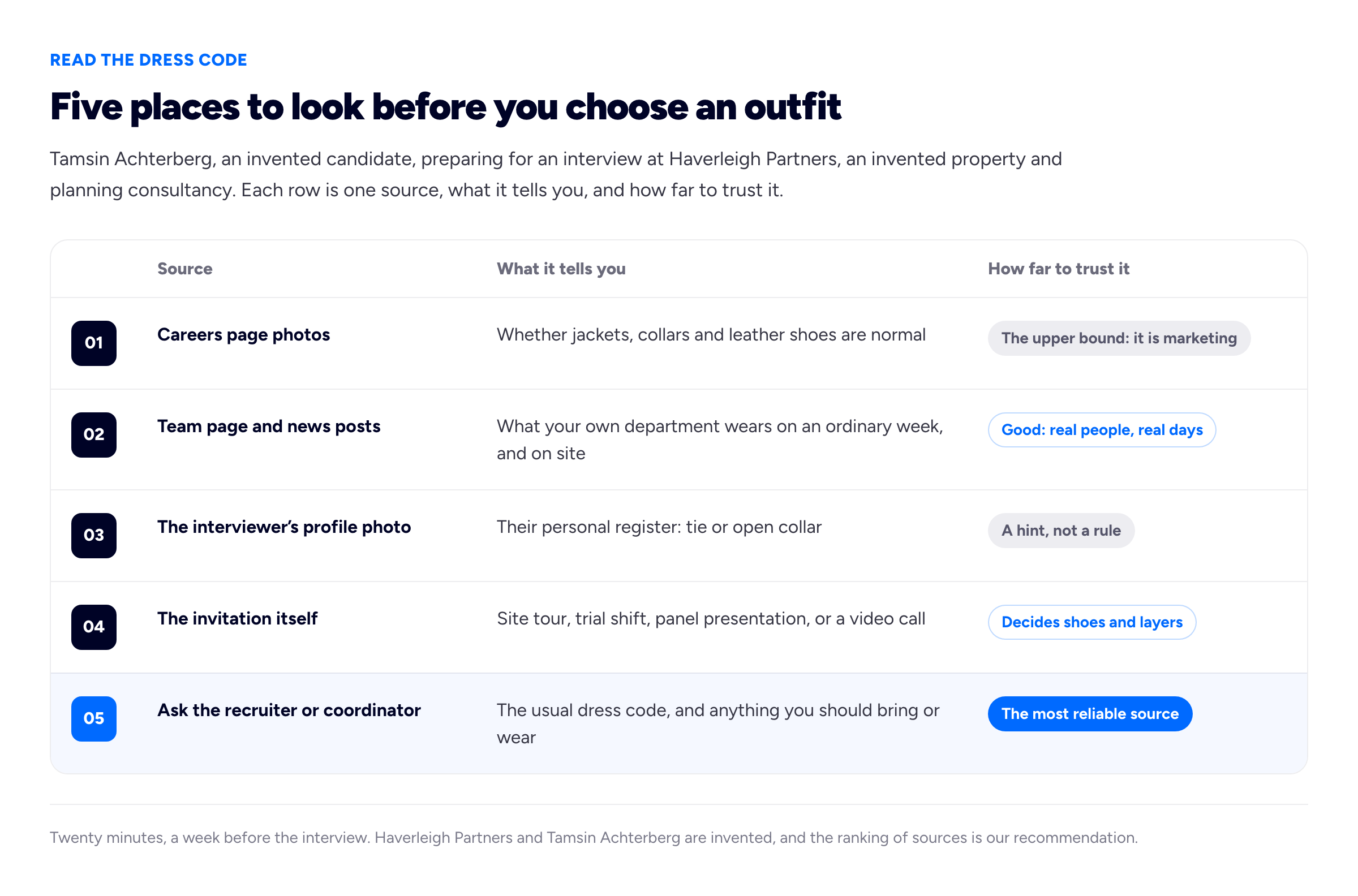
Work down the rows in order: the early sources are quick, and the last one, simply asking, usually settles the question outright.
One notch above the team
Once you know roughly what people wear, dress one step smarter. It helps to think of a ladder with five rungs:
- Casual: T-shirts, hoodies, jeans, trainers.
- Tidy casual: a plain knit, polo or shirt, dark jeans or chinos, clean leather or minimal trainers.
- Smart-casual: a collared shirt or smart plain top, tailored trousers or a skirt, an unstructured jacket or cardigan, leather shoes or smart flats.
- Business: a suit or matching jacket and trousers or skirt, a shirt or blouse, a tie optional or expected by sector.
- Formal business: a dark suit, a pressed shirt, a tie where that is the house norm, polished shoes.
Find the team's rung and go up one. If you are torn between two, choose the higher one and make it removable: a jacket can come off as you sit down if everybody is in shirtsleeves, and the outfit underneath is still correct. You cannot add a jacket you did not bring.
Why one notch rather than as smart as possible? Dressing far above the team carries its own small signal. A three-piece suit at an eight-person start-up can read as not having looked them up, which is the opposite of what you meant. It will not cost you the job, but it puts you slightly out of step in a conversation where you want to look as though you already belong.
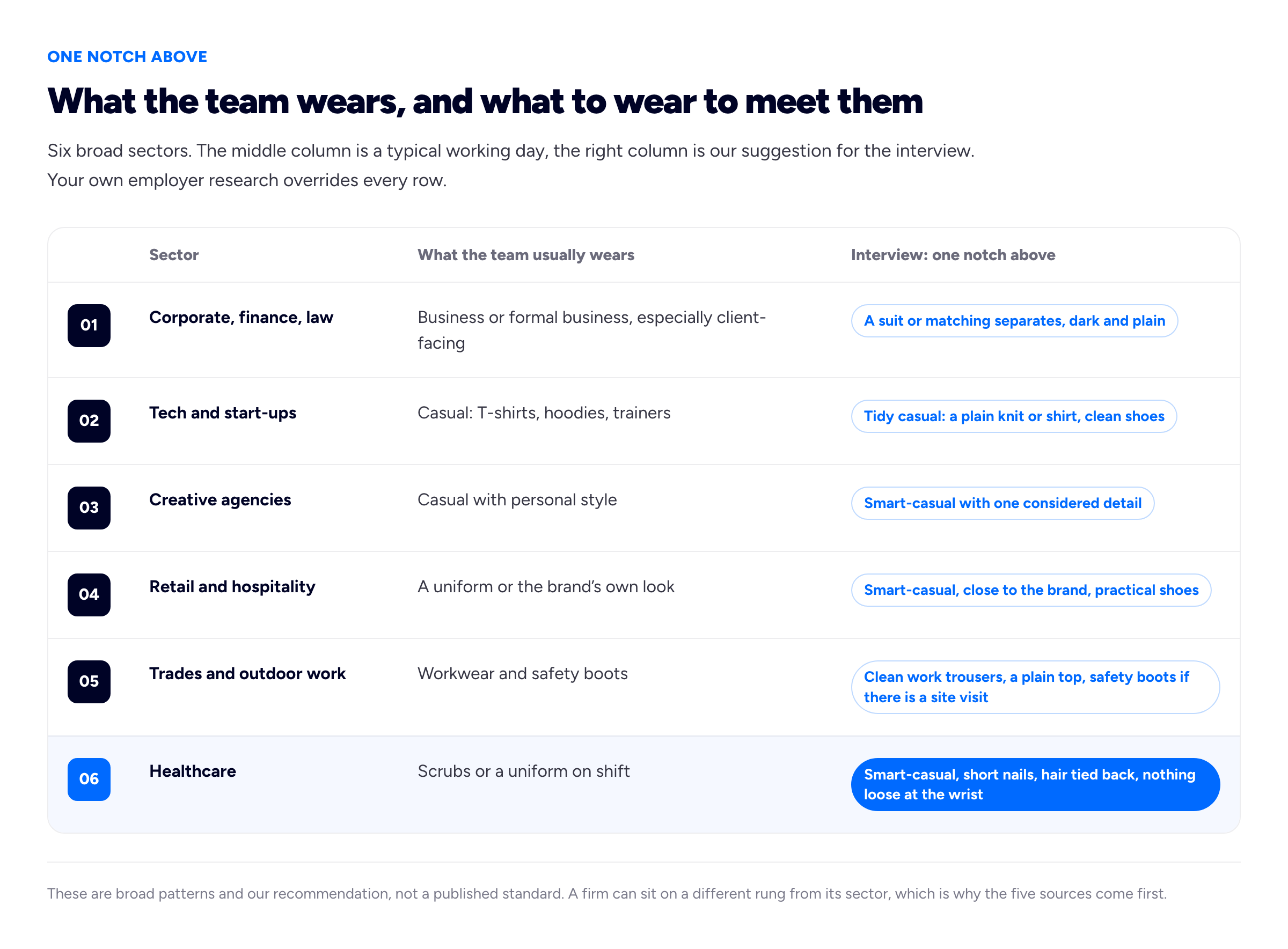
The right-hand column is a starting point, not a uniform: if your research says a particular firm sits on a different rung, the research wins.
Sector by sector
Corporate, finance, law and the public sector
Here the traditional advice mostly holds: a suit or matching separates in navy, charcoal or another dark plain colour, a plain shirt or top, polished shoes. Whether a tie is expected varies between firms and has loosened a great deal, so check photos of the team you would join, not the board. Many public-sector and in-house legal teams sit a notch lower, at smart business without a tie. Keep accessories quiet; the conversation is meant to be about your judgement, not your watch.
Tech, software and start-ups
Tidy casual is right: a plain knit or button-up, dark jeans or chinos, clean shoes. A blazer over that is fine if it makes you feel prepared. What reads badly is not formality but scruffiness: a creased printed T-shirt says you did not think about the day. If the role faces customers, such as sales or consulting inside a tech company, go one notch higher.
Creative agencies, design and media
What you wear is quietly part of your portfolio here, and some personality is welcome. Smart-casual with one considered detail works well: a good jacket over something with colour, interesting glasses, well-chosen shoes. One detail, not five. If you are presenting work, keep busy patterns away from a busy slide, and see writing a portfolio case study for what to put in front of the room.
Retail, hospitality and customer service
Look at what staff wear on the shop floor and dress like a smarter version of it, close to the brand's look; you do not need to wear its products. Practicality matters more than polish, because you may be shown round a kitchen or asked for a short trial shift. Closed, non-slip shoes are the default for anything involving a kitchen floor.
Trades, construction, logistics and outdoor work
Clean work trousers, a plain top or polo, and a jacket suited to the weather. If there is any chance of a site visit or practical test, bring your own safety boots and ask whether you need anything else, such as a hard hat. Being dressed to do the work is the professional choice; a suit can leave you unable to take part in the part of the interview that matters most.
Healthcare, care and clinical roles
Smart-casual is the norm; you will not usually wear scrubs. Clinical settings care about infection control, so interviewers notice what would matter on a ward: short, clean nails, long hair tied back, little jewellery at the hands and wrists, nothing loose that would trail.
Comfort and practicality
An uncomfortable outfit is not a cosmetic problem. A waistband that digs in, a collar you keep pulling at or shoes that pinch on the walk from the station all take attention away from the questions.
- Wear it before the day. Sit, stand, walk for ten minutes, lift your arms. That is how you find the gaping button or the sleeve that rides up. Wear new shoes in at home first.
- Plan for walking. For a site or office tour, choose shoes you could cover a mile and a flight of stairs in. If you want to change shoes, swap before you reach the building, not in reception.
- Layer for a room you cannot control. Meeting rooms swing between cold air conditioning and full sun. A jacket or cardigan lets you adjust, and the outfit underneath must still look finished on its own.
- Avoid anything you have to manage. A slipping scarf, a falling bag strap, jewellery that clinks on the table. Interviewers notice fidgeting with clothes more than the clothes.
For everything that goes in the bag alongside the outfit, from the umbrella to the spare copies of your resume, see what to bring to an interview.
Video interviews: what the camera actually sees
On a video call the interviewer sees your head and shoulders at low resolution, through compression that struggles with fine detail. Dress for that.
- Dress fully anyway. You may need to stand up, and being properly dressed changes how you sit and speak.
- Choose solid mid-tones. Navy, mid-blue, green, burgundy and grey generally sit well on webcams. Bright white can make the camera darken your face, and a very dark top against a dark wall loses your outline.
- Avoid fine patterns. Narrow stripes and small checks can shimmer on camera. A plain top avoids it.
- Put the formality at the neckline. The frame is mostly collar and shoulders, so a jacket or collared shirt reads as interview clothing on a small screen in a way a T-shirt does not.
- Check the picture, not the mirror. Open the actual app ten minutes early, in the actual light. Fix the lighting before the clothes: a lamp in front of you does more than any change of top.
What to avoid
None of these loses you a job on its own, and interviewers are more forgiving than candidates fear. Each puts a small distraction between you and what you are saying.
- Dirty, creased, stained or damaged clothes. This matters more than formality. A clean, pressed casual outfit beats a creased suit.
- Anything that does not fit when you sit and reach forward.
- Strong fragrance. Interview rooms are small, and someone in one may get migraines. Light or none.
- Loud slogans, logos and novelty prints, including a competitor's branding on a bag or lanyard.
- Shoes you cannot walk in, or that clatter on a hard floor for the whole tour.
- Tags, stickers or tacking stitches still on new clothes. Check the vents of a new jacket before you leave.
What if you got it wrong?
Sometimes you arrive in a suit and the person who meets you is in shorts. That is fine. Take the jacket off if it feels natural and stop thinking about it, because the interviewer already has. A light line ("I wasn't sure of the dress code, so I erred on the formal side") is disarming. If you are under-dressed, one line at most, then concentrate on the answers. A clothing misjudgement is forgotten within minutes; a candidate distracted by one is not. If you want to learn how the team works day to day, our list of questions to ask the interviewer includes several that open that up.
Dressing well on a budget
You do not need a new outfit, and certainly not an expensive one. Fit, cleanliness and a plain palette are what read well, and all three are cheap.
- Start with what you own and buy only the missing piece.
- If you buy one thing, make it a plain jacket in navy, grey or black. It lifts almost everything underneath, works on video, and comes off if the room is casual.
- Try second-hand and charity shops for tailoring. Check lining, seams and buttons, and if the shoulders fit but the sleeves do not, the sleeves are the cheaper alteration.
- Borrow from someone a similar size, especially for a one-off formal interview.
- Ask your careers service or employment adviser whether any local charity or college helps job seekers with interview clothing.
- Spend on care, not labels: a lint roller, an iron, shoe polish and a needle and thread.
Your identity is not a dress-code problem
Professional clothing is not defined by gender, and there is no need to choose from a "men's" or "women's" list. Pick from the ladder above whatever you are comfortable in: a suit, a tailored dress, separates, a knit and trousers. The test is the same for everyone: clean, fitted, one notch above the team, comfortable enough to forget about.
Religious and cultural dress is professional dress. A hijab, turban, kippah, patka, head wrap or traditional dress worn neatly is right for an interview, and you should feel no pressure to remove or change it. In the United States, the Equal Employment Opportunity Commission's guidance on religious garb and grooming in the workplace covers applicants as well as employees, and treats refusing to hire an applicant because she wore a headscarf as a breach of Title VII. In Great Britain, Acas notes that religion or belief discrimination law protects job applicants too. The law differs elsewhere, so check official guidance where you live. In practice a good employer will not give it a second thought, and one that does has told you something about itself.
The same goes for hair: natural hair, locs, braids, twists and covered hair are all professional. Visible tattoos and piercings are ordinary in many workplaces, and the staff photos will usually show you whether they are at this one; covering up is your choice. If a disability or condition affects what you can wear, wear what works for you, and if an employer's instructions for a practical test would be difficult, ask the recruiter in advance what alternatives they can offer.
A worked example: Tamsin's outfit
- Sources: jackets in the careers-page portraits; knitwear and boots on site and suits at a council committee in the news photos; "smart-casual, most people wear a jacket for client meetings" from the recruiter, plus a site walk.
- The team's rung: smart-casual in the office, business for clients.
- One notch above: smart-casual with a structured jacket, the top of one rung and the bottom of the next.
- The outfit: a navy jacket, a plain mid-blue top, dark grey tailored trousers, flat leather shoes with grip for the site, a waterproof coat that covered the jacket, and a small watch.
- Rehearsal: worn for twenty minutes on the Sunday evening and walked round the block. One button was loose; it was sewn on that night.
When Lucian Oduya came down to reception in a jacket with no tie, she was exactly one step above him: right for the interview, ready for the site, and not thinking about her clothes for the rest of the morning, which is the point of all of it.
Frequently asked questions
What is the dress code for an interview?
There is no single interview dress code. There is the employer's own, and you aim one notch above it. Find it from staff photos and by asking the recruiter. If you cannot, smart-casual with a removable jacket is the safest default for most office jobs, with a suit for corporate, legal and finance roles.
What should you avoid wearing to a job interview?
Anything dirty, creased or damaged, anything that does not fit when you sit, strong fragrance, loud logos or slogans, shoes you cannot walk in, and anything you will keep adjusting. Clean and comfortable matters more than formal or expensive.
Can I wear jeans to an interview?
Yes, at many tech, creative and casual workplaces where the team wears them, if they are dark, plain and in good condition and the rest of the outfit is lifted. Avoid them for corporate, legal, finance and public-sector interviews, and whenever you cannot find out the dress code; dark chinos are the safe swap.
Is a suit always the safest choice?
Not always. It is safe in formal sectors, but at a small start-up or on a workshop floor it can look as though you did not research the company. Smart-casual with a jacket is more flexible when you are unsure, because it can go up or down in the room.
What should I wear to a video interview?
A solid, mid-tone top with a collar or a jacket, no fine stripes or small checks, in a colour that contrasts with your background. Check yourself in the actual video app beforehand, and fix the lighting before the clothes.
What is a red flag in an interview, as far as clothes go?
Mostly signs of not having prepared: visible stains, a tag still attached, or an outfit wildly at odds with the workplace. Interviewers care much less about style than candidates fear. For reading the wider signals, see signs an interview went well.
Can I wear religious or cultural dress to an interview?
Yes. Worn neatly, it is professional clothing, and in many countries applicants are protected from religious discrimination in hiring. Check the official guidance where you live if you are unsure of your rights.
How we put this guide together
Bunfolio builds portfolio websites and gives away free career tools, so much of our work is helping people get ready for the interviews a portfolio leads to. Almost everything here is our recommendation, not sourced fact, because no authority publishes a correct interview outfit. The five sources and their order, the five-rung ladder, the "one notch above" rule, the sector suggestions, the video advice and the budget tips are judgements we stand behind, written in those terms. An employer's own instructions override every one of them.
The only statements of law are the two about religious dress, and each links to the official body we read it from: the US Equal Employment Opportunity Commission and Acas in Great Britain. The law is different elsewhere, so we have pointed you to official guidance rather than guessed. We have left out the statistics that usually decorate this topic, such as how many seconds an interviewer takes to judge your appearance or what share of hiring managers reject candidates over clothes, because we could not trace any of them to a published method, sample and date, and a number nobody can source is worse than none.
Tamsin Achterberg, Lucian Oduya and Haverleigh Partners are invented, as are the recruiter's reply, the news photographs and Tamsin's email, which is a model to adapt. The diagrams show our own recommendations, not any company's policy.
Related reading: what to bring to an interview, questions to ask the interviewer, thank-you email after an interview, what are your weaknesses? and why should we hire you?
More from the blog
October 20, 2026 · 19 min read
Signs an Interview Went Well (and Which Ones to Ignore)
Most lists of good interview signs are really lists of good manners. Here is which signals carry information because they cost the interviewer something, which are politeness every candidate gets, whi...
October 19, 2026 · 19 min read
Thank You Email After an Interview (and How to Follow Up)
Send it the same day, keep it under 150 words, and make it about one thing the interviewer actually said. What to reference, one email or several after a panel, subject lines, what to leave out, and w...
October 18, 2026 · 19 min read
What to Bring to an Interview (and How Early to Arrive)
The whole arrival on one page: what to bring sorted into always, sometimes and never, how early to turn up and why earlier is worse, how long to expect to be there, and what each of those answers beco...