
September 13, 2026 · 32 min read
How to Fire a Freelance Client Without Wrecking the Ending
Most advice stops at the first email. The hard parts are either side of it: working out whether you are leaving or just tired, knowing what you owe and what you are owed at the moment you stop, and handing over work in a state that does not invite an argument. The four exits, the exit ledger, the handover, and what to send when they push back.
There is a particular Sunday evening that tells you before you admit it. The project is not a disaster. Nobody has shouted. But you have read the same message four times without replying, you have moved the work to Wednesday again, and you have caught yourself hoping the client goes quiet for a week so you do not have to open the file.
Most advice about ending a client relationship is written as though the hard part is the sentence. It is not. The hard part is everything either side of it: working out whether you are actually leaving or just tired, knowing what you owe and what you are owed at the moment you stop, handing over work in a state that does not invite an argument, and living with whatever the client says about you afterwards.
This guide covers the whole exit. It assumes the project has already started — if you are still deciding whether to take the work, the client red flags worth catching before you sign is the post you want, and catching it there is enormously cheaper. It also assumes the trigger is not purely money. If the problem is an unpaid invoice, work through the escalation ladder for late payment first; stopping work at day fourteen is a lever, and firing a client who still owes you four figures throws that lever away.
Leaving is a decision about the next four weeks, not the last four
The single most common reason freelancers stay on a project they should have left is that leaving feels like wasting what they have already spent. Six weeks in, walking away seems to write off six weeks. It does not. Those weeks are gone in every version of the future, including the one where you grit your teeth and finish.
The only question that carries information is forward-facing: from today, what does each remaining week cost, and what does it buy? A project that has four weeks left and will produce something you can show is usually worth finishing even if you dislike every call. A project that has four weeks left, will produce something you would quietly leave off your site, and is blocking the two enquiries you keep pushing back is not, and the sunk six weeks have no vote.
Asking it that way also protects you from the opposite mistake. Leaving is expensive too — it costs the remaining fee, sometimes the reference, and always a week of admin and unpleasantness. Plenty of projects that feel intolerable on a Sunday are merely annoying on a Tuesday, and annoying is a thing professionals deliver through.
Work out which of four things you are actually doing
"Firing a client" gets used for four quite different actions, and people reach for the most drastic one because it is the one with a name. Before you write anything, place your situation in the right row.
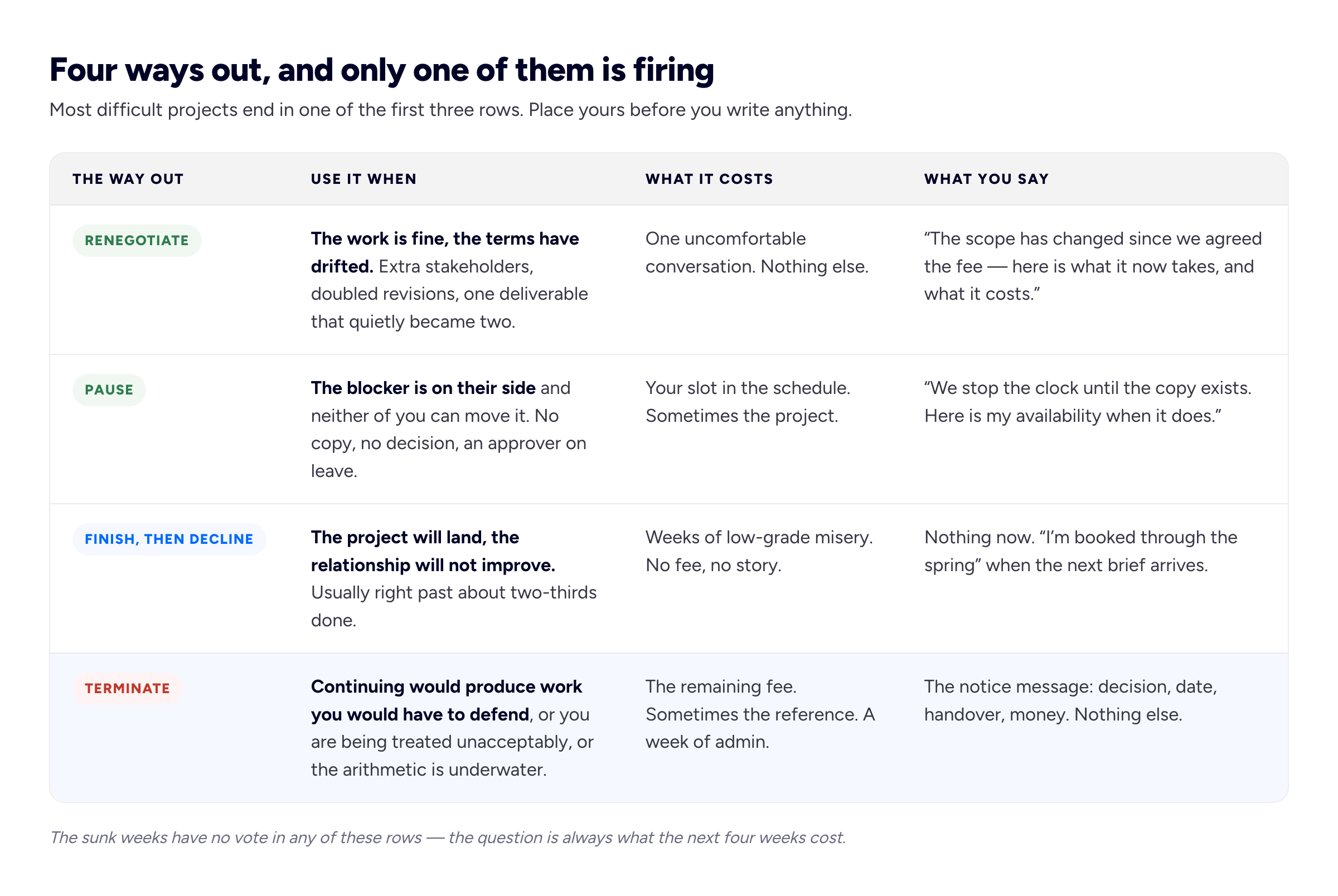
Most of what gets called firing a client belongs in one of the first three rows.
Renegotiate when the work itself is fine and the terms have drifted. Three extra stakeholders, a doubled revision count, a deliverable that quietly became two — none of that is a reason to leave, it is a reason to re-quote. The scope creep guide has the wording for that conversation, and it resolves more of these situations than leaving does.
Pause when the blocker is genuinely on their side and neither of you can move. Copy that has not been written, a stakeholder on leave for a month, a product decision nobody will make. Stopping the clock is not a failure; continuing to half-work a stalled project while it eats your calendar is. Say what has to exist before you restart, and say what your availability looks like when it does.
Finish and decline the next one when the project will land but the relationship will not improve. This is the underused option. You deliver what you promised, you invoice, you close it properly, and when they come back with the next brief you are booked. No confrontation, no fee lost, no story anyone can tell about you. If the current project is more than about two-thirds done, this is usually the right answer.
Terminate now when continuing would produce work you would have to defend, when you are being treated in a way you would not accept from an employer, or when the arithmetic has gone so far underwater that finishing costs more than leaving. That is the rest of this guide.
A test that beats trusting your gut
"Trust your gut" is the standard advice and it is unfalsifiable — your gut also tells you to leave on the Sunday and stay on the Tuesday. Three questions do better, and you should be able to answer all three in writing before you decide.
Has the specific problem been named once, plainly, and survived? Not hinted at in a call. Named, in writing, with a proposed change and a consequence. A surprising share of mid-project misery is a process failure that persists only because nobody has said it out loud: feedback arriving from four people with no consolidation, an approver who never appears, requests that arrive at eleven at night. If you have not yet sent the message that says "we have had three rounds of contradictory feedback and I do not think we can finish this way — can we agree that Priya consolidates and signs off from this round on?", you do not yet know whether you have a bad client or an unmanaged project. Send it, give it one cycle, and see. If it works, you have saved the fee. If it does not, you have documentation, which matters later.
Is the problem the work or the working relationship? Work problems are usually fixable and usually partly yours — a brief you accepted while it was vague, an estimate you gave too fast, a discipline boundary you let blur. Relationship problems are the ones that do not respond to competence. Being spoken to contemptuously, having agreed decisions reopened as though they never happened, being asked to do something you think is dishonest: no amount of better project management touches those, and they get worse under pressure, not better.
Would a competent successor hit the same wall? This one is uncomfortable and worth sitting with. If you genuinely believe any freelancer would be stuck in the same place — no decision-maker, no content, a target that moves weekly — the problem is the engagement and leaving is a reasonable professional judgement. If you suspect a more experienced freelancer would have held the line in week one and be fine now, leaving still might be right, but the lesson to take forward is about your boundaries rather than about this client.
There is a fourth question worth asking privately: would I take this project again, today, at twice the rate? If the answer is an immediate yes, you have a pricing problem, not a client problem, and the rate-setting guide is more use to you than this one. If it is still no at double, the money was never the issue and you can stop negotiating with yourself about it.
What your contract says about leaving
Read your own agreement before you write a word to the client, because the next forty minutes of your life are governed by it and most freelancers have not looked at theirs since signing.
Three clauses matter at an exit. Termination — whether either party can end the engagement for convenience, and what notice is required. Fourteen days is a common figure in the agreements we see; some say nothing at all. Intellectual property — whether ownership of what you have made transfers on payment or on delivery, because that single word decides whether the half-finished designs on your drive are theirs or yours right now. Kill fee or cancellation — whether a percentage of the remaining balance becomes payable when the engagement ends early, and crucially whether that applies when you are the one ending it, which is often not the case.
If you have no written contract, you are not without rights — you have an agreement, it simply has terms nobody wrote down, and what fills the gaps depends entirely on where you and the client are. That is the point at which this stops being something a blog post can answer. What a post can tell you is the practical consequence: with nothing in writing, your position rests on the paper trail you do have, which is the emails, the accepted quote, the approved milestones and the invoices. Gather them into one place now rather than later. The contract essentials guide covers what to put in place so the next exit is a clause rather than an argument.
One thing worth saying once and plainly: none of this is legal advice, we are not lawyers, and contract and termination law varies enormously by country. Anything with real money attached deserves an hour of a qualified person's time where you actually live.
Settle the money before you send the message
Work out your exact financial position before you announce anything, because the moment you give notice the conversation moves to money and you want to arrive with a number rather than a feeling. The mistake that costs most is vagueness — "we'll sort the invoicing out" is how a clean exit turns into six weeks of email.
Take a worked example. Everything here is invented, but the shape is ordinary: a brand and website build quoted at a fixed £6,400, structured as a 40% deposit, a milestone at design sign-off and a balance at launch. You gave notice in week seven, after design sign-off and partway into build.
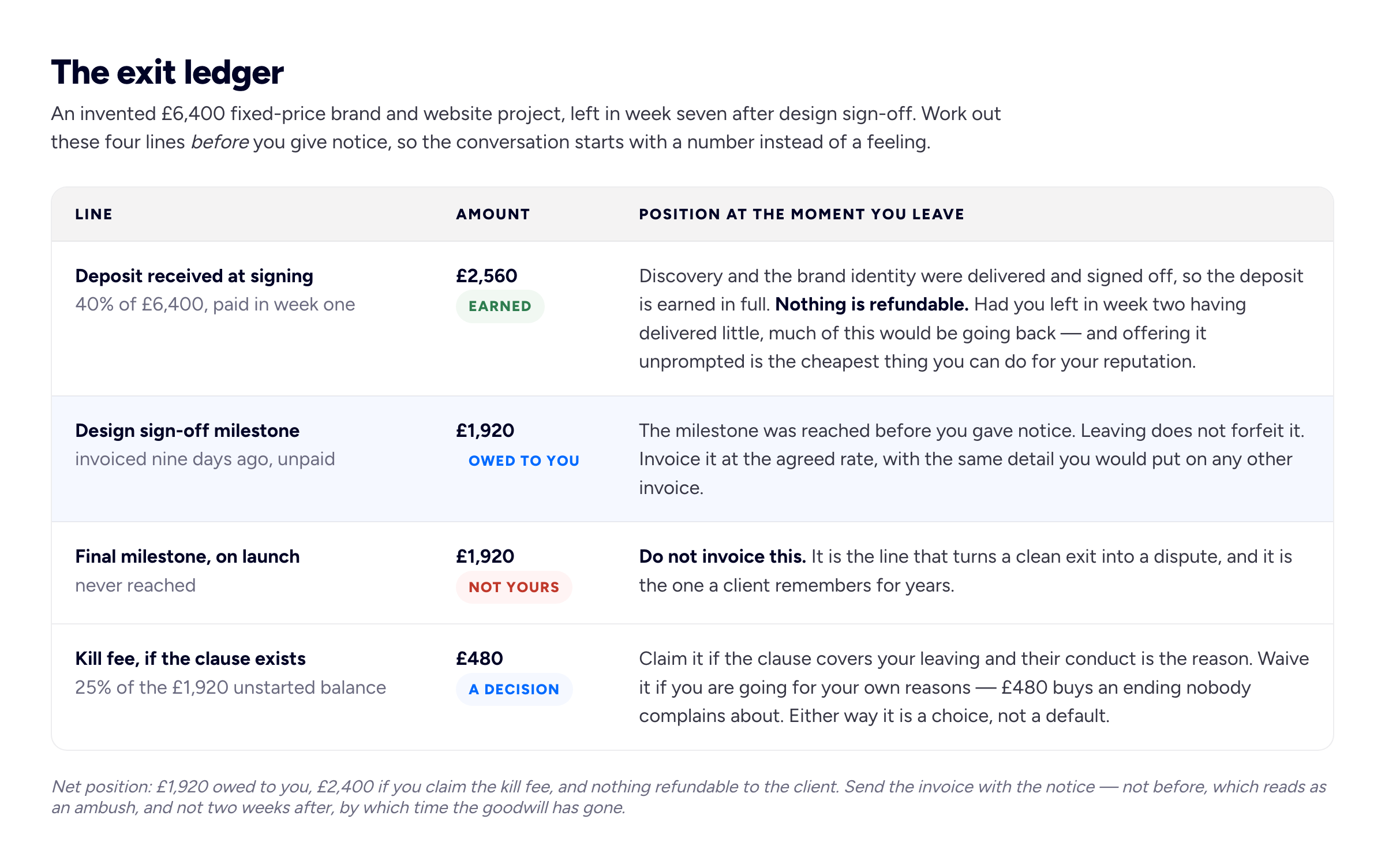
The line people get wrong is the third one — invoicing for a milestone that was never reached is what turns a clean exit into a dispute.
Four questions produce that ledger for any project.
- What have you received, and is it earned? A deposit is earned as you deliver against it, not at the moment it lands. Here the £2,560 covered discovery and the brand identity, both delivered and signed off, so none of it is refundable. Had you taken the same deposit and left in week two with nothing delivered, a large part of it would be going back, and saying so yourself is worth more than being made to.
- What have you delivered but not been paid for? Invoice it, at the agreed rate, with the same detail you would use on any other invoice. The £1,920 milestone was reached before you gave notice; leaving does not forfeit it.
- What have you not reached? Do not invoice it. This is the line that generates disputes, and it is the line a client will remember.
- Is there a kill fee, and do you want it? A 25% cancellation charge on the £1,920 unstarted balance is £480. If the clause exists and the client's conduct is why you are leaving, claim it. If you are leaving for your own reasons — capacity, fit, a change in your business — waiving it costs £480 and buys an ending nobody complains about. That is often a good trade, and it is a decision, not a default.
Send the final invoice at the same time as, or immediately after, the notice message. Not before, which reads as an ambush, and not two weeks later, by which time the client's willingness to settle promptly has evaporated along with their goodwill.
The handover is what buys you a clean ending
A professional exit is judged almost entirely on what the client is left holding. Leave them with a usable package and the story they tell is "it didn't work out, but they were good about it". Leave them with a folder of files nobody can open and the story is considerably worse, travels further, and is the version that reaches the person who was about to hire you.
Hand over, in a single organised place:
- Everything you have produced, in editable form — not just exports. Source files, layered artwork, the repository, the document rather than the PDF.
- A written status note. Half a page: what is finished, what is in progress and how far, what decisions are outstanding, and the two or three things a successor will otherwise have to rediscover. This is the single highest-value item in the package and it takes twenty minutes.
- Ownership of every account you set up, not access to it. This is the part that goes wrong most often, because sharing a login feels like handing something over and is not. Transfer the registrar and hosting, make them the owner on analytics and Search Console rather than a user, move the repository to their organisation along with any deployment secrets, transfer the design files rather than granting view access, and remove yourself as the agency or partner on any advertising or business account. Then take your own access away.
- A note of anything only you can currently do. The worst version of this ending is the one where they come back in March because the domain auto-renewed on your card, or a certificate expired on a service still registered to your email. Spend ten minutes listing everything with your name or card attached and deal with it while you are still speaking.
- Anything you bought on their behalf, with licences. Fonts and stock are where this goes wrong: a typeface licensed to you is not licensed to them, and the honest thing is to name it in the status note so they can buy their own rather than discover it at launch.
- What you are deliberately not handing over, said out loud. Your internal working files, your templates, your process documents. Nobody is entitled to your toolkit, and stating it prevents a request later.
- Confirmation of what you have deleted, once the handover is accepted. Their customer data, exports, anything you were given access to. If you work anywhere with data protection rules worth the name this is an obligation rather than a courtesy, and a one-line "I've removed my copies of the export you sent in August" closes the engagement in a way clients notice.
One caveat on timing, and it is the reason the IP clause matters. If your agreement transfers ownership on payment and there is an unpaid invoice, you are within your rights to complete the handover once that invoice clears, and saying so calmly is normal commercial practice. What you should not do is improvise a hostage situation that your contract does not support — it converts a recoverable debt into a dispute in which you are no longer obviously the reasonable party.
What to actually say
Write it, do not say it first. A call feels braver and reliably goes worse: you will soften it, they will counter-offer, and you will leave without a record of what was agreed. Send the message, offer a call afterwards if they want one. Keep it to four elements — the decision, the date, the practicalities, the money — and resist every instinct to add a fifth.
The version for capacity or fit, which covers most exits and is the one to reach for whenever it is honestly true:
Hi Daniel — I want to let you know that I'm going to step away from the website project. My last working day on it will be Friday 3 October, which is two weeks from today and in line with the notice period in our agreement.
This isn't a decision about you or the project; the work has moved somewhere I'm not the right person to take it, and I'd rather say so now than deliver something neither of us is happy with.
Before I finish I'll hand over everything in editable form, transfer the hosting and analytics into your name, and write up where things stand so whoever picks it up isn't starting cold. I've attached the invoice for the design milestone signed off on 12 September; the final milestone hasn't been reached so there's nothing owing on it.
Happy to talk it through on a call if that's useful.
The version where the client's conduct is the reason needs one added sentence and no more. Name the behaviour once, factually, without adjectives, and do not build a case:
I've raised the volume of out-of-hours requests twice, most recently on 8 September, and it hasn't changed. That's the reason, and I don't think there's a version of this project that works for either of us.
What not to write, in any version: the full inventory of everything they did wrong, an apology for a decision you are entitled to make, or a promise to "help out if anything comes up" that you have no intention of honouring.
Do not use an excuse, however often you are told to
A great deal of published advice on this subject recommends inventing a reason — a fictional change of business direction, a made-up relocation, a personal situation that is not happening. One widely read guide titles its template "the excuse". We think this is bad advice for three reasons, and it is worth naming because you will meet it everywhere.
It fails practically: a client who believes you are leaving because you have stopped taking website work will introduce you to someone as the designer who no longer does websites, and will be confused when your site says otherwise. It fails immediately when they solve the imaginary problem, which they often try to do — the budget appears, the timeline moves, and you are left leaving anyway with nothing honest to say. And it is a misrepresentation written into a document that may later sit in a dispute, a platform case or a small claim, which is a strange place to have planted something untrue.
A short true reason is always available. "The work has moved outside what I can deliver well" is true far more often than people admit, costs nothing, and cannot be solved out from under you.
When to send it
Timing matters more than the wording. The clean cut points are the end of a milestone, the end of a sprint or the end of a billing cycle — anywhere there is a natural seam, the handover is smaller and the invoice is uncontroversial. Avoid the middle of a launch week if you can, not because you owe them the launch, but because a notice delivered into a crisis is the version that gets retold.
On sequencing, the honest answer is that both orders have a cost. Getting the outstanding invoice paid before you give notice is cleaner for you and is what most people quietly do; it is also, if the gap is long, the thing a client will later describe as having been misled. Sending notice and invoice together is the defensible version and occasionally costs you a payment that would otherwise have gone through without thought. If the sum is small, send them together. If the sum is large and already overdue, you are in a non-payment situation rather than a firing situation, and the escalation ladder is the right tool — finish that before you start this.
The conversation after the message
Expect one of four replies, and decide now which ones can move you.
Acceptance. The most common, and it surprises people every time. Many clients have sensed the same thing and are relieved someone said it. Confirm the handover date, deliver it properly, and stop there.
The counter-offer. More money, fewer deliverables, a different contact. Take it seriously only if it addresses what you actually named. More money for the same relationship is the offer to be most careful with — it is the one you accept on a thin month and regret in week three, and it resets nothing.
Guilt. A launch date, a campaign, a budget approved on the strength of you. This is worth genuine sympathy and no change of decision. Two weeks' notice and a clean handover is precisely how a professional mitigates it; you are not responsible for a plan built with no contingency.
Escalation. Anger, threats to withhold payment, a sudden reinterpretation of what was agreed. Move everything to email, answer in short factual sentences, restate the position once, and stop responding to anything that is not a question about the handover or the invoice. If the amount is large enough to matter, this is the point to get proper advice rather than to win the argument.
Whichever arrives, the message you need next is the one almost nobody writes down. The first message is easy to find a template for; the second — the reply that holds the line without escalating — is where people fold. It has one job, which is to restate the decision without re-arguing it, and it should be shorter than the first message rather than longer:
I understand, and I'm sorry it lands at an awkward time. My decision hasn't changed and Friday 3 October is still my last day on the project.
What I can do between now and then is make the handover as complete as possible — the editable files, the accounts transferred into your name, and a written summary of where everything stands. If it would help, I'll also write a short brief you can send to whoever picks it up.
On the invoice: the design milestone was signed off on 12 September and is payable under the original terms. There's nothing owing on the final milestone because it wasn't reached.
Three things make that message work. It concedes the feeling and not the decision. It offers more of the only thing you are still willing to give, which is help with the transition. And it restates the money in one flat sentence with dates attached, because a number stated calmly twice is far harder to reopen than a number defended at length.
Should you refer them to somebody else?
Recommending a replacement is the most frequently repeated tip in everything written on this subject, and it is worth a moment's thought rather than a reflex. You have just concluded this engagement is unworkable. Passing it to a peer without saying why makes your clean ending their bad month, and in a small professional community that gets back to you eventually.
The honest version is easy enough. Offer to make an introduction rather than a recommendation, and tell the person privately what you would want to know — that there are four stakeholders and no decision-maker, that the budget is real but the timeline is not, whatever it actually is. If the problem is the budget or the fit, refer freely; somebody working at a different rate may be delighted. If the problem was how you were treated, do not hand it on at all. Saying "I'd rather not put a name forward, but I'm happy to write up the brief so it's easy to hire for" is a complete and defensible answer.
Keep the paper trail, even when it ends well
Before you close the folder, put the record somewhere you will still be able to find it in two years. Almost nobody mentions this, and it is the only asset you have if the ending turns out not to be over.
What to keep: the signed agreement or the accepted quote, the milestone approvals, the notice message and their reply, the final invoice and any payment confirmation, the handover package and the message that delivered it, and the earlier message where you named the problem the first time. That last one is the item people throw away and later want most, because it is the difference between "they walked out" and "they raised it on 8 September, nothing changed, and they gave two weeks' notice".
It matters in three specific situations, all of which arrive without warning: a card payment reversed weeks later, a claim in a small-claims or money-claim process, and a dispute raised on a platform where somebody neutral has to decide between two accounts using only what is uploaded. In all three the person deciding was not there. The file is the whole of your case, and assembling it in the calm week is a great deal easier than assembling it in the angry one.
If the work came through a marketplace
Everything above assumes a direct client. If the engagement lives on Upwork, Fiverr, Contra or a similar platform, the exit has a second layer, and the general advice to "just stop working with them" can quietly cost you something that takes months to rebuild.
Three differences are worth planning around. Ending a contract is a recorded event, and on platforms that publish performance metrics, contracts that close without a completed outcome can affect the score that determines how visible you are — which means the cost of leaving is not only this fee. Money usually sits in escrow rather than with either party, so releasing, refunding or disputing funded milestones is a platform process with its own deadlines, not something you and the client settle between yourselves. And the platform's own dispute path is generally the only one available to you for work done through it, which is the reason to keep the entire conversation on-platform from the moment you decide to leave, however much easier email is.
The practical sequence: read the platform's current help documentation before you do anything, because these rules change and a blog post is the wrong source for them; agree the closing position with the client in platform messages rather than by email; settle funded milestones explicitly rather than letting a contract lapse with money sitting in escrow; and close the contract through the platform's own flow rather than by going quiet. If there is a feedback exchange at the end, the calm factual version is worth writing even when you feel otherwise — it is attached to your profile far longer than the project lasted.
Can you still show the work?
Almost nobody writes about this, and it is the first thing most freelancers think about privately: seven weeks of work, and is any of it allowed on your site?
It depends on what you agreed, and the default is less generous than people assume. Portfolio rights are a separate permission from ownership — a client can own the work outright while you retain the right to display it, but only if somebody wrote that down. Without a portfolio clause, showing unpublished work from a terminated project is a judgement call made on someone else's material, and if you are in the middle of a tense exit it is a poor moment to make it.
Three practical positions. If your contract has a portfolio clause, it almost certainly still applies after termination — read it, then use it. If it does not, ask in the same message as the handover, when you are being generous and they are feeling reasonable; a plain "may I show the brand work in my portfolio once you've launched?" gets a yes more often than you would think. And if the answer is no, or the relationship makes asking unwise, you can still show the thinking — the process, the approach, the problem and how you framed it — without publishing the client's identity or their final assets. The guide to portfolios under NDA covers how to do that without it reading as evasion.
The broader lesson is to stop depending on any one client's permission. A body of work spread across several projects, some of them your own, on a portfolio site you control, means a single difficult ending removes one item rather than your only evidence.
When you cannot afford to lose the income
Most advice on this subject is written as though you have a choice. Often you do not — the client is 60% of this month, rent is real, and "fire them" is a luxury sentence. The answer is not to endure it indefinitely. It is to make the exit a plan with a date instead of a decision you keep failing to take.
Work out the actual runway. What does this client pay per month, how long would replacing them take at your current enquiry rate, and how many months of costs do you have? A precise answer is usually less frightening than the vague one, and occasionally it reveals you could have left a month ago.
Shrink the engagement rather than ending it. You can often withdraw from the part that is unbearable and keep the part that pays — hand back the stakeholder management, drop to one deliverable, move from an open-ended retainer to a defined piece of work. Less income than now, more than zero, and it buys you weeks.
Use price as the exit. Quote the rate that would make the work genuinely worth doing, and mean it. Sometimes they say yes, which solves the problem; usually they decline, which ends the engagement with no confrontation and no bad ending. It is the least dramatic exit available and it is badly underused.
Do the pipeline work first, this week. Leaving with nothing behind it is what makes people go back. An afternoon on the outreach that actually produces enquiries, and the exit stops being a cliff.
Set a date while you do it. "When I have one more retainer" becomes never; "the end of November regardless" does not.
The aftermath you actually have to manage
Two things worry people and only one of them deserves it.
References. A client you left mid-project is not a reference, and you do not need them to be. This is an argument for collecting a testimonial from every good client at the moment the work lands, so that one bad ending is a gap rather than a hole — asking for testimonials properly is a twenty-minute habit that makes exits like this survivable.
Public feedback. On a marketplace with ratings this is a genuine risk and worth factoring into how you handle the money, because a contested refund is what produces a one-star review far more often than the departure itself. Off-marketplace it is mostly imagined. Clients who have been handed a complete package and a fair final invoice rarely go looking for an audience; and if a review does appear, one calm factual reply that states the facts without arguing is the entire correct response. Prospects read the tone, not the dispute.
The thing nobody warns you about is how quickly it stops mattering. The exit occupies your whole head for about four days and then becomes an ordinary business event you rarely think about again.
What to change before the next one
Every difficult exit should leave you with a clause. Add a termination provision with a stated notice period both ways, so the next one is a procedure rather than an improvisation. Add a portfolio clause, so the answer about showing the work is already yes. Tie ownership to payment rather than delivery. Take a deposit large enough that an early exit does not leave you working for nothing. And write down, somewhere only you read it, the specific thing you saw in week two and talked yourself out of — the proposal stage is where that observation becomes a question you ask next time.
Frequently asked questions
Can I fire a freelance client mid-project?
Yes, subject to whatever your agreement says about notice and cancellation. The practical requirements are that you give the notice your contract specifies, hand over completed work in a usable form, invoice only for what you actually delivered, and keep the stated reason short and factual. A mid-project exit handled that way is an ordinary commercial event, not a breach.
How much notice should I give a client?
Whatever your contract says, and two weeks where it says nothing — long enough to hand over properly, short enough that you are not living in the exit for a month. Give more if you are mid-deliverable and finishing it would leave them in a materially better place, less only if the situation is one where continuing is unreasonable to expect of you.
Do I have to refund a deposit if I leave the project?
A deposit is earned as you deliver against it. If the work you have completed is worth what you have received, there is nothing to refund and you should say so with the ledger to back it. If you took a deposit and are leaving before delivering much of anything, the corresponding part goes back, and offering it before you are asked is the single cheapest thing you can do for your reputation.
Should I tell the client the real reason I am leaving?
Tell them a true reason, briefly. That is not the same as telling them everything. "The work has moved outside what I can deliver well" is true and sufficient in most cases; where conduct is the cause, name the specific behaviour once, factually, and stop. Never invent a softer reason — they may solve it, and then you are leaving anyway with nothing honest left to say.
Can I put unfinished work from a terminated project in my portfolio?
Only if you have the right to, which is a separate permission from who owns the work. Check for a portfolio clause; if there is none, ask directly as part of the handover, when goodwill is highest. If the answer is no, you can still present the process and your thinking without identifying the client or publishing their assets.
What if I cannot afford to lose the income?
Then make it a dated plan rather than an open question. Calculate the real runway, consider shrinking the engagement instead of ending it, try quoting the rate that would make the work worth doing, and spend an afternoon on outreach before you send anything. Set a fixed date regardless of what the pipeline looks like, because "when things pick up" is how people stay for another year.
How do I end a contract on Upwork or another marketplace?
Through the platform's own process, and after you have read its current help documentation rather than any blog post, because these rules change. Keep the whole conversation in platform messages, settle or explicitly release any funded milestones rather than letting the contract lapse with money in escrow, and close the contract formally instead of going quiet. Be aware that on platforms publishing performance metrics, a contract closed without a completed outcome can affect how visible your profile is, so the cost of leaving is not only the fee.
Is it better to finish the project and simply not work with them again?
Usually, if the project will land. You keep the fee, the ending is clean and there is no story anyone can tell. Reserve terminating for cases where continuing would produce work you would have to defend, where you are being treated unacceptably, or where the arithmetic has gone so far underwater that finishing costs more than leaving.
How we put this guide together
Nearly all of this is our own judgement, formed from working with freelancers who publish their portfolios with Bunfolio and from the patterns they describe when a project ends early. The four-row framing of the exits, the three-question test, the exit ledger, the handover checklist, the advice to give two weeks where a contract is silent and the position on referring a client onward are recommendations rather than established rules, and we have labelled them that way rather than present them as findings.
We wrote it because the existing guidance is unusually thin in specific places. Most of what is published on firing a client covers the decision and the first email and stops; we could not find a guide that worked through the money at the moment of exit, what is actually in a handover, whether you may show the unfinished work, what to send when the client pushes back, or what changes when the contract lives on a marketplace. Those sections exist because they were missing, not because they were easy. The marketplace section is deliberately general: platform rules on contract closure, escrow and performance metrics change often enough that the only correct source is the platform's own current documentation, and we would rather point you there than quote a figure that is wrong by the time you read it.
One piece of widely published advice is rejected here on purpose rather than overlooked: inventing a reason for leaving. Several well-ranked guides recommend it and one supplies a template named for it. Our objection is stated in the post — it fails when the client solves the fictional problem, it misrepresents your position in a document that may later be evidence, and a short true reason is nearly always available.
We have cited no statistics. There are widely repeated figures about how many freelance projects end early and what share of clients are described as difficult, and we could not trace any of them to a primary source we were prepared to stand behind, so they are absent rather than repeated. Where we say something is common, we mean common in what we see.
This is not legal advice and we are not lawyers. Termination rights, notice, deposits and what governs an agreement with nothing in writing all vary by jurisdiction, and the sums involved in an early exit are often large enough to justify one paid hour with somebody qualified where you live. Every client, name, date, sum and message in this post is invented, including the £6,400 project and its ledger; the scripts are written to be copied and adapted, not because any exchange happened as written. Bunfolio gives freelancers a free portfolio website; it is not a contract, invoicing or legal tool.
Related reading: the client red flags worth catching before you sign, the contract clauses that make an exit a procedure, what to do when the real problem is an unpaid invoice, and how to renegotiate scope instead of leaving.
More from the blog
August 18, 2026 · 31 min read
Freelance Client Red Flags: What to Check Before You Sign
Most warning signs are an inexperienced buyer rather than a bad one. Which ones a single conversation fixes, which ones mean walk away, and how to decline without burning the relationship.

October 5, 2026 · 16 min read
How to Become a Freelance Photographer: From Good Photos to Paid Work
A practical path from "I take good photos" to paid freelance work: choosing a niche, the kit you actually need, and building a portfolio before you have clients. Plus the business basics photography a...

October 1, 2026 · 16 min read
Freelancing Tips: 29 Practical Habits From First Client to Tax
The freelancing habits that prevent most problems before they start, grouped by stage from setting up to looking after yourself. Each of the 29 tips comes with a concrete action, a template line you c...