
October 27, 2026 · 19 min read
How to Write a Resignation Letter (With Sample Letters)
The five things a resignation letter must say and what to leave out, why you tell your manager before you send it, how much notice you actually owe in the US and UK, a two weeks' notice email, and sample letters for seven situations, from short notice to retiring.
A resignation letter needs five things: the date, a plain sentence saying you are resigning from your named role, your last working day written as a date, an offer to help with the handover, and your name. A line of thanks is worth adding. Everything else is optional, and a few things should be left out entirely, above all your reasons for leaving if those reasons are complaints. Tell your manager in person or on a call first, then send the letter the same day so the conversation and the paperwork agree. Check your contract for your notice period before you do either.
That fits on half a page. Below: the order to do things in, how much notice you actually owe (in the US the familiar two weeks is usually custom rather than law), a two weeks' notice email, sample letters for seven situations, and counter-offers, exit interviews and handovers.
What a resignation letter must contain
The letter is a dated record of when you gave notice and when you are leaving. HR files it, payroll works from it, and if there is ever a disagreement about your last day, both sides will point to it. So the essentials are the facts that record needs:
- The date you are sending it. It records when you gave notice, which is the date everyone will count from.
- Who it is to. Your line manager by name. If your contract or handbook says resignations go to HR, address it to your manager and copy HR in.
- A clear statement that you are resigning, and from which role. "Please accept this letter as formal notice of my resignation from my position as Marketing Coordinator." No hedging, nothing that reads as the opening of a negotiation.
- Your last working day, as a date. Not "in two weeks". A date removes any argument about whether two weeks ends on a Friday or the following Monday.
- An offer to help with the handover. One sentence; it is what your manager is worrying about while reading.
- Your name and, if it is printed, your signature.
A short thank-you belongs in most letters: it is the line people remember when asked for a reference two years later. Keep it specific if you can: "thank you for trusting me with the spring range launch" lands better than "thank you for the opportunity".
What to leave out
The letter will outlive the mood you wrote it in. It sits in your personnel file and can be produced if a reference or a dispute ever comes up. So leave out:
- Grievances. Not about your manager, your pay, a colleague or the way the department is run. If you want a complaint acted on, raise it separately through the proper channel. Tucked into a resignation letter it only colours how you are remembered.
- A long explanation. You do not owe a reason. "I have accepted a role elsewhere" or nothing at all are both fine.
- Your new salary or the name of your new employer, unless you are happy for both to be passed around.
- Anything that sounds conditional. "Unless something changes" invites a counter-offer you may not want, and makes the date unclear.
- Apologies. Leaving a job is normal. "I am sorry to leave at a busy time" is fine once; three apologies read as guilt.
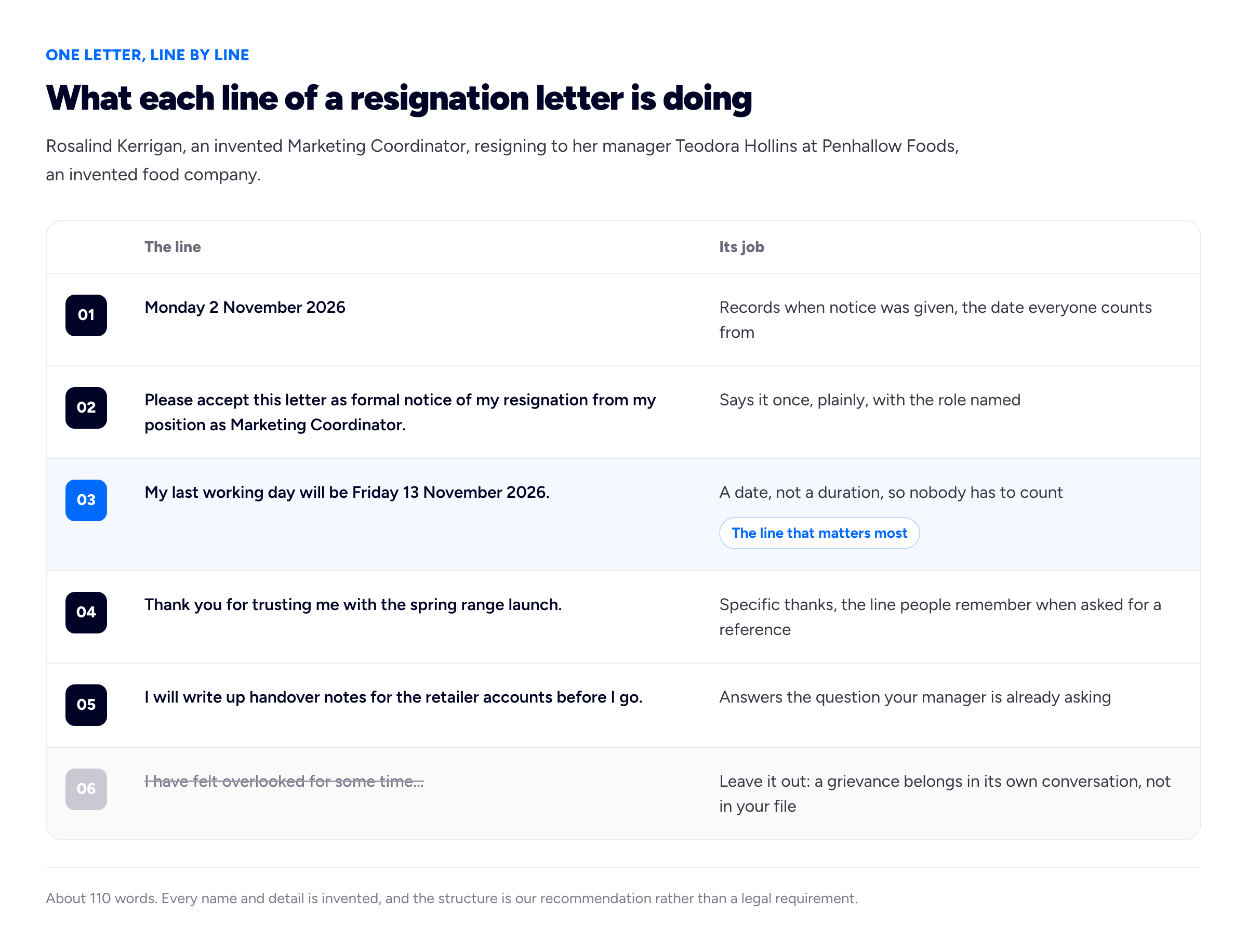
Row 03 is the one that saves an argument later; row 06 is the one people regret writing.
The order: tell your manager first, then send the letter
Your manager should hear it from you, not from an email notification between meetings, and certainly not from a colleague. The order we recommend is:
- Check your contract or handbook for your notice period, who resignations go to, and whether they must be in writing. Also check how much holiday you have left, because that affects your last day and your final pay.
- Have your new offer in writing before you resign, if you are leaving for another job. A verbal offer can be withdrawn; your resignation is hard to take back.
- Ask your manager for a short private meeting, in person or on a video call. Do not say what it is about in the invitation if you can avoid it; "have you got fifteen minutes today?" is enough.
- Tell them in the first minute. "I wanted to tell you in person that I have decided to resign. My last day will be the thirteenth." Then stop and let them respond.
- Send the letter the same day, ideally within the hour, saying what you said in the room. That way the date on the letter and the conversation match.
- Agree how the team will be told, and let your manager decide when. Until then, keep it to yourself.
- Write the handover notes during your notice, not on your last afternoon.
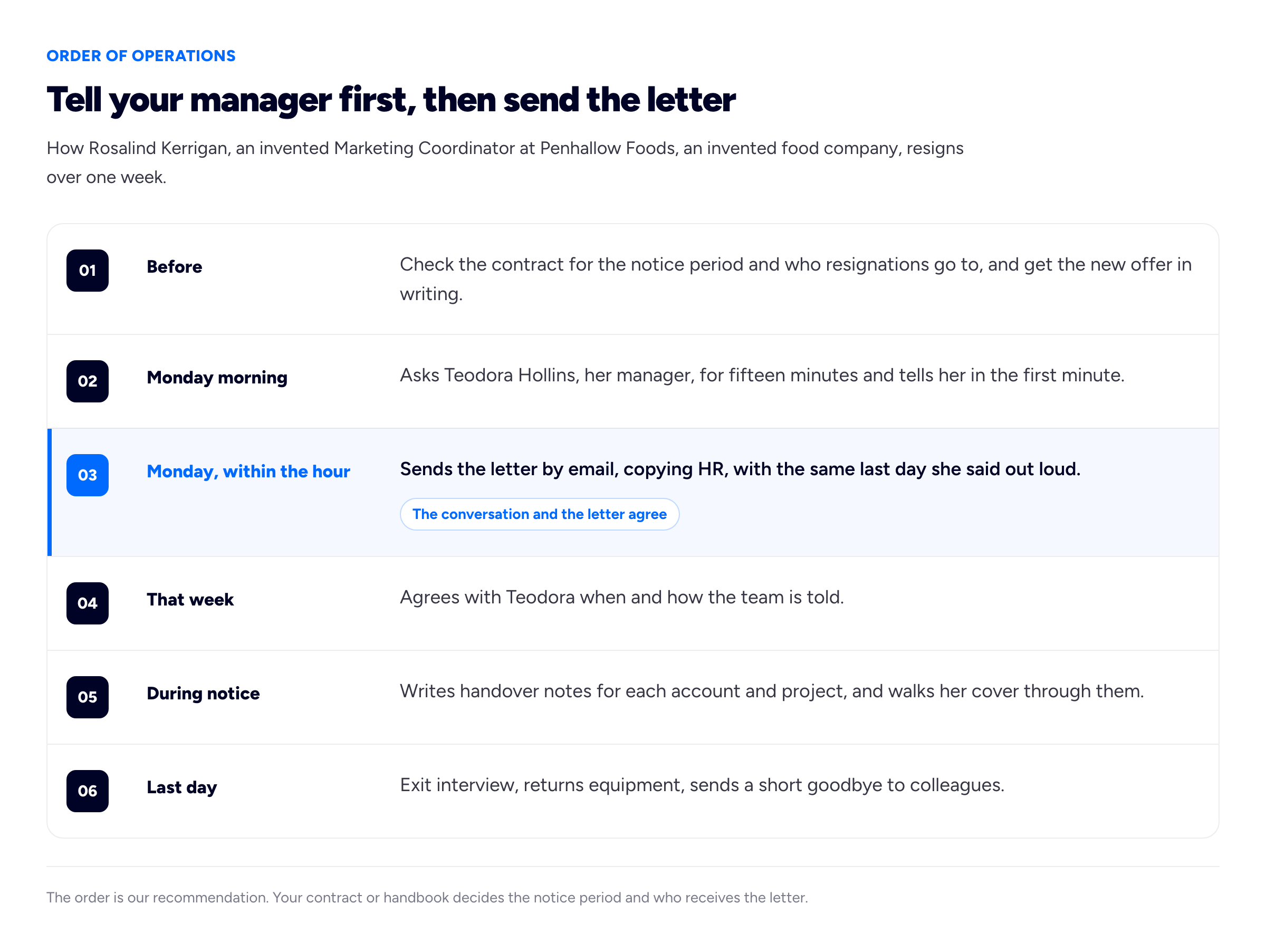
Steps two and three are an hour apart on purpose: the conversation comes first, and the record follows while the conversation is fresh.
How much notice do you have to give?
This depends on your country and your contract, and it is the one part of resigning where guessing can cost you. Here is what the official sources say.
In the United States
Most US jobs are "at will". The federal government's own guidance says that all states except Montana allow at-will employment, and that it does not cover people working under a signed contract, a union's collective bargaining agreement, or in the public sector. Where at-will applies, neither side usually has to give notice. New Jersey's labour department puts it directly: notice is not required by either party because it is an at-will state.
So "two weeks' notice" is, for most people, a professional custom rather than a legal duty. It is still worth keeping. It protects your reference and gives your team time to cover your work, and your handbook may tie things such as paying out unused leave to giving notice. And if you have a contract, a union agreement or a public-sector role, your notice period may be written down and binding, so check it.
Final pay works the same way: it is mostly state law. The US Department of Labor says employers are not required by federal law to give former employees their final paycheck immediately, but that some states may require immediate payment. Your state labour department's website will say which applies to you.
In the United Kingdom
In the UK there is a statutory minimum, and your contract can add to it. Acas, the government-funded advisory service, explains that if you have worked for at least one month you must give a minimum of one week's notice, and that your contract, written statement or a staff policy might require more. That longer contractual period is the one that usually applies. Acas also says that if you do not give enough notice and your employer does not agree an alternative, you are likely to be breaching your contract, and it suggests putting any agreed change, such as using holiday to shorten your notice, in writing.
In Australia and elsewhere
In Australia, the Fair Work Ombudsman publishes the rules on giving notice at fairwork.gov.au, and your own contract is the place to start. We are not stating a figure for Australia here; check the Ombudsman's guidance for your situation. Anywhere else, the pattern is the same: find your employment contract, then your country's official employment guidance, and use whichever gives the longer period.
Whatever the rules, write your last day as a date, and if you are unsure how the notice is counted, ask HR to confirm the date in writing. That one email settles more than any template can.
The standard two weeks' notice letter
This is the letter most people need: leaving on ordinary terms, giving the usual notice. It is about 110 words, and it does every job in the anatomy above.
Monday 2 November 2026
Dear Teodora,
Please accept this letter as formal notice of my resignation from my position as Marketing Coordinator at Penhallow Foods. My last working day will be Friday 13 November 2026.
Thank you for the past three years, and especially for trusting me with the spring range launch. I have learned a great deal from you and from the team.
Before I leave I will write up handover notes for the retailer accounts and the packaging project, and I am happy to walk whoever covers them through everything. Please let me know if there is anything else you would like me to prioritise.
Kind regards,
Rosalind Kerrigan
For a printed copy, add your address at the top and sign above your typed name.
How to write a two weeks' notice email
An email resignation is a resignation letter with a subject line. The content is the same; three things are different.
- The subject line says what it is, such as "Resignation: Rosalind Kerrigan", so HR can find it in a search next year.
- Send it to your manager and copy HR if your handbook says resignations go to HR. Do not copy the team.
- Put the letter in the body, not only in an attachment. Attach a signed PDF as well if your employer asks for one.
Subject: Resignation: Rosalind Kerrigan
Dear Teodora,
Following our conversation this morning, I am writing to confirm my resignation from my role as Marketing Coordinator. My last working day will be Friday 13 November 2026.
Thank you for your support over the past three years. I will prepare handover notes for my accounts and projects this week so that nothing is left hanging.
Kind regards,
Rosalind Kerrigan
"Following our conversation this morning" is the most useful phrase in it. It shows anyone reading later that you told your manager first.
Sample resignation letters for other situations
Each of these keeps the same skeleton and changes one or two lines. Swap in your own names, role and dates.
Short notice
Use this when you need to leave sooner than your notice period. Ask, do not announce: in the UK, Acas notes that leaving without the notice your contract requires is likely to be a breach unless your employer agrees. Offer what you can to soften it.
Dear Teodora,
Please accept this letter as notice of my resignation from my position as Marketing Coordinator. I know my contract asks for four weeks' notice, and I am sorry to ask this, but for personal reasons I would like to leave on Friday 6 November 2026, if you are able to agree to that.
To make it as easy as possible, I will have handover notes for every open project to you by Wednesday, and I am happy to take calls from my cover for a fortnight after I go. If an earlier date is not possible, I will of course work the full period.
Kind regards,
Rosalind Kerrigan
You do not have to give the personal reason. If outstanding holiday could cover part of the gap, offer it.
Leaving on good terms, with thanks
When the job was good, say so properly, once.
Dear Teodora,
Please accept this as formal notice of my resignation as Marketing Coordinator. My last day will be Friday 13 November 2026.
This was not an easy decision. When I joined Penhallow Foods I had never run a product launch, and you let me run two. You also taught me to write a brief that a supplier can actually work from, which I will be using for a long time.
I would like to leave everything in good order, so I will prepare full handover notes and make myself available to whoever takes on my accounts. I hope we stay in touch.
With thanks and best wishes,
Rosalind
Leaving a toxic job
This is the letter people most want to make long, and the one that should be shortest. Writing down everything that went wrong will not change anything, and this is the one document about your time there certain to be kept. If something unlawful or unsafe happened, report it through the proper route, keep your own dated notes, and take advice; do not try to do that job inside a resignation letter.
Dear Teodora,
Please accept this letter as formal notice of my resignation from my position as Marketing Coordinator. My last working day will be Friday 13 November 2026.
I will complete handover notes for my current work before I leave.
Regards,
Rosalind Kerrigan
That is complete. It has no thanks, because thanks you do not mean will read as sarcasm, and it has no complaints, because those belong somewhere else. It is polite, factual and impossible to use against you. If you want to explain your reasons, the exit interview is the better place.
Resigning by email when you cannot meet first
When your manager is away for weeks or several time zones off, send the email and say why it came first.
Subject: Resignation: Rosalind Kerrigan
Dear Teodora,
I would have preferred to tell you this in person, but with you away until the end of the month I did not want to delay. Please accept this email as formal notice of my resignation as Marketing Coordinator. My last working day will be Friday 13 November 2026.
I have copied HR so that the paperwork can start. I would be glad to talk on a call whenever suits you, and I will have handover notes ready for my cover by the end of next week.
Kind regards,
Rosalind Kerrigan
Retiring
Retirement letters usually give more notice and say a little more. Check your pension scheme's paperwork and your handbook before you set a date; some employers have their own retirement process alongside the letter.
Dear Teodora,
After a lot of thought, I have decided to retire, and I am writing to give formal notice. My last working day will be Wednesday 31 March 2027.
I wanted to give you plenty of time to plan. I would be happy to help recruit and train my successor, and to put the supplier contacts and launch calendars I keep in my head down on paper.
Working at Penhallow Foods has been the best part of my career, and I am grateful to you and to everyone on the team.
Warm regards,
Rosalind Kerrigan
Part-time or temporary roles
A part-time job needs exactly the same letter, and the same notice under your contract. Two details differ. Give your last day as a date you are actually scheduled to work, and if you are on a rota, say which shifts you will still cover. If you are placed through an agency, check your agency contract: you may need to give notice to the agency as well as, or instead of, the client.
Dear Teodora,
Please accept this as notice of my resignation from my part-time role as Marketing Assistant. My final shift will be Friday 27 November 2026, and I will work all of my rostered shifts until then.
Thank you for being so flexible with my hours while I finished my course. I will leave notes on the weekly social posts for whoever picks them up.
Best wishes,
Rosalind Kerrigan
Letter or email, and how to sign it
Email is normal now, and a dated email is a perfectly good record. Use a printed, signed letter if your contract asks for one or your employer still works on paper: your address and the date at the top, the recipient and company, the body, then your signature above your typed name. Keep it to a page.
Whichever you use, keep a copy. Save the sent email somewhere other than your work account, because your access to that will end on your last day.
If they make a counter-offer
Some employers respond to a resignation with an offer: more pay, a new title, a different manager. Decide before the meeting what, if anything, would change your mind, because a counter-offer made across the table is designed to be answered on the spot. If you are leaving for reasons money will not fix, a raise usually only delays the same conversation. If you genuinely would stay for the right offer, it is better to have asked for it before resigning.
Answer politely and quickly: "Thank you, I appreciate it, but my decision is made." If you have accepted another job, you have made a commitment there too. We recommend never using a resignation as a bargaining tool; it changes how you are seen afterwards.
The exit interview
Many employers ask leavers for an exit interview, either with HR or through a form. It is usually voluntary, and it is a fair place to give feedback that might help the people staying. The rule we suggest is to describe, not accuse. "The workload on the launch team doubled this year without a new hire, and that was a big part of my decision" is useful to an organisation and hard to resent. "My manager is impossible" is neither.
Stick to things that could be changed, give an example for each, mention what worked well too, and assume it may reach your manager.
Handover notes
People remember the handover more than the letter. Write a short document your replacement can use without you in the room. For each project or account, cover:
- What it is and where it stands today, in two or three sentences.
- The next deadline, and what needs to happen before it.
- Who the contacts are, inside and outside the organisation, and what each one is responsible for.
- Where the files, passwords (through the proper password manager, never in the document) and recurring tasks live.
- Anything unusual: the supplier who only reads email in the morning, the report that breaks if the month has five Fridays.
Share a draft in your first week of notice, not your last, then walk your cover through it.
After you leave: update your profile and your work
Once your notice is given, update your CV while the details of the job are fresh: the projects you shipped, what changed because of them, and the figures you can still stand behind. Wait until your last day, or until you have agreed the timing with your new employer, before changing your LinkedIn headline, and if you keep a downloadable CV there, our guide on adding your resume to LinkedIn explains the options. This is also a good moment to collect the work you are allowed to show, before you lose access to the shared drive. A portfolio site, whether you build it yourself or use a free one like Bunfolio, keeps that work somewhere that does not belong to your employer.
Check what you are allowed to take. Client work and internal documents are usually your employer's, so ask before you keep copies, and describe confidential projects in general terms rather than sharing the files.
Frequently asked questions
Do I have to give a reason for resigning?
No. A resignation letter only needs to say that you are resigning and when your last day is. You can tell your manager more in conversation if you want to, and you can give fuller feedback in the exit interview, but the letter does not need a reason.
Can I resign by email or text?
Email is fine and is now the usual way, ideally after telling your manager in person or on a call. Check your contract in case it says resignations must be in writing in a particular form. A text message is a poor record and reads as abrupt; if you have to send one, follow it the same day with a proper email.
Is two weeks' notice a legal requirement?
It depends on where you work. In most US states employment is at will, so two weeks is a custom unless a contract, union agreement or public-sector rule says otherwise. In the UK there is a statutory minimum of one week after a month's service, and your contract can require more. Elsewhere, check your contract and your country's official employment guidance.
What if my employer tells me to leave straight away?
It happens, especially in sales or roles with access to client data. Ask, politely and in writing, whether you will be paid for your notice period and how your unused holiday will be handled. The answer depends on your contract and local law, so check both, and in the UK the Acas helpline can advise on your situation.
Can I take back a resignation?
Only if your employer agrees. Once you have resigned clearly, they are entitled to accept it. That is why we recommend resigning only once you are sure, and only once any new offer is in writing.
How long should a resignation letter be?
Our recommendation is under 150 words: three short paragraphs and a sign-off. Extra length is usually where the regrettable sentences live.
How we put this guide together
Bunfolio builds portfolio websites and free career tools, so we see a lot of people changing jobs. The legal points about notice and final pay come from official pages we read while writing it: USA.gov's termination guidance, the New Jersey Department of Labor's FAQ as one state's statement of at-will employment, the US Department of Labor's last paycheck page, and Acas on notice when resigning. We tried to read the Fair Work Ombudsman's notice pages for Australia and could not load them on the day, so we have stated no Australian figure and point you to the Ombudsman instead. None of this is legal advice, and your own contract comes first.
Everything else is our recommendation: the five essentials, what to leave out, the order of operations, the lengths, and the advice on counter-offers, exit interviews and handovers. We have left out the statistics that usually decorate this topic, such as how often counter-offers end in a second resignation, because we could not trace any to a published method, sample and date.
Rosalind Kerrigan, Teodora Hollins and Penhallow Foods are invented, as are the spring range launch, the packaging project and every other detail in the sample letters and both diagrams. The letters were written by us as models to adapt, and none should be sent as it stands.
Related reading: the thank-you email after an interview, how to make a resume stand out, how to end a cover letter, questions to ask the interviewer and building a career portfolio.
More from the blog
October 4, 2026 · 22 min read
How to Write a Cover Letter for an Internship (With 3 Examples)
Little or no work experience? Here is how to read an internship advert and match each requirement to your coursework, projects, societies or part-time job, with the format to copy, a fill-in template,...
September 27, 2026 · 23 min read
How to Write a Letter of Presentation (With 6 Examples)
A letter of presentation is what Spanish, Italian and Portuguese speakers call a cover letter, and it also means a letter introducing yourself or your services to a prospective client. What each meani...

October 24, 2026 · 19 min read
Artist Statement Examples (and How to Write One Without Artspeak)
What an artist statement is and how it differs from a bio and a project statement, the four lengths to keep ready, a four-move method for drafting one, plain-language rules, an artspeak paragraph rewr...