
September 27, 2026 · 17 min read · Updated October 5, 2026
How to End a Cover Letter: Closing Lines That Sound Confident, Not Pushy
A cover letter ending has three jobs: restate your fit in one line, name a next step and thank the reader. Closing sentences graded from too passive to too pushy, sign-offs compared including Yours sincerely vs Yours faithfully, endings for special cases, and 12 lines to adapt.
End a cover letter with a short closing paragraph that does three things: restates in one sentence why you fit this particular job, names a concrete next step such as a conversation or an interview, and thanks the reader for their time. Then add a plain sign-off such as "Sincerely" or "Kind regards", your full name, and the contact details and portfolio link the reader needs to act on it.
That is the whole mechanism. What makes it hard is tone. Read any long thread about cover-letter endings and the same worry comes up: people are torn between sounding passive ("I hope to hear from you at some point") and sounding pushy ("I will call your office on Monday to arrange an interview"). This guide deals with that worry directly, with a graded set of closing sentences, a comparison of sign-offs including the British "Yours sincerely" versus "Yours faithfully" rule, endings for particular situations, and a set of lines you can adapt.
What the closing paragraph is for
By your last paragraph the reader has roughly decided. The ending will not turn a "no" into a "yes", but it can make a "maybe" easier to act on. It has three jobs, done in about three sentences.
- Restate the fit in one line. One sentence tying your strongest point to what the employer most needs: "The reporting redesign I led is close to the dashboard rebuild in your advert." Not "my skills make me an ideal candidate", which tells the reader nothing they can check.
- Name a next step. A conversation, an interview, a chance to walk through a piece of work. Naming it is not presumptuous; it is why the letter exists.
- Thank them. One short clause is courtesy; a paragraph of gratitude is grovelling.
Everything else can go: your phone number repeated in the prose, "hard-working team player", a note that your resume is attached when the reader has it open. Two or three sentences is normal, and nobody thinks less of you for stopping.
Passive, confident or pushy: grading the closing sentence
The debate about "I look forward to hearing from you" is really a debate about where on a scale your final sentence sits. At one end the letter trails off, as if the writer is apologising for having applied. At the other end it tells the employer what they are going to do. The confident middle states what you want and leaves the decision where it belongs, with the reader.
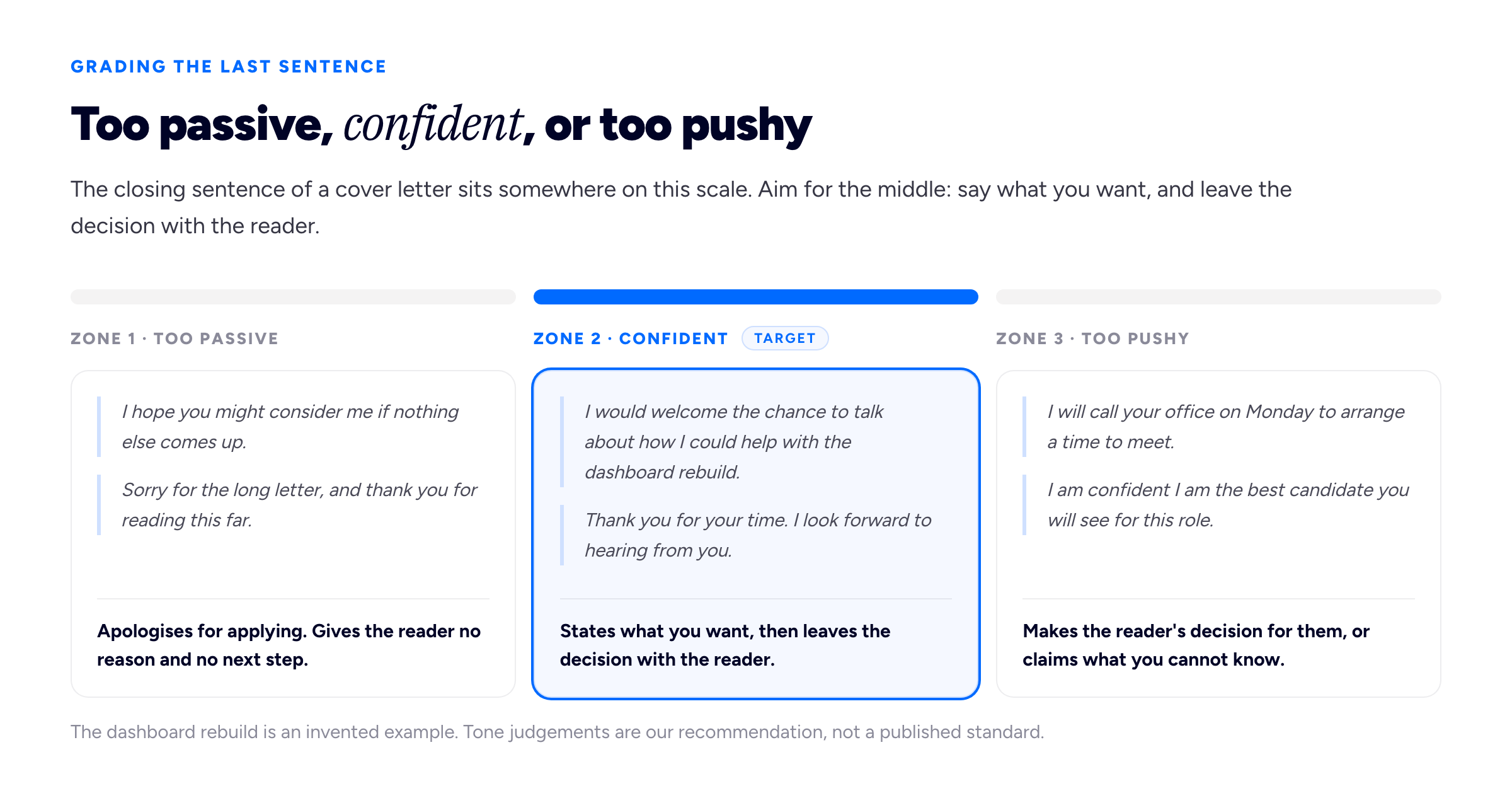
The target is the middle zone: a clear request followed by a courteous hand-back. Both extremes fail for the same reason — they are about the writer's nerves, not the reader's decision.
Why the passive ending fails
Passive endings hedge everything: "if you think I might be suitable", "should you have any time". Stacked together, the hedges read as someone who does not expect to be taken seriously. The fix is not force; it is removing the qualifiers: "I would welcome the chance to discuss the role."
Why the pushy ending fails
Pushy endings usually come from old advice to "take control of the next step". The classic form is "I will call you next week to arrange an interview." Purdue's Online Writing Lab does suggest telling readers when you will contact them, and following through if you say you will; the problem is the verb. "I will arrange an interview" decides something that is not yours to decide. If you want to mention a follow-up, frame it as an offer rather than a schedule: "If it would help, I am happy to follow up next week." And when an application goes through an online portal with no named reader, a promised call is a promise you may not be able to keep.
The other pushy pattern is the superlative. "I am the best candidate you will see" is a claim you cannot know, and it invites the reader to disprove it.
The confident middle
A confident ending sounds like one professional writing to another: specific ("the dashboard rebuild", not "the role"), the request stated once, no over-explaining. Read it aloud and ask whether you would say it to the hiring manager's face. Few people would say "I humbly hope you will find time to consider my application", or "I will be calling you on Monday".
Closing salutations for a cover letter, compared
The closing salutation, also called the sign-off or complimentary close, is the phrase before your name. It matters less than people fear: nobody rejects you for "Best regards" instead of "Sincerely". But a sign-off that clashes with your greeting, or is too casual for the setting, is a small avoidable jolt at the very end.
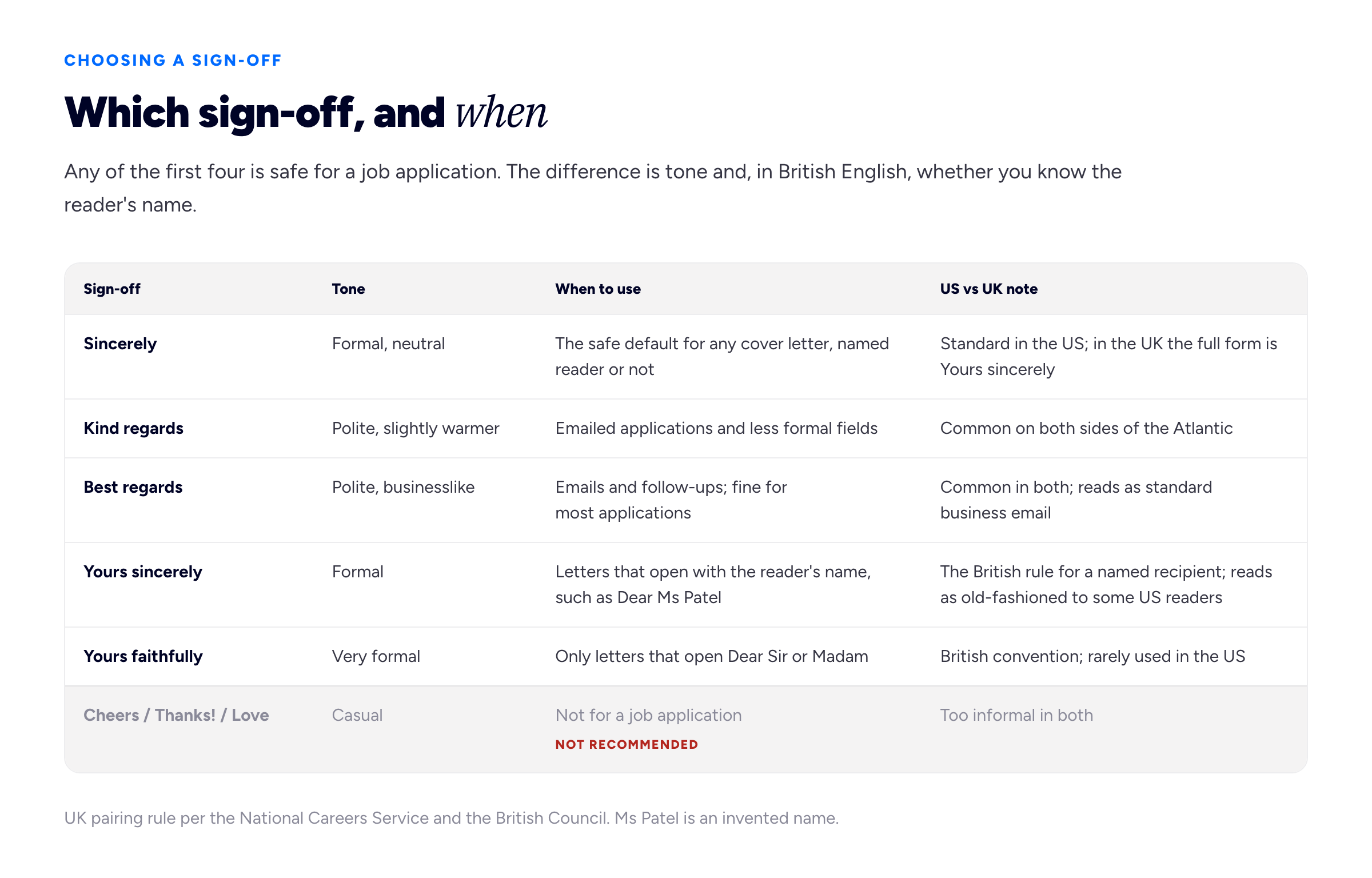
If you are writing to a US employer and unsure, "Sincerely" is the choice nobody will notice. If you are writing to a UK employer, let the greeting decide between "Yours sincerely" and "Yours faithfully".
The same choices as a list, from most to least formal, with a comma after each and your full name on the line below:
- Yours faithfully — British usage, only when the letter opens "Dear Sir or Madam".
- Yours sincerely — British usage for a letter that opens with the reader's name; also acceptable, if a little old-fashioned, in the US.
- Sincerely — the safe default in the US, whether or not you know the reader's name.
- Respectfully — very formal; suits government, military and some academic applications, and reads as stiff elsewhere.
- Kind regards — polite and slightly warmer; good for emailed applications.
- Best regards — businesslike; fine for most applications and follow-ups.
- Thank you for your consideration — works as a close on its own if your last paragraph has not already thanked the reader; do not use it as well as a thank-you sentence.
Whichever you pick, the format is the same: the salutation, a comma, then your full name on its own line. In an emailed application, follow the name with your phone number and portfolio link; in a letter you attach or post, leave room for a signature above your typed name if you are printing it.
The British rule: "Yours sincerely" versus "Yours faithfully"
British English has a pairing rule that trips people up, and it is simple once it is stated correctly. The UK government's National Careers Service puts it this way: if you know the name of the person you are writing to, end with "Yours sincerely"; if you have addressed the letter "Dear Sir or Madam", end with "Yours faithfully". The British Council's LearnEnglish guide to cover letters gives the same pairing: "Dear Mr / Mrs / Ms" plus a surname closes with "Yours sincerely", and "Dear Sir or Madam" closes with "Yours faithfully".
Two details: in British usage only the first word is capitalised ("Yours sincerely"), and the rule follows the greeting you actually used. In the US, "Yours faithfully" is rare, and "Sincerely" or "Sincerely yours" covers both cases; Purdue's guidance on formatting cover letters gives "Sincerely" or "Sincerely Yours" as its examples.
Is there a sign-off to avoid?
Anything you would put at the end of a text message: "Cheers", "Thanks!", "Talk soon". Also avoid stacking two closes ("Thanks and best regards, Sincerely"), which looks like an editing accident. In our view "Warm regards" and "All the best" suit a follow-up to someone you have already spoken to better than a first approach.
Endings for particular situations
The three jobs stay the same in every case. What changes is which fact you restate and what next step makes sense.
When you do not know the hiring manager's name
Try first: the advert, the company's team page or a polite call often turns up a name. If not, "Dear Hiring Manager" or "Dear [Team name] team" is a widely used modern alternative to "Dear Sir or Madam", closed with "Sincerely" or "Kind regards". If you do use "Dear Sir or Madam" for a UK application, the correct close is "Yours faithfully".
Thank you for considering my application. I would welcome the chance to talk about how my experience running weekend service for 120 covers could help your team through the summer.
For an internship
Do not apologise for your lack of experience. Restate what you bring (a relevant module, a project, a skill the advert names) and what you want to learn, and ask for the conversation like anyone else. Our internship cover letter guide covers the rest of the letter.
The data-cleaning project I completed for my statistics module is close to the work your advert describes, and I would like to learn how it is done at scale. I would welcome the chance to discuss the internship, and thank you for your time.
If you are short on things to point at, our guide to building a portfolio alongside a resume explains how a small body of shown work can do more than a long list of claims.
For a teaching position
Candidates for a teaching post often hold similar qualifications, so restate something only you can claim: a subject strength, a club you ran, work with a particular group. In the UK, schools often ask for an application form with a supporting statement rather than a free-standing letter, so check what the school wants first.
I would be glad to bring the Year 9 reading programme I built at my placement school to your English department, and I would welcome the chance to discuss it at interview. Thank you for considering my application.
If you keep a record of lesson plans and pupil work, a teaching portfolio gives the interview panel something to look at before they meet you.
When you are changing careers
The closing line is where you make the bridge explicit, once. Name the transferable thing and connect it to the new job, without apologising for the change.
Eight years of running client accounts taught me to turn messy requirements into a plan people sign off, which is most of what your project coordinator role asks for. I would welcome the chance to talk it through.
When someone referred you
Mention the referrer early in the letter; at the end, a brief callback is enough.
Priya Shah suggested I write to you, and she is happy to talk about the work we did together. Thank you for your time, and I look forward to hearing from you.
Asking for the interview directly
You can ask for an interview in so many words. Keep it a request, not an instruction.
I would appreciate the opportunity to interview for the role, and I am available at any time over the next two weeks.
Offering your availability is a useful, concrete detail. Stating a deadline for their reply is not.
Emailed application or attached letter?
The closing paragraph is the same either way. What differs is what goes underneath it.
An attached letter (a PDF uploaded to a portal or attached to an email) follows printed-letter conventions: the sign-off, space for a signature if you want one, then your typed full name. Your contact details sit in the header; the National Careers Service advises checking they match those on your CV.
An email that is the cover letter (the letter is the body of the message) needs a signature block, because there is no letterhead. Keep it to four or five lines:
Kind regards,
Jordan Reyes
Product designer
jordan@example.com · (555) 010-0147
jordanreyes.example.com · linkedin.com/in/jordanreyes-example
The phone number lets a recruiter call without opening an attachment, and the portfolio link gives them the next thing to click. If you do not have somewhere to point them, a free portfolio website gives you a clean link to put in the signature, and our guide to putting a portfolio link on your resume covers how to format the address so it survives copy-and-paste and applicant tracking systems.
An email with a letter attached needs only a one- or two-sentence note naming the role and the attachment, then the same signature block.
Common mistakes at the end of a cover letter
- Repeating the resume. The last paragraph is not a place to list your skills again. If a skill matters, it belongs higher up, and the skills section of your resume is where the full list lives.
- Ending with a question the reader has to answer. "Would you be available for a call next Tuesday at 3pm?" puts an administrative task on someone who has not decided to interview you yet.
- The generic fit claim. "I am confident my skills make me a perfect fit" appears in so many letters that it registers as noise. Replace it with the specific fact that makes you a fit.
- Apologising. For the length, for your lack of experience, for taking their time. Thank them instead.
- A mismatched sign-off. "Dear Sir or Madam" closed with "Cheers", or a warm, informal letter closed with "Yours faithfully".
- Getting the name wrong. In a reused letter, the company name in the last paragraph is easy to forget. Reread the ending before sending.
- Making it too long. Six closing sentences dilute the one that mattered. The same instinct applies to how long a resume should be.
Closing lines you can adapt
Each does at least two of the three jobs. Swap in your own specifics; a real detail beats any line copied word for word.
- "I would welcome the chance to talk about how I could help with [specific project or goal]. Thank you for your time."
- "Thank you for considering my application. I look forward to hearing from you."
- "My experience with [specific thing] is a close match for [need in the advert], and I would be glad to discuss it at interview."
- "I would appreciate the opportunity to interview for the role, and I am available at any time in the next two weeks."
- "If it would be useful, I am happy to walk you through [a specific piece of work] in more detail."
- "Thank you for reading. I would be glad to answer any questions about my application."
- "I am excited by [something specific about the company], and I would welcome a conversation about how I could contribute."
- "[Referrer's name] suggested I get in touch, and I would be glad to talk further. Thank you for your time."
- "Examples of this work are on my portfolio at [link], and I would be happy to discuss any of them."
- "Having freelanced for [type of clients], I am ready to bring that experience in-house, and I would welcome the chance to discuss the role."
- "I would like to learn more about the team's plans for [area], and to explain how I could help. Thank you for considering me."
- "Thank you for your time and consideration. I hope to speak with you soon."
For line 10, our guide to freelance work on a resume covers presenting that history. Line 9 works best when the link shows the work quickly, ideally with client quotes; see how to ask clients for testimonials.
If you are staring at a blank page rather than a weak ending, our free AI cover letter generator drafts a short, three-paragraph letter from the job advert and your own background notes, in a warm, plain or formal tone. Treat its closing as a starting point and put your own specifics in before you send it; it can only use the facts you give it.
Frequently asked questions
What is a good ending sentence for a cover letter?
One that states what you want and hands the decision back politely. "I would welcome the chance to discuss how I could help with [specific goal]. Thank you for your time" works in almost any field. The specific goal is what makes it good: it shows you read the advert and gives the reader one more reason to say yes.
What are 7 effective ways to end a cover letter?
There is no official list of seven, but these cover most situations: restate your fit in one specific line; ask directly for an interview; offer to walk through a piece of work; mention your availability; refer back to the person who referred you; point to your portfolio; and close with a simple thank-you and "I look forward to hearing from you". Most good endings combine two or three of these.
How do I finish off a letter of application?
The same way as a cover letter, since in British usage "letter of application" and "covering letter" are often used for the same thing. Thank the reader, say you look forward to hearing from them, make sure your contact details are present and match your CV, then sign off with "Yours sincerely" if you addressed a named person or "Yours faithfully" if you wrote "Dear Sir or Madam". In the US, "Sincerely" covers both.
What is a good closing sentence for a letter?
One that states the next step, thanks the reader, or both: "Thank you for your help with this; I look forward to your reply." For a job application, tie it to the role.
Should I say "I look forward to hearing from you"?
Yes, if it follows a sentence that does the real work. On its own it is a polite convention, and the National Careers Service includes it in its own advice for the final paragraph. The complaint that it sounds passive is really a complaint about letters where it is the only thing in the last paragraph. Put a specific restatement or request before it and it reads as a courteous close rather than a hopeful shrug.
What is the best way to close a cover letter?
With a two- or three-sentence paragraph that restates your fit for this specific role, proposes a next step such as a conversation, and thanks the reader, followed by a plain closing salutation and your full name. The best closes are specific: they mention something from the advert or the team, so the reader can tell the letter was written for them. Avoid ending on an apology, a question about whether they received your application, or a promise to phone them.
What is the correct closing salutation for a cover letter?
"Sincerely" is correct for almost any cover letter in the US. In British English, match the greeting: "Yours sincerely" after "Dear Ms Patel", "Yours faithfully" after "Dear Sir or Madam". "Kind regards" and "Best regards" are also correct, particularly for an application sent as an email. Put a comma after the salutation and your full name on the next line; the list above sets out when each one fits.
Is "Best regards" too casual?
No. "Best regards" is standard business-email language, and it is fine for an emailed application in most fields. For a formal attached letter, especially to a law firm, a public body or a traditional employer, "Sincerely" (or "Yours sincerely" in the UK) is the safer choice. What is too casual is "Best" on its own, "Cheers" or "Thanks!".
How we put this guide together
The three jobs of a closing paragraph, the passive-to-pushy scale, the tone judgements on each sign-off and the example lines are our own recommendations, drawn from how cover letters are read rather than from any official standard. Weigh them as opinions with reasons attached. The passive-versus-pushy framing responds to a long-running public debate among job seekers about whether "I look forward to hearing from you" sounds passive.
We have deliberately left out statistics we could not trace. Figures such as "X% of hiring managers read the last paragraph first" or "letters that ask for an interview get Y% more callbacks" circulate widely, but none of the versions we found pointed to a published survey method, so none of them appear here.
The factual claims point at primary sources we read: the National Careers Service's advice on writing a covering letter (the "Yours sincerely" and "Yours faithfully" rule, and its advice on the final paragraph and matching contact details); the British Council's LearnEnglish page on cover letters (the same greeting-and-close pairing); and the Purdue Online Writing Lab's guidance on formatting and organising cover letters (the contents of the closing paragraph, and "Sincerely" as the US close). Conventions vary between employers and sectors, so if an advert or a school's application pack tells you how to format your letter, follow it.
Jordan Reyes, Priya Shah, Ms Patel, the dashboard rebuild and the email addresses and web addresses in the examples are invented to show the shape of a closing paragraph and a signature block. The phone number uses the 555-01xx range reserved for fictional use.
Related reading: how to start a cover letter, how long a cover letter should be, how to put a portfolio link on your resume, portfolio vs resume, how long a resume should be, writing a resume skills section and putting freelance work on your resume.
More from the blog
October 2, 2026 · 15 min read
How to Start a Cover Letter: Greetings, Opening Lines and Examples
Start with your details and the date, a greeting to a named person or "Dear Hiring Manager", then an opening that names the role, gives one specific hook and says why this employer. Greetings compared...
October 4, 2026 · 16 min read
How to Write a Cover Letter for an Internship (With Example)
Little or no work experience? Here is how to read an internship advert and match each requirement to your coursework, projects, societies or part-time job, with a full example letter annotated paragra...
September 28, 2026 · 15 min read
How Long Should a Cover Letter Be? Words, Pages and Paragraphs
One page is the published guidance and four or five short paragraphs is the shape. Where a 250–400 word target comes from, when faculty, federal, emailed and form applications change it, what to cut,...