
September 10, 2026 · 28 min read
How Long Should a Resume Be?
The one-page rule is folklore with a real origin, and it stopped being a rule some time ago. The branch points that actually decide your page count, what earns a place on the page, how far back to go, and why a resume that runs to one-and-a-bit pages is worse than either one or two.

You have a resume that runs to one page and about four lines. You are now doing the thing everybody does: narrowing the margins to 0.4 inches, dropping the body text to 9.5pt, deleting the space above "Education", and considering whether the fourth bullet on your current job was really necessary. Or you are doing the opposite — padding a thin page with a skills grid and an interests line so it does not look like you ran out of career.
Both of those are the same mistake, made in opposite directions. You have decided the page count first and are now bending the content to fit it.
The honest answer to how long a resume should be is "it depends", which is why almost every article on this question is useless. They say it depends, list the things it depends on, and leave you exactly where you started — except now you know that seniority is a factor, which you already did. What is missing is the bit that resolves it: a procedure that takes your actual situation and returns a number.
That is what this is. There is a decision ladder with four branch questions, a test for what earns a place on the page, a straight answer at every branch, and the one case where the conventional advice is simply wrong. You should be able to run your own resume down it in about ten minutes and stop wondering.
The one-page rule is folklore with a real origin
It is worth knowing where it came from, because the origin tells you exactly when it still applies.
The one-page rule is a constraint inherited from paper. A resume was a physical object. It was posted or handed over, photocopied for a panel, stapled, filed in a drawer, and read by one person holding it. In that world a second page was a genuine cost to somebody else: another sheet to copy, another thing to lose, another page to hold while reading the first. A stack of one-pagers on a desk could be fanned out and compared. A stack of two-pagers could not. The rule was not aesthetic. It was logistics.
Most of that is gone. Your resume is a file. Nobody staples it. A second page costs the reader a scroll, and the reader is scrolling anyway because the window is shorter than a page of A4 on almost every laptop. The record sits in a database that does not care how many pages it came from, and the person who eventually opens it is reading on a screen that reveals roughly half a page at a time regardless of how many pages there are.
What has not changed is the thing underneath the rule. Attention is finite, and a reader deciding whether to spend more attention on you is making that decision early and on weak evidence. That is a real constraint and it did not go away when paper did. But it is a constraint on density — on how quickly your document rewards someone for continuing — and density is not page count. A one-page resume of vague, interchangeable sentences fails that constraint badly. A two-page resume where the first half-page is unanswerable passes it.
So the folklore is not stupid. It is a decent rule of thumb that got mistaken for a law, and then got repeated by people who had never asked what it was a rule of thumb for.
The six-second statistic, and why we are not using it
Every article about resume length eventually reaches for the same number: recruiters spend six seconds — or seven, or 7.4 — looking at your resume. It is usually deployed as the clinching argument for one page. We are not going to cite it, and the reason is worth a few paragraphs, because it is a good example of how a number becomes true by repetition.
The figure is traceable, which is more than can be said for most resume statistics. It comes from an eye-tracking study conducted in 2012 by TheLadders, a job search company. The publicly circulated brochure version, archived by Boston University, describes the method plainly: thirty professional recruiters, observed over a ten-week period, with the underlying report credited to the company's own Head of User Experience Design. A 2018 re-run, announced by the company in a press release, revised the figure to 7.4 seconds.
Three problems, in ascending order of seriousness.
First, thirty people is a small sample, the selection criteria are not published, and the study has never appeared anywhere that would have subjected it to review. That does not make it wrong. It makes it uncheckable, which is a different thing and is why we will not build an argument on it.
Second, and much more importantly, it was a commercial study by a company that sold professional resume rewriting. The brochure does not hide this — its central finding is that professionally rewritten resumes scored better on "usability" than the ones candidates wrote themselves. That is not a scandal, it is marketing, and it was presented as marketing. But a statistic whose function in its original document is to demonstrate the value of the publisher's paid service should not then be used as neutral evidence about how hiring works, by us or by anybody else.
Third, and this is the part that actually matters for your question: even if the number is exactly right, it says nothing about page count. Six seconds is a triage decision, not a read. It is the moment where someone decides whether to read you at all. The study's own account of where that attention went — name, current title and company, previous title and company, the dates attached to both, education — is a list of things that all live in the top third of page one. If the first six seconds are spent on the top third of page one, the existence of a page two is irrelevant to them. The number, taken seriously, is an argument about what goes at the top. It is not an argument about how long the document is.
So: no six seconds here. If you see it used to prove that your resume must be one page, the person using it has not read it.
Length is an output, not an input
Here is the reframe that makes the whole question tractable.
You do not decide to write a two-page resume. You decide what earns a place on the page, you write those things properly, and the page count is whatever falls out of that. Length is a result. Treating it as a target is what produces both of the failure modes at the top of this article — the squeezed one-pager where nothing has room to be specific, and the padded two-pager where the second page exists to justify itself.
The test for what earns a place has three parts, and a line has to pass all three.
Does it give evidence for a claim the reader cares about? The reader is holding a job description. Every line of your resume either supports a requirement on that list or it does not. "Excellent communication skills" supports nothing — it restates a requirement rather than evidencing it. "Wrote the weekly release notes read by 400 support staff" is evidence.
Is it the best available evidence for that claim? If three bullets all demonstrate that you can run a project, you need the strongest one and not the other two. Most resumes that are too long are too long because of near-duplicates: the same competence, demonstrated four times, once per job. Keep the best instance. The others are costing you a page and buying nothing.
Would deleting it change what the reader decides? This is the brutal one and it removes more material than the other two combined. Your GCSE grades. The 2009 role at the company nobody has heard of, in a field you left. "References available on request", which is a sentence that has never once altered a hiring decision. The three-line personal statement that could be pasted onto any resume in the pile.
Run the whole document through those three questions and the length problem usually solves itself. Most resumes that feel like they need a second page are one-page resumes carrying half a page of material that fails the test. Most resumes that feel thin are not short of experience; they are short of specifics, and the fix is to say more about what is already there rather than to add more things.
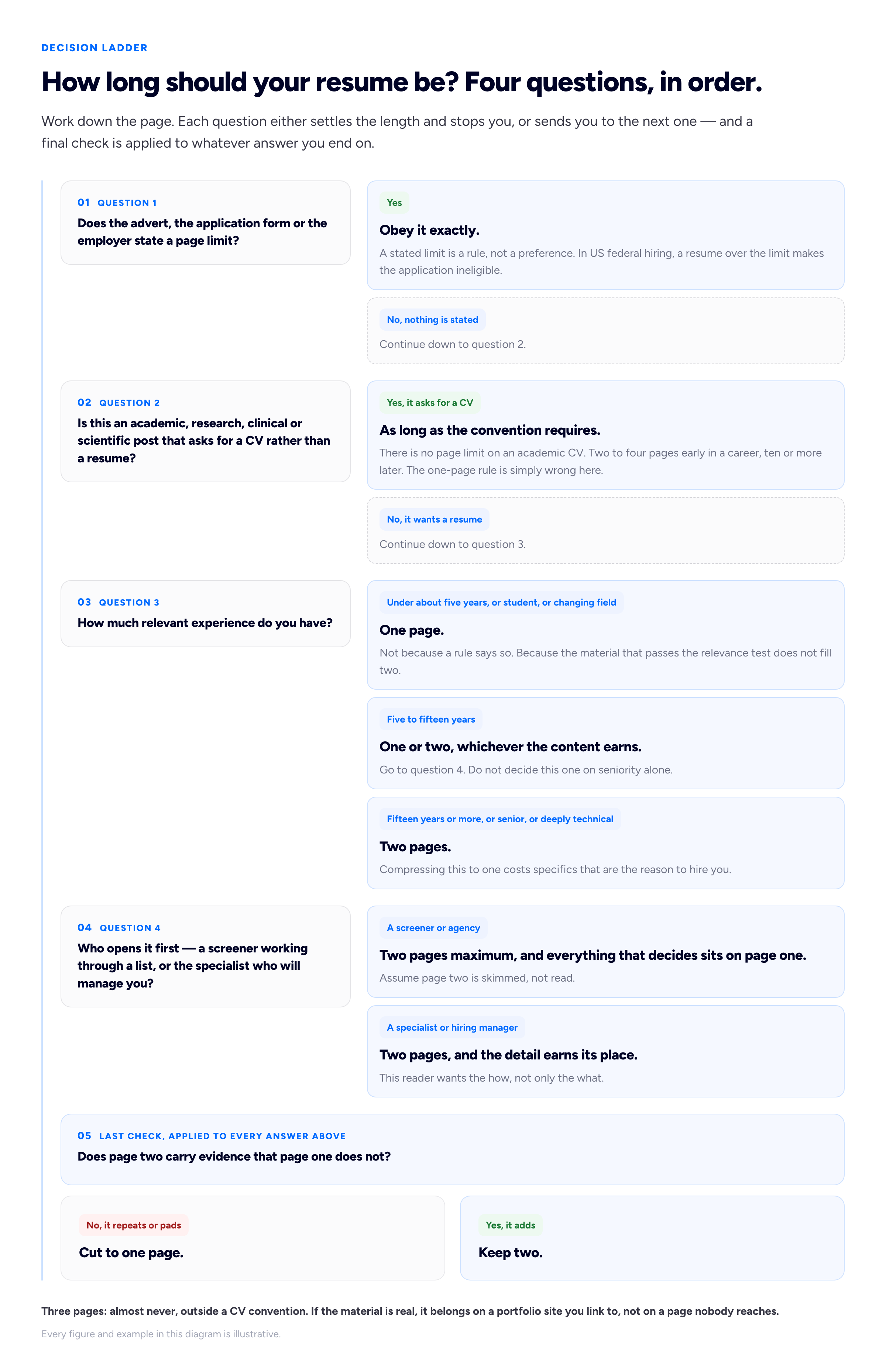
Four questions, asked in this order. The last one is the one most people skip.
The branch points that actually decide it
Years of experience
This is the one people mean when they ask how many years of experience should be on a resume, and it is genuinely the strongest single predictor — but it is a proxy, not the cause. Under about five years of relevant work, one page is nearly always right, and it is right because the material that survives the relevance test does not fill two. A graduate resume padded to two pages reads as somebody who has not yet learned what matters. Over about fifteen years, two pages is normal and compressing to one costs you the specifics that make the case.
The middle — five to fifteen years — is where the question is real, and it is the band where "it depends" gets deployed and nothing follows. Here is the straight version: in that band, do not decide on seniority. Write the document with the relevance test applied honestly, then look at what you have. If it lands at a page and a quarter, cut to one. If it lands at a page and three quarters, fill to two properly. Both are fine. The page count is reporting a fact about your material, not a judgement about your career.
Who is actually reading it
Two very different readers open resumes, and they want different documents.
A screener — an agency recruiter, an internal talent coordinator, someone working a longlist — is answering one question: does this person plausibly meet the requirements. They are fast, they are working through a list, and they will not read page two carefully on the first pass. That does not forbid a second page. It means everything that decides must be on the first one, and page two has to survive being skimmed.
A specialist — the engineering manager, the design lead, the clinical director who will actually work with you — wants the opposite. They want the how. Which database, at what scale, with whom, and what broke. For that reader a second page is not indulgence, it is the interesting part, and cutting it to obey a rule from the photocopier era removes exactly what would have got you the call.
You usually know which one you are sending to. Direct application to a small company: the specialist, often the founder. Large corporate portal or agency: a screener first, a specialist later, and the same file has to work for both — which is an argument for two pages structured so page one stands alone.
Where the one-page rule is flatly wrong: academic and clinical CVs
If the post asks for a CV rather than a resume, and it is an academic, research, medical or scientific role, the entire framing above does not apply. A CV is a complete record, not a selection. Publications, conference papers, grants, teaching, supervision, clinical rotations and committee service are all listed, and they are listed because the field expects them to be.
University careers offices say this plainly. Carnegie Mellon's CV quick-tips sheet states flatly that "There is no page limit", that newer professionals typically start at two pages, and that "All experiences and skills are included, usually without regard to how many pages the CV is." Georgetown's careers centre puts numbers on it: "CVs are typically 2-to-4 pages for a new professional, with a recommended maximum of 10 pages for a seasoned professional."
The trap is a vocabulary one. Outside the United States, "CV" is often just the ordinary word for a resume — a British job advert asking for your CV wants the normal two-page document, not an academic record. The UK's own National Careers Service guide to writing a CV is instructive here: it lists the sections a CV should contain — contact details, introduction, education history, work history, references — and declines to state a length at all. Read the word in context. If the advert mentions publications, it means the academic thing. If it mentions a covering letter and a start date, it means a resume.
The case that overrides everything: a stated limit
If the advert, the form or the employer states a page limit, that is a rule and not a preference, and it outranks every other consideration in this article.
The clearest live example is United States federal hiring, where the long-form federal resume — routinely four, five or more pages for decades — has been abolished. Under the Merit Hiring Plan, OPM's applicant guidance states that "Resumes must be no longer than two-pages in length", and since 27 September 2025 USAJOBS itself restricts stored, uploaded and built resumes to two pages. The parallel guidance to agencies is blunter about the consequence: "If the only resume received by an applicant is longer than two pages, the applicant is ineligible for further consideration." It also confirms the CV carve-out — for posts that need one, "typically in the medical and research fields", agencies may accept it as a separate document.
That is a useful case precisely because it is so specific, and because it inverts the advice that was correct eighteen months earlier. If you are working from a federal resume guide written before late 2025, throw it away. More generally: whenever a limit is stated anywhere in the advert, treat it as the answer to how many pages a resume can be, and do not spend another minute on the question.
How far back should a resume go?
The usual answer is ten to fifteen years. It is a reasonable default and it is not actually the rule, because the rule is not about time.
The real question is where the reader stops caring, and that is a function of relevance and of what has changed in your field, not of a number. A developer's 2011 role is ancient history because the stack, the tooling and the working practices have all turned over twice. A structural engineer's 2011 project may be the largest thing they have ever worked on and is still the best evidence they have. A teacher's first headship is not less relevant for being fourteen years ago.
So make the cut like this. Work backwards from today. Keep a role in full while it is still doing work — while it evidences something the target job wants and no more recent role evidences better. The moment you reach a job that fails that test, stop writing bullets. Everything older gets one compressed line.
That compressed line is the piece most people are missing, and it solves the problem elegantly:
Earlier career: Account Executive, Halden Brooke (2014–2016); Marketing Assistant, Corran Bay (2012–2014).
Titles, employers, dates, one line, no bullets. It shows a continuous history, it takes four seconds to read, and it does not spend a quarter of a page on work that is not making your case. It also removes the reason people cut old roles entirely, which brings us to the uncomfortable part.
The age question, factually
People truncate their history at ten years mainly because they are worried about age discrimination. That worry is not paranoid and the advice around it is often both wrong and slightly cowardly, so here is the factual position.
In the United States, the Age Discrimination in Employment Act protects workers aged 40 and over. The EEOC states the scope directly: the ADEA "forbids age discrimination against people who are age 40 or older", and prohibits discrimination "in any aspect of employment, including hiring" (EEOC, age discrimination). The statute itself makes it unlawful for an employer "to fail or refuse to hire... any individual... because of such individual's age" (29 U.S.C. § 623(a)(1)), and separately makes it unlawful to publish any job advertisement "indicating any preference, limitation, specification, or discrimination, based on age" (§ 623(e)). Notably, the regulations do not prohibit an employer from asking: 29 CFR § 1625.5 says that "A request on the part of an employer for information such as Date of Birth or age on an employment application form is not, in itself, a violation of the Act" — but adds that such a request "will be closely scrutinized" (29 CFR 1625.5).
In the United Kingdom, age is a protected characteristic under section 5 of the Equality Act 2010, defined by reference to "a particular age group", and section 39 makes it unlawful for an employer to discriminate "in the arrangements A makes for deciding to whom to offer employment" — which covers shortlisting, not only the final offer.
What follows practically. You are not obliged to state your date of birth, and you should not. Graduation years are optional and you can drop them, particularly where the degree is decades old and the institution does the work by itself. What you should not do is build the whole document around concealment: unexplained gaps, roles with no dates, a history that starts abruptly in 2016 with no acknowledgement that anything preceded it. Those read as evasive to a reader who was not counting, and they cost you on every application including the ones where nobody cared. Dated roles for the last ten to fifteen years, a one-line earlier-career block, and no birth date is the version that is both honest and unremarkable.
How many jobs should you list on a resume?
There is no correct count, but there is a useful sanity check, and it is that a full history is shorter than people imagine. US Bureau of Labor Statistics figures put median employee tenure at 3.9 years as of January 2024, rising to 9.6 years for workers aged 55 to 64 (BLS, Employee Tenure Summary). Median tenure is not the same as your own job count, but it does mean that a fifteen-year career commonly resolves to four or five employers, not twelve. If your list is much longer than that, something structural is going on, and the fix is structural rather than a matter of deleting rows.
Three structural situations, with the shape that handles each.
Contract and temporary work. Eight six-month contracts is not eight jobs from the reader's point of view; it is one working pattern. Group them under a single heading — "Contract engineer, various clients, 2019–2024" — with the clients named in a line beneath and bullets describing the two or three engagements that carry the best evidence. This is accurate, it is conventional, and it is far easier to read than eight separate blocks.
Freelance work. Same instinct, different pitfalls, and enough of them that we wrote it up separately in how to put freelance work on a resume — including how to group client work under one heading without it reading like a cover-up for a gap.
Short roles you would rather not explain. A four-month job that ended badly is usually better included, briefly and without commentary, than left as a hole. The exception is genuinely early, genuinely irrelevant work: nobody needs the summer you spent in a call centre eleven years ago, and it can disappear into the earlier-career line along with everything else from that period.
The number you are aiming for is not a number. It is: every role that is either doing evidential work or preventing a gap, and nothing else.
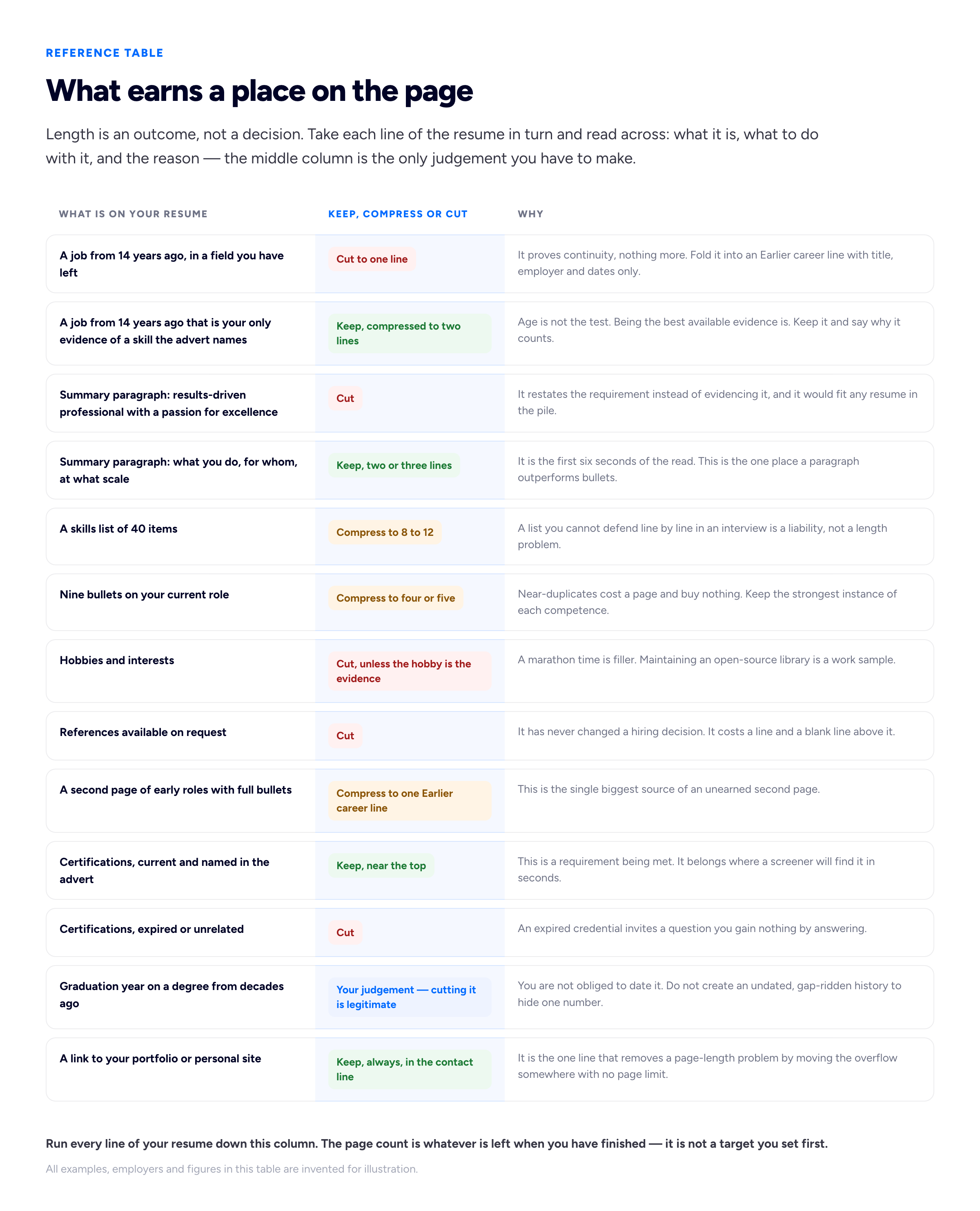
The middle column is the whole method. Decide each line on its merits and stop counting pages.
The one-and-a-bit page problem
A resume that runs to one page plus four lines is worse than either a clean one page or a full two, and it is worth understanding why, because it is the most common length failure by a distance.
It reads as an accident. A full second page reads as a document with two parts. Four orphaned lines read as a document that overflowed and nobody noticed — and the reader's eye lands on a mostly-blank sheet carrying your least important content, which is a poor final impression to engineer by accident. Printed, it is worse: page two is one-tenth full and unmistakably looks like a mistake.
So resolve it, in one direction or the other.
To get back to one page, in order of how much they return: delete the weakest bullet from each role, which usually recovers five or six lines on its own; collapse the earlier roles into the one-line block; cut the skills list to what you would defend under questioning; remove the references line; and tighten the summary from four lines to two. What you should not do is shrink the type below about 10pt, drive margins under about 0.5 inch, or delete the white space between sections. Those three make the page unpleasant to read in exchange for nothing, and a reader can tell instantly — the document arrives looking cramped, which is itself a signal.
To fill out to a genuine two pages, do not add sections. Go back to your strongest two or three roles and give them the specifics you cut: the scale, the constraint, the outcome, the thing that broke. Add a projects section if you have real projects. Most resumes that are one-and-a-bit are not short of a page of content; they are short of detail on the content they already have, and the detail is the part that gets you interviewed.
One structural tip that fixes this permanently: put a hard break between page one and page two, and make page one stand alone as a complete argument. If a screener reads only page one, they should have everything they need to say yes to a phone call. Page two is then unambiguously supporting material, which is the right relationship, and it stops mattering whether it is full. This is much easier to get right in a tool that shows you where the break lands while you type than in a word processor where you discover it on export — ours is one of the free tools, and it draws the page boundary live.
What the parser thinks about your page count: nothing
A recurring anxiety worth disposing of: applicant tracking systems do not penalise length. A parser pulls text out of your file and maps it onto fields. It has no notion of a page — the concept barely survives the extraction — and it is not scoring you on brevity. Nothing about a second page makes you less findable in a recruiter's search.
What does hurt you in those systems is formatting damage, and the desperate compression people apply to hit one page is a reliable way to cause it. Two columns to save vertical space, a table used as a layout grid, contact details pushed into the page header, a skills block rendered as a graphic: each of those is a real parsing risk, and each is usually introduced by someone fighting for space. We covered the mechanics, and a two-minute test you can run on your own file, in what ATS-friendly formatting actually means. The short version is that the cost of squeezing is paid in the parse, not in the page count.
If you would rather not fight the layout at all, our free resume builder lays out a single column with conventional section headings, which removes the temptation to buy space with a layout that parses badly. It is free with no account step, and one thing to know before you get to the end rather than at it: the PDF it produces carries a small "Created with Bunfolio" credit at the foot of the page, which is what pays for the tool being free. The same discipline applies to what goes in it — the skills section is where unearned length accumulates fastest.
Where the overflow actually goes
Every argument in this article eventually runs into the same wall: there is material you genuinely want the reader to have, and it does not fit, and the answer is not a third page.
The answer is a link. A resume is a summary document with a hard constraint. A portfolio or personal site has no page limit, no convention about length, and — unlike a resume — it can show the work rather than assert it. The case study you wanted to describe in six bullets becomes a page with the actual artefacts on it. The client list you were compressing into one line becomes a page. The code, the designs, the writing samples, the before-and-after that no bullet has ever conveyed properly: all of it goes there, and the resume carries one URL in the contact line.
This is not a consolation prize. It is a better outcome, because the reader who follows the link is the reader who was already interested, and they arrive at evidence rather than at more claims. We wrote about where to put that link and what happens after someone clicks it in putting your portfolio link on your resume, and about what the reader on the other end is actually assessing in what hiring managers look for in a developer portfolio. If you have no site yet, building a resume website covers the smallest version that works, and the templates are the fastest route to a published page with a URL you can paste into the file today.
Two related cases worth naming. If the thing you cannot fit is context — why you left, why the gap, why the sideways move — that belongs in the covering letter, not in a resume bullet, and if the blank page is the obstacle our cover letter generator will give you a draft to argue with. And if you are early enough in your career that the length problem is the opposite one, building a portfolio with no professional experience is a more productive use of an afternoon than padding a one-page resume to look fuller.
Frequently asked questions
How long should a resume be?
One page if you have under about five years of relevant experience, two pages if you have fifteen or more, and whichever the content earns in between. If the advert states a page limit, that limit overrides all of this. If the role asks for an academic or clinical CV, none of it applies and there is no page limit at all. The more useful framing is that length is an output: decide what earns a place using the relevance test, and the page count falls out.
How many pages should a resume be?
One or two. Two is completely normal and carries no penalty once you have real experience to describe. Three or more is only conventional in academic, research and clinical fields where a CV is being asked for. If you are outside those fields and heading for a third page, the material is real but the destination is wrong — it belongs on a portfolio site you link to. If you want to see where your own content lands, drafting it in a free resume builder that shows the page break as you type answers the question in about five minutes.
Does a resume have to be one page?
No. There is no rule requiring it, no system that rejects a second page, and no evidence that recruiters discard two-page resumes. The one-page convention is inherited from a paper-and-photocopier era. What survives from that era is the genuine point underneath it — that a reader decides fast, on the top third of page one — which is an argument about what goes first, not about how long the document is.
Can a resume be 2 pages?
Yes, and for most people with a decade of experience it should be. The only real conditions are that page one stands alone as a complete argument, and that page two carries evidence page one does not. A second page that repeats the first at greater length is the version that costs you something — not the second page itself.
How far back should a resume go?
Roughly ten to fifteen years is the default, but the actual rule is about relevance rather than time. Work backwards and keep a role in full for as long as it evidences something the target job wants and no more recent role evidences better. When you reach a job that fails that test, stop writing bullets and compress everything older into a single "Earlier career" line with titles, employers and dates. That keeps your history continuous without spending a quarter of a page on work that is not making your case.
How many years of experience should be on a resume?
Detail the last ten to fifteen years and summarise anything before that in one line. You are not obliged to include a date of birth or a graduation year, and omitting them is legitimate. What does not work is building the document around concealment: undated roles and unexplained jumps read as evasive to readers who were not thinking about your age until you made them.
How many jobs should you list on a resume?
Every role that either provides evidence or prevents an unexplained gap, and no others. In practice a fifteen-year career is usually four to six employers. If your list is far longer, group rather than delete: contract work goes under one heading with clients named beneath, freelance work goes under one heading with representative engagements, and genuinely old, genuinely irrelevant jobs disappear into the earlier-career line.
Can a resume be 3 pages?
Outside academic, research, clinical and some senior public-sector contexts, no — and the reason is not that a rule forbids it but that a third page is almost never read. US federal applications are now explicitly capped at two pages, and an over-length resume makes the application ineligible. If you have three pages of genuine material, the third page is a portfolio site, not a sheet of paper.
Do longer resumes get filtered out by applicant tracking systems?
No. Parsers extract text into fields and have no meaningful concept of a page. What does cause problems is the formatting people adopt while fighting for space — multiple columns, layout tables, contact details in the page header, text rendered as a graphic. The compression is the risk, not the length.
How we put this guide together
Bunfolio builds portfolio sites and runs a set of free career tools, so resume length reaches us constantly as the question underneath a different question — people asking what to do with material that will not fit. The sourced facts here are narrow and flagged as they appear: the US federal two-page limit and its consequences, the academic CV conventions quoted from two university careers offices, the age discrimination statutes, and the BLS tenure figure. Everything else is our own judgement and should be weighed as such — the three-part test for what earns a place, the four-question ladder, the screener-versus-specialist split, the claim that one-and-a-bit pages is worse than either neighbour, and the argument that the answer to a third page is a link rather than a sheet.
We deliberately did not use the best-known statistic in this topic, the claim that recruiters spend six seconds — or 7.4 seconds — on a resume. Unusually, it is traceable: it comes from a 2012 eye-tracking exercise by TheLadders, a job search company, involving thirty recruiters over ten weeks, with the underlying report credited to the firm's own Head of User Experience Design and never published anywhere that would have reviewed it. Its function in the original document is to demonstrate that resumes professionally rewritten by that company scored better than ones candidates wrote themselves, which makes it marketing material rather than neutral evidence about hiring. And even granting the number entirely, it measures a triage decision that happens in the top third of page one, so it cannot support any conclusion about page count — which is the argument it is almost always deployed to win. We have linked the archived brochure and the 2018 press release so you can read the method rather than the headline.
Primary sources, all fetched and checked while writing. The US federal two-page limit and the ineligibility consequence are from OPM's applicant guidance and agency guidance on the Merit Hiring Plan. Academic CV length is quoted from Carnegie Mellon's CV quick tips and Georgetown's CV guidance; the UK's National Careers Service CV guide is cited for what it lists and for declining to state a length. Age discrimination law is cited to the EEOC, 29 U.S.C. § 623 and 29 CFR § 1625.5 in the United States, and to sections 5 and 39 of the Equality Act 2010 in the United Kingdom. Tenure figures are from the BLS Employee Tenure Summary for January 2024, released September 2024. These are US and UK sources; readers elsewhere should not assume the regulatory detail transfers. None of this is legal advice.
Every example, name, employer, date and figure invented above is exactly that — invented for illustration, including everything in both diagrams. Halden Brooke and Corran Bay are not companies, the earlier-career line is fabricated, and the thirteen rows in the keep-compress-cut table describe a pattern rather than any real person's resume. The four-question ladder is our framework, not an industry standard, and no employer, recruiter or applicant tracking system was tested to produce either image.
Related reading: what ATS-friendly resume formatting actually means for the file mechanics that squeezing tends to break, putting freelance work on a resume for the job-count problem a client list creates, where to put your portfolio link on your resume for the line that moves your overflow somewhere with no page limit, and building a career portfolio for the longer-term version of the same evidence problem.
More from the blog
November 1, 2026 · 19 min read
Cover Letter vs Resume: What Goes in Each, and When You Need Both
The resume is the record; the cover letter is the argument for this role. What belongs in each and what must never be repeated, when a letter is really needed, how the two should point at each other,...
October 28, 2026 · 19 min read
References on a Resume: Should You List Them, and How?
Usually not on the resume itself, and never "available on request". When references do belong on the application, how to choose referees who will actually help, how to ask and brief them, the referenc...
October 16, 2026 · 16 min read
CV vs Resume: The Difference and Which One to Send
In the US a CV is an academic record and a resume is the short document; in the UK and most of the world, "CV" is the name for that short document.