
October 28, 2026 · 19 min read
References on a Resume: Should You List Them, and How?
Usually not on the resume itself, and never "available on request". When references do belong on the application, how to choose referees who will actually help, how to ask and brief them, the reference sheet to send when asked, and what to do as a freelancer or with no formal employer.
In most cases, do not put references on your resume. Leave the page for your experience, keep your referees' names and contact details on a separate one-page reference sheet, and send that sheet when an employer asks for it, which is usually late in the process, after an interview and often just before an offer. Do not write "references available on request" either: every employer assumes it, and the line spends space saying nothing. The exceptions are real but narrow. If an application form has fields for referees, fill them in. If a job advert, a public-sector application or an academic post asks for references with the application, give them exactly as asked. And if you are applying somewhere listing references on the CV is the local norm, follow the advert and local guidance rather than an American rule of thumb.
The rest of this guide covers what most pages on the question skip: choosing referees who will actually help, asking and briefing them, the reference sheet itself, what to do with no formal employer, and what a former employer can usually say.
The short answer, in three lines
- On the resume itself: no references, and no "available on request" line.
- Ready in a folder: a separate reference sheet with two or three referees, each of whom has agreed and knows what job you are going for.
- When asked: send the sheet promptly, then tell your referees to expect a call.
Two words this guide uses: a referee is the person who vouches for you, and a reference is what they say.
Why references usually stay off the resume
Our recommendation rests on four reasons, and none of them is etiquette for its own sake.
The page is short and references do not sell you. A resume has one job: get you to interview. A list of names and phone numbers does not help a recruiter decide whether you can do the work; your experience, results and skills do. Our guide to how long a resume should be says one page is nearly always right for anyone with under about five years of relevant work. Three referees with full contact details take up a quarter of a page, which is space your most recent role could have used.
References are checked late. In most hiring processes, nobody rings your referees until they are seriously considering an offer. Supplying them up front gives the employer nothing it needs yet.
Your referees' details are not yours to scatter. A resume goes into applicant tracking systems, recruiter inboxes, job boards and, sometimes, places you never sent it. Every copy carries your referees' phone numbers and email addresses. People who agreed to vouch for you did not agree to be contacted by every agency that downloads your file.
You lose control of the timing. The best references come from a referee who knows the call is coming, knows the role and has your resume in front of them. If their details sit on every application, they can be rung cold, about a job they have never heard of, by someone you have not yet met. A referee caught off guard gives a polite, vague reference, which is the least useful kind there is.
Should you write "references available on request"?
No. It still appears on old templates, but it tells the employer something they already assume, and it costs a line that could hold a portfolio link or a certification.
If your history is unusual, such as years of freelance work, the fix is still not a line at the bottom. It is to make the work verifiable: client names where you may use them, a portfolio link on your resume and outcomes they can check. Our guide to putting freelance work on a resume covers it.
When references do belong on the application
"Leave them off" is a default, not a law. Follow the instructions in front of you over any general advice, including ours. These are the situations where references go in with the application.
The application form asks
Many employers, especially larger ones and anything in the public sector, use an online form rather than, or as well as, a resume. If the form has fields for referees, fill them in. Leaving required fields blank, or typing "on request", can stop the application going any further. Some forms ask whether the employer may contact your referees before an interview; you can usually say no for your current employer, and that is a normal answer, not a red flag.
The advert or announcement asks
Some job adverts say "please include the names of two referees". When they do, include them, either at the end of the resume or on a separate sheet attached to the same application, whichever the advert suggests. US federal applications are a common case where the announcement and the application system decide what you include, so read the announcement first. The Bureau of Indian Affairs' federal resume guide, for example, ends its sample resume with a references section asking for at least three references with contact information. Treat the specific announcement you are applying to as the authority, not a general article.
Academic and research CVs
An academic CV is a different document from a resume, with different conventions; our guide to CV vs resume explains how they diverge. Academic applications often ask for referees at the application stage, sometimes with letters sent directly by the referee. Follow the call for applications exactly: how many referees, whether letters are needed, and whether they go in the CV or a separate form.
Where it is the local norm
Conventions vary by country and by sector. In some places, a CV commonly ends with referees' details, and in others it does not. We are not going to pretend there is a reliable country-by-country rulebook, because we have not found an official source that maintains one. If you are applying in a market you do not know, look at the advert, the employer's own careers pages and the guidance published by that country's public employment service, and do what they ask.
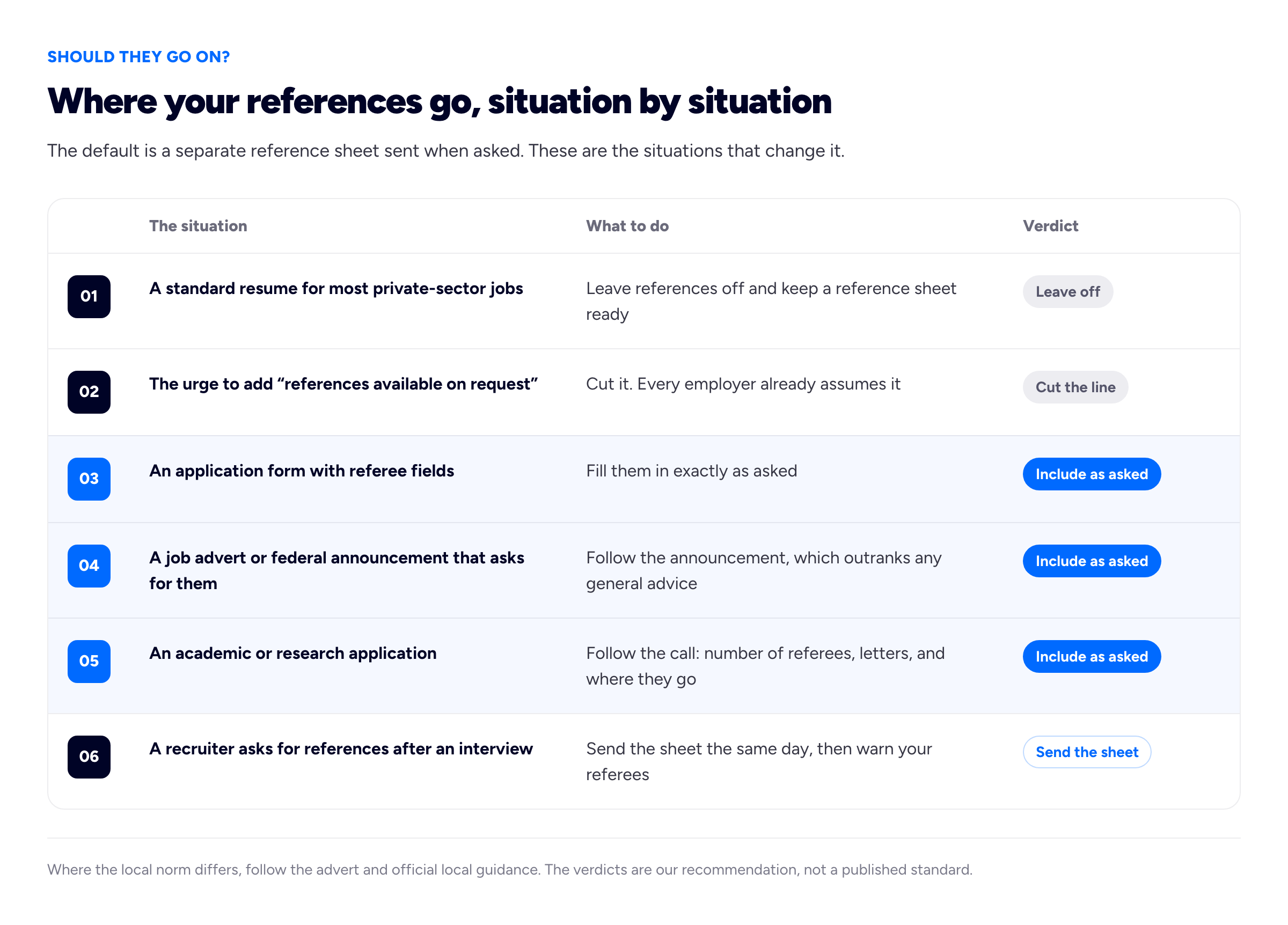
The default is a reference sheet you send when asked; the highlighted rows are the times the employer has already asked.
How to list references on a resume when you are asked to
If an advert asks for references on the resume itself, keep them short.
- Put them last. A section headed simply "References" at the end, after education and skills. Never above your experience.
- Give each referee four or five lines: name, job title, organisation, how you know them, and one email address and one phone number. Most employers prefer an email.
- Match the rest of the document: same font, size and spacing.
- Give exactly as many as they ask for. Extra referees make a recruiter choose.
- Only include people who have said yes recently. Consent from three years ago does not count.
If the advert does not say where, a separate page attached to the same application is usually cleaner than squeezing the section onto the resume, and it keeps your resume reusable.
How to choose your referees
The person with the most impressive job title is rarely the right referee. A reference is useful when the person can describe your work in specific detail, and that depends on three things.
Recency
A manager from last year can describe who you are now. A manager from eight years ago is describing someone who has since changed jobs, learned new skills and possibly changed careers. As a rule of thumb, we would prefer referees from your last two roles, and many employers ask specifically for your most recent one.
They saw the work
The best referee watched you do the job week in, week out: a line manager, a team lead, a senior colleague, a client who received your work. A chief executive who met you twice will say kind, general sentences and the call will be over in four minutes.
What each can speak to
Choose referees who between them cover what the new job needs. If the role leans on organisation and on handling difficult people, you want one referee who saw your organisation and one who saw you with difficult people. Before you settle on names, write one line for each: "Can speak to: ...". If two referees have the same line, one of them is redundant.
Take Yusra Wexford, an invented candidate. She spent two years as a patient services administrator at Morvale Clinic, an invented private clinic, and is applying for an operations coordinator role with a larger healthcare group. Her obvious first referee is Ludmila Bramley, the practice manager who was her line manager at Morvale and can speak to how she ran the appointment system and handled complaints. Her second is a former team lead from an earlier receptionist job who saw her train new starters. Her third, if one is asked for, is the tutor on the evening course in healthcare administration she finished last year, who can speak to her written work. Each one covers something the advert asks for, and none duplicates another.
Who not to ask
- Family and friends, unless they genuinely supervised your work, and then say so.
- Anyone you are not sure about. If you hesitate when you imagine what they will say, ask someone else.
- Your current manager, too early. Most employers understand that you may not want your current employer contacted until an offer is made. Say so, and offer a former manager or a senior colleague in the meantime.
If you have never had a formal employer
Freelancers, graduates, people returning after years of caring and career changers often have no line manager to name. You still have referees: look for people who saw your work, not people who signed your payslip.
- Freelancers: clients you worked with directly and repeatedly are the natural choice. A client who hired you three times can speak to reliability in a way nobody else can. Ask the person you actually dealt with, not their boss.
- Students and recent graduates: a lecturer or tutor who marked your work, a dissertation or project supervisor, or the manager of your part-time or holiday job. A part-time manager who saw you turn up on time for two years is a strong referee for a first job.
- Volunteers: the person who coordinated your volunteering, especially where you had real responsibility: running a stall, managing a rota, handling money.
- Career changers: a former manager from your old field can still speak to how you work, and a course tutor or a client from a side project can speak to the new skills.
How to ask someone to be your referee
Ask before you apply, in writing, and in a way that makes it easy to say no: someone who says yes reluctantly gives a reluctant reference.
Here is the message Yusra might send Ludmila.
Subject: Would you be a referee for me?
Hi Ludmila,
I hope things are going well at Morvale. I am applying for operations coordinator roles, mostly at larger healthcare groups, and I wondered whether you would be willing to act as a referee for me. You saw my work more closely than anyone, especially the move to the new booking system and the complaints log.
If you are happy to, I will send you my current resume and each job advert before anyone contacts you, so you will never get a call out of the blue. If now is not a good time, that is completely fine, and thank you either way.
Best wishes,
Yusra
Three things make it work. It names the kind of role, so the referee knows what they are vouching for. It says why this person, which reminds them of the specific work. And it promises a heads-up, which is the thing busy referees worry about most.
Once they say yes, confirm which email and phone number they want you to share, and use only those.
How to brief a referee before the call
This is the step most candidates skip, and it is where a reference turns from polite to useful. A referee who has not seen the job advert will talk about you in general terms. A referee who has read it can answer the questions that matter.
When an employer tells you they are going to contact your references, send each referee a short note the same day with four things.
- Who will call and roughly when. The organisation, the role and, if you know it, the person's name and whether it will be a call, an email or a form.
- The job advert, or a link to it, so they can see what the employer needs.
- Your current resume, so their account of your dates and duties matches yours. A mismatch on dates is the kind of small thing that makes a reference checker look harder.
- Two or three things worth mentioning, tied to the advert. Not a script, a reminder. "They are keen on someone who can manage a diary across several sites; you might remember I ran the bookings for both Morvale sites while the second administrator was on leave."
Do not ask them to say anything untrue, and do not write their reference unless they ask you to draft one; if they do, keep it factual.
Afterwards, thank them and tell them how it turned out. You will almost certainly need to ask again.
The reference sheet: format and an example
The reference sheet is a single page you keep ready and send as a PDF when asked. It should look like it belongs with your resume.
- A header that matches your resume: your name and contact details in the same style, then a heading such as "References".
- Two or three referees, most relevant or most recent first.
- For each one: name, job title, organisation, a line describing the relationship and when you worked together, an email address, a phone number, and, optionally, the best time to reach them.
- The relationship line is the part people forget. "Practice Manager, Morvale Clinic" tells the employer who Ludmila is. "My line manager from 2023 to 2025, when I was a patient services administrator" tells them why her view of Yusra matters.
- A file name that says what it is, such as
yusra-wexford-references.pdf, so it can be found in a recruiter's downloads folder.
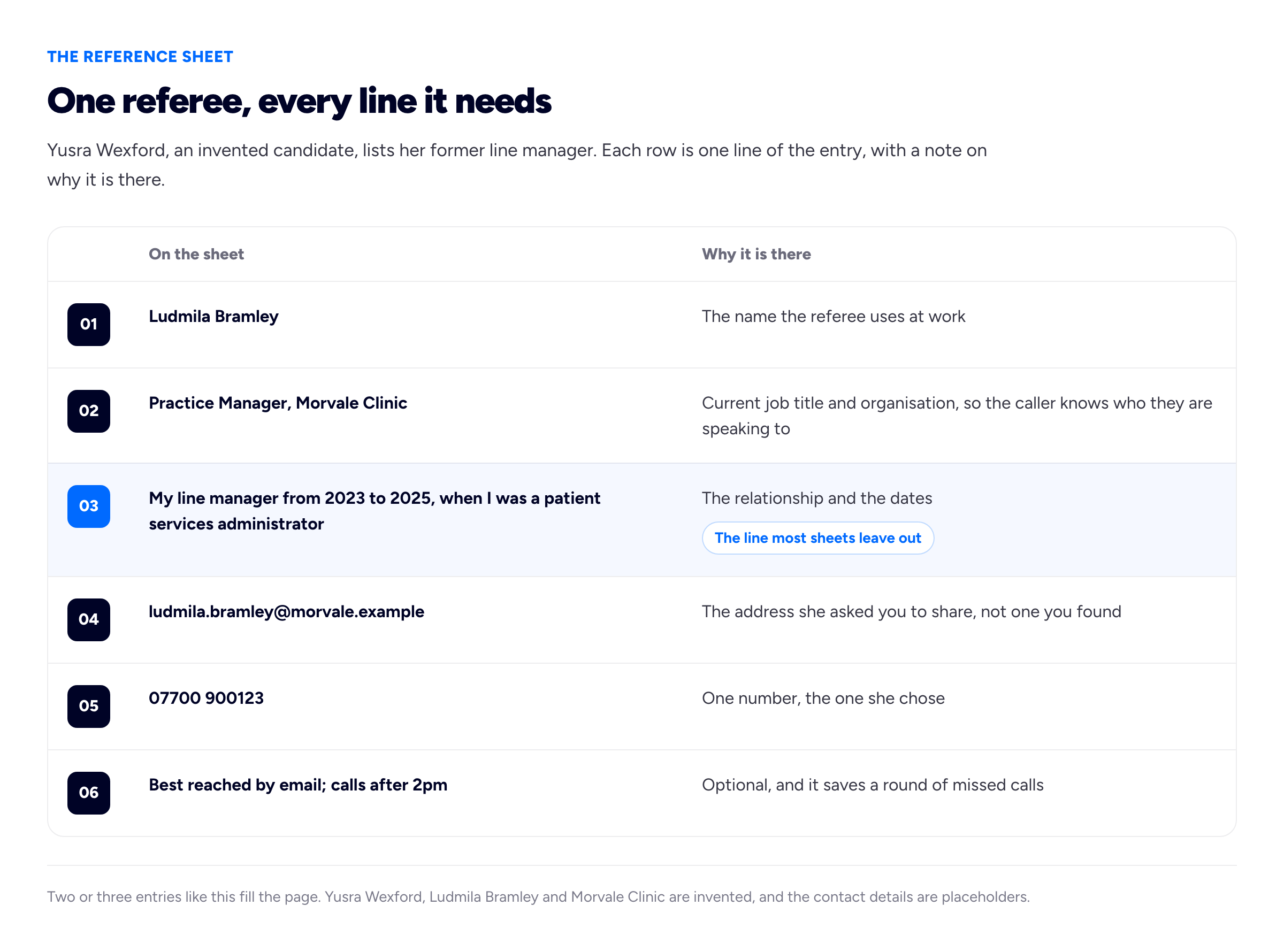
The relationship line is what turns a name and a number into a reason to trust what this person says.
Update the master copy whenever a referee changes job or number; a dead email address makes a recruiter do extra work at exactly the wrong moment.
What a former employer can and cannot usually say
This is the part of the topic most surrounded by myth, and the honest answer is that it depends on the country, on any written agreement, and on the employer's own policy. We are not lawyers, and nothing here is legal advice.
In the UK, the government's page on work references sets out the basic position. An employer does not usually have to give a reference at all, unless there was a written agreement to do so or the employer is in a regulated industry, such as financial services. If they do give one, it must be fair and accurate. It can cover your performance and whether you were dismissed, or it can be brief, confirming things like your job title, salary and dates. Once you have started with a new employer you can ask that employer for a copy of a reference it received, but the page says you have no right to ask your previous employer for it. The same page explains when you may be able to challenge a reference you believe is misleading, and points to Acas and Citizens Advice for advice.
Outside the UK the rules differ, and we have not found an official source that summarises them. Check your own government's employment guidance or an employment adviser rather than a forum thread.
What we can say with confidence is what happens in practice. Many organisations route every reference request through HR and confirm only factual details, such as dates of employment and job title, as a matter of policy. That is why a short, factual reference from a large employer usually says nothing about you; it is the policy speaking. It is also why the personal reference, from someone who agreed to speak about your work, does the heavy lifting.
Two practical consequences follow.
- Ask your referee how their organisation handles references. If Ludmila is only permitted to confirm dates, Yusra needs to know that before she relies on her as the main referee. Some managers can give a personal reference in their own name; some cannot.
- Make sure your dates and job titles match. If the factual reference says you were an administrator from March to January, and your resume says senior administrator from February, the mismatch is what gets noticed. Check your resume against what your employer actually has on file.
If you parted on bad terms with an employer, do not try to hide that employer. Choose a different referee who saw your work there, such as a senior colleague or a manager from a different team, and be ready to explain the circumstances briefly and without blame if you are asked.
Testimonials: references people can read before they call
References are private, late and on request. Testimonials are the opposite: public, early and visible before anyone has decided to interview you. They do different jobs, and if you work freelance or in any field where you show your work, it is worth having both.
A testimonial on your portfolio site is a short quote from a client or manager, with their name and role, about a specific piece of work. It does not replace a reference: an employer who wants to check you will still want to speak to someone, and the person who wrote a testimonial is often the ideal referee. But it means the conversation starts from evidence. Our guide on how to ask clients for testimonials covers how to ask for one that is specific rather than flattering, and how to get permission to publish it.
Never publish a referee's contact details on a public page; a testimonial carries a name and a role, nothing more. If you are building a portfolio site to sit beside your resume, Bunfolio has a testimonials section built in, but any portfolio that lets you quote people with their permission will do the job.
For the resume itself, see our guide to making a resume stand out.
Frequently asked questions
Should I put references on my resume?
Usually not. Keep them on a separate reference sheet and send it when asked, normally after an interview. Include them only when the form, advert or announcement asks, or when it is the clear local norm.
Is "references available upon request" still needed?
No. Every employer assumes it, so the line says nothing and takes space. Delete it from old templates.
How many references should I have?
Have two or three ready, and give exactly as many as the employer asks for. Choose them so that between them they cover what the job needs, rather than three people who will say the same thing.
Who should I use as a reference if I have never had a job?
Someone who has seen you work, even unpaid: a lecturer or tutor who marked your work, a project or dissertation supervisor, a volunteer coordinator, or the manager of a part-time or holiday job. Avoid family and friends.
Can I use a freelance client as a reference?
Yes, and for freelancers they are often the best referees available. Choose a client you worked with directly and repeatedly, ask the person you actually dealt with, and check whether their organisation lets them give a personal reference.
Do I need to tell my references that someone will call them?
Yes, every time. Send the job advert, your resume and two or three things worth mentioning the day you learn they will be contacted.
Can my current employer find out I am job hunting from a reference request?
Only if your current employer is contacted. In our experience employers routinely accept a request to wait until they have made an offer, and many application forms ask the question directly. Say on the form or to the recruiter that your current employer should not be contacted before an offer, and give a former manager in the meantime.
How we put this guide together
Bunfolio builds portfolio websites and gives away free career tools, so we read a lot of resumes, application forms and job adverts. Most of this guide is our recommendation, and we want to be plain about which parts: leaving references off a standard resume, cutting "references available on request", the three tests for choosing a referee, the request and briefing scripts, the reference sheet layout, and the advice for freelancers and people without a formal employer are our judgement from that reading, not a published standard. No official body publishes a correct way to lay out a reference sheet.
Where we state facts, we have linked the primary source we read: the UK government's page on work references for what a UK employer must and need not do, and the Bureau of Indian Affairs' federal resume guide as one example of a US federal sample resume that includes references. Rules on references differ by country, by contract and by employer policy, and we have not found an official source that compares them, so we have said so rather than guessing. We have also left out the statistics that usually decorate this topic, such as the share of employers who check references or how many candidates lose offers over them, because we could not trace any to a published method, sample and date.
Everyone named here is invented: Yusra Wexford, Ludmila Bramley and Morvale Clinic, along with the unnamed team lead, tutor and healthcare group. The email to a referee, the briefing note, the reference sheet entry and its contact details were written by us as models to adapt; the phone number and email address are placeholders, not anyone's real details.
Related reading: how to make a resume stand out, how long a resume should be, how to ask clients for testimonials, CV vs resume, freelance work on a resume and signs an interview went well.
More from the blog
October 16, 2026 · 16 min read
CV vs Resume: The Difference and Which One to Send
In the US a CV is an academic record and a resume is the short document; in the UK and most of the world, "CV" is the name for that short document.

October 15, 2026 · 16 min read
How to Add Your Resume to LinkedIn (and When Not To)
A resume can live in three different places on LinkedIn and they do different jobs. Here is how each works, who sees it, and when a link beats a file.
October 3, 2026 · 16 min read
How to Make a Resume Stand Out: What to Change on the Page
A resume stands out by being the easiest one in the pile to say yes to, not by looking different. Here is how to rebuild the top of page one, turn duties into results (even without numbers), tailor ho...