
September 11, 2026 · 23 min read · Updated October 5, 2026
Teaching Portfolio: Two Documents That Share One Name
A principal scans a binder for four minutes across a table; a tenure committee reads a dossier for an hour against written criteria. Advice for one is actively wrong for the other. What goes in each, the three properties of a philosophy statement that works, and how to show student work without breaching confidentiality.
Two entirely different documents are called a teaching portfolio, and most of the advice you will find does not say which one it is describing. One is a binder a school principal glances at across a table for four minutes during an interview. The other is a forty-page dossier a tenure committee reads in a quiet room over an hour, against criteria written down in a faculty handbook. They share a name, a rough idea — evidence that you can teach — and almost nothing else.
Advice written for one is actively wrong for the other. The laminated, colour-coded binder that reads as organised and enthusiastic to a hiring principal reads as unserious to a promotion committee. The reflective teaching philosophy statement that anchors a tenure dossier will not be read at all in an interview, where the reader is scanning for lesson plans and classroom management and has already decided about you on other grounds. If you build the wrong one, the work is not merely wasted; it argues against you.
So this guide separates them. It covers what each kind is for, who reads it and how fast, what goes in, how to write the philosophy statement that anchors the academic version, what to do about the cover page, and the genuinely difficult question of how to show student work without breaching confidentiality. It ends with the version that serves both — a web page you can send in an email — and a build order that gets you there in a weekend.
Two documents, one name
Before you gather a single artefact, decide which portfolio you are building. The decision changes every choice after it.
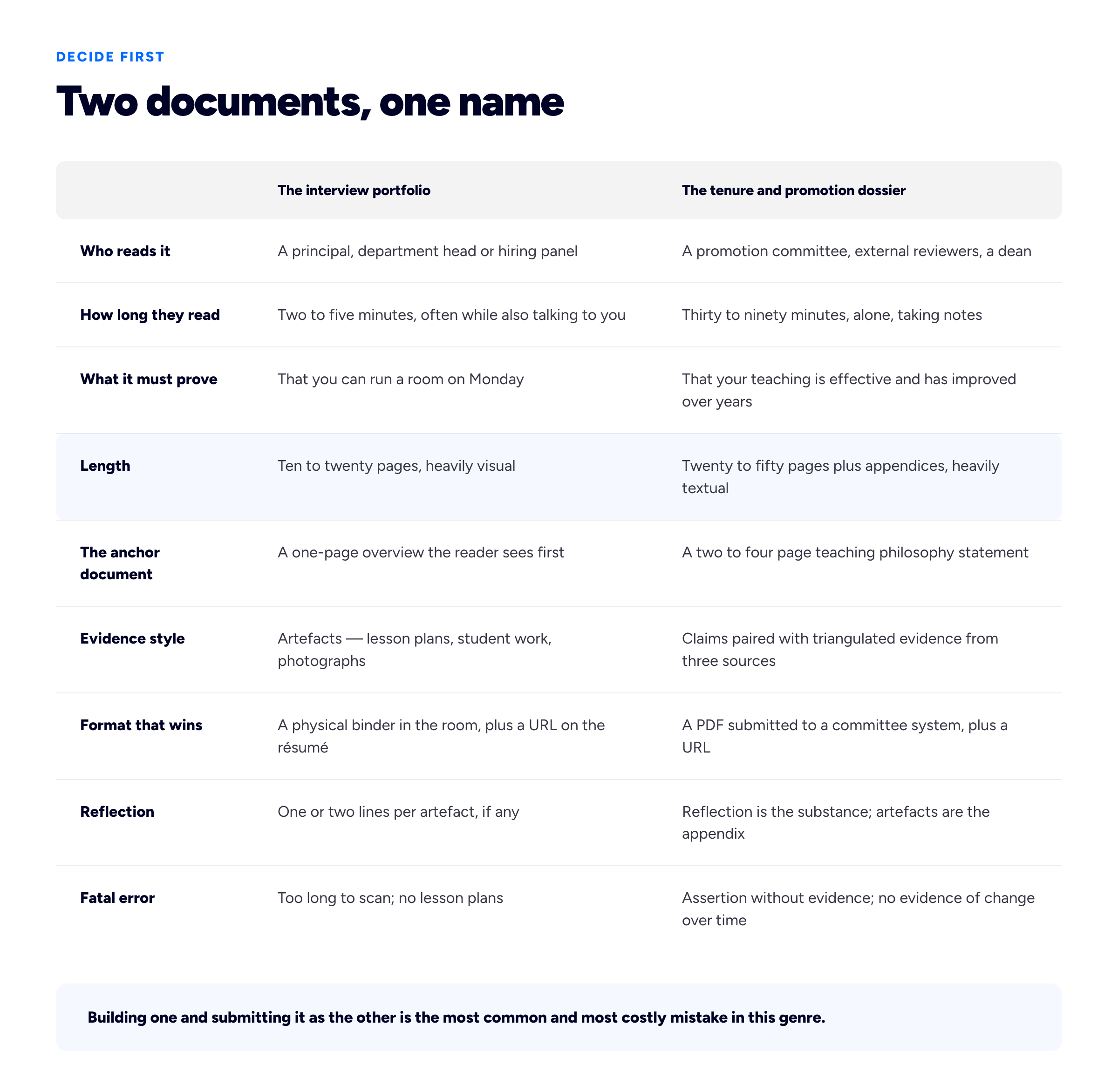
The two portfolios share a name and a purpose and disagree about everything else. Decide which you are making before you collect anything.
There is a third case worth naming because it catches people out: the student teaching portfolio, assembled during a teaching qualification and assessed against a standards framework — a set of competencies your programme names, each of which you must evidence. That one is really a compliance document, and its structure is dictated to you. Follow the framework exactly, then afterwards mine it for the interview portfolio, which is what you will actually need next.
What a teaching portfolio actually is
Underneath the format arguments there is a single idea, and it is worth stating plainly because it explains why weak portfolios are weak.
A teaching portfolio is a set of claims about your teaching, each paired with evidence that a sceptical stranger would accept. Not a scrapbook. Not a collection of everything you have made. The unit is the pair: a thing you say about how you teach, and a document that would persuade someone who has never seen you in a room.
Almost every weak portfolio fails at the pairing rather than at the collecting. It contains forty artefacts and no claims — a folder of lesson plans, some certificates, a seating chart — leaving the reader to infer what any of it demonstrates. Or it contains claims and no artefacts: three pages asserting that you differentiate instruction, build relationships and hold high expectations, with nothing attached that a reader could check. Both are common. The second is worse, because a committee reading unsupported assertions about teaching effectiveness is being asked to take your word for the one thing they convened to assess.
The fix is mechanical. Write your claims first, as a list, before you open a single folder. Then go looking for the evidence each one needs. Claims with no available evidence get cut or downgraded; evidence that supports no claim gets left out, however much work it was.
What to include: the interview portfolio
This is the K–12 version, and the thing to understand about it is the reading speed. A principal is interviewing six candidates in a day. Your binder will be open on the table between you, occasionally turned around, frequently upside down from the reader's point of view, and it will get somewhere between two and five minutes of actual attention — most of it while a conversation is happening. It is not read. It is scanned, and pointed at.
That produces a hard design constraint: every spread has to make sense in three seconds, and you have to be able to find any page without hunting. In practice:
- A one-page overview at the front. Not a contents page — an overview. Who you are, what you teach, the year groups and subjects you are certified for, and three or four lines on how you run a classroom. If the reader gets no further than this, it should still have done a job.
- Two or three complete lesson plans, chosen to show range: one you would teach to a class that is with you, one built for a class that is not. Include the actual materials, not a summary of them.
- Student work from one of those lessons, at three levels of attainment, with your written feedback visible. This is the single most persuasive artefact in the genre and the one most often missing. It shows what you asked for, what you got, and how you responded — all at once.
- Your classroom management approach, stated concretely. Not a philosophy of behaviour. The actual routines: how students enter, how you get attention, what happens on a first and second and third incident, how you contact home. Principals hire on this more than on anything else and are told about it in generalities by nearly everyone.
- Assessment and data. One example of how you track progress and what you changed as a result. A marking record on its own is inert; a marking record with a line about what you re-taught is evidence of a teacher thinking.
- Photographs of a classroom you have set up — displays, seating, working walls. Rooms with no identifiable children in them. See the confidentiality section below before you use anything with a face in it.
- Letters, observations and certificates at the back. They are worth including and nobody reads them in the room; they are there to be noticed as a block, and occasionally checked later.
Two things that do not belong: your full transcript, and a teaching philosophy essay. The first is administrative and will be requested if wanted. The second belongs in the academic version — in an interview binder it occupies the prime opening position with prose nobody will read under time pressure.
What to include: the tenure and promotion dossier
The higher-education version inverts almost all of that. Here reflection is the substance and artefacts are the appendix. The reader has time, is reading alone, and is applying written criteria — which means the first thing to do is obtain those criteria and organise your dossier to match their headings exactly. Committees reading twenty dossiers against a rubric reward the one that lets them find each thing where they expect it.
The core is usually some version of:
- A teaching philosophy statement, two to four pages. Treated below; it is the hardest part.
- A description of your teaching responsibilities — courses, enrolments, levels, whether you designed or inherited each one, supervision and advising loads. This is context, and it is regularly left out, which makes everything after it harder to weigh. Teaching four new preparations to 300 first-years is a different job from teaching one seminar twice.
- Evidence of effectiveness from more than one source. Student ratings, peer observation, and something from the work itself — student performance, exit surveys, alumni comment, external examiner reports. Triangulation is the point. Any one source is contestable; three sources agreeing is hard to dismiss.
- Course materials — syllabi, assignments, rubrics, examples of your feedback on student work.
- Evidence of development over time. The distinctive requirement of the academic version, and the one candidates most often miss. A committee is not only asking whether you teach well; it is asking whether you notice problems and act on them. Show a course before and after a change, with the reason for the change and what happened.
- Teaching development activity — courses taken, programmes completed, pedagogy you have read and used, contributions to curriculum or to colleagues' teaching.
A word about student ratings, because they will be in your dossier whether you like them or not. Present them, present them honestly including the bad ones, and give them context: response rates, class size, whether the course is required, whether it is a course students find hard. The research literature on what these instruments actually measure is genuinely contested — studies by MacNell, Driscoll and Hunt (2015, Innovative Higher Education) and by Boring, Ottoboni and Stark (2016) found ratings tracking instructor gender and other factors independent of teaching quality, and the debate has not settled. You should not lean on that literature to dismiss poor scores in your own dossier; it reads as defensive. Use it to justify triangulation instead, and let the peer observations and student work carry weight the numbers cannot.
Teaching dossier or teaching portfolio: the same document under another name
If you are applying to a Canadian university, or have been asked for a "teaching dossier", you are being asked for the academic version described above. The two terms name the same kind of document. The University of Waterloo's career development guidance puts it directly: teaching dossier is the preferred term in Canada, and you may hear the same document called a teaching portfolio if you apply to institutions outside Canada. The University of Ottawa's teaching and learning service defines a teaching dossier as a personal portfolio of your teaching and learning journey in higher education.
What changes with the name is mostly the convention around length and shape, so read the guidance of the institution you are applying to. Several Canadian teaching centres set a much shorter main document than the twenty to fifty pages we suggest planning for in a full tenure file:
- Queen's University's Centre for Teaching and Learning describes a dossier as typically 6 to 12 pages, covering a biographical overview, teaching philosophy, strategies, experience, evidence of effectiveness, professional development, scholarship, leadership, awards and sample syllabi.
- The University of Toronto's Teaching Assistants' Training Program suggests 6 to 12 pages plus up to 20 pages of appendices, organised around a philosophy statement, teaching experience, teaching goals, professional development, student evaluations, peer evaluations and sample materials.
- The University of Ottawa gives the same 6 to 12 pages, not including appendices.
In practice, that means a short, tightly argued narrative up front, with the evidence pushed into appendices the reader can check. Everything else in this guide still applies: claims paired with evidence, more than one source of evidence of effectiveness, and a record of how your teaching changed. A graduate student or teaching assistant's dossier is shorter again, because the experience it covers is shorter, and that is expected rather than held against you.
The teaching philosophy statement
This is where most academic portfolios go wrong, and the failure is consistent enough to name. The statement becomes a page of warm, unfalsifiable sentences — that you meet students where they are, foster critical thinking, create an inclusive environment where every voice is valued. Every one of those is true of every good teacher and describable by every bad one. A reader learns nothing, which in a document whose purpose is to distinguish you is close to a wasted page.
A statement that works has three properties.
It is falsifiable
Every claim should be one a reasonable colleague could disagree with. "I believe in active learning" is not; nobody argues for passive learning. "I do not lecture for more than twelve minutes without a task, even in a 300-person hall, because I would rather cover less material and know what landed" is — plenty of good teachers would push back on that trade, which is precisely what makes it informative.
Every belief is followed by a practice, and every practice by evidence
Belief, then the specific thing you do because of it, then the artefact that proves you do it. Three steps, repeated. If you cannot complete the chain for a belief, either you do not really act on it or you have not found the evidence yet; in both cases it should not be in the statement in its current form.
It admits something
The most credible statements contain a difficulty. An approach that did not work and what replaced it. A tension you have not resolved — between coverage and depth, between rigour and access, between what the syllabus requires and what the students in front of you needed. Committees read a great many confident documents. A candidate who can describe a problem in their own teaching accurately is demonstrating the reflective capacity the whole exercise is meant to assess.
On length and voice: two to four pages, first person, present tense, no epigraph, no quotation from a famous educator in the opening line. Write it last, after you have assembled the evidence, not first — the statement should describe the teaching your artefacts actually show, and writing it first produces a document your evidence then fails to support.
The cover page
A small thing that gets asked about constantly, so: a cover page for a teaching portfolio needs your name, your subject and level, and a way to contact you. That is the requirement. Everything else is optional and most of it is a liability.
The failure mode here is decoration — clip-art apples, a script font, a border of pencils, a quotation about how teaching is touching a life forever. It is an understandable instinct and it works against you, because it is the first thing the reader sees and it sets an expectation of sentiment rather than substance. A cover page in a plain serif or sans on a white ground, with a single photograph of you if you want one, reads as more professional than anything decorated, in both the interview and the academic version.
If your programme or institution specifies a cover format, use theirs exactly. If you are including a table of contents — worth doing in a binder, essential in a dossier — put it on the page after the cover, not on the cover itself. And in the interview binder, remember that the reader may never turn past the overview page, so the overview, not the cover, is where the work of first impression is actually done.
Showing student work without breaching confidentiality
This is the part of the job that most guides skip, and it is the part with actual consequences. Your best evidence is student work and photographs of a room full of children, and both are governed.
The starting position is straightforward: remove identifying information, and get permission for anything you cannot remove. In practice that means redacting names from student work before it goes in — including the name in the header, the name on the reverse, and the name written into the body of an essay, which is the one people miss. It means photographs framed on displays, materials, seating and the backs of heads rather than faces. It means no full names anywhere, and no combination of details specific enough to identify a child in a small community.
In the United States, student education records are covered by FERPA — 20 U.S.C. § 1232g, with the operative rules at 34 CFR Part 99; other jurisdictions have their own regimes and your employer will have a policy that is stricter than the law. The practical rule that survives everywhere: ask your school before you publish anything, and ask in writing, because the answer varies by district, by school and sometimes by head teacher. Consent obtained by a school for its own newsletter is not consent for your personal portfolio site.
The anonymised version is rarely weaker. A redacted piece of student work with your feedback on it demonstrates exactly what the named version demonstrates. A photograph of a working wall says as much about your classroom as a photograph of children standing in front of it. Where you genuinely cannot show a thing, describe it and say why it is absent — "student work for this unit is not reproduced here for confidentiality; available on request in person" — which reads as professional judgement rather than a gap. The same reasoning applies across other fields, and we work through it at more length in our guide to showing NDA and confidential work in a portfolio.
Binder, PDF or website
You need more than one format, and they do different jobs.
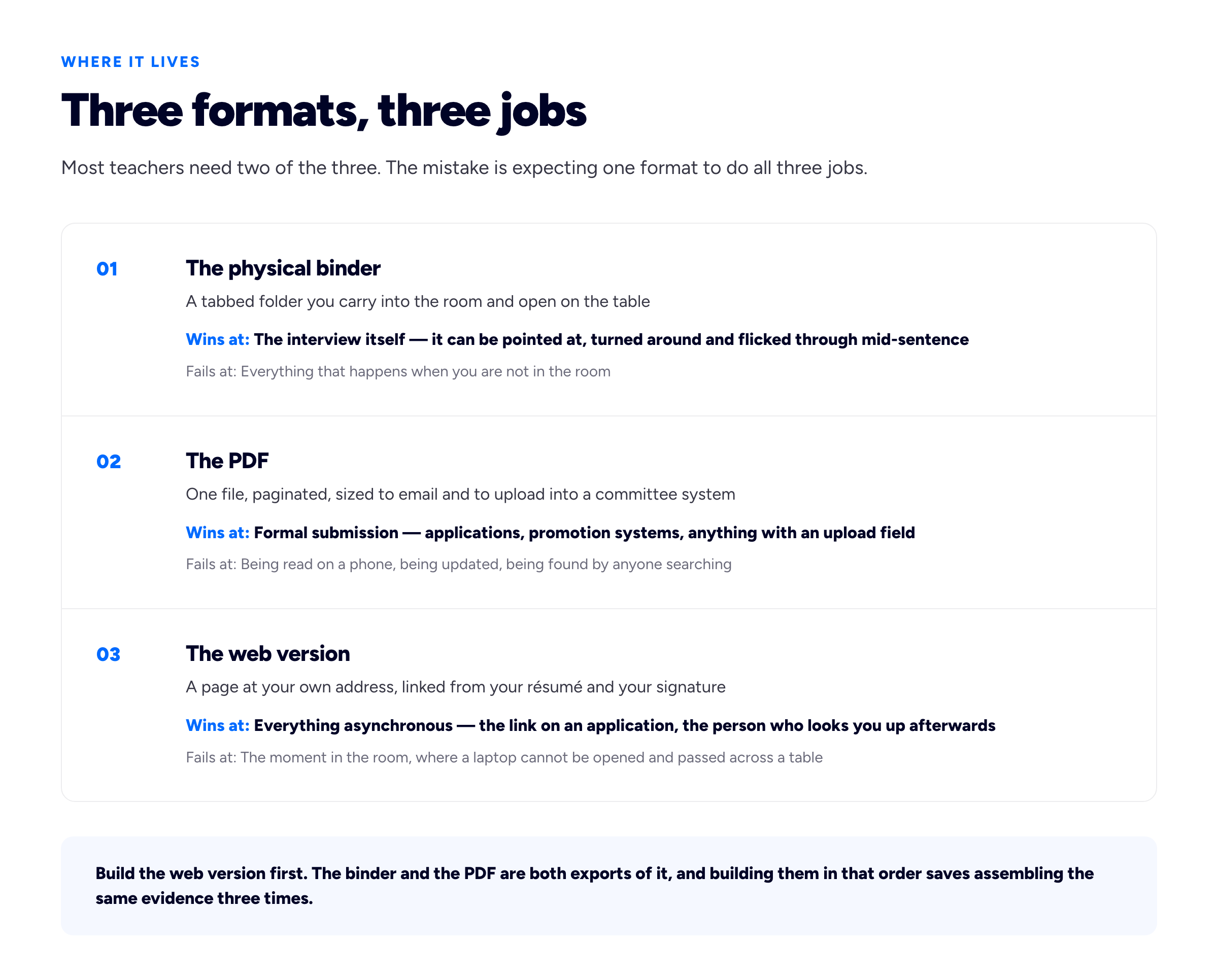
Most teachers need two of these. The web version is the one to build first, because the other two can be produced from it.
The binder is not obsolete and the people telling you it is have not sat in a hiring interview recently. In the room, paper wins: it can be turned around, pointed at, opened at two places at once, and handled while you are both talking. A laptop cannot do any of that without becoming the focus of the conversation.
But the binder only exists in the room, and most of what determines whether you are hired happens outside it — the application read before the interview, the person who searches your name afterwards, the head of department the principal forwards you to. That is the web version's job, and it is why a URL on your résumé is worth more than a better binder. It also solves a problem paper cannot: it can be updated the week something changes, rather than reprinted.
If you build the web version first, the other two fall out of it. The sections are the same, the evidence is the same, and the binder becomes a print-and-tab exercise rather than a second project. Our portfolio templates are built around that section structure, and the examples gallery shows how other people have handled the same sequencing problem. For the résumé that carries the link, the free résumé builder will produce a clean one-page PDF without an account.
A realistic build order
Assembled cold, this is a weekend. Attempted in the order most people attempt it — opening a design tool and making a cover page — it is a month that produces something thin.
- Write the claims. Six to ten sentences about your teaching that you would defend. An hour, on paper, before you open anything.
- Find one piece of evidence for each. This is the long part. Expect to cut two or three claims you cannot evidence, and to find evidence for something you had not thought to claim.
- Redact and get permissions. Do it now, not at the end. If a permission is going to be refused it changes what you build, and finding that out on the last day is how portfolios ship with a hole in them.
- Build the web version — overview, philosophy or approach, two or three opened-up units with materials and student work, evidence and observations, contact. One page, sectioned, with anchors.
- Write the philosophy statement last, describing the teaching your evidence shows.
- Export the binder and the PDF from the same material, in whatever order your applications demand.
Two habits after that. Add one artefact per term while it is fresh, because the version of you that remembers why a lesson changed is the one teaching it, not the one applying for a job eighteen months later. And re-read the whole thing once a year with the question a committee asks — what has changed here, and why — which is the question the archive answers badly unless you have been maintaining it.
Frequently asked questions
What is a teaching portfolio?
A set of claims about your teaching, each paired with evidence a sceptical stranger would accept — lesson plans, student work, observations, ratings, materials. It exists in two quite different forms: a short, visual binder used in hiring interviews, and a long, reflective dossier submitted for tenure, promotion or a teaching qualification. Establish which one you are being asked for before you build anything.
What is a teaching dossier?
It is the Canadian name for the academic teaching portfolio: a document that describes and evidences your university teaching, used for faculty applications, renewal, tenure, promotion and teaching awards. Outside Canada the same document is usually called a teaching portfolio. Canadian teaching centres such as those at Queen's, Toronto and Ottawa suggest a main document of about 6 to 12 pages, with supporting evidence in appendices.
What should be included in a teaching portfolio?
For an interview: a one-page overview, two or three complete lesson plans, student work at three levels with your feedback, your classroom management routines stated concretely, one example of assessment data and what you changed because of it, photographs of a room you set up, and letters and observations at the back. For a tenure dossier: a teaching philosophy statement, a description of your teaching responsibilities, evidence of effectiveness from three independent sources, course materials, evidence of change over time, and teaching development activity.
How long should a teaching portfolio be?
An interview binder should be ten to twenty pages — short enough that a principal can flick through the whole thing in the time available. A tenure dossier is often twenty to fifty pages including evidence, though Canadian teaching centres commonly suggest a 6 to 12 page main document with appendices behind it. The number that matters is whatever your institution's criteria specify, and those criteria are usually written down. Ask for them rather than guessing.
What goes on the cover page of a teaching portfolio?
Your name, your subject and level, and contact details. Nothing else is required. Avoid decorative borders, script fonts and inspirational quotations — they set an expectation of sentiment where you want an expectation of substance. If your institution specifies a format, use theirs exactly, and put the table of contents on the following page rather than on the cover.
Do I still need a physical binder, or is a website enough?
You need both, for different moments. Paper is better in the room — it can be pointed at, turned around and flicked through while you are talking, which a laptop cannot. The website is better everywhere else: the link on your résumé, the application read before the interview, the person who looks you up afterwards. Build the web version first and print the binder from it.
How do I show student work without breaching privacy?
Redact names before anything is reproduced — including the header, the reverse, and any name written inside the work itself. Photograph displays, materials and the backs of heads rather than faces. Ask your school in writing before publishing anything, because employer policy is usually stricter than the law, and consent given for a school newsletter does not cover your personal site. In the US, student education records fall under FERPA. Where you cannot show something, say so and offer it in person.
What is a teaching philosophy statement, and how long should it be?
Two to four pages of first-person prose describing how you teach and why. It should be falsifiable — claims a reasonable colleague could disagree with, not sentiments nobody could — and every belief should be followed by a specific practice and the artefact that evidences it. Write it after you have assembled your evidence, not before, and include at least one thing that did not work.
Is a teaching portfolio the same as a teaching résumé?
No. A résumé asserts, in one page: where you worked, what you taught, what you are qualified in. A portfolio evidences, over many pages: here is the teaching itself, and here is what it produced. They travel together — the résumé gets you the interview and carries the link, the portfolio is what is read once someone is already interested.
How we put this guide together
Bunfolio builds portfolio sites, so our vantage point is what happens to a body of evidence once someone has to present it to a stranger, and where a reader stops reading. The judgements here are our own recommendations rather than official guidance, and you should weigh them as judgement: the hard split between the interview binder and the tenure dossier, the claim-and-evidence pairing as the unit of the document, the three properties of a philosophy statement that works, the argument that a decorated cover page costs you, the build order, and the advice to write the philosophy statement last. They reflect a consistent pattern — portfolios fail at pairing claims to evidence far more often than they fail at gathering material.
We have deliberately cited no figures for how many teachers are asked for a portfolio, no percentage of hiring decisions influenced by one, and no average time a principal spends looking at a binder. Numbers of that shape circulate widely in education-careers writing and we could not trace them to a study we would be willing to stand behind. The reading-time estimates above are described as what to design for, not as a measured finding, and should be read that way.
Where a factual claim is made it points at a primary source. Student education records in the United States are governed by FERPA, whose statutory text is 20 U.S.C. § 1232g and whose operative rules are 34 CFR Part 99 — the regulation is the thing to read rather than a summary of it, and the Department of Education's Student Privacy Policy Office publishes plain-language guidance alongside it — and it is not a substitute for your own employer's policy, which is usually stricter. On student ratings of teaching, the two studies named are MacNell, Driscoll and Hunt (2015) in Innovative Higher Education and Boring, Ottoboni and Stark (2016); we have described their direction rather than quoting effect sizes, because this is a contested literature and a single number lifted out of it would misrepresent the state of the question. The section on the Canadian teaching dossier draws on pages we read on 5 October 2026: the University of Waterloo Centre for Career Development's guidance on teaching dossiers (for the terminology), the Queen's University Centre for Teaching and Learning, the University of Toronto Teaching Assistants' Training Program, and the University of Ottawa Teaching and Learning Support Service (for definitions, contents and length). The book-length standard reference on the academic version is Peter Seldin's The Teaching Portfolio, now in several editions; nothing here is a summary of it. None of this is legal advice, and a question about a specific child's work belongs with your school's data protection lead rather than with a blog post.
Every example sentence, claim, artefact and scenario above is invented for illustration, including everything in the two diagrams. They exist to show the shape of a well-evidenced entry. They do not describe any real teacher, classroom, student or institution.
Related reading: the career portfolio for the general case of evidencing work outside a creative field, the nursing portfolio for another profession where the same document is read by an interview panel and a promotion committee, how to build a portfolio with no experience if you are still in training and have no classroom of your own yet, showing NDA and confidential work for the redaction problem in more depth, the about page on your portfolio for writing about yourself without the warm generalities, and what pages a portfolio website should have for the structure of the web version.
More from the blog
October 31, 2026 · 19 min read
Professional Summary: How to Write One (With Examples)
A professional summary is three or four lines built from the job advert: your role and level, two pieces of proof, and what you bring to this employer. Summary, profile and objective compared, when an...
October 24, 2026 · 19 min read
Artist Statement Examples (and How to Write One Without Artspeak)
What an artist statement is and how it differs from a bio and a project statement, the four lengths to keep ready, a four-move method for drafting one, plain-language rules, an artspeak paragraph rewr...
October 16, 2026 · 16 min read
CV vs Resume: The Difference and Which One to Send
In the US a CV is an academic record and a resume is the short document; in the UK and most of the world, "CV" is the name for that short document.