
September 8, 2026 · 18 min read · Updated October 5, 2026
Event Planner Portfolio: How to Show the Work Nobody Sees
A good corporate event leaves almost nothing behind, which makes it hard to prove you ran it. Here is how to build an event planner portfolio from scale lines, rebuilt run-of-show pages, post-event figures and honest agency credit, not just stage photos.
An event portfolio is the evidence that you can plan and deliver events: three to five case studies, each with the event's scale, your role, the brief, a sample of your working documents, what happened on the day and the result, with photographs as support rather than the whole story. To make an event planning portfolio that wins work, build those case studies around the questions a buyer asks, lead with the event type you want more of, and publish them where a link can be forwarded.
A good event leaves almost nothing behind. The stage is struck by midnight, the badges go in a recycling bin, the attendees go home remembering a keynote and a decent lunch, and nobody remembers the coach that arrived forty minutes late or the fire door you had moved two metres to satisfy the venue's safety officer. The better you are at the job, the less evidence there is that you did it.
That is the question freelancers in event production keep asking each other: how do you build a portfolio when your best work is, by design, invisible? The search results mostly offer galleries of stage photos and template shops selling glossy PDF decks. Both show what an event looked like. Neither shows what the person hiring you is trying to find out.
This guide is for the planner, producer or coordinator who sells to businesses and agencies — conferences, product launches, brand activations, non-profit galas, festivals. It is about making the logistics, the budgets and the calm under pressure legible to a stranger, without breaking a confidentiality agreement or claiming an agency's credit.
How to make an event planning portfolio, step by step
The rest of this guide explains each part. As an order of work:
- Choose the buyer. Corporate marketing teams, associations, agencies, non-profits or private clients. The events you lead with, and the language you use, follow from who signs the contract.
- List every event you have worked on, with your role. Lead planner, producer, coordinator, crew. Be exact now, because you will need to be exact on the page.
- Check what you are allowed to show. Re-read any NDA or agency contract, and ask clients and photographers before using names or images. Anything you cannot name can usually be described anonymously.
- Pick three to five events and order them by relevance. The one closest to the work you want next goes first, even if a bigger event comes later.
- Write each as a case study. A scale line, your role, the brief, what you did, what happened on the day, the result and a testimonial, in that order.
- Add one rebuilt working document per event. A page of a run-of-show, a floor plan or a risk register, with client and supplier names removed. This is the evidence the photographs cannot give.
- Choose a few photographs per event that show scale and set-up, not only the stage at its best moment, and credit the photographer.
- Publish it as a website, and keep a short PDF for buyers whose procurement process asks for one.
What a corporate buyer is really buying
A head of marketing commissioning a launch, an association executive handing over their conference, an agency producer hiring for six weeks: none of them is primarily buying taste. They are buying the removal of a risk — that the event goes wrong in public, with their name on it. Anyone who has commissioned events for a few years has a story about the supplier who went quiet three weeks out, or the planner who was brilliant at the pitch and absent when registration failed at 8.15 on the first morning. Your portfolio is read by someone looking for signs that you are not that person.
The US Bureau of Labor Statistics describes the occupation in the same terms: planners "arrange all aspects of events and professional gatherings", and the qualities it lists are communication, interpersonal, negotiation, organisational and problem-solving skills. Not one of those shows up in a photograph of a lit stage.
Why the photo grid undersells you
The typical event portfolio is a grid of wide shots, centrepieces and a crowd with their phones up. It has three problems. The first is attribution: the stage was designed by a set designer, built by a fabricator, lit by a lighting designer and photographed by a photographer. Your contribution — getting all of them to the loading bay in the right order, on budget, with the right insurance certificates — is not in the frame, and an experienced buyer knows it. The second is sameness: ballrooms and conference halls look alike in photographs, so five portfolios blur into five sets of round tables under uplighting. The third is ownership, which we come back to below: often the photographs are not yours to publish.
None of this means dropping photographs. It means treating them as one kind of evidence among six.
Six kinds of evidence for invisible work
Think of the portfolio as a set of exhibits rather than a gallery. There are six, and most event portfolios contain only one of them.
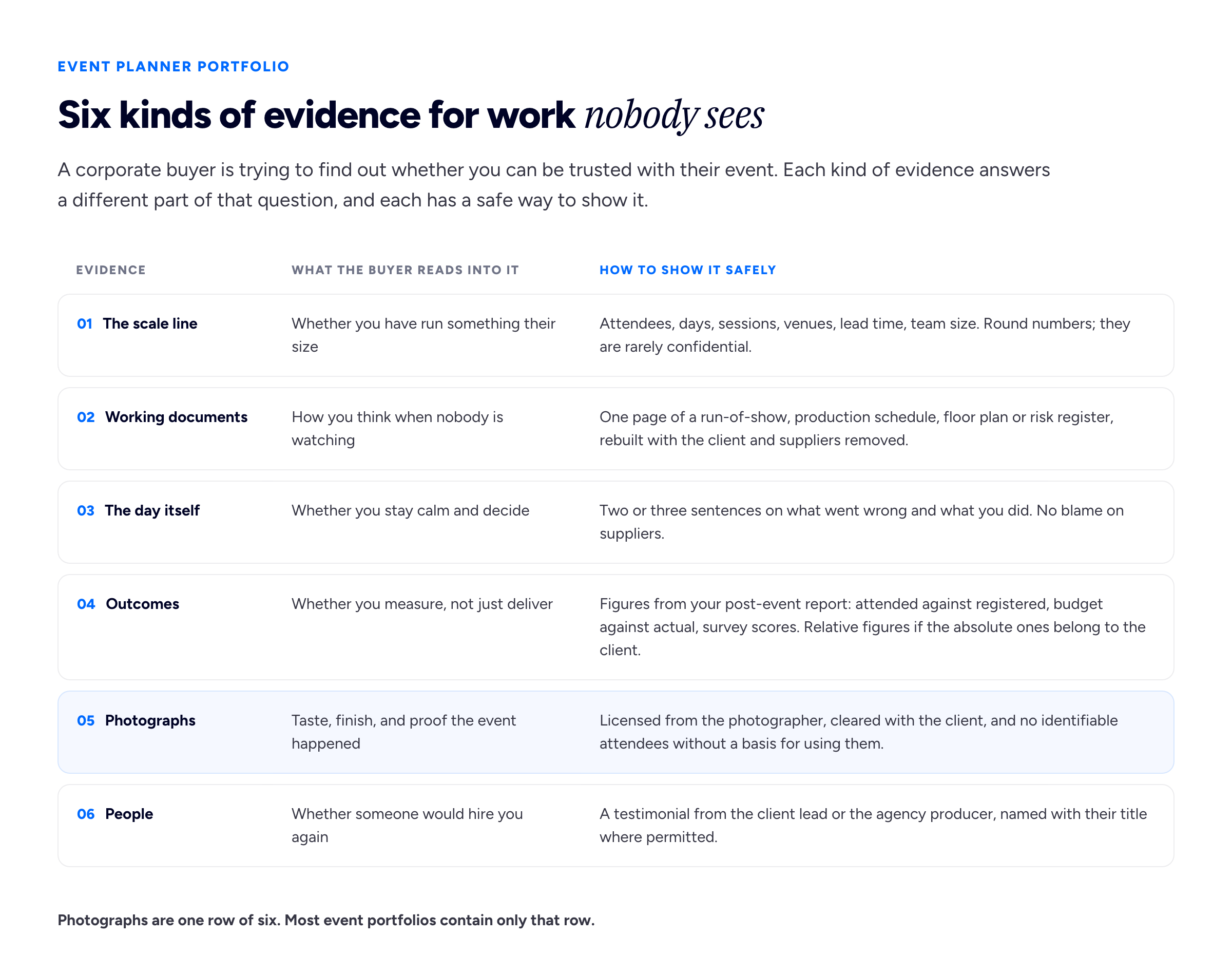
The highlighted row is the one most portfolios are built from. The other five are where a buyer actually finds you.
The scale line
One line at the top of every project: how many people, over how many days, across how many rooms or sites, with how much lead time, and with what size of team. "Three-day user conference, 1,400 delegates, 60 sessions across nine rooms, eleven months' lead time, core team of four plus 30 on-site crew." That sentence answers the buyer's first question — has this person run something like mine? — better than any photograph. Headcounts are rarely confidential even when the client is. Budgets are more sensitive: a band is usually enough ("mid six figures"), and if you cannot state one, leave it out rather than hinting.
Working documents
The most underused exhibit in the field. One page of a run-of-show, cue by cue, tells a producer more about your competence than a showreel. So does a production schedule with its dependencies visible, or a risk register that shows you thought about weather, crowd flow and a speaker cancellation before any of them happened. You cannot publish the real documents, but you can rebuild one page — client and supplier names removed, times and rooms genericised — and label it plainly: "Sample page, rebuilt from a real run-of-show with identifying details removed."
The day itself
Experienced buyers know something goes wrong at every event; they want to know what you do then. Two or three sentences per project on the problem and your decision are disproportionately persuasive — the keynote speaker's flight was cancelled, so you moved the panel into the slot and had the speaker record a video address from the airport. Write these without blaming anyone. A portfolio that names a supplier's failure reads as a planner who will one day name yours.
Outcomes
Corporate events are commissioned to achieve something — pipeline, press coverage, donations, renewals — and the buyer's boss will ask whether they did. If you write a post-event report, you already have your figures: attendance against registration, budget against actual, satisfaction scores, amount raised. The meetings industry has a long-standing convention here. The Events Industry Council's APEX Post-Event Report template, first approved in 2003 when the body was still the Convention Industry Council, describes the post-event report as the record of an event's details and activities, recommends completing it within 60 days of the event, and says the most recent one should accompany any request for proposals for the next occurrence. The template is dated and venue-focused, but the principle carries: a written record of what happened, in numbers, makes the next contract easier to win. If the absolute figures are the client's, relative ones usually survive — "registrations up by about a quarter", "4% under the approved budget".
Photographs
Choose ones that show logistics rather than decoration: a registration area with no queue at peak arrival, wayfinding that makes a confusing venue legible, a backstage cue desk. Include the artefacts you designed or specified — badges, lanyards, signage, printed agendas — photographed flat, because those are genuinely yours.
People
A named testimonial from the client lead or the agency producer who hired you is the closest thing this field has to a reference check on the page. Ask the week after the event, while the relief is fresh. Our guide to asking clients for testimonials has wording you can adapt.
Writing an event case study
Put those exhibits together and you have a case study. Three to five of them, written properly, are a stronger portfolio than thirty photo albums — the same reasoning as our advice on how many projects to put on a portfolio website. Each one follows the same order, because the order mirrors the questions a buyer asks.
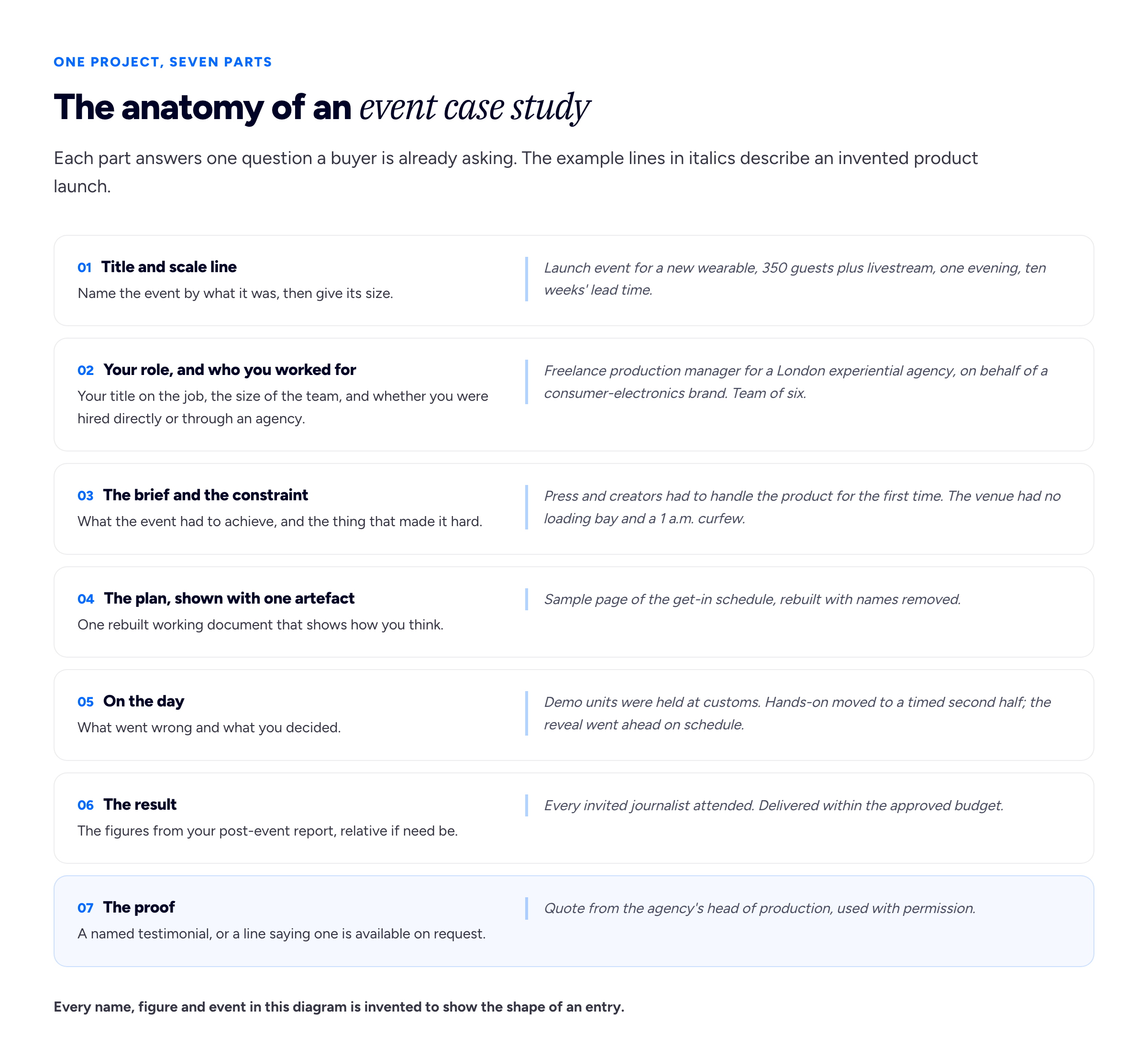
Seven parts, in the order a buyer's questions arrive. The redacted version keeps every part and only removes names.
Here is an invented example in full; the event, numbers and quote are fictional.
Annual members' conference for a professional body
Scale: Two days, 900 delegates, 42 sessions across six rooms, exhibition of 30 stands. Nine months' lead time.
Role: Lead event planner, contracted directly by the association. Worked with the head of membership, an AV supplier and a venue events team; managed two freelance coordinators on site.
The brief. Reverse three years of falling attendance without raising the delegate rate, and move from a hotel to a purpose-built venue an hour further from most members.
What I did. Re-tendered AV and catering against a written specification, which funded a cheaper early-bird tier. Rebuilt the programme around member-submitted sessions. Wrote the risk register, including a transport contingency that turned out to be needed.
On the day. A rail strike was announced four days out. We moved the first session back 45 minutes, ran coaches from two mainline stations and streamed the opening plenary.
Result. Attendance up by roughly a fifth on the previous year; final spend within 3% of budget; the exhibitors' rebooking rate was the highest the association had recorded.
Proof. "The first conference in years where I spent the two days talking to members instead of fixing things." — Head of Membership (name on request).
The general mechanics are covered in our guide to writing a portfolio case study. What is particular to events is the scale line and the "on the day" section; neither should be missing.
Working under an agency's name
Much corporate event work reaches freelancers through agencies: the agency wins the brand, then hires a freelance production manager and a team of coordinators, and the client may never know your name. Four rules we would suggest — our judgement, not an industry standard:
- The agency is your client, not the brand. Describe the work as "freelance production manager for [agency], on behalf of a global software company" unless the agency has said you may name the brand.
- Check your agreement for two clauses. Confidentiality, which may cover the brand's identity, and non-solicitation, which may prevent you from approaching the agency's client directly. A page that reads as a pitch to the agency's own client is a quick way to stop getting agency work.
- State your role precisely. If you ran the build and the agency ran the creative, say so. Claiming the concept will eventually reach someone who was in the room.
- Credit the team. Naming the agency and key suppliers reads as confidence, and agencies notice who credits them.
The easiest time to settle this is before the job starts, with a line in your terms allowing you to describe the engagement in general terms, subject to approval of the wording. Our guide to freelance contract essentials covers where that line sits.
NDAs, attendees and whose photographs they are
Corporate events carry plenty of confidential material: unreleased products, sales targets, donor guest lists. Our guide to showing confidential work covers the general approach — describe the sector, the scale and the constraint, withhold the name, and say plainly that you have. Two issues are specific to events.
The people in the pictures. Event photographs are full of identifiable people, and in the UK the Information Commissioner's Office puts it plainly: "If someone can be recognised from a photograph it's usually considered their personal data" (ICO guidance, written for schools but stating a general principle). The attendees agreed, at most, to be photographed for the organiser's purposes — not for yours. Favour shots of rooms, sets, signage and crowds at a distance, and ask before using anything where a delegate's face is the subject.
Who owns the photographs. Under UK law, "the author of a work is the first owner of any copyright in it", with an exception for work made by an employee in the course of employment (Copyright, Designs and Patents Act 1988, section 11). An event photographer is usually a freelancer, so the photographs typically belong to them, licensed to whoever commissioned them — which is rarely you. The rules differ in other countries, so check where you work. In practice, ask the photographer for permission to use a small selection with a credit, and ask the client too. If you commission the photographer yourself, write portfolio use into the brief; it costs nothing at booking.
What to lead with, event type by event type
The case study shape stays the same; the emphasis shifts with what the buyer worries about.
Conferences and congresses. The buyer worries about flow: registration, changeovers, speaker management. Lead with the scale line and show a page of your speaker schedule.
Product launches. The buyer worries about secrecy and timing. Lead with how you protected the embargo — restricted access lists, a covered get-in, staff briefings — and write the entry to survive anonymisation, because launches are often under NDA.
Brand activations. The buyer worries about footfall and permissions. Show visitor numbers and the licences and consents you secured. Photographs earn more space here, because the physical build is the point.
Non-profit galas. The buyer worries about money raised against money spent, so that ratio is your headline outcome. Guest lists are confidential; totals raised usually are not, once the charity has published them.
Festivals and public events. The buyer worries about safety and licensing, so your crowd-management plan and your part in the safety planning are the evidence. For wedding and private social events, the buyer and the evidence are different enough that they need their own portfolio — our wedding planner portfolio guide covers that side.
If you do several of these, lead with the one you want more of. A portfolio is a statement about the next job, not a record of every past one.
A PDF deck or a website?
Search for an event planner portfolio template and most of what you find is PDF, sold by template shops. The format persists for a reason: corporate procurement runs on tenders and requests for proposals, which want attachments.
So have both, and give them different jobs. The website is the public version: indexable, linkable from LinkedIn and your email signature, and kept up to date. The PDF is the tailored version you attach to a specific proposal — the three case studies most relevant to that buyer, plus the sample documents and figures you would not publish openly. Our guide to writing a freelance proposal that wins covers the proposal it travels with.
The failure mode is a beautiful deck that is the only place your work exists. A buyer who hears your name from a colleague will search for you, and should find a page.
For the website, Bunfolio gives you a free portfolio site on a subdomain: sign in with Google, write your case studies into the portfolio section, and connect your own domain later if you want one, which is the only paid part. You can see how the layouts handle text-heavy projects on the templates page.
Certifications, and where they belong
Does a certification matter for a freelance portfolio? It helps with some buyers and is invisible to others. The BLS entry is careful on the point: certifications are voluntary and "not required", though they "demonstrate specific knowledge or professional expertise".
The two you are most likely to meet on corporate briefs:
- CMP (Certified Meeting Professional), awarded by the Events Industry Council, which says more than 12,000 meeting professionals in 55 countries hold it. Eligibility requires, among the options, 36 months of full-time industry experience within the past five years, plus 25 clock hours of qualifying education or a 200-hour internship, before you sit the exam.
- CSEP (Certified Special Events Professional), managed by the International Live Events Association, which asks for a minimum of five years of full-time practical experience in the events industry. It is aimed more at the special-events and experiential side.
If you hold one, put the letters after your name and a line in your About section; the case studies still do the persuading.
If you are just starting
The BLS entry notes that planners may benefit from experience in hotels, convention centres and convention bureaus, or from "coordinating university or volunteer events and shadowing professionals". All of those produce case studies. A student society's conference with 200 attendees, written up with a scale line, a run-of-show sample and an honest "on the day" section, is a better first portfolio entry than a mood board for an imaginary gala.
Volunteering on crew at a large event lets you say what you saw a good production manager do, as long as you state your own role plainly. Our guide to building a portfolio with no experience covers the rest of the starting-out problem.
Frequently asked questions
What is an event portfolio?
A collection of evidence that you can plan and deliver events: case studies with a scale line, your role, the brief, sample working documents, what happened on the day, results and a testimonial. Photographs are part of it, not all of it.
How do I make an event planning portfolio with no experience?
Start with events you have run in any setting: a student society conference, a charity fundraiser, a community festival, or crew work at a larger event. Write each up as a case study with an honest scale line, your exact role and what happened on the day. One real small event, documented properly, is stronger evidence than a mood board for an event that never took place.
Should my event planner portfolio be a PDF?
Keep a PDF for tenders and proposals, tailored to each buyer, but do not let it be the only place your work exists. A public website is what people find when they search your name.
Can I include events I worked on through an agency?
Yes, described accurately. Name the agency as your client, describe the brand in general terms unless the agency agrees otherwise, state your exact role, and check your agreement for confidentiality and non-solicitation clauses first.
How many events should I show?
Three to five full case studies is enough for most freelancers, chosen to match the work you want next. A list of other events can follow underneath.
Do I need the CMP to win corporate work?
No. It is voluntary. It carries weight with some association and corporate buyers, and it requires two to three years of industry experience depending on the route, so it tends to come after your first portfolio, not before.
How we put this guide together
Bunfolio builds portfolio sites for freelancers, and much of this guide is our own recommendation rather than an industry standard: the six kinds of evidence, the seven-part case study, the emphasis by event type, the agency credit rules, and the advice to keep a public website alongside a tailored PDF. They apply what we see persuade buyers in portfolios generally — a stated scale and a specific decision do the most good — to a field where the work is unusually hard to photograph. Weigh them as judgement.
We have deliberately not quoted any statistic about how often events go wrong, how much work flows through agencies, or how long buyers spend on a portfolio. We could not trace figures like these to a primary source we would stand behind, so they are not here.
The factual claims point at primary sources. The occupational description, the listed skills, the wording on voluntary certifications and the note on early experience come from the BLS Occupational Outlook Handbook. The post-event report guidance is from the Events Industry Council's own APEX Post-Event Report template. CMP holder numbers and eligibility come from the Events Industry Council's About CMP and eligibility pages, and the CSEP requirement from ILEA; both change from time to time, so check them before you apply. The photograph and personal data line is quoted from the ICO, and the copyright rule from section 11 of the Copyright, Designs and Patents Act 1988. We are not lawyers, and nothing here is legal advice on your agreements or on data protection where you work.
Every example in this guide is invented for illustration — the members' conference, the product launch, the rail strike, the customs delay, the figures, the agency and the testimonial, including everything in both diagrams. They describe no real event.
Related reading: showing confidential work in a portfolio, how to write a portfolio case study, writing a freelance proposal that wins, how to ask clients for testimonials, and marketing portfolio examples for the adjacent discipline many event buyers sit in.
More from the blog
September 6, 2026 · 18 min read
Wedding Planner Portfolio: How to Show the Work Nobody Photographs
A wedding planner's portfolio is usually other people's photographs of other people's flowers, and couples cannot see the planning in it. How to show logistics, credit suppliers properly, start with s...
August 16, 2026 · 17 min read
How to Show NDA and Confidential Work in Your Portfolio
Your strongest projects are often the ones you are not allowed to show. What you can still describe under an NDA, how to write a redacted case study that persuades, and how to ask for the permission y...
November 2, 2026 · 19 min read
Upwork vs Fiverr: Which Suits the Way You Work?
Upwork has you pitch for posted jobs with Connects; Fiverr has buyers order a fixed-price Gig you defined. Who each suits by service and experience, how the first job happens on each, the fees, paymen...