
September 6, 2026 · 18 min read · Updated October 5, 2026
Wedding Planner Portfolio: How to Show the Work Nobody Photographs
A wedding planner's portfolio is usually other people's photographs of other people's flowers, and couples cannot see the planning in it. How to show logistics, credit suppliers properly, start with styled shoots, and present packages and reviews honestly.
To make a wedding planner portfolio, choose four to eight weddings that resemble the couples you want to book next, and build each one as a short case study: a facts line, the problem you solved, a redacted piece of your planning, credited photographs and the couple's own words. Put them on a site of your own alongside your packages, reviews and a simple way to enquire. If you have no weddings yet, a clearly labelled styled shoot fills the gap honestly.
A wedding planner's portfolio is usually a gallery of someone else's photographs of someone else's flowers. The tablescape was the florist's, the light was the photographer's, and the venue was beautiful before anybody arrived. A couple scrolling through it can see that the day looked lovely. What they cannot see is the thing they would be paying you for.
Planning is invisible work. It is the timeline that absorbed a forty-minute delay without the guests noticing, the supplier chased three times until the marquee flooring arrived, the budget rebalanced in March so the band survived. None of that photographs. The planners whose sites convert are not the ones with the prettiest pictures; they are the ones who make the invisible part legible.
This guide covers who reads a wedding planner portfolio and what each reader checks, how to show logistics rather than only styling, how to structure a single wedding, credit and permission etiquette with photographers, styled shoots for when you have no weddings yet, packages, reviews and certification. The general structure of a freelance site is in our guide to a freelance portfolio website that wins clients, and this post does not repeat it.
How to make a wedding planner portfolio, step by step
The sections after this one explain the reasoning in detail. If you want the order of work first, it is this:
- Decide who you want to book next. Write down the guest count, budget band, setting and style of the weddings you want more of. Every later choice, from which weddings to include to which comes first, follows from this.
- Gather the material from each wedding. Your final timeline, the supplier list, your planning notes, the photographer's gallery and anything the couple wrote to you afterwards. Most of it is already in your inbox and planning software.
- Ask permission before you build anything. Ask the couple whether their wedding can appear and under which names, and ask the photographer whether you can use a selection of images with a credit. Get both in writing.
- Pick four to eight weddings and order them by relevance. Lead with the wedding closest to the couples you named in step one, not the newest or the most photogenic.
- Write each wedding as a short entry. A facts line (guests, venue type, season, service), the brief in one sentence, one real problem and how you handled it. The structure is set out below.
- Add one piece of logistics evidence per wedding. A run-of-show extract, a supplier map or a wet-weather plan, with names and contact details removed. This is what shows the planning itself.
- Select eight to fifteen photographs per wedding and credit them. Include at least one frame of the space before guests arrived, and name the photographer and every supplier.
- Write your services page. What full planning, partial planning and on-the-day coordination each include, and a "from" price for each.
- Collect reviews and link your directory profiles. A testimonial with the month, year and venue type on each wedding, plus links to wherever else couples have reviewed you.
- Publish it on your own site and check it on a phone. Plenty of couples will open it from a link on a phone, so make sure the weddings, prices and enquiry form all work there.
If you are starting with no weddings at all, replace steps two to seven with a styled shoot or an assisting role for now, labelled honestly; the section on starting with no experience covers how.
Three readers, and only one of them is the couple
The couple books and pays, but at least two other people will open your portfolio and make decisions from it.
The couple is anxious more than aesthetic. Most have never planned an event of this size, and underneath the Pinterest language they are asking one question: will this person stop it going wrong? They want weddings that resemble theirs in size, budget and style, and a clear picture of what you would do for them, month by month.
The venue coordinator is often the person who recommends you, or who is asked about you. Venues see planners every weekend and know exactly which ones make their day easier. They read for competence: do you work to a run-of-show, respect their load-in times and house rules, and have you worked at venues like theirs?
Other wedding professionals — photographers, florists, a larger planning company looking for an associate — read for reliability and credit etiquette. A portfolio that credits suppliers properly tells them you will credit them too. One that presents a florist's installation as your own tells them to be careful.
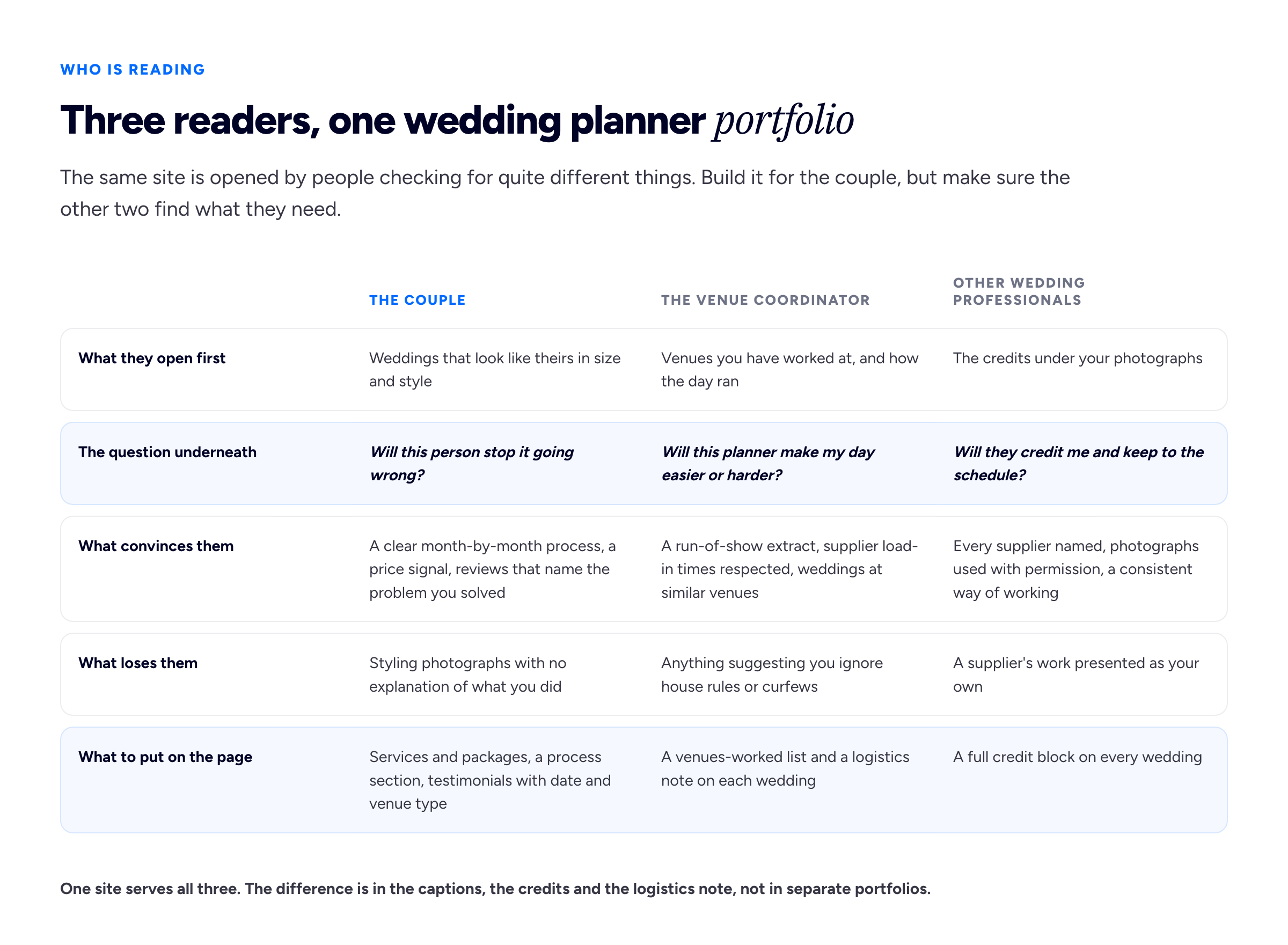
You do not need three portfolios. You need captions and credits that let the second and third readers find their answer without making the couple read it.
Show the logistics, not only the photographs
This is what separates a planner's portfolio from a stylist's mood board, and the part template sites never mention. A photograph shows the outcome. Your job is to show the working behind it in a form a non-planner can take in within a minute. Four kinds of evidence do most of it:
- A run-of-show extract. Not the whole document — a redacted slice. Twenty lines covering the hour from ceremony to wedding breakfast, with supplier arrivals, the room turnaround and the buffer you built in, with names, phone numbers and addresses removed. A venue coordinator reads it in ten seconds and knows whether you are a professional.
- A supplier map. "Fourteen suppliers across two sites, with a single ninety-minute load-in window" says more about your job than any tablescape.
- Budget as structure, not figures. Almost never publish a couple's actual spend. You can say how the budget was shaped — "we moved a fifth of the flower budget to the evening food after the guest list grew" — which shows judgement without disclosing anything private.
- The problem you solved. Every wedding has one: a venue that changed hands, a storm warning, a supplier who went out of business six weeks before, a seating plan that needed diplomacy. One sentence on what happened and what you did is the most persuasive line on the page, because it is exactly the scenario the couple fears.
Ask the couple before any of this goes up. A timeline, however redacted, describes their day. Our guide to showing confidential work in a portfolio covers that conversation and what to do when the answer is no.
How to build each wedding entry
The unit of a wedding planner portfolio is a single wedding, and most sites underbuild it: twelve photographs in a grid under two first names. Treat each wedding as a short case study instead — not long, but structured, so a reader skimming five weddings finds the same information in the same place every time.
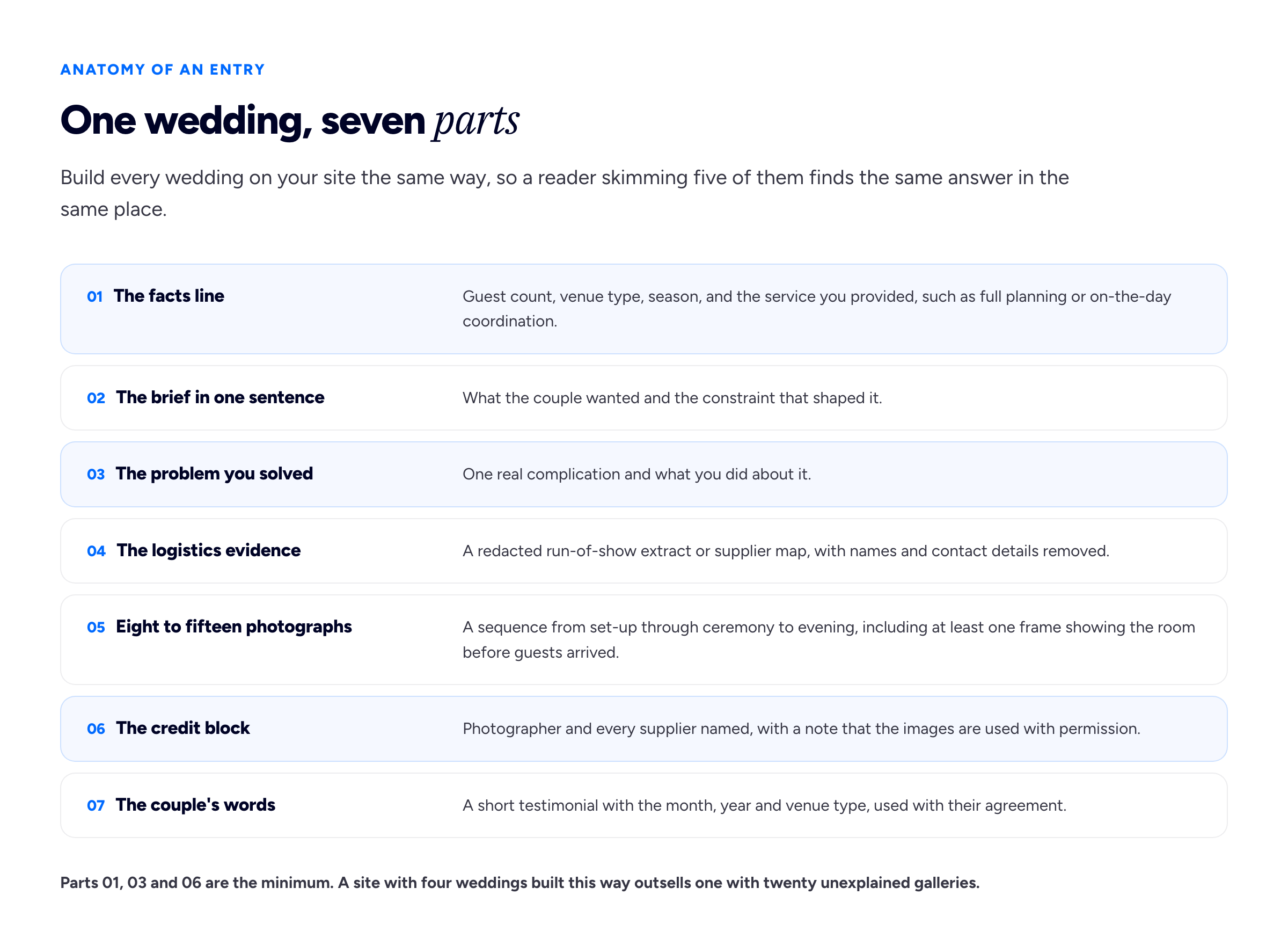
The facts line, the problem solved and the credit block are the three parts almost every planner's site is missing.
Here is how the written part might look. The couple, venue and details are invented for illustration:
120 guests · converted barn and marquee · late September · full planning, fourteen months
Anna and Tom wanted a long, relaxed day with food at the centre of it, on a budget that had to absorb thirty extra guests in the final four months.
Five days out, the forecast turned. We had agreed a wet-weather plan with the venue at the first site visit, so the ceremony moved from the orchard to the barn with a forty-minute turnaround, the florist re-rigged the arch indoors, and drinks moved under the marquee canopy. Guests heard it from the ushers on arrival, not from a panicked message the night before.
The facts line lets a couple decide in two seconds whether this wedding resembles theirs; the rest shows a plan made months ahead and executed calmly, which is the entire product. Our guide to writing a portfolio case study goes further into the structure.
Order weddings by relevance, not date. Lead with the one closest to the couples you want next in size, budget and setting, even if it is not your newest or your most beautiful. Four to eight fully built weddings are usually plenty; the weakest entry sets expectations more than the strongest.
Photographs you did not take: credits and permission
Almost every image on a planner's site was taken by a wedding photographer, and that has a consequence many planners miss. As a general rule, copyright in a photograph belongs to the person who took it, not to the people in it or the people who arranged what was in front of the lens. The UK Intellectual Property Office sets out the general position in its guidance on ownership of copyright works, and the US Copyright Office covers the same ground in its FAQ on who owns a copyright. This is general information rather than legal advice; the position differs between countries and can be changed by the photographer's contract.
So you need the photographer's permission to put their images on your site, and the smoothest time to ask is before the wedding. Most photographers are happy to agree, because a planner's site is a referral source for them too. Ask specifically, in writing:
Hi Sam — looking forward to the 21st. Would you be happy for me to use a selection of the images on my website and social accounts, credited to you with a link, once the couple have had their gallery? I won't use them in paid advertising or submit them anywhere without checking with you first.
- Wait for the couple's gallery. Posting before the couple has seen their own photographs is the fastest way to lose a photographer's goodwill, and the couple's.
- Do not re-edit, heavily crop or filter the images. The photographer's edit is part of their work.
- Credit every supplier, not only the photographer: florist, stylist, caterer, venue, stationery, hire, band. It is how the industry refers work, and it makes your own contribution clear.
- Ask the couple separately. The photographer's permission covers the photograph, not the couple's agreement to appear on your business site.
A wedding planning portfolio with no experience: styled shoots, honestly labelled
The new planner's problem is circular: couples want to see weddings you have planned before letting you plan theirs. There are three legitimate ways out, and one that backfires.
Assisting. Working as an assistant for an established planner gives you real logistics experience and — with the lead planner's permission — material you can describe accurately as "assisted on" rather than "planned". Never blur that line; every supplier on the day will know.
Small real events. A friend's small wedding, a vow renewal, an elopement. Plan them as properly as a paid job: write the timeline, run the supplier list, document it. A small real wedding with a genuine run-of-show beats a large imaginary one.
Styled shoots. A planner, photographer, florist, stylist and models create an editorial wedding scene with no real couple. For a new planner it demonstrates design direction, supplier coordination and delivering a concept on a fixed day. Treat it like a job: a one-page concept, a supplier list with roles, a shoot-day timeline, and usage terms agreed in writing with everyone before anything is photographed.
What backfires is presenting a styled shoot as a real wedding. Label it plainly — "Styled shoot: real team, no real couple" — and write the entry around the concept, the coordination, and what you would change for sixty real guests. The same principle runs through our guide to a portfolio with no experience, and getting your first freelance clients covers what comes next.
Packages and pricing on the page
Most planners sell some version of three services, and many couples do not know the difference. Naming and explaining them is half the job of your Services section:
- Full planning — from early budget and venue search through to the day itself.
- Partial planning — you join after the venue and key suppliers are booked, and take over the remaining detail and logistics.
- On-the-day coordination — which always starts weeks before, because nobody can run a timeline they did not help write. Say how far ahead you start.
For each, list what is included: meetings, site visits, whether you attend the rehearsal, hours on the day, whether an assistant comes, and how supplier payments are handled.
A "from" figure for each service does more than a full rate card and far more than silence, which filters out couples who would have been a good fit but were unsure whether to ask. Flat fee or percentage of budget is your choice — how much to charge as a freelancer covers the arithmetic — but say which you use. Deposits, payment stages and cancellation belong on the page in plain words, backed by your contract; see freelance contract essentials.
Reviews: The Knot, WeddingWire and your own site
Directory reviews matter more in this industry than in most, so it is worth knowing the actual rules. The Knot and WeddingWire are both run by The Knot Worldwide, and its published review policy is specific: only verified clients can review, vendors may not offer anything of value for a review with a prescribed sentiment or discourage a client from posting, and vendors cannot remove individual negative reviews. Replying to reviews is a feature of paid listings.
Beyond the directories, the same principles are increasingly law. The US Federal Trade Commission's rule on fake reviews and testimonials, announced in August 2024, prohibits fake testimonials, incentives conditioned on a particular sentiment, and undisclosed reviews from staff. The UK Competition and Markets Authority published its fake reviews guidance in April 2025. Google's Maps review policy forbids incentives and selectively soliciting positive reviews — so asking only the couples you know were delighted breaks its rules.
- Ask every couple, the same way. It is compliant and it produces your best material. How to ask clients for testimonials has a script.
- Put the testimonial next to its wedding, with the month, year and venue type. It does more than a page of anonymous praise.
- Link to the directory rather than copying it. Your site is where you choose the best three; the directory is where a sceptical couple checks the full record. WeddingPro offers an official badge and review widget for your own site, and advises against pasting review text from your Storefront.
- Never write a review for a couple, even when they ask you to "just put something together". Send them a question instead.
Certification: what it proves and what it does not
The credentials in this field are issued by trade associations and training providers, not by a government regulator. The Association of Bridal Consultants, a membership organisation founded in 1955, runs a tiered designation pathway from registered through certified, professional and accredited to master wedding planner; other bodies run their own schemes.
If you hold a qualification, name the awarding body and the level; "certified wedding planner" on its own tells a couple nothing they can check. If you do not, do not apologise for it. A well-built wedding entry with a real timeline extract is stronger evidence than a certificate. Business insurance, if you carry it, is worth stating, because venues often ask.
Wedding planner portfolio examples and templates: what to take from them
Search for wedding planner portfolio examples and you mostly find Pinterest boards and shops selling downloadable PDF templates. A PDF is fine as a pitch document after a first call. It is a poor substitute for a website: a couple cannot find it by searching your name, and a venue coordinator cannot forward it as a link.
When you study other planners' sites, study structure rather than styling: how fast you find their services and a price signal, whether each wedding says what the planner did, how suppliers are credited, and whether the About page sounds like a person — our guide to writing a portfolio About page covers that.
A good wedding planner portfolio template needs few sections, in this order: a hero saying who you plan for and where, a short About, Services with what each package includes, the weddings, testimonials, and a Contact section asking for date, venue and guest count. Bunfolio is built around that shape: sign in with Google and you get a free site on your own subdomain, in one of four templates, with Services, Portfolio, testimonials and Contact already in place, and a custom domain as an optional paid extra. If you also plan corporate events or conferences, that client reads differently — our event planner portfolio guide covers it.
A pre-send audit
- Does every wedding open with a facts line: guest count, venue type, season and service?
- Does every wedding name one real problem and what you did about it?
- Is there at least one redacted run-of-show or supplier map, with private details removed?
- Is every photograph used with written permission, unedited and credited?
- Are styled shoots labelled as styled shoots?
- Does each service say what is included and give a "from" price?
- Do testimonials carry a month, year and venue type, and do you ask every couple?
Frequently asked questions
What should a wedding planner portfolio include?
Four to eight weddings, each built as a short case study: a facts line with guest count, venue type, season and service; a one-sentence brief; one problem you solved; a redacted run-of-show extract or supplier map; eight to fifteen credited photographs used with permission; and a testimonial with the month and venue type. Around them, a Services section with what each package includes and a "from" price, a short About page, and a Contact form asking for date, venue and guest count.
How do I build a wedding planner portfolio with no experience?
Assist an established planner and describe that work accurately as assisting; plan small real events such as a friend's wedding as properly as a paid job; and organise styled shoots with usage terms agreed in writing beforehand. Label styled shoots plainly, and write each entry around the concept and the coordination rather than implying there was a real couple.
How many weddings should a wedding planner portfolio show?
Four to eight, each fully built with a facts line, a problem solved, credited photographs and a testimonial, is usually plenty. More weddings with less explanation weakens the page, because a couple judges you by the weakest entry they open as much as the strongest. Lead with the one closest to the weddings you want to book next.
Can I use the wedding photographer's photos on my website?
Only with the photographer's permission. Copyright in a photograph generally belongs to the photographer, and planning the wedding gives you no rights in the images, so ask in writing — ideally before the wedding — for website and social use with a credit. Wait until the couple has their gallery, do not re-edit the images, and get the couple's agreement separately. This is general information, not legal advice.
Should I rely on The Knot and WeddingWire instead of my own website?
Use both for different jobs. The directories are where many couples search and where a sceptical couple checks your full review record; your own site is where you explain your services, show your logistics and choose which weddings lead. The directories' rules — verified clients only, no incentives tied to sentiment, no removing individual negative reviews — are in The Knot Worldwide's published review policy.
Do I need to be certified to be a wedding planner?
Certification in this field comes from trade associations and training providers rather than a government regulator, and couples book on evidence of work more than credentials. If you hold one, name the awarding body and level. Check your own country's rules for running a business, such as insurance, separately.
How we put this guide together
Bunfolio builds portfolio sites, so we spend our time reading what freelancers publish and where a page loses the person who could have booked them. The recommendations here are our own judgement rather than industry standards: the three-reader split, the position that logistics evidence matters more than styling photographs, the seven-part wedding entry, the four-to-eight wedding range, leading with the most relevant wedding, the case for a "from" price, and labelling styled shoots. Weigh them as opinion.
We have cited no statistics. The wedding industry circulates many confident figures — average planner fees, the share of couples who hire a planner, how many reviews a couple reads — and we could not trace the ones we found to a primary source with a stated method, so they are absent rather than borrowed.
Factual claims point at primary sources. Photograph ownership: the UK Intellectual Property Office's guidance on ownership of copyright works and the US Copyright Office's FAQ on who owns a copyright. Directory review rules: The Knot Worldwide's review policy. Fake and incentivised reviews: the Federal Trade Commission's announcement, the Competition and Markets Authority's fake reviews guidance and Google's Maps review policy. The Association of Bridal Consultants' founding date and designation pathway: its own site. Policies and schemes change, so check them at source. Nothing here is legal advice; copyright, consent and consumer law differ by country and are overridden by what you actually signed.
The couple, venue, photographer, dates and messages used as examples are invented for illustration and do not describe a real wedding or agreement. We have deliberately not named or reproduced any real planner's portfolio.
Related reading: the event planner portfolio guide for corporate and non-wedding events, the photography portfolio website guide for the other side of every wedding gallery, the makeup artist portfolio guide for another bridal booking business, and how to ask clients for testimonials.
More from the blog

September 8, 2026 · 18 min read
Event Planner Portfolio: How to Show the Work Nobody Sees
A good corporate event leaves almost nothing behind, which makes it hard to prove you ran it. Here is how to build an event planner portfolio from scale lines, rebuilt run-of-show pages, post-event fi...

August 16, 2026 · 17 min read
How to Show NDA and Confidential Work in Your Portfolio
Your strongest projects are often the ones you are not allowed to show. What you can still describe under an NDA, how to write a redacted case study that persuades, and how to ask for the permission y...
November 2, 2026 · 19 min read
Upwork vs Fiverr: Which Suits the Way You Work?
Upwork has you pitch for posted jobs with Connects; Fiverr has buyers order a fixed-price Gig you defined. Who each suits by service and experience, how the first job happens on each, the fees, paymen...