
August 29, 2026 · 18 min read · Updated September 25, 2026
The Freelance UX Designer Portfolio: Winning Clients, Not Interviews
A hiring manager is deciding whether you can do the job for two years. A client is deciding whether you can solve one problem, for roughly this money, starting soon. Almost every difference in the portfolio follows from that.
Almost all advice about UX portfolios is advice about getting hired: structure the case study this way, show your process, prepare for the review. Good advice for a staff job — we have written our own version of it in the UX designer portfolio guide.
It is the wrong document if you are freelance. A portfolio built for interviews and one built for clients are different objects that happen to share some screenshots. Freelancers who miss this end up with a rigorous site that draws compliments from other designers and almost no enquiries.
The difference comes from one thing. A hiring manager is deciding whether you can do this job, for us, for the next two years. A client is deciding something narrower and more anxious: can you solve this specific problem, for roughly this money, starting roughly now, without becoming my problem. Nearly every practical difference follows from that sentence.
What the client is deciding
"This specific problem." The client does not have a UX problem. They have a checkout that leaks, or an onboarding flow support keeps explaining. They decide you are relevant long before they read your process.
"For roughly this money." They have a number in their head, often an unreliable one. Everything implying scale — the clients you name, the engagements you describe, any figure you publish — is read as a price signal.
"Starting roughly now." Timing loses more freelance enquiries than quality does. A client with a live problem needs to know you exist, are available, and can begin within a horizon they can live with.
"Without becoming my problem." The clause nobody designs for, and often the decisive one. Hiring an unknown freelancer is a risk to the buyer's own standing, so they hunt for evidence that you scope honestly, finish and hand over cleanly. Ambitious concepts with nothing shipped read as risk.
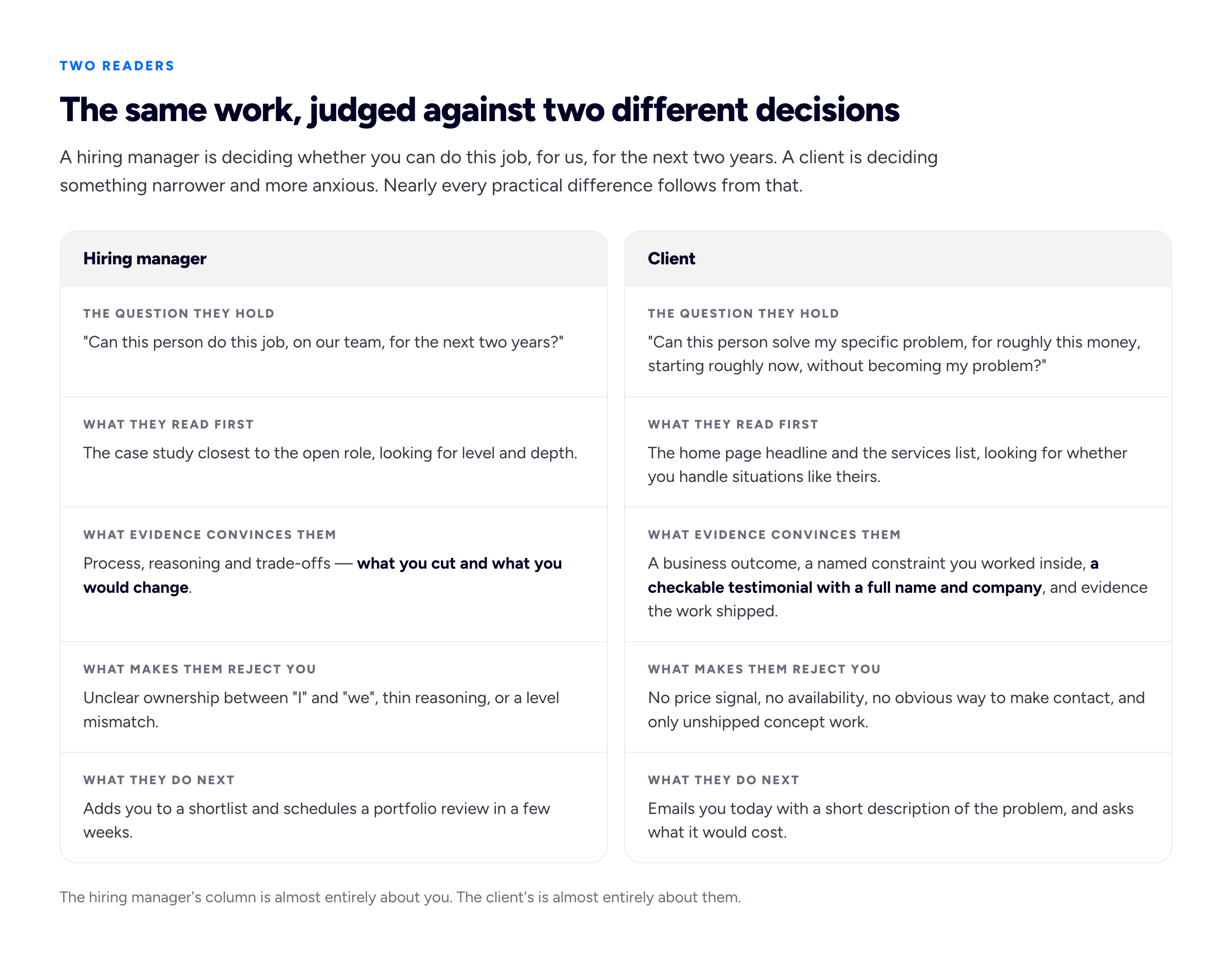
Two readers, two questions, almost no overlap in what satisfies them.
The hiring manager's column is almost entirely about you. The client's is almost entirely about them. A freelance portfolio that talks mostly about the designer is not badly written; it is correctly written for the wrong reader.
The same project, written twice
Write one project both ways and the difference stops being abstract. Both versions below are invented for illustration — no real engagement, client or figure is being described. The project: a regional plant-hire company whose online quote form was losing people at the last step.
Version one, written for a hiring manager
Sole product designer, ten weeks, alongside two engineers and a product manager. I ran six contextual interviews with depot staff and eight remote sessions with hire customers, synthesised the transcripts into an affinity map, and built a journey map of the quote-to-collection path. I tested mid-fidelity prototypes over two rounds and handed over an annotated component set. What I would change: I would have brought engineering into the IA work earlier, and instrumented the funnel before the redesign rather than after.
Method, ownership, sequencing, self-criticism. Now the same project, addressed to somebody who might buy the next one.
Version two, written for a client
A plant-hire company was losing quote requests at the final step. Their customers were site foremen filling in a form on a phone, in a yard, wearing gloves — and the form asked for a delivery postcode, a collection postcode and two dates before it asked which machine they wanted. The constraint: whatever I designed had to keep feeding the existing hire system unchanged, because replacing that system was a separate project, already scheduled and already long. I rebuilt the request around the machine first, moved every logistics question after it, and cut the required fields from fourteen to five. Completed quote requests rose over the two months after launch, and the office stopped ringing people back for missing details. Ten weeks, one designer, no change to the back office.
What actually changed
The facts are identical. Five things moved:
- The subject moved from the designer to the business. One opens with a role; the other with a problem the reader might recognise as their own.
- Method went invisible. The interviews still happened — they are why the second version knows about the gloves — but a client does not buy interviews, they buy the finding.
- The constraint moved to the front. "It had to keep feeding the existing system unchanged" says you can work inside a mess you did not create.
- The outcome became commercial — more completed requests, fewer chase-up calls, claimed as a direction rather than a percentage. If you did not measure it, do not invent a figure.
- Cost and shape became explicit. "Ten weeks, one designer, no change to the back office" lets a reader price their own version of the job. The self-criticism went: keep that for the conversation, where it lands as candour rather than doubt.
In practice: write the client paragraph first, at about 150 words, and let it sit at the top of the case study. Anyone who wants the process can scroll.
Which artefacts sell
UX produces a lot of attractive intermediate objects — affinity walls, journey maps, personas — and in a job application they show a reviewer you know the moves. To a client, a journey map for a company they have never heard of, in a notation they do not read, looks like the thing they fear buying: weeks of expensive preamble before anything changes. What persuades a buyer, strongest first:
- The actual before and after, annotated. Two screenshots and four labels saying what moved and why — the most persuasive object a freelance UX portfolio can contain, and far rarer than it should be.
- A live link to something shipped. "You can use this yourself" ends an entire category of doubt.
- A research finding that visibly changed the design, in one sentence: what you learned, what you did differently. The only form in which research reliably sells.
Services a client can actually buy
Nobody has ever had "UX design" on a purchase order. They have had a budget line for a project, a quarter or a retainer. If your services section lists capabilities — research, wireframing, prototyping, design systems, Figma — you have described your skills and left the buyer to invent the transaction. Most will not. They will email a designer whose site already told them what the transaction looks like.
Packaging converts a capability into a thing with edges: a name, a duration, a deliverable, an inclusion list and an exclusion list.
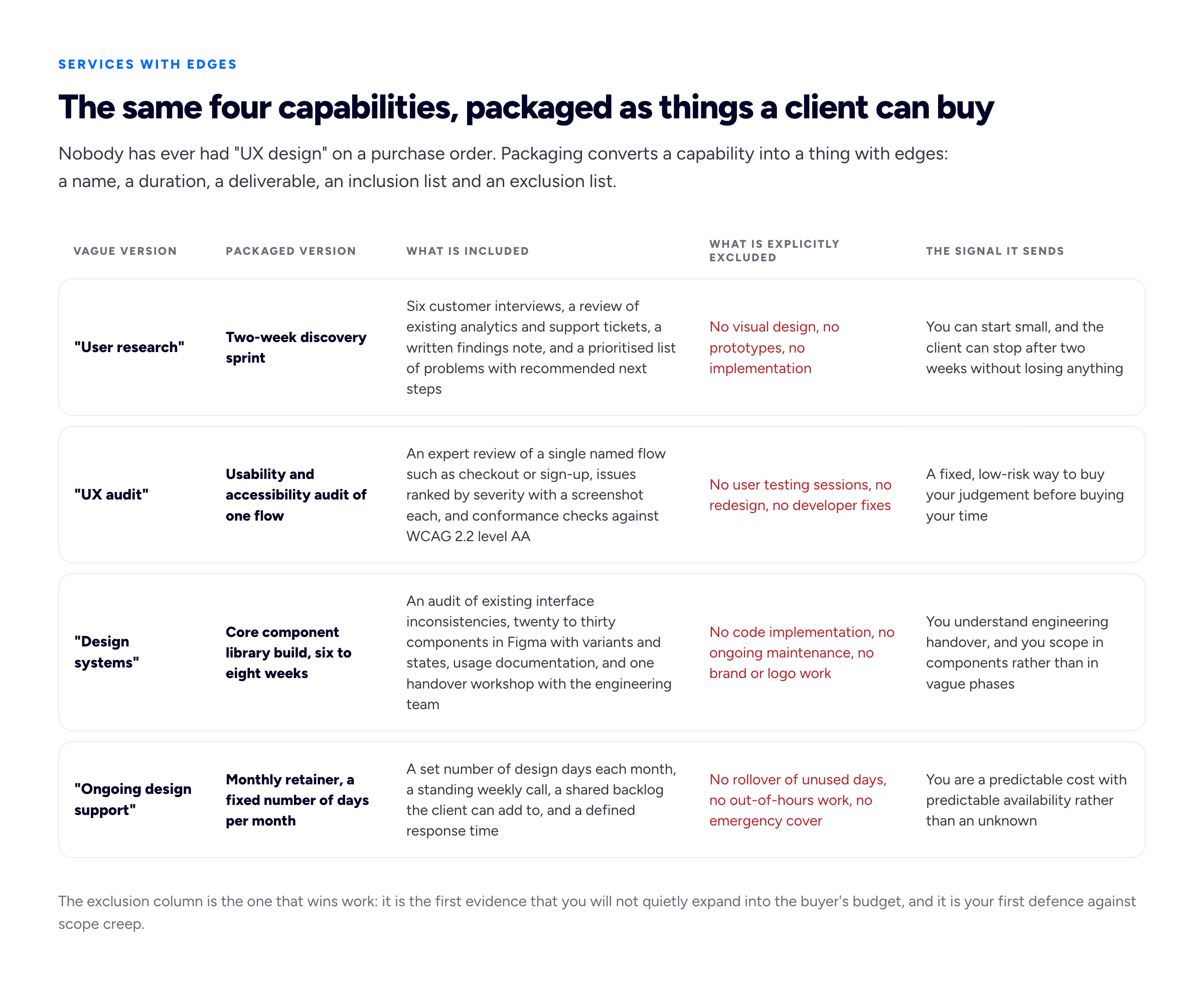
The same four capabilities, expressed as things with a name, a duration and an edge.
The exclusion column is the one that wins work. It reads as generosity, because it is the first evidence that you will not quietly expand into the buyer's budget — and it is your first defence against scope creep.
Audits are the easiest first purchase. A fixed-price review of one flow is the smallest way for a stranger to try working with you, and it routinely produces the next project. Say what you audit against: the W3C's WCAG 2.2, published in October 2023 and updated in December 2024, is the reference procurement teams recognise. Clients are increasingly obliged to care: UK public sector bodies are covered by the Public Sector Bodies (Websites and Mobile Applications) (No. 2) Accessibility Regulations 2018, and the EU's European Accessibility Act (Directive 2019/882) extends accessibility requirements to services including e-commerce, banking and e-books. Naming an obligation makes you legible to a buying committee in a way "I care about inclusive design" is not.
Pricing on the page: the honest trade-off
This gets answered as a rule when it is genuinely a trade-off, and both sides are real.
What a published figure buys you. It removes the enquiries that were never going to convert — the call with a founder who imagined the redesign cost a few hundred pounds, the proposal written for a budget that did not exist. It is also a competence signal: someone who can state what they charge has done this often enough to know.
What it costs you. It sets a ceiling. If your page says a sprint starts at a number and a well-funded client arrives with a harder version of the job, you have anchored the conversation below where it should have opened. Prices also date badly: a figure set two years ago and forgotten is quietly underselling you.
Three patterns, in increasing order of caution. Every figure below is invented for illustration — not a benchmark, and not our estimate of what anyone should charge.
The "from" figure
Usability and accessibility audit of one flow — from £1,800, delivered in ten working days.
Best for productised work with a stable scope. "From" has to be honest: if nothing has ever gone out at that number it is bait, and the first call exposes it.
The typical-engagement range
Most projects run four to ten weeks and typically land between £6,000 and £18,000 depending on scope. Retainers start at four days a month.
Best for bespoke work: a range plus a duration lets a reader place themselves without committing you. If the top of the range is more than about three times the bottom, you are describing two services and should split them.
Showing nothing
Legitimate when your pricing varies by an order of magnitude, when work comes through agencies who know your rate, when you are moving upmarket, or when the number belongs in a procurement proposal. Put something in its place, though: silence reads as expensive to cheap clients and inexperienced to expensive ones. "Projects usually run four to ten weeks; tell me roughly what you have budgeted and I will tell you honestly whether it is enough" invites contact without the number. Arriving at the figure itself is covered in how much to charge as a freelancer. Whichever you pick, diarise a review date.
Availability, and the path from reading to emailing
A stale portfolio and a fully booked designer look identical from the outside. A visitor cannot tell whether you last touched the site eighteen months ago because you are busy or because you quietly went back to full-time work. Faced with that, a client with a live problem emails somebody else, and you never learn it happened.
An availability line with a real date on it. Not "available for freelance work", which could have been written at any point in the last decade. Something with a month in it:
Taking on new projects from October 2026. Two days a week currently free for retainer work.
The date makes it credible and forces a maintenance habit: a stale month is visibly stale, which is uncomfortable enough that you will fix it. If you are fully booked, say so — "booked until January, happy to talk now about work starting then" keeps a conversation silence would have lost.
A plain email address, in copyable text. Not an image, not obfuscated, not behind a button that opens a modal. The people you most want to hear from — a head of product forwarding your site to a colleague, an agency producer assembling a team — need to select your address and paste it into an email they are already writing.
A contact form alone loses work. Forms fail in ways you cannot see: a misconfigured mail service, a spam filter, a validation rule that rejects the client's own domain. A form also makes a stranger compose their enquiry in your box, with no copy of what they sent. Keep it, never make it the only route, and test it quarterly from a device you are not signed in on.
Then say what happens next: "Email me a paragraph about the problem and I will reply within a working day, usually with two or three questions and a rough shape." That lowers the cost of making contact, which is the entire job of the section.
Proof a client can check
A hiring manager can check you by ringing a former manager and running four interviews. A client has neither, so they lean on the proof you supply — which makes testimonials matter more to a freelancer than to almost anyone else.
Most are unusable, because they praise the designer's personality. "A pleasure to work with, incredibly talented and always responsive" gives a buyer nothing to act on, and is indistinguishable from something you wrote yourself. A usable one contains four things:
- The situation before you arrived, in the client's own words — what lets a reader recognise their own problem in someone else's sentence.
- What you specifically did, at the level of "rebuilt our quote form" rather than "improved our UX".
- What changed — commercial, operational or human. Fewer support calls counts. A sales team that stopped apologising counts.
- A full name, role and company. An unattributed quote is worth close to nothing because it cannot be checked. Where a client cannot be named, an attributed role and sector is the honest fallback.
You get all four by asking specific questions rather than requesting "a testimonial", which puts the client in front of a blank page. Ask what the situation was before you started, what changed afterwards, and whether they would put that in two or three sentences you could publish. Then draft it for them to correct: you have turned a writing task into an approval task. The script is in how to ask clients for testimonials; ask in the week the project ends, because goodwill has a half-life.
Two boundaries. Get explicit permission to publish the quote, the name and the company logo. And do not write your own reviews or publish incentivised ones without saying so — the Competition and Markets Authority's fake reviews guidance (CMA208) of April 2025 sets out how consumer protection law applies to published reviews, including concealed incentivised ones. It addresses consumer reviews rather than business-to-business testimonials, so a client quote on a freelance site is a different animal in law, but the principle is the one a buyer applies anyway.
When you cannot show the work
Freelance UX work is unusually likely to be invisible: internal tools, unreleased products, white-label delivery through an agency. The instinct is to conclude you have nothing to show, and it is nearly always wrong — the problem shape, the constraint, your approach and the outcome can usually be described without naming the client, showing the interface or quoting a figure. Check the actual agreement rather than assuming, and say plainly that details have been withheld: a case study that acknowledges its own redaction reads as trustworthy, not evasive. The specifics are in showing NDA and confidential work in a portfolio.
Agency subcontracting deserves its own sentence, because it is so common and so often handled badly. If you delivered through an agency, the client relationship, the credit and often the right to publish belong to the agency. Ask what you may say, in writing, and ask early: an agency asked politely at the end of a good project will usually agree to something, while one asked nothing at all will find your public case study on their client's redesign a genuine problem.
Where it lives, and who owns the address
The last difference is timescale. A job portfolio has a busy few months and goes quiet. A freelance portfolio is a permanent business asset whose address you print on invoices. A portfolio at yourname.com survives every tool change you will ever make; one living entirely on somebody else's domain does not, because moving platforms points every link, ranking and bookmark at a page you no longer control. The mechanics are in connecting a custom domain to your portfolio.
Read the terms of whatever you build on with the freelance case in mind. Some specialist portfolio builders aimed at UX designers state on their own pricing pages that the free tier keeps case studies as private drafts rather than public pages, retains the builder's branding, and reserves the custom domain for a paid plan. That is a reasonable business model, and for someone using the tool to apply for jobs — where you send a link to a named person — the constraints barely bite. For a freelancer they bite hard: a page the public cannot reach cannot be found by a client, cannot rank, and cannot be linked to.
For what it is worth, Bunfolio gives you a public portfolio site on a free subdomain, with your own domain as an optional paid add-on. There are four fixed templates rather than a gallery or a page builder, which is a real limitation if the site itself is meant to be the portfolio piece — build that yourself. What matters is less which tool you pick than whether the address is one you can take with you.
Frequently asked questions
Do I need a separate portfolio for clients and for jobs?
Not two sites — two versions of one site is a maintenance burden that quietly rots. Build the client version, because it is the one earning money, and keep an unlisted page with the process-heavy write-ups for when a hiring manager asks. Better still, let one case study run long, with the process below the client summary: the client stops after 150 words, the hiring manager keeps going.
Should I put my rates on my site?
Publish a figure if the work is productised and the scope stable. Publish a range if it is bespoke. Publish nothing if your pricing varies by an order of magnitude, or if you are moving upmarket and would anchor yourself low — but put typical project length in its place and invite people to name their budget.
How many case studies does a client portfolio need?
Three, and one written properly. A client is looking for a pattern, not a survey of everything you have done, and a fourth merely-adequate project pulls down the impression the strong ones made. Anything beyond three belongs in a one-line list. Selection is covered in how many projects to put in a portfolio.
What if all of my work is under NDA?
Describe the shape without the identity: sector, team size, duration, constraint, what changed. Then compensate elsewhere — a testimonial from a client who can be named, a teardown of a public product as a work sample, or a small piece of your own you can show end to end. Anonymised case studies with two named testimonials are credible; the same portfolio with no attribution anywhere is not.
Do I need a niche?
Not to start, but "can you solve my specific problem" is easier to answer when your site has narrowed the field. A domain niche — healthcare, logistics, fintech — is strongest for freelance UX, because domain knowledge is expensive to buy elsewhere. A problem niche such as onboarding or internal tools is easier to claim early. The trade-offs are in should freelancers niche down.
Can I show work I did as a subcontractor for an agency?
Ask the agency in writing, and ask before you need to. Many will agree to a version that credits them, omits the end client, or waits for a public launch. If the answer is no, describe the working relationship instead — the sectors, the problems, the length of the engagement — and take a testimonial from your contact there. Agency contacts are often the best referrers a freelancer has.
Should I show wireframes and research artefacts at all?
Only if they are legible and sit underneath the outcome rather than in front of it. The test is whether the artefact answers a question the client was asking.
How we put this guide together
Bunfolio builds portfolio sites for freelancers, so the structure recommended here — the client-first summary at the top of a case study, the packaged services section with an explicit exclusion list, the availability line with a real date on it — is our own recommendation, drawn from what we see freelancers put on these pages and which sections they leave empty. The distinction organising the piece, between what a hiring manager is deciding and what a client is deciding, is an argument rather than a finding: it is stated as our view.
Three claims are external and sourced. The accessibility standard named in the audit package is WCAG 2.2, published by the W3C in October 2023 and updated in December 2024. The UK public sector obligation is the Public Sector Bodies (Websites and Mobile Applications) (No. 2) Accessibility Regulations 2018, and the EU requirement extending accessibility to services including e-commerce and banking is the European Accessibility Act, Directive 2019/882. The point about published reviews comes from the Competition and Markets Authority's fake reviews guidance (CMA208) of 4 April 2025, whose scope we have described accurately rather than stretching it to cover our point.
We have included no statistic about freelance rates, conversion or hiring behaviour: there are a great many confident numbers circulating on those topics that cannot be traced to a primary source, and repeating them would make this guide less reliable rather than more. Every figure, quotation, company and project used as illustration is invented — the plant-hire company, both versions of its case study, the audit price, the project range and the availability line were written by us to demonstrate a shape. Where we describe the shape of another portfolio tool's free tier, that summarises what such tools state on their own pricing pages; we have deliberately not named a company or quoted a price, because both change.
Related reading: the UX designer portfolio guide for the job-seeking case, a freelance portfolio website that wins clients, how to write a portfolio case study, and getting your first freelance clients.
More from the blog
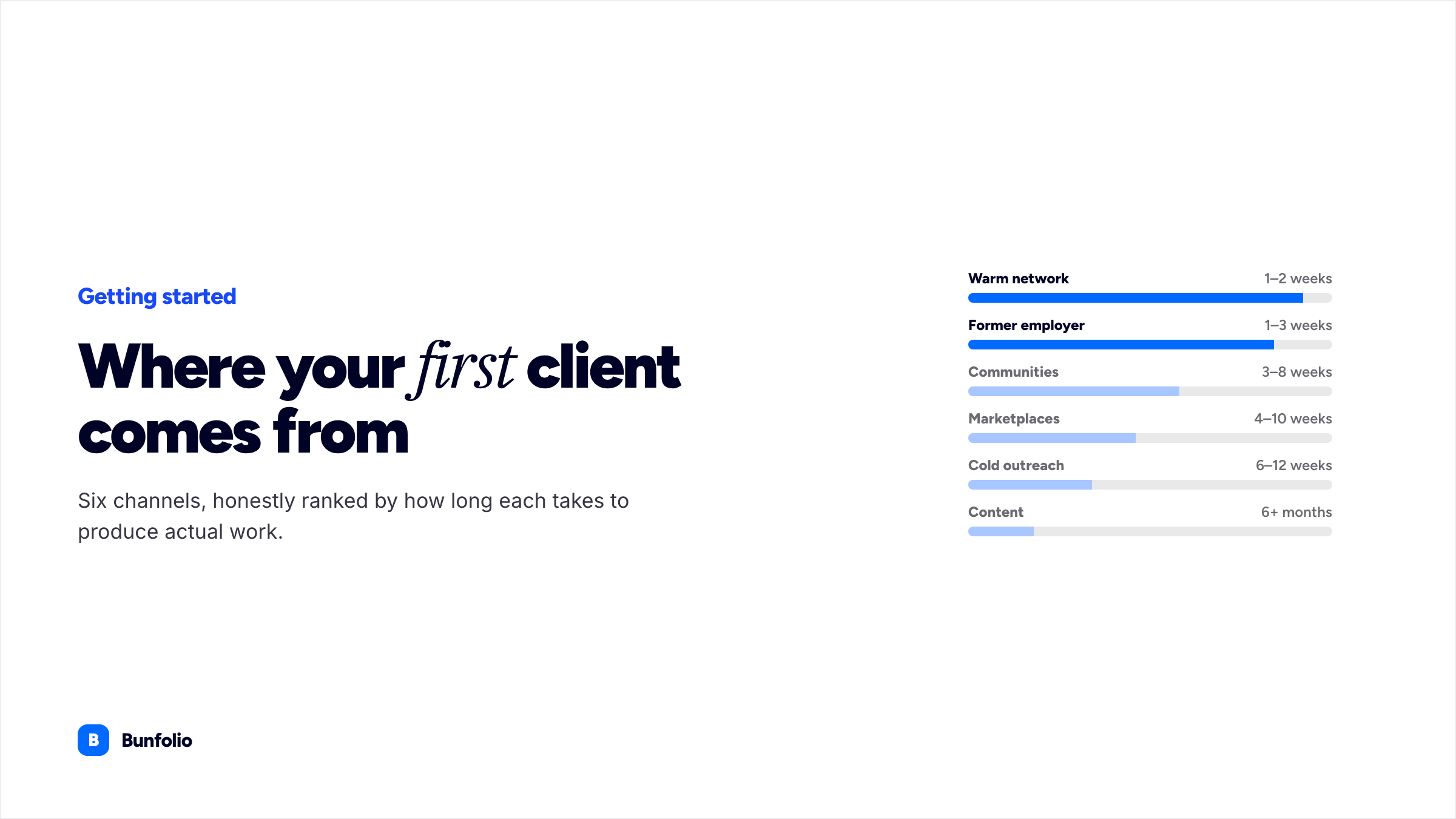
July 30, 2026 · 22 min read
How to Get Your First Freelance Clients
Six channels ranked by how fast each one realistically produces work, cold outreach that earns a reply, and how to turn a first job into the evidence that wins the second.
July 9, 2026 · 13 min read
How to Build a Freelance Portfolio Website That Wins Clients
The eight sections a hiring client actually reads, how to choose which work to show, and the technical floor your site has to clear — plus a realistic weekend plan for getting it live.
October 5, 2026 · 16 min read
How to Become a Freelance Photographer: From Good Photos to Paid Work
A practical path from "I take good photos" to paid freelance work: choosing a niche, the kit you actually need, and building a portfolio before you have clients. Plus the business basics photography a...