
November 25, 2026 · 19 min read
What to Include in a Cover Letter: Every Part, With an Example
A cover letter should include a header with your contact details, the date and the employer's details; a greeting to a named person; an opening naming the job; one or two paragraphs of evidence; why this employer; a closing with a next step; a sign-off; and your attachments or portfolio link. In an email, the header becomes a subject line.
A cover letter should include eight parts, in this order: a header with your contact details, the date and the employer's details; a greeting to a named person; an opening that names the job and why you fit; one or two paragraphs of evidence; a paragraph on why this employer; a closing with a next step; a sign-off with your name; and your portfolio or attachments.
Every guide gives some version of that list. What decides whether each part works is the detail: the header when the letter is an email, evidence rather than claims, "why them" without flattery, and what to leave out. This guide goes part by part, shows the header in three formats, lists what does not belong, and ends with one complete letter annotated line by line.
The greeting, the first line, the ending and the length each have a full guide of their own on this blog; here you get the rule and the example, and a link for the depth.
The eight parts at a glance
One invented application runs through the whole guide. Grace Whitfield is a marketing coordinator applying for a Marketing Coordinator role at Alder & Finch, an independent furniture and homeware brand. The role reports to Samir Haddou, the head of marketing, and the advert asks for someone to run the email calendar, coordinate product launches with the design team and report on campaign results every month.
Here is every part of her letter in one table. Check your draft against each row.
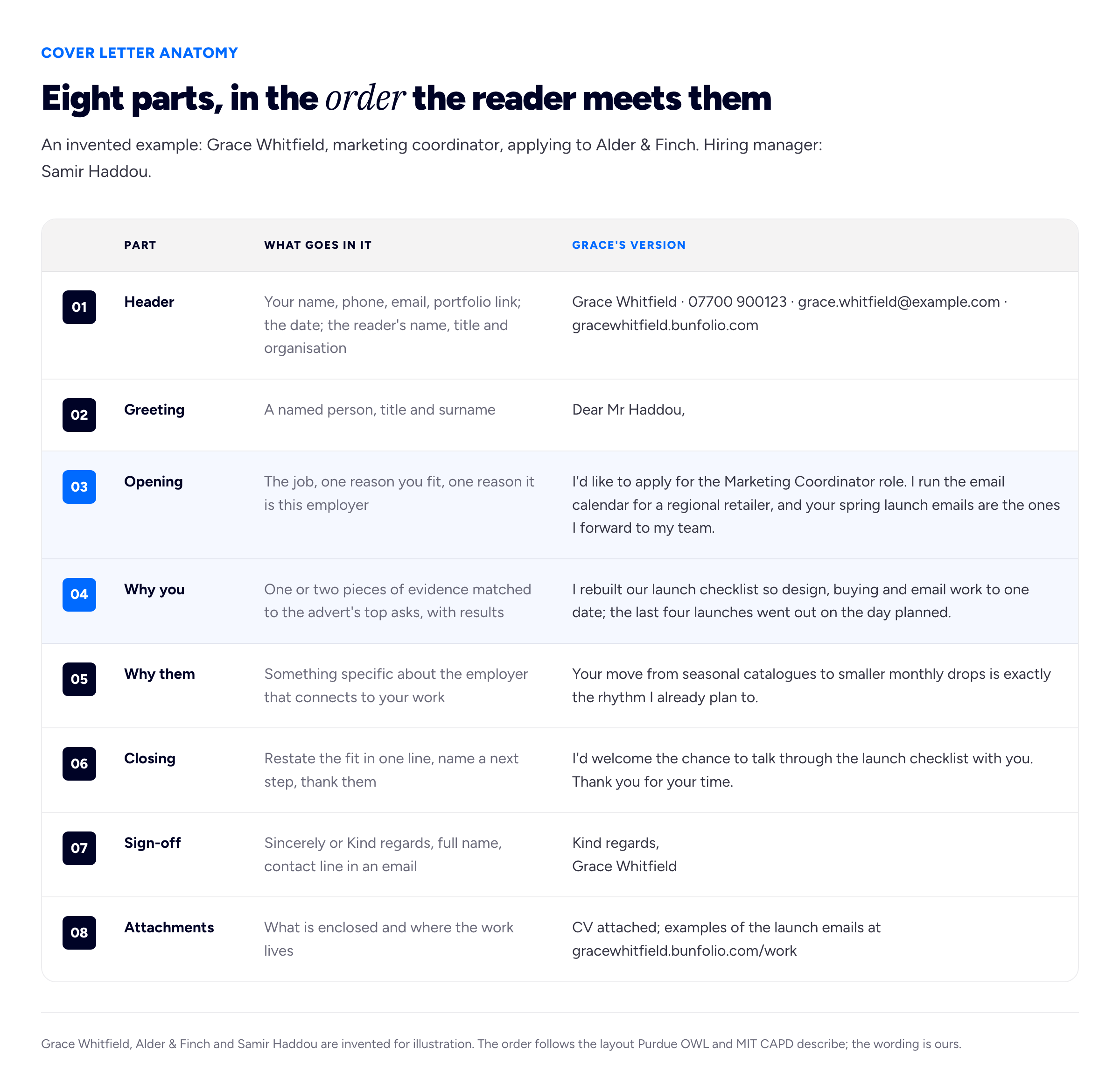
The eight parts of a cover letter, with what each must contain and one invented applicant's line for each.
The highlighted rows carry the decision. Header, greeting and sign-off are hygiene: wrong looks careless, right goes unnoticed. The opening and the evidence are where a reader decides whether to keep going.
Part one: the header
The header is the most format-dependent part. Purdue's Online Writing Lab gives the order for a printed or attached letter: your own contact information first, then "the date and company contact information should directly follow your contact information." That is three blocks, top to bottom.
Your contact block
Your full name, a phone number you answer, a professional email address, and a link if people judge your work by looking at it: a portfolio, GitHub, or LinkedIn if it says more than your CV does. A full postal address is optional for most jobs now; add a town or city if location matters (a hybrid role, a relocation).
The rule that matters more than any of those choices: the contact block must match your CV exactly. Same name, same spelling, same email, same phone, same link. A recruiter searching their applicant system for "Grace Whitfield" may never find "Gracie Whitfield". Copy the header straight from your CV; our guide to the resume header covers that block in detail, and the letter's version should be its twin.
The date
The date you send it, written in full. British convention is day first ("25 November 2026"), American month first ("November 25, 2026"). Spelling the month out removes the ambiguity of 11/12 versus 12/11. Update it every time you reuse a letter; an old date says the letter was not written for this reader.
The employer block
The reader's name, their job title, the organisation and its address (the office the job is in, or head office). If you could not find a name, use the team or role ("Hiring Manager, Marketing"). This block is mostly a signal of care: it shows you know who you are writing to.
A reference line, if there is a reference
MIT's careers office says that if the role "has a reference number or code, be sure to include it in your letter". Put it on one line above the greeting: "Re: Marketing Coordinator, ref. AF-2611". No reference, no line.
UK and US layouts
Two layouts are in use. The American block format, which Purdue describes, puts everything flush left. The traditional British business-letter layout puts your address in the top right; the University of Reading's careers guidance still recommends a "formal business letter layout with your address in the top right-hand corner". Both are correct. If in doubt, use flush left: it survives being pasted into an applicant system, where right-aligned text tends to collapse. The documents themselves differ by country too: what a British employer calls a CV is not always what an American one means, as our guide to CV vs resume explains.
The email version, where most of the header disappears
When the cover letter is the body of an email, or text pasted into a portal box, the email already carries a date and your address. So the date and employer block go, and your contact details move to the signature at the bottom. The subject line takes the header's place, doing the work of the reference line.
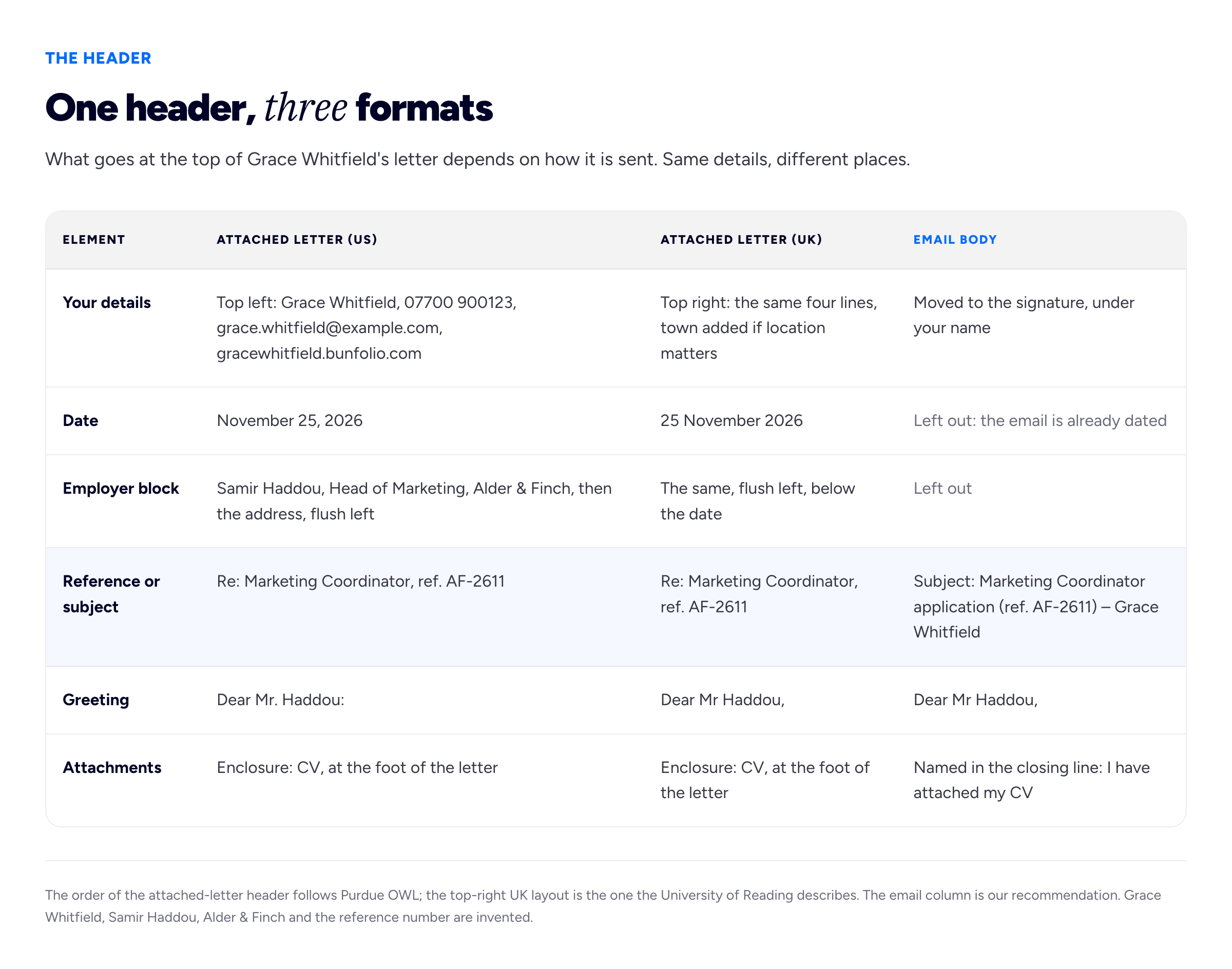
The same header written for an American attached letter, a British attached letter and an email body.
Put your name in the subject line: "Application" on its own is unsearchable in an inbox of forty.
Part two: the greeting
Address the person who will read the letter, by title and surname. Purdue's example is "Dear Mr. Roberts:", and it adds that if you are unsure which title someone uses, you can avoid the problem "by simply using the person's full name". The National Careers Service says it is "important to try to address your cover letter to someone by name", and falls back to "Dear Sir or Madam" when you cannot find one. MIT's fallback is "Dear Hiring Manager", which reads less stiffly to most people now.
The company's team page named Grace's reader, so her greeting is "Dear Mr Haddou," in the British style. In an American letter it would be "Dear Mr. Haddou:" with a full stop after the title and a colon after the name. Where to find a name when the advert does not give one, how to handle doctors, panels, recruiters and double-barrelled surnames, and why "To whom it may concern" is best avoided, are all in our guide on how to address a cover letter.
Part three: the opening paragraph
MIT's guidance is to state "clearly in your opening sentence the purpose for your letter and a brief professional introduction", and to "specify why you are interested in that specific position and organization". In practice that is three things in two or three sentences: the job you are applying for, one concrete reason you fit it, and one reason it is this employer.
I'd like to apply for the Marketing Coordinator role at Alder & Finch. For the past two years I've run the email calendar and product-launch schedule for a regional homeware retailer, and your spring launch emails are the ones I forward to my own team as the standard to aim for.
Grace skips "I am writing to express my interest in", which spends a sentence on what the reader knows, and skips adjectives about herself ("passionate", "results-driven"). She gives the job, her current work in terms the reader can picture, and one specific thing about the employer. The National Careers Service also suggests saying how you found the job; worth a clause if it helps (a referral, a talk), not if the answer is "a job board". If there is no advert at all and you are introducing yourself cold, a letter of presentation does the same job without a vacancy to point to.
The types of opening line, graded from weak to strong, with a dozen to adapt, are in our guide on how to start a cover letter.
Part four: why you, the evidence paragraph
The body of the letter, and the part most people get wrong by writing claims instead of evidence. "I have strong organisational skills" is a claim. Evidence is what you did, with a result someone could check. MIT puts it as citing "a couple of examples from your experience that support your ability to be successful in the position", and it adds the line that should sit above every draft: "Try not to simply repeat your resume in paragraph form."
How to choose what goes in
Underline the two or three things the advert asks for most (usually near the top, or repeated). Pick one example from your work for each, and write it in four beats: the situation in a clause, what you did, what changed, and why that matters to this job. The University of Reading's guidance makes the same point about structure: "each paragraph addresses only one important factor." If you draft with an AI assistant, give it the advert and your own notes in the same way; our ChatGPT resume prompts include one for a cover letter.
Of Alder & Finch's three asks, Grace leads with launch coordination, where her experience is strongest and least obvious from her CV:
The part of my current job I'd bring most directly is launch coordination. When I started, design, buying and email each kept their own schedule, and launches regularly slipped by a week while assets were chased. I built a single launch checklist with one date for everyone and a weekly fifteen-minute check-in, and the last four launches went out on the day we planned them. Your advert describes the same three teams working towards monthly drops, which is the rhythm I already plan to.
One paragraph or two
One strong paragraph beats two thin ones. Add a second piece of evidence only if it says something your CV does not. Grace adds one sentence on reporting in her final letter, because the decision her report changed is new information; "monthly campaign reporting" alone would just echo her CV. How many words each paragraph gets, and how to cut a long letter down, is in our guide on how long a cover letter should be.
Evidence the letter can point to, not hold
Some evidence is grasped faster by looking than reading: a launch email, a report, a landing page. A line such as "you can see the four launch emails at the link below" turns a claim into something the reader can open. A portfolio site does this better than an attachment, because it is one link that works on any device and shows the work rather than describing it. Our guide on adding a portfolio link to your resume covers where and how to put the link.
Part five: why them
Most letters skip this or fill it with praise ("I have long admired your innovative brand"). The National Careers Service's advice is to "convince them that you're enthusiastic about working for them", and Reading's careers guidance adds the useful warning: "Never just repeat what is on their website." Reciting their mission statement proves only that you visited the homepage.
A useful "why them" sentence names something specific the employer is doing and connects it to your own work. Grace's version:
I've followed Alder & Finch's move from two seasonal catalogues a year to smaller monthly drops, and it's the part of the role I'm most interested in: it rewards exactly the kind of tight, repeatable launch process I've spent the last year building.
It works because it names something the company actually decided and ties it to her evidence. Look in their recent emails, social posts, launches, the advert's own description of what is changing, or a talk by someone who works there. This paragraph can be two sentences folded into another; what matters is that it is there. If you are writing with no advert at all, it carries the letter: see our guide to the letter of interest.
Part six: the closing and the call to action
The closing does three things in about three sentences: restates the fit in one line, names a next step, and thanks the reader. MIT's version is to "restate succinctly your interest in the role and why you are a good candidate" and to "thank the reader for their time and consideration". The National Careers Service adds: "Let them know how they can best contact you."
I'd welcome the chance to talk through the launch checklist and how I'd adapt it to monthly drops. I have attached my CV, and examples of the launch emails are at gracewhitfield.bunfolio.com/work. Thank you for your time.
"I'd welcome the chance to discuss" is confident; "I will call your office on Monday" is pushy; "I hope to hear from you at some point" is passive. Graded closing sentences and five complete closing paragraphs are in our guide on how to end a cover letter.
Part seven: the sign-off and signature
A plain sign-off, a line space, and your full name. In the UK, the convention the National Careers Service gives is "Yours sincerely" when you have addressed a named person and "Yours faithfully" after "Dear Sir or Madam". Reading's guidance applies "Yours faithfully" to "Dear Hiring Manager" too. In the US, "Sincerely" covers almost every case. "Kind regards" is acceptable in both countries and is the most common choice for emails.
On a printed letter, Purdue says to "sign your name in ink" between the closing and your typed name. On an attached PDF a scanned signature is optional. In an email, the signature block (name, phone, email, link) is where the header's details went, so do not leave it out.
Kind regards,
Grace Whitfield
07700 900123 · grace.whitfield@example.com
gracewhitfield.bunfolio.com
Part eight: attachments, enclosures and links
An attached letter traditionally ends with an "Enclosure" line under your name. It is a holdover from paper, but it is a useful check: if it says "Enclosure: CV", make sure the right CV is attached.
In an email, name the attachment in the closing ("I have attached my CV") and name the file sensibly: "Grace-Whitfield-CV.pdf", not "CV_final_v3.pdf". Send PDFs unless asked for Word. For work samples, one portfolio link beats five attachments, which the reader must open one by one and which can trip an email filter.
What not to include in a cover letter
Each of these feels relevant while you are writing, and each costs you space, tone or leverage.
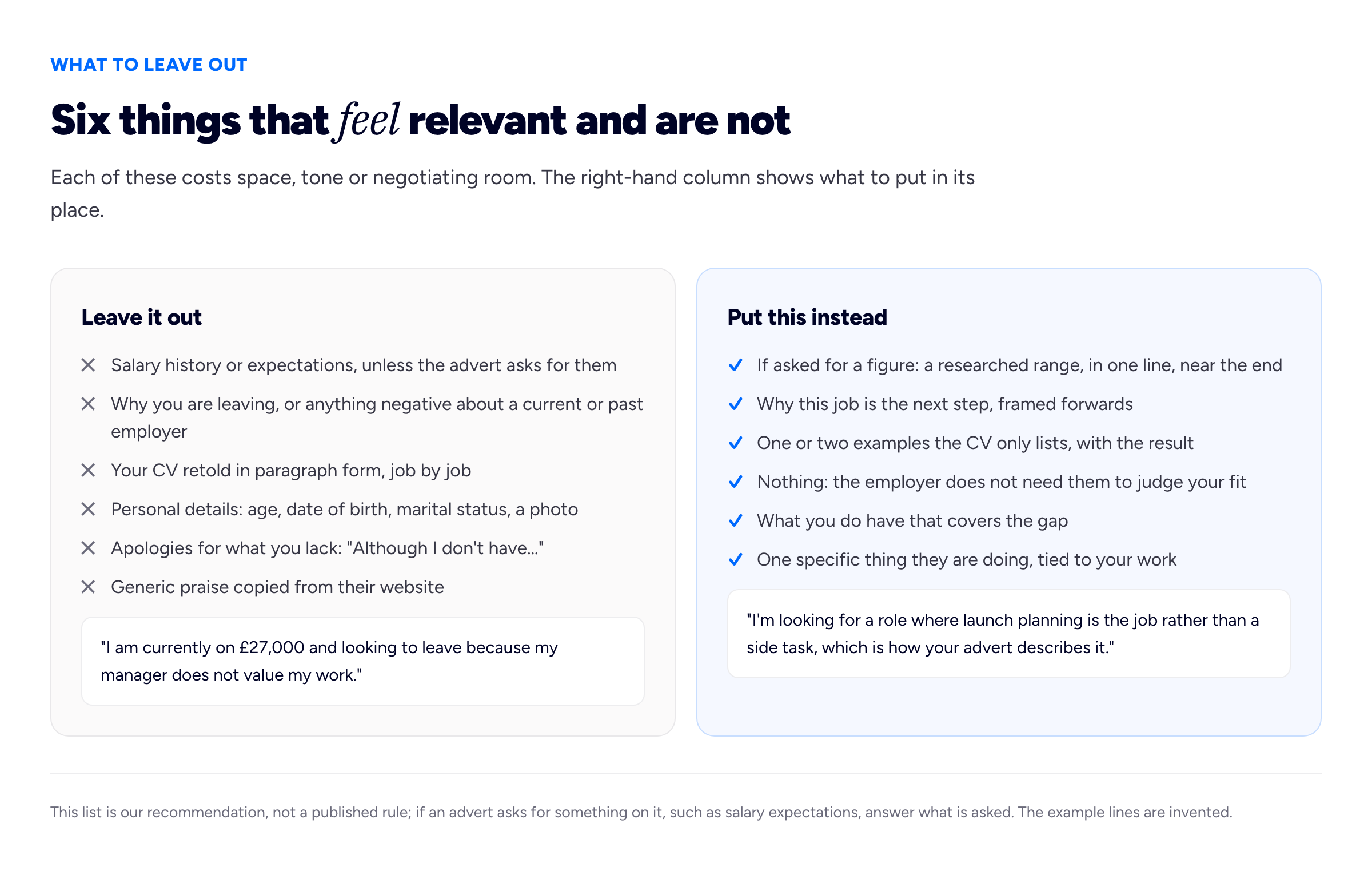
Six common inclusions that weaken a cover letter, each paired with what to write instead.
Salary history or expectations, unless asked
Volunteering your current salary sets an anchor before you have shown what you are worth. Leave it out unless asked. If the advert asks for expectations, give a researched range in one sentence near the end ("My salary expectation for this role is £30,000 to £33,000"); ignoring the request looks evasive. How to research that range and negotiate once an offer arrives is in our guide to salary negotiation.
Negatives, and why you are leaving
Even a mild complaint about a manager reads as a preview of how you will talk about this employer later. Frame any reason for moving forwards, as what this job offers. Our guide to reasons for leaving a job has wording for the interview, where the question does come up.
Your CV, retold
Same facts, never the same sentences. If your evidence paragraph could be made by joining CV bullets with "and", it is retelling, not arguing. See one achievement written for each document in our guide to cover letter vs resume.
Personal details the employer does not need
Age, date of birth, marital status, nationality (unless asked about the right to work) and a photo tell the reader nothing about your fit in a UK or US letter. The National Careers Service notes that if you have a disability, "you do not have to mention your disability at this stage if you prefer not to"; whether to do so is your decision, and leaving it out is a normal choice.
Apologies for gaps
"Although I don't have a marketing degree…" puts the gap in the reader's head before the strength. Write about what you do have that covers it. Reading's guidance allows that you "can briefly mention any additional factors" in the closing paragraph, such as grades that were lower than expected; the operative word is briefly.
The whole letter, annotated
Here is Grace's letter as an attached file, British layout with her details flush left for pasting safely into a portal. The notes in brackets are ours and would not appear in the real letter.
Grace Whitfield
07700 900123 · grace.whitfield@example.com
gracewhitfield.bunfolio.com[Header: copied exactly from her CV. No street address.]
25 November 2026
Samir Haddou
Head of Marketing
Alder & FinchRe: Marketing Coordinator, ref. AF-2611
[Date in full, day first. Employer block from the team page. The reference number from the advert.]
Dear Mr Haddou,
[Named greeting, British punctuation.]
I'd like to apply for the Marketing Coordinator role at Alder & Finch. For the past two years I've run the email calendar and product-launch schedule for a regional homeware retailer, and your spring launch emails are the ones I forward to my own team as the standard to aim for.
[Opening: the job, the fit, the employer, in two sentences.]
The part of my current job I'd bring most directly is launch coordination. When I started, design, buying and email each kept their own schedule, and launches regularly slipped by a week while assets were chased. I built a single launch checklist with one date for everyone and a weekly fifteen-minute check-in, and the last four launches went out on the day we planned them. I also write the monthly results summary my manager takes to the leadership meeting, which last quarter led us to drop one underperforming weekly send and move the budget to launch emails.
[Why you: two of the advert's three asks, each with a result. Reporting gets one sentence; the decision it changed is what the CV lacks.]
I've followed Alder & Finch's move from two seasonal catalogues a year to smaller monthly drops, and it's the part of the role I'm most interested in: it rewards exactly the kind of tight, repeatable launch process I've spent the last year building.
[Why them: one thing the company decided, tied back to her evidence.]
I'd welcome the chance to talk through the launch checklist and how I'd adapt it to monthly drops. My CV is enclosed, and examples of the launch emails are at gracewhitfield.bunfolio.com/work. Thank you for your time.
[Closing: next step, where the work is, thanks. Three sentences.]
Yours sincerely,
Grace Whitfield
Enclosure: CV
[Sign-off matched to the named greeting; enclosure line as a check that the CV went with it.]
The body is about 260 words, well inside one page. As an email, Grace would delete the date, employer block and enclosure line, move her contact details under her name, write "I have attached my CV", and use the subject line from the header diagram. Everything else stays word for word.
Applying for a first job or internship? The parts are identical; the evidence comes from study, part-time work, volunteering or a project, as long as you say what you did and what happened. See the cover letter for an internship and how to make a resume for your first job. Pasting into a portal text box? Treat it like an email body, skip bold and bullets, and check any character limit first.
A final check before you send
- Header matches your CV exactly: name, phone, email, link.
- Date is today's, written in full.
- Employer name, reader's name and job title are spelled correctly. The National Careers Service's advice is blunt: "Make sure the company name and recruiter's details are correct."
- The opening names the job in the first sentence.
- Every claim about yourself has evidence next to it.
- "Why them" mentions something this employer did, not something any employer would say.
- The closing names a next step and says where your work is.
- Sign-off matches the greeting; your name is under it.
- The attachment is attached, and is the right version.
- Read aloud once. Reading's guidance warns that "grammar and spelling mistakes are likely to result in your application being rejected".
Frequently asked questions
What are the main parts of a cover letter?
A header, a greeting, an opening paragraph, one or two paragraphs of evidence, a paragraph on why this employer, a closing with a next step, a sign-off with your name, and a note of anything attached. In an email, the header becomes a subject line and your details move to the signature.
What should a cover letter header include?
Your full name, phone number, email address and, if relevant, a portfolio or LinkedIn link; then the date; then the reader's name, job title, organisation and address. Add a reference line if the advert has a reference number. Make your details match your CV exactly.
Do you put your address on a cover letter?
A full street address is optional for most jobs now. Include your town or city if location matters to the employer, and the full address only if the application asks for it. In an emailed cover letter, leave addresses out entirely.
Should a cover letter include salary expectations?
Only if the advert asks for them. If it does, give a researched range in one sentence near the end of the letter rather than ignoring the request. Do not volunteer your current salary.
What should you not put in a cover letter?
Salary history, criticism of an employer, your CV retold in paragraphs, personal details such as age or marital status, apologies for skills you lack, and praise that could go to any company. None helps the reader decide.
How we put this guide together
Most of this guide is our recommendation, not sourced fact: the eight-part checklist, the four-beat evidence paragraph, the "why them" test, the leave-out list, the email column of the header diagram, flush left as the safe default, and the final check. They come from writing career tools at Bunfolio, not from a study.
The sourced points come from four careers-service pages, all read on 17 November 2026: Purdue Online Writing Lab's cover letter formatting and organisation (header order, the full-name greeting, signing in ink); MIT Career Advising and Professional Development's how to write an effective cover letter (reference numbers, "Dear Hiring Manager", the paragraph structure, not repeating your resume, one page); the National Careers Service's covering letter guidance (naming the reader, Yours sincerely and Yours faithfully, three to five paragraphs, disability disclosure, checking details); and the University of Reading's cover letters guidance (top-right address layout, one factor per paragraph, not repeating the website, Yours faithfully after Dear Hiring Manager, mistakes leading to rejection).
We have deliberately left out the statistics that usually decorate this question: seconds a recruiter spends on a letter, the share of hiring managers said to read them or reject letters with typos, the percentage of applicants who "customise". We could not trace any to a published sample and method, and an untraceable number reads as evidence when it is not.
Grace Whitfield, Alder & Finch and Samir Haddou are invented for illustration, as are Grace's roles, results, contact details, the reference number, the salary figures and every line of the example letter and all three diagrams.
Related reading: how to start a cover letter, how to address a cover letter, how to end a cover letter, how long a cover letter should be and cover letter vs resume.
More from the blog
November 1, 2026 · 22 min read
Cover Letter vs Resume: What Goes in Each, and When You Need Both
A resume, or CV outside North America, is the reusable record of what you have done; a cover letter is a one-page argument written for one job. What goes in each, the UK 'CV and cover letter' naming,...
October 29, 2026 · 20 min read
How to Address a Cover Letter (Greetings and Salutations)
Find the name first, then choose the greeting. Where hiring managers' names actually hide and when to stop looking, title and surname versus full name, what to write when there is no name, panels and...
October 4, 2026 · 27 min read
How to Write a Cover Letter for an Internship (With 5 Examples)
Little or no work experience? Here is how to read an internship advert and match each requirement to your coursework, projects, societies or part-time job, with the format to copy, a fill-in template,...