
November 23, 2026 · 19 min read
How to Make a Resume for Your First Job (With Two Samples)
List everything that involved turning up, being trusted or finishing something: school, volunteering, clubs, sport, babysitting, odd jobs, caring at home. Put education near the top, include unpaid work under Experience, write each line as a verb plus a result, and keep it to one page. Two complete samples show how.
To make a resume for your first job, list everything you have done that involved turning up, being trusted or getting something finished: school, volunteering, clubs, sport, babysitting, odd jobs, caring at home, things you taught yourself. Put your education near the top, then an "Experience" section that includes unpaid work, and write each line as a verb plus a result. Keep it to one page.
That is the whole method. The rest of this guide is the detail that makes it work: what counts as experience when nobody has paid you, the section order for a first resume, how to turn "I helped out at the café" into a line a manager believes, two complete sample resumes (one for a high school student, one for a new graduate), what to do about references, and what to leave off. The examples follow two invented people: Zoe Martins, 17, applying for a weekend job at Riverside Cinema, and Kwame Asante, who has just finished university and wants a programme assistant role at Greenfield Community Centre.
What a first-job employer is actually looking for
Nobody hiring for a first job expects you to have done the job before. The manager at Riverside Cinema reading Zoe's resume knows she has never worked a till on a Saturday night with a queue out of the door. What they are trying to work out is something simpler and more nervous: will she turn up, will she do what she is shown, and can she be left alone with customers and cash without anything going wrong?
Those questions can be answered from almost any part of your life. A weekly volunteer shift says you turn up. A family that trusts you with their children and house keys says you can be trusted. None of it was paid, and that does not matter.
For a new graduate the question shifts: can he organise things, write clearly, deal with the public and learn quickly? Kwame's degree, dissertation, society role and part-time work all answer that, if he writes them as evidence rather than titles.
So the job of a first resume is not to hide that you lack experience. It is to show the reader, line by line, that you already have the habits the job needs.
Step 1: list everything you have done, before you judge any of it
Open a blank document, not a template. Write a long, messy list of everything you have done in the last three or four years that involved any of these: turning up regularly, being responsible for something, dealing with people you did not know, handling money, finishing something with a deadline, or learning a skill without being made to.
People starting out almost always leave things off this list because they assume they do not count. Here is what does count, and what each one tells an employer:
- Volunteering. Regular unpaid work is experience, full stop. It goes in the experience section, not in a separate list at the bottom. A weekly shift at a food bank or a community centre café is the closest thing to a retail or hospitality job you can have without being paid for it.
- Babysitting, pet sitting, tutoring, lawn mowing, odd jobs. This is self-employment, even if you never called it that. Someone paid you, came back, and recommended you to others. Repeat bookings are a reference in themselves.
- Clubs and societies. Membership on its own says little. A role inside one, such as treasurer, organiser of an event, or the person who kept the rota, says a lot.
- Sport and music. Training three evenings a week for two years is a commitment most adults cannot match. Captaining a team is leadership, and the National Careers Service gives exactly that example of a hobby that shows skills.
- School and university projects. A group project with a deadline, a science fair entry, a dissertation, a lab report you were proud of. Pick the ones with a result you can describe.
- Caring at home. Looking after a younger brother or sister every day after school, or helping care for a relative, takes reliability and patience. You decide how much to say about it, but it is real responsibility and it can explain why you did fewer clubs.
- Things you taught yourself. A language from an app, video editing for your friends' channel, coding, baking for a school stall. Self-taught skills say you learn without being pushed, which is exactly what a first employer needs.
- Work experience and job shadowing. Even a week at a local business counts, as long as you say what you did rather than just where you were.
Do not cut anything yet. The strongest line on most first resumes is something the writer nearly forgot.
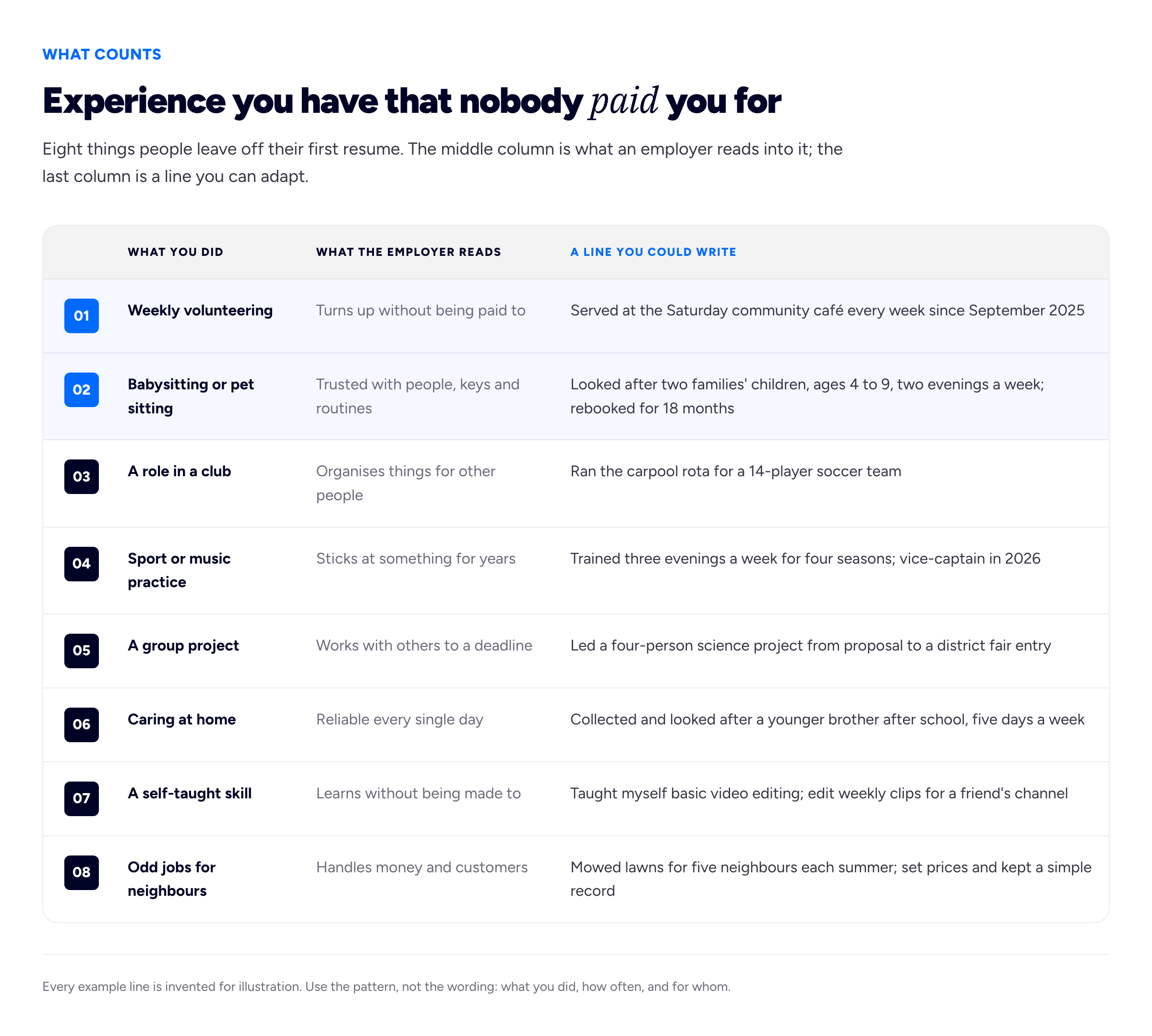
The middle column is the one to keep in your head: every line on a first resume is really an answer to "can I trust this person?"
Step 2: use the right section order for a first resume
The order of sections on an experienced person's resume is built around their jobs. Yours should be built around your strongest evidence, which for most first-time applicants is education plus a mixed experience section. Harvard's careers guidance makes the general point well: put your headings in order of importance rather than in a fixed template order. The National Careers Service says the same about education specifically: you can put it straight after the introduction "if you're early in your career or do not have much work experience".
Our recommended order for a first resume is:
- Header: your name, phone number, email address and town. Nothing else is required.
- Objective or summary: two lines saying what you are and what you are looking for.
- Education: school or university, qualification, expected or actual date, and one or two things worth knowing.
- Experience: paid and unpaid together, most recent first. Volunteering and self-employment go here.
- Activities and achievements: clubs, sport, projects, awards. Fold this into Experience if you only have one or two.
- Skills: a short line of practical skills, plus languages.
- Availability: for part-time and weekend jobs only.
Two variations are worth knowing. If you are still at school and your experience section is genuinely thin, a combined heading such as "Experience and activities" lets one volunteering role and one sports team sit together and look like a full section. And if you are a graduate with four years of steady part-time work, as Kwame has, you can move Experience above Education once the work is more relevant to the job than the degree.
Step 3: write the header and the opening lines
First resumes get the header wrong in two ways. If your email address is the one you made at thirteen, make a new one with your name in it. And leave off your street address: your town is enough. Our guide to the resume header covers the details, including whether to add a LinkedIn or portfolio link.
Under the header, write two lines. Experienced applicants write a professional summary; a first job is one of the few cases where a short objective is the better choice, because what you are looking for is genuinely useful information. Say what you are, what you want, and one thing that makes you a safe bet:
High school senior looking for a weekend role at Riverside Cinema. A year of serving customers and handling cash at a community café, and available every Friday evening and weekend.
Notice what is missing: "hardworking", "passionate", "team player". Those words cost nothing, so readers skip them. The cash, the café and the availability can be checked.
Step 4: turn activities into achievement bullets
Most first resumes describe where the person was. Good ones describe what the person did and what changed because they did it.
Harvard's guide asks for writing that is "specific, active and factual" and suggests quantifying results where you can. In practice, every bullet on your first resume should follow this pattern:
Action verb + what you did + how often or for how many + what came of it.
Most bullets need at least the first three parts.
Use how often, how many and how long
When you have no sales figures or targets, frequency and scale do the work numbers do on a senior resume. "Every Saturday since September 2025" proves reliability more convincingly than the word "reliable" ever could. "About 60 customers a morning" tells the cinema manager that a Friday night queue will not shock you. "Two families, for 18 months" says people trusted you and kept trusting you.
Use honest approximations ("about", "up to") and never inflate them; the real answer at interview has to match the page.
Choose verbs that mean something
"Helped" and "was responsible for" are the two weakest openings on a first resume because they hide what you did. Replace them with the actual action: served, cleaned, organised, taught, collected, counted, built, wrote, trained, planned, answered, sold, fixed, led. Do not write in the first person; resume bullets drop the "I".
Say the result, even when it is small
A result does not need to be dramatic. "Rebooked" is a result. "Asked to train the next volunteer" is a result. "Finished on time" is a result if the project had a deadline that others missed. Small, true, checkable results beat big vague ones every time. It is the same habit that makes any resume stand out, as our guide on how to make a resume stand out explains.
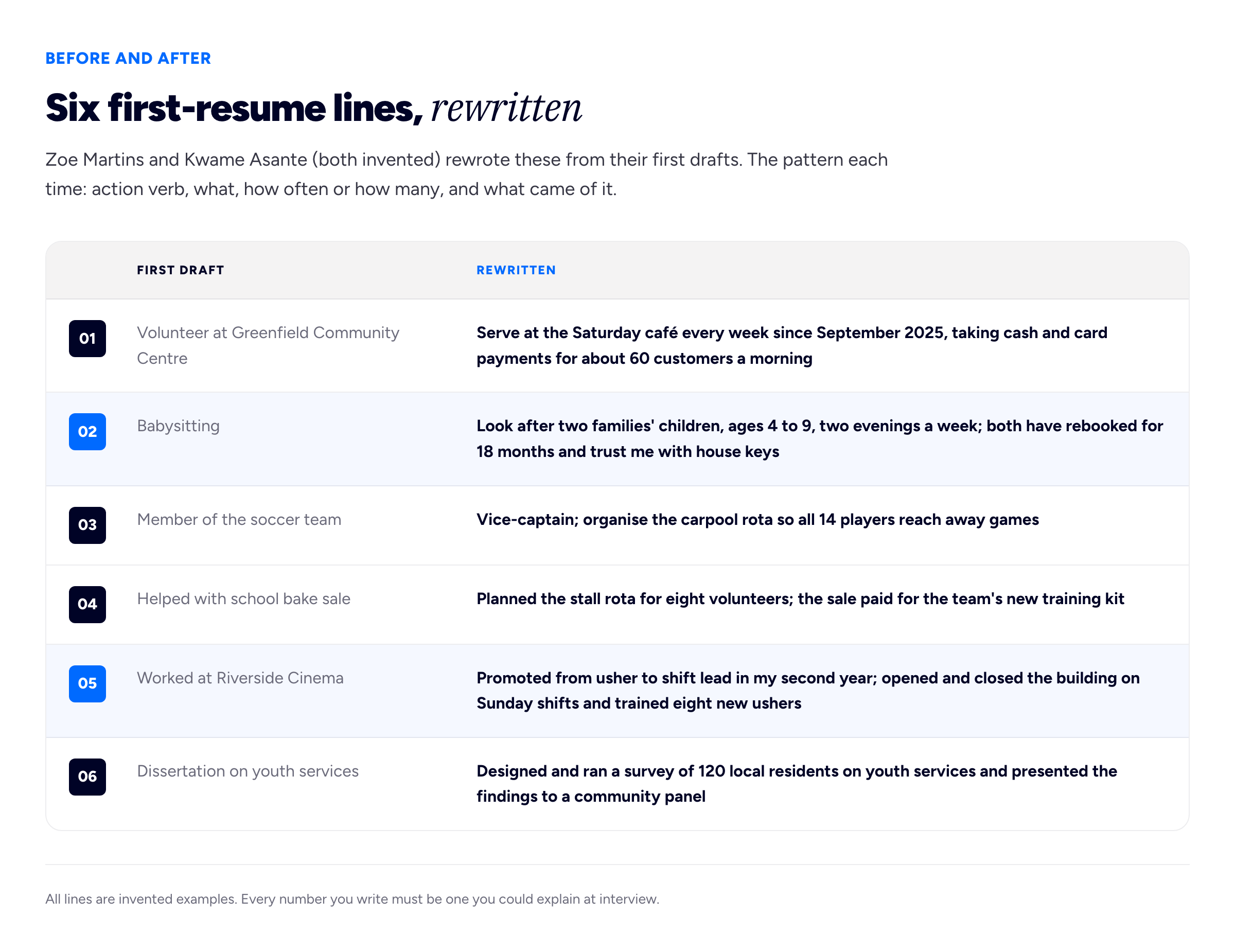
Nothing in the right-hand column is grander than the left; it is the same activity with the frequency, the scale and the result put back in.
Step 5: write the education section properly
For a high school student, education is a short block: the school, "High school diploma, expected June 2027", and anything specific that helps. That might be a subject relevant to the job, an award, a strong attendance record if it is genuinely strong, or a certificate such as a food safety or first aid course. Leave out middle school.
For a graduate, education does more work. List the degree, the university, the dates and your grade or GPA if it helps you. Our recommendation is to include a GPA when it is something you are pleased to have the reader see, and leave it off otherwise; nobody will assume the worst from its absence on a one-page resume. Below that, add one or two lines of evidence from inside the degree: a dissertation, a capstone project, a placement or a module directly relevant to the job. Kwame's dissertation survey is more useful to a community centre than his full module list, so the survey gets a line and the module list does not.
"Relevant coursework" earns a line only when three named courses match the advert. Ten course titles are filler.
Step 6: add skills, languages and availability
Keep the skills section to one or two lines of practical, checkable things: cash handling, a language and your level in it, software you have actually used, a driving licence if the job involves travel, certificates. Our full guide to the resume skills section explains why a long list of soft skills hurts more than it helps; on a first resume, your bullets should prove the soft skills so the skills line does not have to claim them.
For part-time, weekend and holiday jobs, add an availability line. It is one of the most useful things a first resume can include and very few do. A shift manager reading "Available Friday 5 to 11pm, Saturday and Sunday any time; full-time in the summer holidays" knows straight away whether you fill their gap. Only offer hours you can really work.
Step 7: keep it to one page
One page is enough room for everything a first-time applicant has, and a second page with three lines on it looks like padding. Our guide on how long a resume should be explains when that changes. For now, if you are running over, cut the weakest activity rather than shrinking the font.
If you are under a page, do not pad it. Three-quarters of a page with six good bullets beats a full page of twelve weak ones.
Sample resume for a high school student
Here is Zoe's complete resume for a weekend job at Riverside Cinema, built with everything above. She is 17, has never had a paid job with an employer, and has a full page anyway.
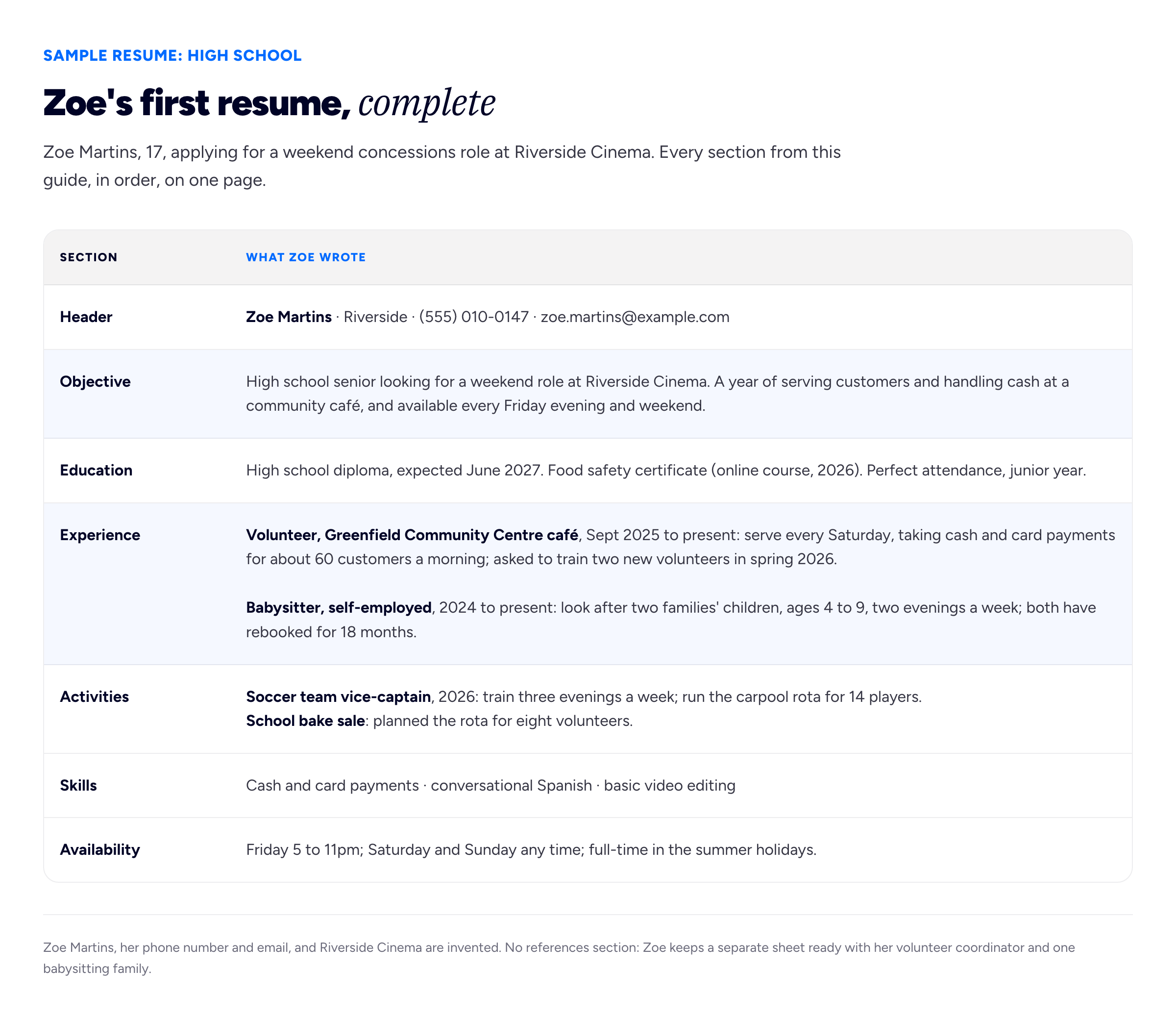
Not one line on Zoe's resume is a paid job with an employer, and every line still answers the cinema manager's real question.
Her volunteering sits under "Experience" with dates, like a job, because it was one in every way except the pay. The objective names the cinema, so it is clearly not one of fifty copies. And the availability line answers the question the manager would otherwise phone to ask.
Sample resume for a new graduate
Kwame has more material, so his challenge is choosing rather than finding. He is applying for a programme assistant role at Greenfield Community Centre, which involves running youth sessions, booking rooms, answering enquiries and writing short reports for funders. Here is his resume as text you can copy the shape of.
Kwame Asante
Riverside · (555) 010-0192 · kwame.asante@example.com
Summary
Sociology graduate with four years of part-time public-facing work and a dissertation on local youth services. Looking for a programme role where organising people, rooms and paperwork is the job.
Education
BA Sociology, 2022 to 2026. Graded 3.4 GPA.
- Dissertation: designed and ran a survey of 120 local residents on youth services; presented the findings to a community panel.
- Relevant coursework: Community Development; Research Methods; Youth and Society.
Experience
Shift lead (previously usher), Riverside Cinema, 2022 to 2026, part-time
- Promoted from usher to shift lead in my second year.
- Opened and closed the building on Sunday shifts, including cashing up and the security checklist.
- Trained eight new ushers using a one-page checklist I wrote, which the manager still uses.
- Handled customer complaints on shift before they reached the duty manager.
Treasurer, student volunteering society, 2024 to 2025
- Managed the society's annual budget and receipts for two fundraising events.
- Set up a shared sign-up sheet that filled every volunteering slot for the year.
Skills
Survey design and basic data analysis in spreadsheets · room and rota scheduling · conversational French · full driving licence
Kwame drops anything that does not serve the advert: a short unrelated summer job, his full module list, his school grades. He keeps the cinema job because opening a building, cashing up, training people and handling complaints are all things the community centre needs. And his dissertation is his most relevant line: he has already surveyed the people Greenfield Community Centre serves.
If your work is the kind people can see, such as design, writing, code, photography or video, a resume can only describe it. A simple portfolio site lets the reader open the actual work. Our guides to a student portfolio and to building a portfolio with no experience cover what to put on one, and Bunfolio will build you a free one if you want somewhere to link from the header.
References on a first resume
Leave references off the resume itself and keep them on a separate sheet. The National Careers Service is clear that you "should not put someone else's contact details on your CV", and in the US a references section is generally seen as wasted space. Our full guide to references on a resume covers when an employer asks for them and how to format the sheet.
The harder question for a first job is who to ask. You do not need a former manager. Good first referees are:
- A volunteer coordinator or club organiser who has seen you turn up regularly.
- A parent you have babysat for or a neighbour you have done jobs for, as long as they are not a relative.
- A coach, music teacher or youth leader.
- A teacher, tutor or academic adviser, ideally one who taught you recently.
Ask before you list anyone, and give them a copy of your resume so what they say matches it.
What not to include
A first resume is short, so everything on it is noticed. Leave these out:
- Your age, date of birth, marital status or nationality. The National Careers Service says not to include any of them, and Harvard's guide also lists age among things to leave off. Your graduation date already tells an employer roughly where you are; that is enough.
- A photo. Harvard's guidance says to leave photos off, and for US jobs that is the norm.
- Adjectives about yourself. "Hardworking, motivated, passionate team player" fills a line and proves nothing. Let the bullets do it.
- Every hobby you have. Include an interest only if it shows something the job needs, or if it gives an interviewer an easy first question.
- Anything you would struggle to explain. If you list "fluent Spanish", expect to be greeted in Spanish. If you list "expert in Excel", expect a question about it.
- "References available on request". It is assumed, and it takes a line you can use for evidence.
One more: do not let a chatbot write the whole thing. Harvard's guidance says plainly that "Generative AI should not be the primary author" of your resume, and the reason is practical. An AI draft invents numbers and skills you never gave it, and on a first resume every line is likely to be asked about. If you use one to tidy wording, our guide to ChatGPT resume prompts explains what to check afterwards.
Before you send it
Read it aloud once. Check that every date uses the same format, every bullet starts with a verb in the right tense (present for what you still do, past for what has finished), and your phone number and email are right: a typo there costs you the job silently.
Save it as a PDF unless the employer asks for something else, and name the file with your name, such as "Zoe-Martins-Resume.pdf". Then change the objective for each job you apply for.
If the application asks for a cover letter, our guide to what to include in a cover letter covers it. If you are applying for something more specific, such as a programme or a scheme, a letter of interest might be what is wanted. And when the call comes, how to prepare for an interview picks up where this guide stops: every line on your resume is now a question you might be asked, and you will want a short story ready for each one.
Frequently asked questions
How do I make a resume for my first job with no experience?
Treat volunteering, babysitting, odd jobs, clubs, sport, school projects and caring responsibilities as experience, because they show the reliability and trust a first employer is looking for. Put education near the top, list paid and unpaid work together under Experience, and write each line as an action verb plus how often and what came of it. Keep it to one page.
What should a high school student put on a resume?
A header, a two-line objective naming the job, your school and expected graduation date, any volunteering or informal work, clubs and sports with a role in them, practical skills such as languages or cash handling, and your availability. Leave out your age, a photo and middle school achievements.
Should I put babysitting on my resume?
Yes. Babysitting is self-employed work, and repeat bookings from the same families show you are trusted with children, keys and routines. List it under Experience with dates, how often you did it and the ages of the children, just as you would a job.
Does volunteering count as experience on a resume?
Yes. Regular volunteering is experience and belongs in the Experience section with your role, the organisation and the dates, not in a separate list at the bottom. The National Careers Service specifically suggests focusing on skills learned through projects, work experience or volunteering when you are starting out.
Should a first resume have an objective or a summary?
For a first job, a short objective usually works better, because what you are looking for is useful to the employer. Keep it to two lines: what you are, the job you want, and one fact that makes you a safe hire, such as a year of weekly volunteering or your availability.
How long should a resume for a first job be?
One page. That is enough space for everything a first-time applicant has, and a second page with only a few lines on it looks padded. If you are short of a full page, leave the white space rather than adding filler.
How we put this guide together
Most of this guide is our recommendation rather than sourced fact. The list of what counts as experience, the section order, the "verb, what, how often, result" bullet pattern, the availability line, the advice on objectives, GPAs, one page and references, and both sample resumes are our own judgement from writing and reviewing first resumes, not findings from a study.
Where we cite published guidance, we read it ourselves on 17 November 2026: the National Careers Service page on CV sections, which is the source for placing education early when you have little work experience, focusing on skills from projects, work experience and volunteering, the sports captain example, leaving out age, date of birth, marital status and nationality, and not putting other people's contact details on your CV; and the Harvard College Guide to Creating a Strong Resume, the source for ordering headings by importance, specific, active and factual wording, leaving off photos and age, and the line that generative AI should not be the primary author. The National Careers Service writes for UK CVs and Harvard for US resumes; on the points we quote, they agree.
We have deliberately left out the numbers that usually decorate this topic: how many seconds a recruiter spends on a resume, what percentage of teenagers have a job, and how much more likely you are to be hired with volunteering on your resume. We could not trace any of them to a published method, sample and date, and a number nobody can source is worse than no number.
Zoe Martins, Kwame Asante, Riverside Cinema and Greenfield Community Centre are invented, as are their phone numbers, email addresses, every resume line, every figure inside those lines and all the example copy in the three diagrams. Use them as patterns to adapt with your own true details, never as wording to copy.
Related reading: how to build a portfolio with no experience, the resume skills section, how to write a professional summary, references on a resume and the student portfolio guide.
More from the blog
October 3, 2026 · 19 min read
How to Make a Resume Stand Out: What to Change on the Page
To make your resume stand out, tailor the top third to the advert, rewrite duties as checkable results, use strong verbs, keep the layout plain and add one link to real work. Twelve changes, explained...

November 25, 2026 · 19 min read
Side Hustles From Home: 11 That Fit Around a Full-Time Job
The side hustles from home that fit a full-time job use a skill you already have and come in small jobs with no fixed hours: editing, bookkeeping, design, tutoring, virtual assistance, web builds, vid...
November 21, 2026 · 19 min read
Resume Header: What to Include, the Title Line, and Examples
A resume header holds your name, a one-line title naming the job you want, one phone number, one professional email, your city and state (or town in the UK) and a LinkedIn or portfolio link. Leave out...