
November 21, 2026 · 18 min read
How to Prepare for an Interview: A Week-by-Week Plan That Works
To prepare for an interview, reread the advert and turn each requirement into the question it will become, research the employer enough to say why you want to work there, and build six to eight true stories with results. Practise answering out loud, prepare two or three questions, and plan the journey and paperwork the night before.
To prepare for an interview, reread the job advert and list what it asks for, research the employer enough to say why you want to work there, and build six to eight true stories that prove the advert's main requirements. Practise answering out loud, prepare two or three questions, and plan the journey and paperwork the day before.
Most guides stop there with a checklist. This one turns it into a plan from the moment the invitation lands to the moment you walk in: how to read an advert so it tells you the questions, how to build the evidence bank that answers most of them, a method for answering questions you did not see coming, and a practice routine that does not make you sound rehearsed. One invented candidate runs through all of it, so you can see each step done rather than described.
The example we will follow
Leila Haddad has spent three years on the front desk and then the phones at a busy GP practice. She has applied for a Patient Experience Coordinator post at Brackenridge Health, an invented group of outpatient clinics. On a Tuesday afternoon she gets this email from Owen Pritchard, the in-house recruiter:
Hi Leila, thanks for your application. We'd like to invite you to an interview for the Patient Experience Coordinator role on Tuesday 2 December at 10:30, at our Ashby Road clinic. It will last about 45 minutes with the head of patient services and me. Please let me know if this time works, and whether you need any adjustments.
Leila has a week, which is what the plan below is built for. If you have less, there is a short-notice version near the end.
Step one: read the invitation properly, then reply
Before you reply, check you know five things: the format (in person, video or phone), who will be there, the length, whether there is a task or test, and whether you need to bring anything, such as identity documents.
Owen's email does not say whether there is a task, so Leila's reply confirms the slot and asks the one missing question:
Hi Owen, thank you, Tuesday 2 December at 10:30 works well and I'm looking forward to it. Could you let me know whether there's any task or presentation to prepare, and whether I should bring anything with me? I don't need any adjustments. Best regards, Leila Haddad
Reply within a working day if you can. Asking about a task is never a weak question: it is exactly what a careful person asks.
This is also the moment to ask for adjustments if you need them. The nidirect guidance for Northern Ireland is direct about it: "If you have a disability, all employers must make reasonable adjustments for you to have an interview." Extra time, an accessible room or questions in writing are common; you do not owe a diagnosis, just say what would help.
The plan, from a week out to the morning
Here is the whole week on one page. Seeing it together means nothing lands on the night before except what genuinely belongs there.
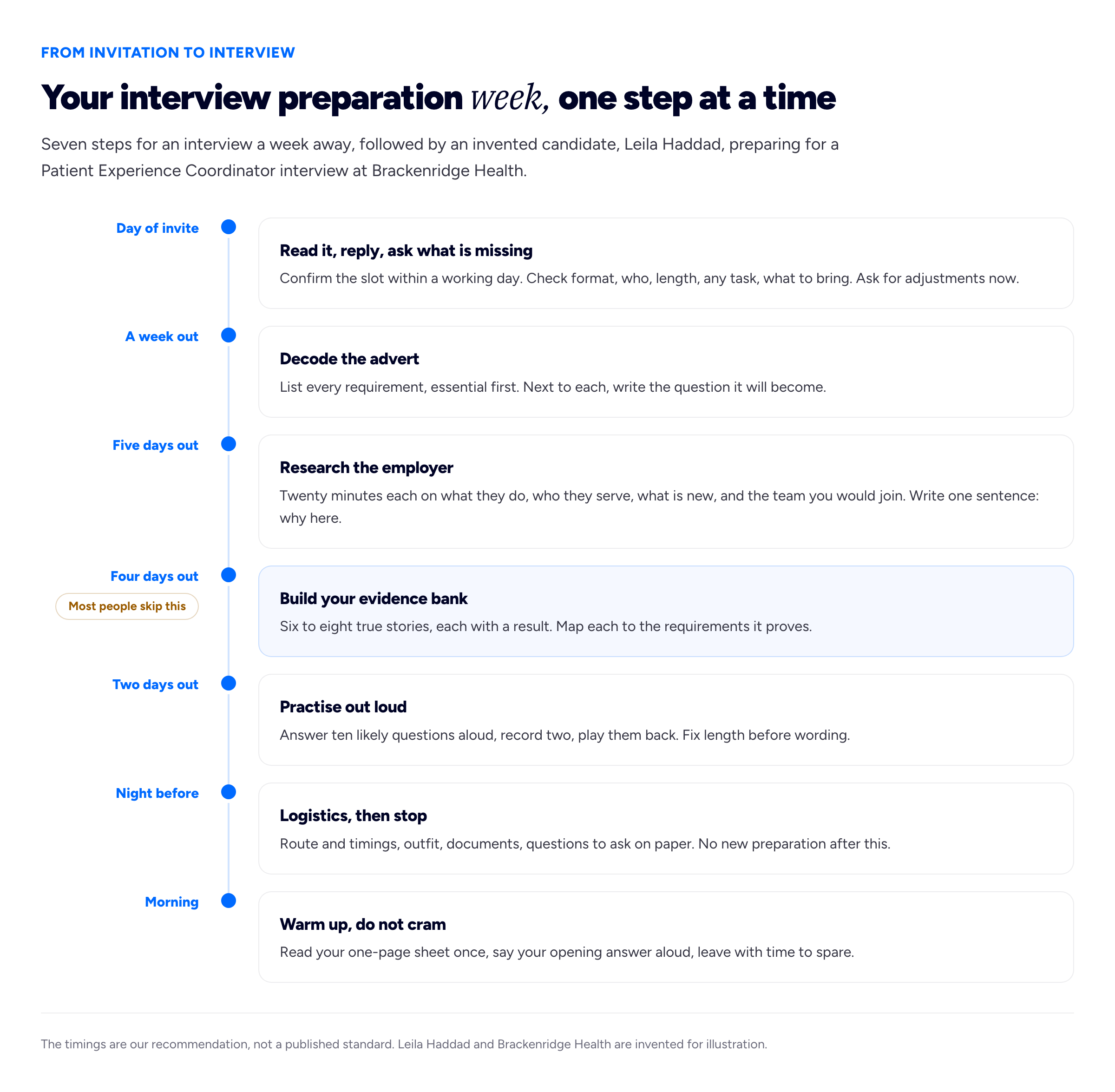
Spread the work across the week so the night before holds only logistics, and the morning only a warm-up.
Decode the advert before you research the company
Most people start on the company's website. Start with the advert instead: it is the closest thing you have to the interviewer's question list. The University of Sheffield's careers service describes the person specification as "a list of essential and desirable criteria", and notes that "Many recruiters will use their criteria as a selection tool". Panels often write questions from those criteria, so knowing them lets you predict most of the questions.
Print the advert or paste it into a document. Then go through it with two columns:
- Every requirement, in their words. Essential criteria first, then desirable. Include the ones buried in the duties paragraph ("you will handle complaints from first contact to resolution" is a requirement, even if it is not in the bullet list).
- The question each one will become. "Experience of resolving complaints" becomes "Tell me about a time you dealt with a difficult complaint." "Confident using data to improve services" becomes "Give an example of when you used information to change how something was done." "Able to work with clinical and non-clinical colleagues" becomes "Tell me about working with someone whose priorities were different from yours."
Leila's advert has six essential criteria and two desirable ones. Her eight likely questions exist before she has opened Brackenridge's website. Underline any phrase the advert repeats; the interview will spend time on it.
The nidirect page puts the same habit more simply: "Reread the job advert to refresh your memory and to make sure you haven't missed anything." Reread your own application too: anything you claimed there is fair game.
Research the employer: enough to say "why here"
Company research has one job: to let you answer "why do you want to work here?" with something only true of this employer. Sheffield's careers service makes the reassuring point that "you are not expected to be an expert, but you should know enough about them". You are not preparing for a quiz.
Our recommendation is to spend about twenty minutes on each of four things, and to write one line of notes per item rather than pages:
- What they do and for whom. Say it back in one sentence of your own.
- What is new. Their news page, recent social posts, anything in the local or trade press from the last year.
- How they describe themselves. Their values page, read for the one value that connects to the job, not all six.
- The team you would join. The hiring manager's public profile, and on LinkedIn the people already doing similar roles.
Then write one sentence: why this job, here. Leila's is: "You've just opened two new clinics and your advert talks about making patient feedback consistent across sites, which is the problem I've been solving at practice level for three years." She will use it at least twice.
Reciting the founding year proves you read the website. Linking something you found to something you have done proves you understand the job.
Build an evidence bank of six to eight stories
This step makes the biggest difference, and most people skip it. The National Careers Service advice is to "prepare some examples from your past experience to refer to in the interview". Sheffield's is to "try to identify specific situations you have been in where you have demonstrated their criteria". An evidence bank is that, written down in advance.
Six to eight stories is the range we recommend. Fewer, and you will tell the same story twice. More, and you will not remember them crisply. One good story usually proves two or three criteria, so eight covers almost any competency-based interview.
What makes a story worth banking
- It is specific. One occasion, not "I often".
- You did something. "We" is fine for context; "I" is what the interviewer scores.
- It has a result. A number if it is real; otherwise a concrete outcome is enough.
- It survives follow-up. The NCS warns you to "be prepared to answer follow-up questions about the examples you give". If you cannot say what you would do differently, it is not ready.
Structure each story with STAR
The National Careers Service sets out the STAR method: Situation, "the situation you had to deal with"; Task, "the task you were given to do"; Action, "the action you took"; and Result, "what happened as a result of your action and what you learned from the experience". Write each story as four short lines, with the fewest words on the situation and the most on the action. The result line is the one people forget and interviewers remember.
We cover the question types that most need this in our guide to behavioral interview questions; here the point is the bank itself. This is what Leila's looks like once it is mapped to her advert:
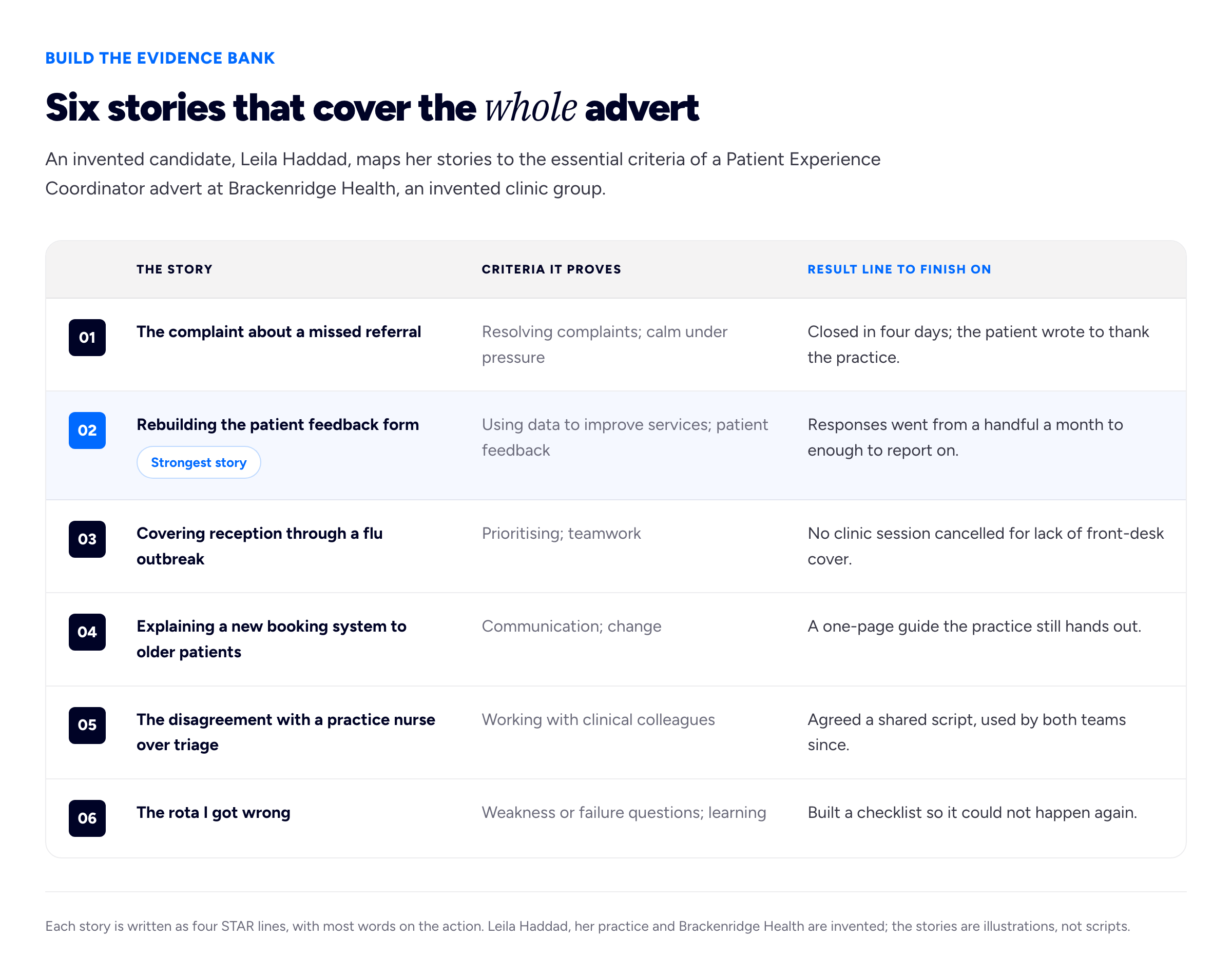
Six stories mapped to the criteria cover nearly every question the advert implies, including the one about a mistake.
Notice row six. Bank one story about something that went wrong and what you changed afterwards; it answers the mistake, weakness and failure questions. Our guide to answering "what are your weaknesses?" goes further on how to frame it.
Stories do not all have to come from paid work. The NCS says examples "could be from work, home or volunteering". For a first job, a group project, a part-time shift or caring for a relative are all real evidence; our guide to writing a resume for your first job has more on finding it.
How to answer interview questions in general
You cannot predict every question, but you can have a method that works on any of them. Ours has four moves:
- Answer first, in one sentence. If the question is "how do you handle a patient who is angry?", the first sentence is your answer: "I let them finish, then tell them exactly what I'm going to do and by when." Everything after supports it.
- Prove it with one story from the bank. "The clearest example was a complaint about a missed referral last spring." Then STAR, briefly.
- Land the result. One concrete line about what changed.
- Link it back to this job. One sentence: "That's the kind of complaint I'd expect to see across several clinics here, and the same approach would scale." Then stop talking.
On length, our recommendation is about one to two minutes for a story-based answer, and well under a minute for a factual one ("When could you start?"). Past two minutes, people start waiting for the end. If they want more, they will ask.
The question types, and which part of your preparation answers each
- The opener ("tell me about yourself"): a prepared 60 to 90 second summary. We have a full guide to answering "tell me about yourself".
- Motivation ("why this role?", "why us?"): your research sentence, plus one thing from your past. See also "why should we hire you?".
- Competency or behavioural ("tell me about a time…"): the evidence bank, used as above.
- Situational or hypothetical ("what would you do if…"): give the steps you would take, then "I did something similar when…" and a story.
- Awkward ones: why you are leaving, a gap, salary expectations. Prepare a calm, true two-sentence answer for each.
When you are stuck
Three moves are always allowed. You can ask them to clarify. You can take a pause: "Let me think of the best example" sounds considered, not lost. And you can use the nearest true example and say so: "I haven't managed a budget, but the closest thing I've done is…". nidirect also suggests you "Prepare notes or cue cards to help you if you think you might need a prompt during the interview". Glancing at your story titles is fine; reading an answer is not.
One question, two answers
Here is the difference in practice. The question is "Tell me about a time you used feedback to improve a service."
The unprepared version: "Well, feedback is really important in healthcare, and I've always been someone who listens to patients. At the practice we did get feedback, and I'd pass things on to the manager, and we'd try to improve things where we could. I think it's about having a patient-centred mindset."
Nothing in it can be checked, nothing happened, and the interviewer has nothing to score against the criterion.
The prepared version: "I rebuilt our patient feedback form. Last year we were getting a handful of paper responses a month, too few to tell us anything. I noticed patients were happy to answer two questions at the desk but not to fill in a page, so I cut the form to three questions, put a QR code on the appointment card and asked reception to mention it at checkout. Within two months we had enough responses to report on, and the first report showed most complaints were about phone waiting times, which led to a second phone line at peak hours. Your advert talks about consistent feedback across clinics, and that's the bit of my job I've enjoyed most."
Same person, same experience. The difference is a week of preparation.
Practise out loud, the right way
Silent practice does not count: reading your notes is not the same skill as speaking. The NCS suggests "You might want to ask someone you trust to help you practise", and Sheffield notes that it is "a good idea to get some practice before your interview, to build confidence".
The routine we recommend, two days out:
- Pick ten likely questions from your decoded advert, plus the opener, "why us?" and "do you have any questions for us?".
- Answer each one out loud, standing or sitting as you will be on the day, with a timer running.
- Record two answers on your phone and play them back. It is the fastest way to hear filler and a missing result.
- Fix length before wording. If an answer runs to three minutes, cut the situation down first.
- Do one round with a person, if you can, who interrupts with a follow-up. A careers service or a friend who has hired people will do. Ask which answer they remember best.
Do not write answers out word for word and learn them. The NCS advice on STAR is to "try to get your points across in a conversational way so as not to appear too rehearsed". Learn the story and its result line, and let the sentences vary.
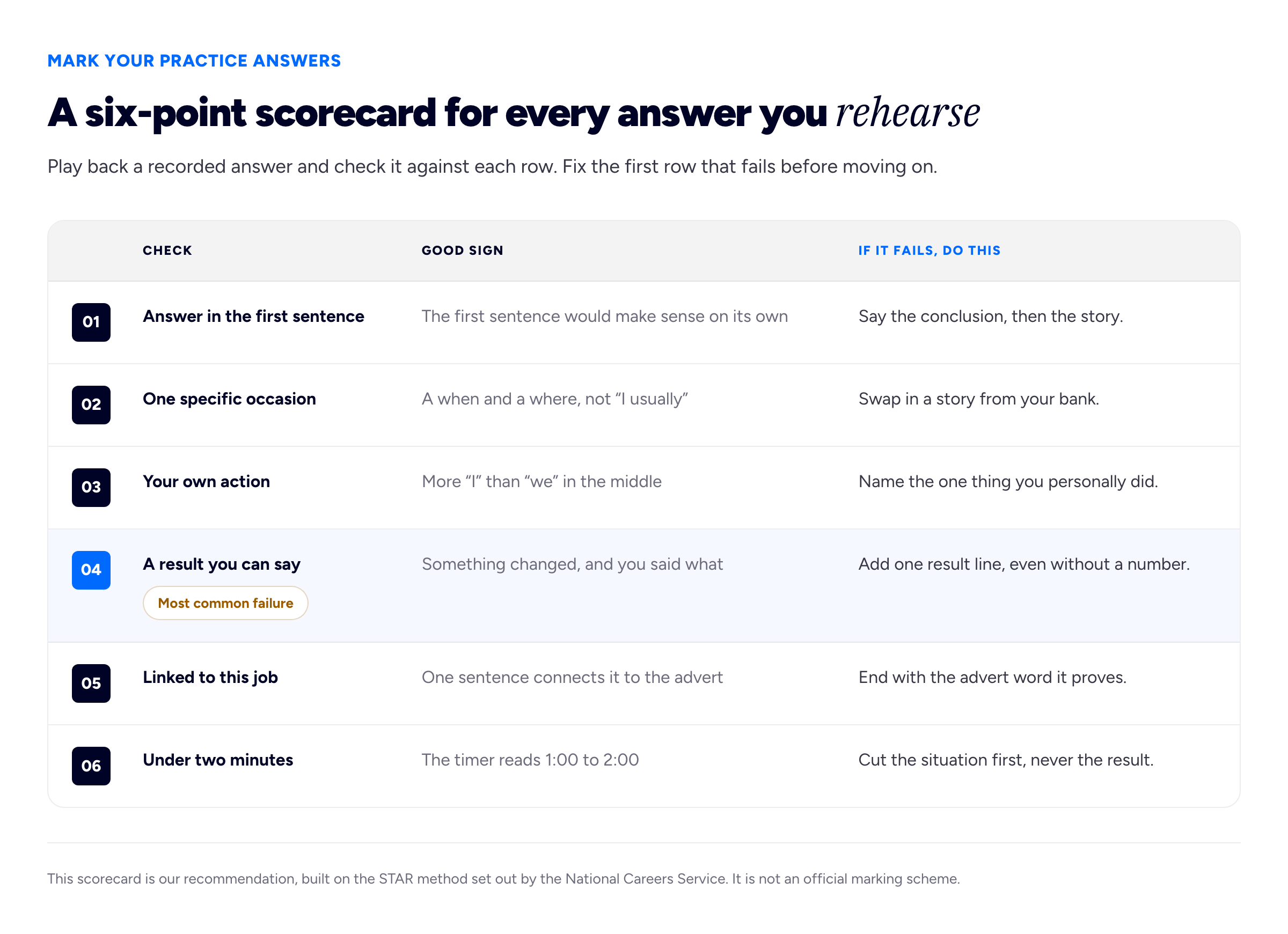
Mark each recorded answer row by row; the missing result line is the fault that turns up most.
Prepare your questions for them
Almost every interview ends with "do you have any questions for us?", and "no, I think you've covered everything" wastes the last good impression you get to make. Prepare three and write them down. Good ones come from your research: "Your advert mentions making feedback consistent across sites; what does that look like at the moment?" Our guide to questions to ask the interviewer has a full bank, grouped by what the answer tells you.
The logistics that sink good candidates
Good answers do not survive arriving flustered and twenty minutes late.
The journey
Work out the route, the time it takes at that hour, and a backup. nidirect suggests that you "Consider travelling to the company the day before the interview to check how long the journey will take". Our recommendation is to reach the building with time for a walk round the block, and to present yourself at reception ten to fifteen minutes before your slot. Save the recruiter's number so a delay becomes a polite call.
What to bring and what to wear
Lay both out the night before; the full list is in what to bring to an interview. For clothes, read what the team actually wears and go one notch smarter; we explain how in what to wear to an interview. If your work can be shown, bring a way to show it. A portfolio site shows evidence a CV cannot, and you can build one free with Bunfolio, though a folder of examples does the same job on the day.
If it is not in person
Video and phone interviews need a quiet room, a charged device and a plan for a dropped connection. The NCS reminds you to "check your computer and internet connection is working if your interview is online". See our guides to preparing for a phone interview and, if several people will interview you, the panel interview.
Make a one-page sheet
The last thing to do the night before is condense the week onto one page: your "why here" sentence, the titles of your six to eight stories with their result lines, your opener in bullet points, and your three questions. Then stop.
The morning, and the first five minutes
On the morning, eat something, read your one-page sheet once, and say your opening answer out loud once, in the shower or on the walk. That is a warm-up, not revision.
Be polite to everyone from reception onwards. In the room, have your sheet and questions within reach. If you are nervous, say a little less rather than a little more; pausing before an answer reads as thought.
Leila arrives at Ashby Road at 10:05, walks round the block, and gives her name at reception at 10:17. The first question is "tell me about yourself", which she has said aloud a dozen times; the third is about feedback, and she has a story ready.
Mistakes that undo good preparation
- Researching the company and not the advert. Knowing the employer does not answer "tell me about a time you…".
- Preparing answers, not stories. A script fails when the wording changes; a story does not.
- Stories without results. The story stops at "and so I dealt with it". The interviewer has nothing to write down.
- Only practising in your head. The first time you say an answer aloud should not be in the interview.
- Forgetting your own application. If you wrote it, they will ask about it.
Variations on the plan
Short notice: the 24-hour version
If the interview is tomorrow, keep the order and shrink each step. One hour on the advert and your application, writing the likely questions. Thirty minutes on the employer, ending in your "why here" sentence. One hour on four stories rather than eight, choosing the ones that cover the most criteria, plus one about a mistake. Thirty minutes saying your opener and two stories out loud. Then the logistics, and sleep.
An internal interview
Do not assume they know your work: "you know what I do" scores nothing. Prepare stories as if they were strangers.
A second or final interview
Write down, the same day, every question you were asked in the first round and anything the interviewer said they wanted. Bank two or three new stories and prepare sharper questions about the first few months.
After you walk out
Before you check your phone, spend five minutes writing down the questions you were asked and how you think each answer went. It is preparation for the next round. Then send a short thank-you; our thank-you email after an interview guide has templates. Our piece on signs an interview went well explains which signals mean anything. And as the nidirect guidance says of interviews that do not go your way, "Look on it as good practice as the more interviews you go to, the better your performance will become."
Frequently asked questions
How long should I spend preparing for an interview?
For a first interview a week away, our recommendation is roughly five to eight hours spread over the week: an hour on the advert, an hour or so on the employer, two hours building your evidence bank, and two hours of practice out loud. With only a day, three focused hours following the short-notice routine is enough.
How do you answer interview questions well?
Answer the question in your first sentence, back it up with one specific example from your own experience, say what the result was, and link it to the job in a final sentence. The STAR method (Situation, Task, Action, Result) structures the example well.
How many examples should I prepare for an interview?
We recommend six to eight specific stories, each with a clear result. Most prove two or three criteria, so that covers nearly every competency question. Include one about a mistake you learned from.
Is it OK to take notes into an interview?
Yes, within reason. nidirect suggests preparing notes or cue cards if you think you will need a prompt, and most interviewers expect you to have your questions written down. Keep them short and glance rather than read.
What should I do the night before an interview?
Do the logistics: check the route and timings, lay out your clothes, pack your documents and questions, and condense your preparation onto one page. Then stop preparing and sleep; late revision unsettles more than it helps.
How we put this guide together
Most of this guide is our recommendation rather than sourced fact. The week-long timeline and its timings, the advice to decode the advert before researching the employer, the four research areas and twenty-minute budget, the six-to-eight story range, the four-move answer method, the one-to-two-minute length, the practice routine and scorecard, the one-page sheet, the arrival timing, the short-notice routine and the five-to-eight-hour estimate are all ours, not findings from a study.
Where we quote published guidance, we read it ourselves on 17 November 2026: the National Careers Service's interview advice (researching the employer, preparing examples, practising with someone you trust, checking your connection for online interviews) and its page on the STAR method (the four definitions, examples from work, home or volunteering, and the warnings about follow-up questions and sounding rehearsed); nidirect's preparing for an interview (rereading the advert, cue cards, travelling the route the day before, reasonable adjustments, and treating each interview as practice); and the University of Sheffield careers service's preparing for an interview page (the person specification as essential and desirable criteria used for selection, identifying specific situations, and practice). The reasonable-adjustments point is nidirect's wording for Northern Ireland; the legal detail differs elsewhere, so check the guidance where you live.
We have deliberately left out the numbers that usually decorate this topic: the share of candidates said to arrive without researching the company, claims that interviewers decide within the first few seconds or minutes, and percentages of hiring managers who supposedly rank preparation above experience. We could not trace any of them to a published method, sample and date, and a figure nobody can source is worse than none.
Leila Haddad, Owen Pritchard and Brackenridge Health are invented for illustration, as are the advert, the emails, Leila's stories and every quoted answer in the text and diagrams. Use them as models to adapt, not answers to borrow.
Related reading: how to answer "tell me about yourself", behavioral interview questions, questions to ask the interviewer, what to bring to an interview and panel interviews.
More from the blog
November 19, 2026 · 24 min read
Panel Interview: Who Sits on It, How It Is Scored, How to Prepare
A panel interview is a job interview in which two or more people question you together and score each answer against the same criteria. Prepare one specific STAR example per person-specification crite...
November 17, 2026 · 20 min read
How to Prepare for a Phone Interview: Timeline and Cheat Sheet
Find out who is calling and why, because most phone interviews are a recruiter screen checking motivation, logistics, salary and right to work. Prepare in three passes: answers the day before, a one-p...
November 22, 2026 · 19 min read
Behavioral Interview Questions: STAR Answers, Examples, Story Bank
Behavioral interview questions ask what you actually did, usually starting "Tell me about a time…", because past behaviour is the best guide to how you will work. Answer with one real occasion in STAR...