
November 19, 2026 · 19 min read
Panel Interview: Who Sits on It, How It Is Scored, How to Prepare
A panel interview is a job interview in which two or more people, usually a chair, the hiring manager, HR and a peer or specialist, question you together and score each answer against the same criteria. Prepare one specific STAR example per person-specification criterion, research each panellist, and answer the asker while speaking to the whole panel.
A panel interview is a job interview in which two or more people interview you together, usually taking turns to ask questions from an agreed list and each scoring or noting your answers against the same criteria. A typical panel has a chair who runs the meeting, the hiring manager you would report to, someone from HR, and often a peer or technical specialist; in senior or public-facing roles a stakeholder from another team may join them. Employers use panels because several trained people scoring the same answers against the same criteria give a fairer, better-documented decision than one person's impression.
To do well in one, you prepare evidence rather than charm. Read the person specification line by line, match each criterion to a short, specific example from your own work, find out who is on the panel and what each of them is responsible for, and in the room answer the person who asked while speaking to all of them. This guide covers why panels exist, who sits on them and what each one is listening for, how scoring works, how to prepare, how to handle the room and a video call, what to ask at the end, and how to follow up with several people at once.
Why employers use panel interviews
The short answer is consistency. When one person interviews you alone, the decision rests on their questions, their memory of your answers and their sense of whether you would fit. When a panel interviews you, the questions are usually fixed in advance, each panellist writes down what you said, and the decision is argued out between people who heard the same answers.
The US Office of Personnel Management, which sets assessment policy for federal hiring, describes structured interviews as using "a standardized questioning and scoring process for all candidates", and says they generally involve more than one interviewer, which it calls a panel, because a panel can document and interpret what it hears better and reduces the risk of bias in the ratings. Its guidance adds that the interviewers must reach a consensus on the scores they give each answer. That one detail explains a lot about how a panel behaves: each person is not only forming a view, they are collecting the evidence they will need to argue for it afterwards.
That is why panels are so common in the public sector, universities, schools, the NHS and charities. These organisations can be asked to justify an appointment to an unsuccessful candidate, an auditor or a tribunal. A panel with a fixed question set and a written scoring record is the easiest process to defend. In the UK Civil Service, recruitment runs on a framework called Success Profiles, which GOV.UK describes as "the recruitment framework used within the Civil Service"; it assesses candidates against up to five elements (behaviours, strengths, ability, experience and technical skills), and which elements apply depends on the role, so the job advert tells you what will be tested.
Local councils publish the same logic in their candidate guidance. Chesterfield Borough Council's page for applicants, for example, tells you the panel will be at least two people, that every candidate is asked the same questions, that every interviewer will take notes throughout, and that the panel will test how closely you match the person specification. One line on that page is worth pinning above your desk before any public-sector interview: "The panel can only score you based on what you say in the interview." Not what is on your application form, not what they might infer, not what you meant. What you say.
Universities, schools and private companies use panels too, especially for senior, technical and cross-functional hires, though companies are often less formal: you may meet three people in a row rather than together, and nobody may be scoring line by line. The preparation below still works, because it is built on evidence.
Who sits on a panel, and what each person is listening for
Most panels mix the same four or five roles, and each one listens for a different part of your answer.
The chair
The chair runs the meeting: welcomes you, introduces the panel, explains the format, keeps time and closes by inviting your questions. The chair is usually responsible for the process being fair, so they are listening for whether you answered the question that was asked, and whether your answers give the panel something it can score. They will also cut you off politely when an answer runs long.
The hiring manager
This is the person you would report to, and the one with the most at stake. They are listening for whether you can do the job they actually have, on the team they actually manage, with the problems they have this month. They are the most likely to ask follow-up questions, and the follow-up is where vague answers fall apart. Sometimes the hiring manager is also the chair.
HR or a recruitment adviser
The HR panellist is there to make sure the process is consistent and lawful, and often to score the behavioural or values questions. They are listening for evidence against the competencies or values on the person specification, and for practicalities such as notice period. They often say least and write most.
A peer or technical specialist
A colleague at your level, or a specialist in the field, is there to test whether you know what you claim to know. They ask the technical question, the scenario, the "what would you do if" question. They are listening for detail and for honesty about the edges of your knowledge. A clear "I have not used that system, but I have used two like it and here is how I would learn it" scores better with this person than a confident bluff.
Sometimes, a stakeholder
For senior posts, community-facing roles and jobs that sit between departments, a panel may include someone from another team, a partner organisation, an elected member, a governor or, in some universities and charities, a student or service-user representative. They are listening for whether you would be good to work with from their side of the table, and whether you understand who the job serves.
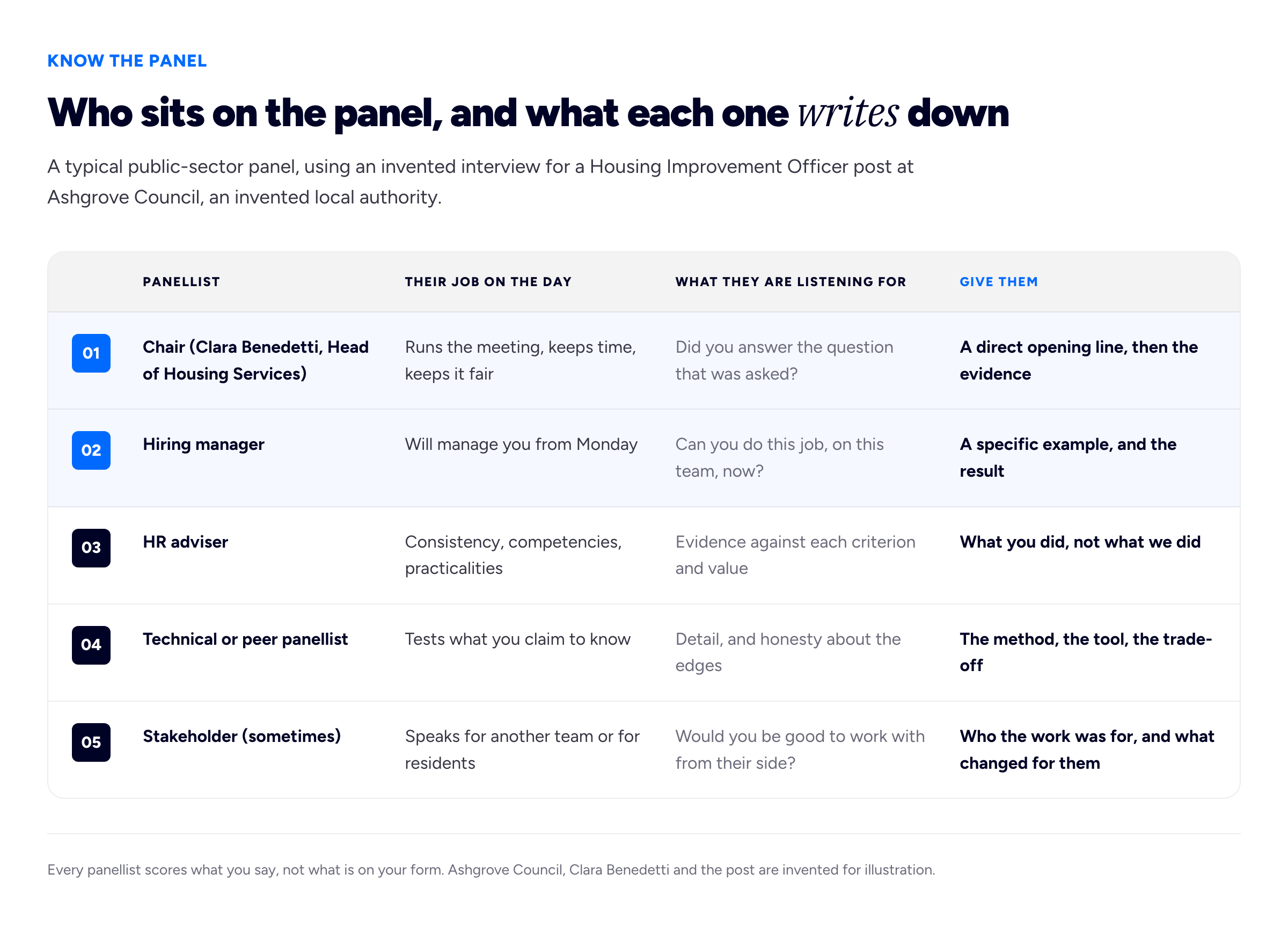
Each panellist is listening for a different part of the same answer, so a good answer gives all of them something to write down.
How panels score your answers
In a structured panel, each question is written to test one criterion, or occasionally two, from the person specification or the competency framework. Each panellist has a sheet with the questions and space for notes, and often a rating scale. The scale itself varies: OPM's guidance gives a five-point example, councils publish their own, and many organisations use descriptors such as "little or no evidence", "some evidence", "good evidence" and "strong evidence" rather than numbers. After you leave, the panel compares notes question by question and agrees a score, and the totals across all criteria decide who is appointed.
Four consequences follow.
- Each answer is scored on its own. A brilliant answer to question two does not rescue a thin answer to question five, because question five is the only place the panel tests that criterion. Prepare evidence for every line, not your three favourite stories.
- The panel can only credit what it heard. If you led a project but describe it as "we", the HR panellist may not be able to score your part. If you mention a result but not what you did to get it, there is nothing to score. Say "I" when you mean you.
- Follow-up questions are usually limited. In a strict structured interview, panellists may be allowed only a set probe or two, so they cannot coax a missing detail out of you. Put the detail in the first time.
- Silence while they write is normal. Panellists are trying to capture your answer in enough detail to argue for a score later. A pause while three people write is not a sign you said something wrong. Wait for the next question.
How to prepare for a panel interview
You can predict a panel's questions more accurately than usual, because the person specification is, in effect, the exam paper.
Step 1: Turn the person specification into a list of questions
Public-sector job packs usually include a job description and a person specification split into essential and desirable criteria, sometimes with a note saying how each criterion will be assessed: application, interview, test or presentation. Every criterion marked "interview" is a likely question. Copy them into a document, one per line, and rewrite each as the question a panel would ask. "Ability to manage a varied caseload and prioritise effectively" becomes "Tell us about a time you had more work than you could do. How did you decide what came first?"
If you are applying to the Civil Service, the advert will name the behaviours being assessed, and the interview will test those behaviours, plus any strengths or technical elements listed. Read that list as carefully as GOV.UK advises reading the job description, because it is the whole of the marking scheme.
Step 2: Match each criterion to one example, and write it in STAR
STAR stands for Situation, Task, Action, Result. It makes sure an answer contains what a panellist needs: the problem, what you personally did, and what changed. Most candidates spend too long on the situation and not enough on the action. As a rough guide, give the situation and task a sentence or two, the action most of your time, and the result a sentence or two with something measurable or observable in it.
Aim for one example per criterion, and a reserve for the criteria that matter most. You can reuse a strong example for two criteria if it genuinely fits both, but tell it from a different angle each time, and do not rely on one story for everything. A panel that hears the same project three times starts to wonder whether there is anything else.
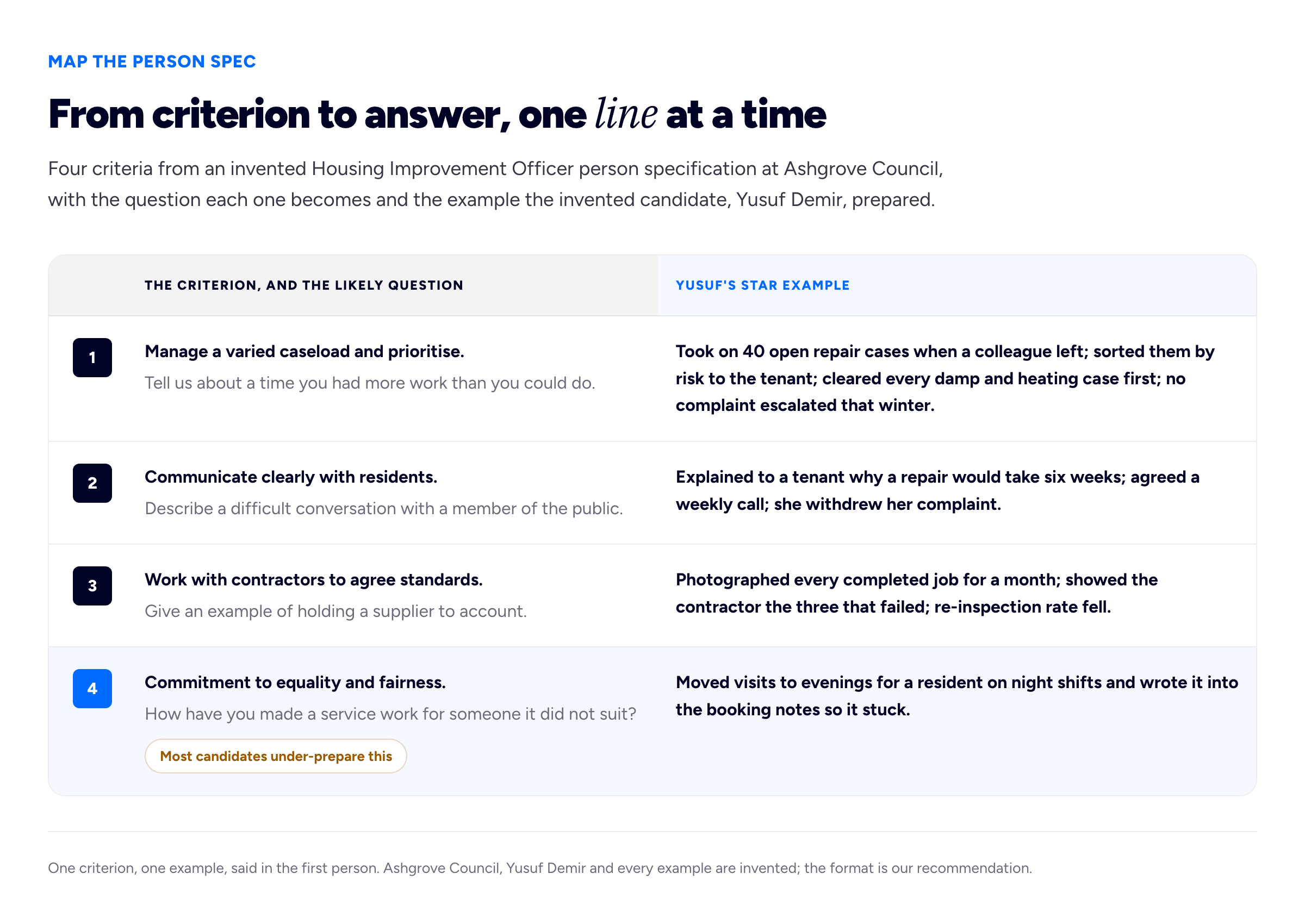
The person specification is the exam paper: each criterion is a question waiting to be asked, and each needs its own example.
Step 3: Find out who is on the panel
Many public-sector invitations name the panel members and their job titles. If yours does not, it is entirely reasonable to reply to the invitation and ask: "Could you let me know who will be on the panel, so I know who I am meeting?" Then look each person up on the organisation's website, its published staff structure, committee papers or a professional profile. You want their job, their team's responsibilities and any stated priorities, not anything personal.
Yusuf Demir, our invented candidate for a Housing Improvement Officer post at Ashgrove Council, found that his panel was Clara Benedetti, Head of Housing Services, as chair; the repairs team leader he would report to; and an HR business partner. A council report on Ashgrove's website mentioned that damp and mould complaints were a priority for the coming year. That told him which example to lead with when the caseload question came.
Step 4: Prepare your opening and your closing
Most panels open with something like "tell us a bit about yourself and why you applied". This is often not scored, but it sets the tone for everything after it. Prepare a 60 to 90 second answer that connects your recent experience to this role and ends on why you want it; our guide to answering "tell me about yourself" walks through the structure. Some panels also close with a summary question such as "why should we appoint you?", which is your chance to name the two or three criteria you are strongest on.
Step 5: Practise out loud, to more than one person
If you can, ask two friends to play a panel: one asks the questions, the other watches you. Practising with two people trains the habit that matters most in the real thing, which is spreading your attention across the table rather than locking onto whoever is talking. Time your answers: about two minutes each.
Finally, sort out the practical side early. Check the location, the format and any test or presentation, and pack copies of your application, your notes and a pen; our list of what to bring to an interview covers the rest.
In the room: handling several people at once
Answer the asker, address the panel
When someone asks you a question, start your answer looking at them. Once you are into the substance, let your eye contact move to the other panellists for a sentence or two each, then come back to the person who asked as you finish. It tells the asker you are answering them, and it tells everyone else the answer is for them too, which matters because they are all scoring it.
Do not play to the most senior person
It is tempting to direct everything at the chair or the most senior-looking person. Resist it. The HR adviser and the technical panellist have equal votes on the scores in most structured panels, and the quietest person in the room may be the one who decides a close call.
Expect note-taking, and help the note-takers
When every panellist is writing, you can make their job easier. Open with a line that tells them what the example is about: "The best example I have is from last winter, when I inherited a colleague's caseload." Signpost the result: "The outcome was that no complaint was escalated that winter." Short, clear sentences are easier to note than long ones with three clauses, and a panellist who can write your answer down accurately can score it accurately.
Use the chair
The chair manages the meeting, so you can use them. If you need a question repeated, ask. If you want a moment to think, say so: "Can I take a second to pick the best example?" None of this costs marks. Rambling while you think does.
Virtual panel interviews
Video panels are now common, especially for first-stage interviews. Everything above still applies, with some adjustments.
- Eye contact means the camera. On video you cannot look round a table. Look at the camera when you are making your main point, and at the screen when you are listening. Keep the panel's video tiles close to the camera if your software allows it.
- Use names to show who you are answering. Because you cannot turn towards the asker, start with their name when it is natural: "Thanks, Clara. The best example I have…" It does the work a glance would do in the room.
- Keep your notes off-screen, and brief. A sheet with the criteria and a keyword for each example is fine. A full script you read from is obvious on camera and makes your answers sound flat.
Test the platform the day before, with the same device, room and lighting, and ask for a phone number to call if the connection drops.
Common mistakes in panel interviews
Saying "we" throughout
Team work is real, but the panel is scoring you. "We redesigned the booking process" gives the HR panellist nothing to write against your name. "I mapped the process, found the two steps that caused most of the delays, and proposed removing them" does.
Running long
Panels usually have a fixed slot and a fixed number of questions. If your answers run to five minutes, the chair either cuts you off or drops a question, and a dropped question may be a criterion you can no longer score on. Aim for two minutes, and finish with the result.
Questions to ask a panel
Most panels end by asking whether you have any questions. Ask two, and if you can, direct them to different people. That shows you have noticed what each panellist is responsible for, and it gives more than one person a reason to remember the conversation.
- To the hiring manager: "What would you most want the person in this role to have achieved by the end of their first six months?"
- To the technical or peer panellist: "What does a normal week look like for the team at the moment, and what is taking up most of your time?"
- To a stakeholder: "From your side, what makes this role easy or hard to work with?"
- To the chair: "What are the next steps, and when should I expect to hear?"
Avoid questions the job pack already answers, and keep salary and leave questions for later unless the chair invites them. For a longer list, and the questions to avoid, see our guide to questions to ask the interviewer.
Following up with a panel
A short thank-you note is still worth sending, but who receives it depends on the organisation.
In many public-sector processes, candidates are told to direct all contact through the recruitment team. If so, send one email to the recruitment contact or the chair, thank the panel as a whole, and ask for it to be passed on. In a less formal process, you can send each panellist a short note. Separate notes should each mention something specific that person raised; three copies of the same paragraph read as a mail merge.
Yusuf's note, sent to Ashgrove's recruitment team the same afternoon, was three sentences: thanks to Clara Benedetti and the panel for their time, one line about the damp and mould priority that the team leader had described, and a sentence saying he was still very interested and looked forward to hearing. Our guide to the thank-you email after an interview has templates you can adapt, and the free professional email generator can draft one if you are stuck on the wording.
Then wait for the date the chair gave you. Public-sector decisions can take a while, because scores have to be agreed and sometimes checked, and references are often taken after the decision rather than before. If you are unsuccessful, ask for feedback: because the panel scored you against written criteria, it can be unusually specific.
For creative, technical and freelance roles, a simple portfolio site linked from your application gives each panellist somewhere to check your examples before or after the interview, so the technical panellist can look at the thing you described rather than taking your word for it.
Frequently asked questions
What is a panel interview?
A panel interview is a job interview where two or more people interview you at the same time, usually taking turns to ask questions. In structured panels, common in the public sector, every candidate is asked the same questions and each panellist notes and scores the answers against the person specification. The panel then agrees a score for each answer.
Who is usually on an interview panel?
Most panels include a chair who runs the meeting, the hiring manager, someone from HR and often a peer or technical specialist. Senior or community-facing roles may add a stakeholder from another team or organisation. The invitation often names the panel; if it does not, it is reasonable to ask.
How do I prepare for a panel interview?
Turn each criterion in the person specification into a likely question, and prepare one specific example for each, structured as Situation, Task, Action, Result. Find out who is on the panel and what each person is responsible for. Practise out loud with two people, so you get used to spreading your attention across more than one listener.
Who should I look at in a panel interview?
Start your answer looking at the person who asked, let your eye contact move across the other panellists during the answer, and return to the asker as you finish. Do not play only to the most senior person. In most structured panels every panellist scores your answer.
Why do panellists write so much during the interview?
Because they will need to agree a score for each answer afterwards, and they can only score what they recorded. Constant note-taking is normal and is not a sign your answer went badly. Short, clear sentences and an explicit result make their notes, and your score, more accurate.
Should I send a thank-you email to every panel member?
It depends on the process. In many public-sector recruitments, contact goes through the recruitment team, so send one email thanking the whole panel and ask for it to be passed on. Where you have each panellist's address and the process is informal, separate short notes that each mention something specific are fine.
How we put this guide together
The sourced facts in this guide come from four primary pages, all read on 16 November 2026. The description of structured interviews, the panel, standardised questioning and consensus scoring comes from the US Office of Personnel Management's assessment policy FAQ, "What is a structured interview?", and the five-point example scale (1, Awareness, to 5, Expert) from its companion FAQ, "How do I score a structured interview?". The Civil Service's Success Profiles framework and its five elements come from the Success Profiles page on GOV.UK, published by the Cabinet Office. The council detail, a panel of at least two, the same questions for each candidate, note-taking throughout and scoring only on what is said, comes from Chesterfield Borough Council's candidate page, "Preparing for your interview". OPM's pages cover US federal hiring, and councils and departments each set their own procedures, so treat those as examples rather than a national rule.
Everything else is our recommendation, written from Bunfolio's work on career tools rather than measured data: the description of what each panellist listens for, the five preparation steps, the STAR time split, the two-minute answer length, the eye-contact rhythm, the video tips, the questions to ask and the follow-up advice. STAR is a widely used convention, not a standard owned by anyone. We have deliberately left out the figures that often appear in articles on this topic, such as the share of employers said to use panel interviews, how much more predictive panels are claimed to be than one-to-one interviews, and how quickly panels are said to make up their minds. We could not trace any of them to a published method, sample and date, and a number nobody can source is worse than none.
Yusuf Demir, Clara Benedetti and Ashgrove Council are invented for illustration, as are the Housing Improvement Officer post, its person specification, the council report, every example in the second diagram and every detail in both diagrams.
Related reading: how to answer "tell me about yourself", questions to ask the interviewer, the thank-you email after an interview and how to answer "what are your weaknesses?".
More from the blog
November 17, 2026 · 19 min read
How to Prepare for a Phone Interview: Timeline and Cheat Sheet
Find out who is calling and why, because most phone interviews are a recruiter screen checking motivation, logistics, salary and right to work. Prepare in three passes: answers the day before, a one-p...
October 25, 2026 · 18 min read
What to Wear to an Interview: Read the Dress Code First
Wear what the team wears on a good day, one notch smarter, in clean clothes you can walk and sit in. How to find out an employer's real dress code before the day, what one notch above means sector by...
October 20, 2026 · 20 min read
Signs an Interview Went Well (and Which Ones to Ignore)
Most lists of good interview signs are really lists of good manners. Here is which signals carry information because they cost the interviewer something, which are politeness every candidate gets, whi...