
November 17, 2026 · 19 min read
How to Prepare for a Phone Interview: Timeline and Cheat Sheet
Find out who is calling and why, because most phone interviews are a recruiter screen checking motivation, logistics, salary and right to work. Prepare in three passes: answers the day before, a one-page cheat sheet and a quiet room an hour before, and be ready with water, notes and a pen five minutes before.
To prepare for a phone interview, find out first who is calling and what the call is for, because most phone interviews are a recruiter's screen rather than the real interview. Then prepare in three passes. The day before: research the employer, reread the advert and your CV, and draft short answers to the five questions a screen almost always asks (tell me about yourself, why this job, why are you leaving, what salary are you looking for, and when could you start). An hour before: build a one-page cheat sheet and set up a quiet room with a charged phone and good signal. Five minutes before: sit or stand somewhere you can talk freely, with water, the sheet and a pen in front of you, and be ready to answer on the first ring.
Most pages ranking for this question give you fifteen tips of equal weight. This guide puts them in order: what a phone screen is actually deciding, a timeline and a cheat sheet you can copy, the parts that only exist on the phone, and one invented candidate walked through the whole call, salary question included.
What a phone interview is actually for
First work out which of two very different calls you have been invited to. The message that booked it usually tells you.
The recruiter screen
This is the common one: someone from recruitment or HR, or an agency, rings to check your application is worth passing to the hiring manager. Prospects, the UK graduate careers service, describes the usual shape: an introduction, a short overview of the role, questions about your CV, experience and motivation, a chance for you to ask questions, and a wrap-up on next steps. It puts a screening call at roughly 15 to 30 minutes.
The caller rarely decides whether you get the job, only whether you go forward. They are usually checking four things:
- Motivation. Do you know what this job is, and do you have a reason for wanting it that is not "I am applying for everything"?
- Logistics. Notice period, start date, location, whether you can work the hours and the hybrid pattern the role requires.
- Money. Whether what you expect to be paid is anywhere near the budget.
- Right to work. Whether you are allowed to work in the country, and whether you would need sponsorship. In the UK, GOV.UK is clear that employers "must check that a job applicant is allowed to work for you in the UK before you employ them", so expect the question; the same page tells employers not to discriminate against anyone because of where they are from.
A recruiter screen rarely goes deep into your skills, because the recruiter may not be the person to judge them. It filters out mismatches, so the usual way to fail one is not a weak answer about your work but a surprise: a salary expectation far above budget, a notice period nobody mentioned, a commute you had not checked, or a vague reason for applying.
The phone interview with the hiring manager
Sometimes the call is with the person you would work for. That is a real interview by phone and goes deeper into your experience and examples. Prepare as you would for a face-to-face interview, and use everything in this guide on top.
If you cannot tell which call it is, ask when you reply to confirm the time. "Thanks, Thursday at 2pm works. Could you let me know who I'll be speaking with and roughly how long to allow?" is a normal question.
The example we will follow
Everything below uses one invented case. Saoirse Doyle has applied for an Operations Coordinator role at Lindqvist Health, a group of outpatient clinics. Two days later, a recruiter called Raj Menon emails to book a 30-minute "initial chat" by phone on Thursday afternoon. "Initial chat" from someone in the talent team, booked for half an hour, is a recruiter screen. Saoirse now knows what to prepare for: motivation, logistics, money and right to work, plus a crisp version of her background.
The preparation timeline: 24 hours, 1 hour, 5 minutes
Preparing in passes means you do the thinking while you are calm and leave only the practical checks for the hour when you are nervous.
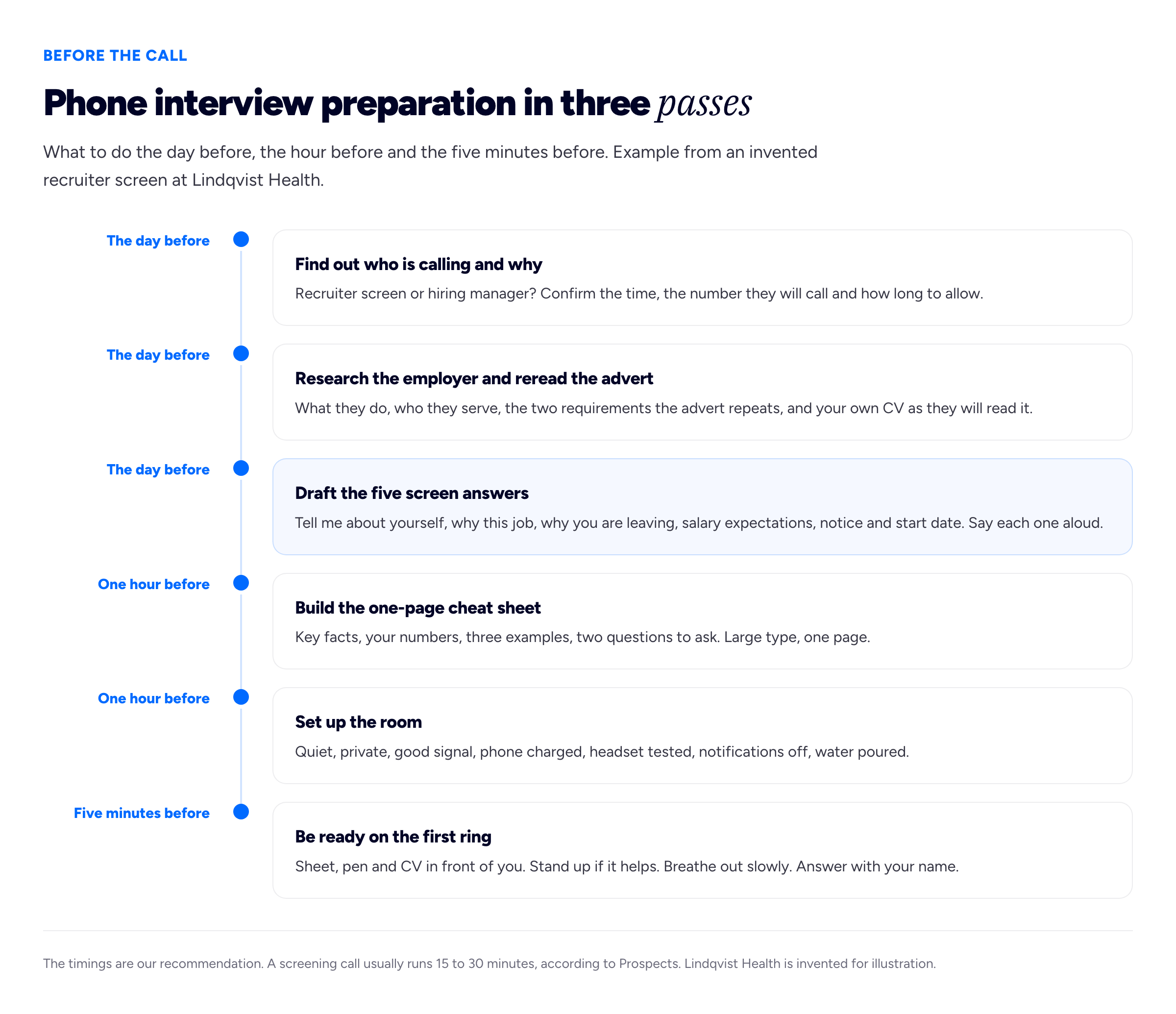
Do the thinking the day before, so the last hour is only about the room, the phone and the page in front of you.
The day before
Confirm the details. The National Careers Service advises noting the date, the time, the caller's name, the company and the role, and checking that the employer has the right number for you. Add one more: which side is calling. If you are expected to dial in, save the number now and check whether it is a video link that also works by phone.
Research enough to explain why you want this job. For a screen you need two sentences: what the organisation does, who it serves and why that appeals to you. Saoirse learns from Lindqvist Health's site that it runs clinics across several towns and has just opened a new one, which is enough to anchor "why us?".
Reread the advert and your own application. The recruiter will have your CV open. Read it as a stranger would and prepare a one-line answer for the gap, the short contract or the job title that does not explain itself. If they may ask for an updated copy, our free resume builder produces a clean one quickly.
Find the two requirements that matter. Every advert lists ten things, and one or two of them are why the job exists. Look for what is repeated and for anything phrased as a problem. The method is set out in our guide to answering "why should we hire you?", and it gives you the spine of every answer you will give on the call.
Draft the five screen answers and say them aloud. Bullet points, not a script, then time yourself: answers that look short on paper often run to two minutes. Prospects and the National Careers Service both suggest recording yourself and listening back, and it is worth doing once.
One hour before
Build the cheat sheet and set up the room, both below. Do not start new research now: the annual report will not come up, and it crowds out what will.
Five minutes before
Go to the bathroom, pour water, put the sheet, your CV and a pen in front of you, and close every tab you do not need. The National Careers Service suggests being ready ten minutes before the scheduled time. Turn the ringer up and decide how you will answer: "Hello, Saoirse Doyle speaking" tells the caller they have the right person and that you were expecting them, which a breathless "Hello?" does not.
The one-page cheat sheet
The phone has one real advantage over a meeting room: the interviewer cannot see your notes. But a dozen pages will not help, because you cannot read and listen at once, and the interviewer hears the rustle and the pause. Prospects recommends short bullet-point notes rather than reading from papers. One page, large type, a fact findable in two seconds.
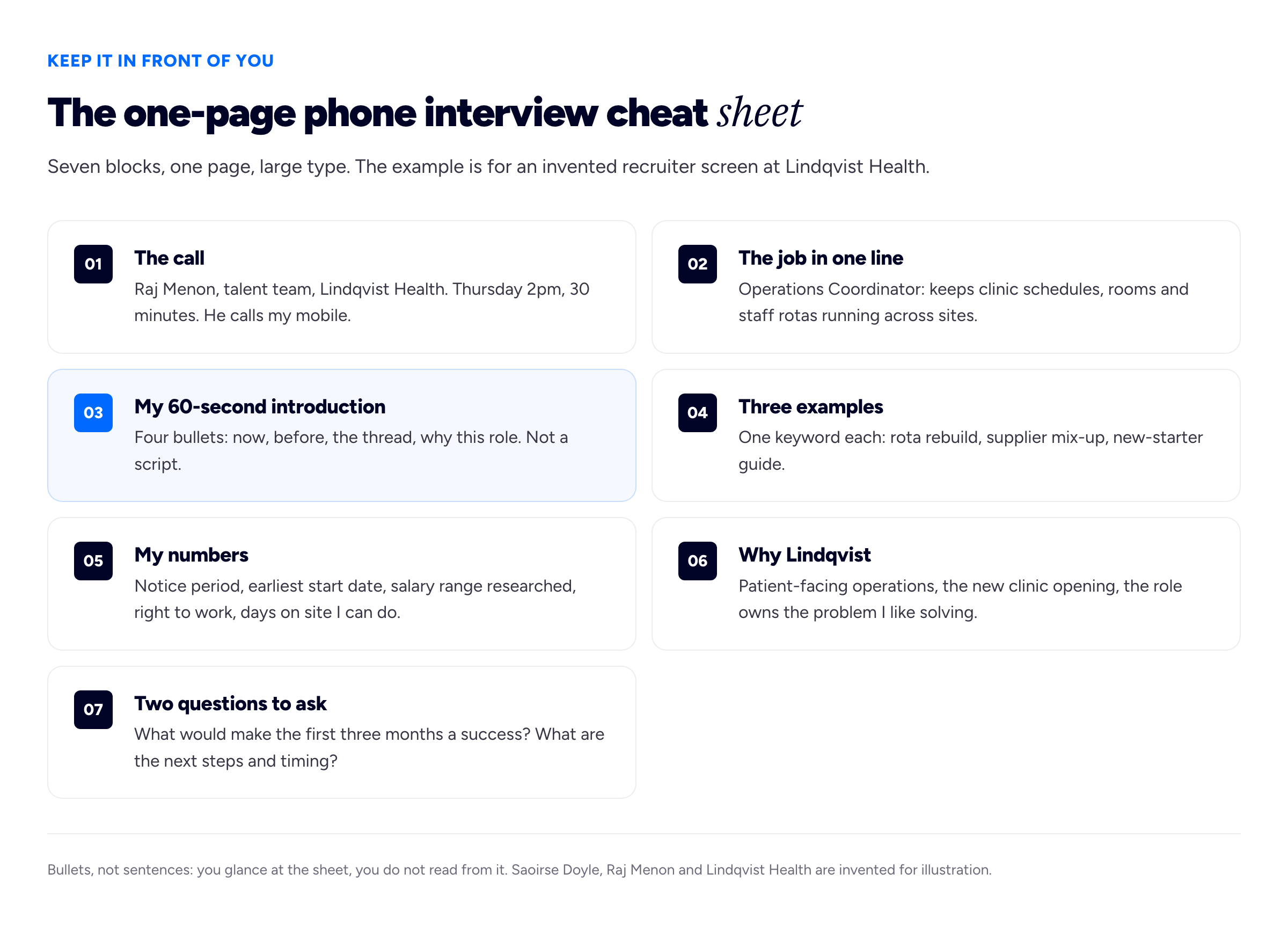
Seven blocks you can find at a glance, so every pause on the call is you thinking rather than you searching.
Four rules make it work:
- Bullets, not sentences. Full sentences get read aloud, and read speech sounds read.
- Your numbers in one box. Notice period, earliest start date, salary range, right-to-work status and how many days you can be on site. A pause before a number sounds like doubt about it.
- Examples as one-word triggers. "Rota rebuild" brings back the whole story of the week Saoirse rebuilt a broken staff rota.
- A blank space for notes. For the hiring manager's name, the stages and the band if they share it. LSE Careers also suggests noting the questions you were asked.
The setup: signal, room, headset and a plan for a dropped call
Practical failures sink more phone interviews than bad answers, and they are the easiest to prevent.
Signal. Take a test call from the exact spot you will sit in, at roughly the same time of day. If the line is poor, move, or use Wi-Fi calling if your phone and network support it. Do not take the call while walking, driving or on a train.
The room. Quiet and private, with a door you can close. Tell anyone you live with when the call is, and, as the National Careers Service suggests, arrange cover for caring responsibilities in advance. Avoid cafés: noise you have learnt to ignore is obvious on the other end.
The phone and headset. Charge the phone fully. A wired headset or earphones with a microphone free your hands for notes, but test them first, since some earbuds pick up more room noise than the handset. Avoid speakerphone, which echoes. Turn on do not disturb, with calls still allowed through.
The missed-call plan. If the line drops, wait a minute for them to call back; if nothing comes, call or email straight away. If they are more than ten minutes late, send a short, friendly email: "Just checking we're still on for 2pm. I'm here and free whenever suits." If you miss the call, ring back immediately and apologise once. Their email and number on the cheat sheet make all of this quick.
Your voice without your body language
In a room, a nod and a smile carry half of what you mean. On the phone everything travels through your voice, and the interviewer cannot see that you are thinking.
- Slow down. Nerves speed people up, and the phone compresses sound. Aim slightly slower than feels natural.
- Use pauses on purpose. The National Careers Service suggests leaving a short pause after each question so you do not talk over the interviewer.
- Say that you are thinking. Silence on the phone sounds like a dropped line. "Good question. Let me think of the best example" buys you five seconds and tells them you are still there.
- Signal that you are listening. Prospects suggests brief acknowledgements such as "OK" or "I see", without interrupting. They replace the nods the interviewer cannot see.
- Stand up, or sit upright. Both the National Careers Service and Prospects suggest standing or sitting up straight. Most people sound more energetic on their feet.
- End your answers clearly. Without eye contact, the interviewer cannot tell whether you have finished. Finish with a sentence that sounds like an ending, then stop.
The questions you will probably get, and how to answer briefly
On a screen, short is good: the recruiter has a list to get through and a summary to write. Our recommendation is answers of 30 seconds to a minute, with the full story ready if they ask for more.
"Tell me about yourself" or "talk me through your CV"
Almost every screen opens with this. Give a 60-second version: where you are now, the one or two things before that matter for this job, the thread that connects them, and why that thread leads here. Do not recite your CV in order. We cover building this answer in our guide to answering "tell me about yourself".
Saoirse's version: "I'm currently a scheduling administrator at a physiotherapy practice, where I run the diaries for six clinicians and manage the room bookings. Before that I spent two years in hospitality, running rotas for a busy restaurant. The common thread is keeping lots of moving parts working on the day, and this role is that job at a bigger scale, across several clinics, which is exactly the step I'm looking for."
"Why this role?" and "Why us?"
Connect one thing about them to one thing about you. "Lindqvist Health is growing, and the advert talks twice about keeping schedules running across sites. That's the part of my current job I like most, and I want to do it somewhere where it's the whole role rather than a corner of it." Two sentences, one specific detail, no flattery.
"Why are you leaving?" or "Why are you looking?"
Answer forwards, not backwards: say what you are moving towards, not what you are escaping. "I've learnt what I can in a single practice, and I want a role with more sites and more complexity." If there is a harder story behind the move, our guide to reasons for leaving a job covers how to tell it honestly and briefly.
"What is your notice period?" and "When could you start?"
Know the answer exactly; check your contract the day before. "My notice is four weeks, so I could start four weeks after accepting an offer."
"Do you have the right to work here?" and "Would you need sponsorship?"
Answer plainly. If you need sponsorship, say so now rather than at offer stage. Hiding it only wastes both sides' time.
"Can you tell me about a time when…?"
Screens sometimes include one or two competency questions. Use one of your three prepared examples, briefly: the situation in a sentence, what you did, and what changed as a result. If you are asked about a weakness, our guide to answering "what are your weaknesses?" gives you a structure that holds up.
How to handle the salary-expectations question
This is the question most people dread, and a screen is the likeliest place to meet it, because checking it is part of the screen's job. There is no trick that avoids it, but there is an order of moves that protects you without sounding evasive.
Research before the call. Look at the advert first, since many include a band. Then look at what similar roles in your area pay on job boards and in published salary guides, and decide on a range you would be happy with. Write it in the numbers box on your cheat sheet.
Ask about the band first, once. "Could you share the range budgeted for the role? I'd like to make sure we're aligned." Many recruiters will tell you, and then you only need to say whether it works.
If they ask again, give a researched range. Refusing twice reads as difficult, and a recruiter with no number to record may not put you forward. Make the bottom of the range a figure you would genuinely accept: "Based on similar operations roles in the area, I'm looking at roughly [your range], depending on the full package and the responsibilities."
If the band they share is below what you need, say so calmly. "That's a little below what I was expecting. Is there flexibility for the right candidate?" is honest, and better found out now than after three rounds.
Saoirse's advert gives no band. She asks Raj for the range; he says it depends on experience and asks again, so she gives the range from her sheet, adds "depending on the full package", and he says it is within budget. Negotiating the actual offer comes much later, and our guide to salary negotiation covers that stage.
Being asked what you expect is a different question from being asked what you earn now, and you can answer the second with the first. What employers may ask about pay varies by country and region, so check the rules where you live.
What to ask at the end
Almost every call ends with "Do you have any questions for me?". The National Careers Service suggests having two or three ready, and Prospects suggests leaving pay, leave and start dates out of your own questions. On a screen, ask what the recruiter can answer, about the role and the process:
- "What would make someone successful in the first few months?"
- "What is the hiring manager most hoping this person will fix or improve?"
- "What are the next steps, and when should I expect to hear?"
The last one matters more on the phone, because a call ends abruptly and there is no walk to the lift where timings usually get mentioned. For a longer list sorted by stage, see our guide to questions to ask the interviewer.
Closing the call and following up
End with three things: thanks, a one-sentence restatement of your interest, and the next step. "Thanks for your time, Raj. Everything you've said about the new clinic makes me more interested, so I'd be really glad to go forward. You mentioned you'd be in touch by the middle of next week?" Then let them end the call.
Straight after, write down what you were asked, the names mentioned, what you were told about pay and stages, and the date they gave you. The National Careers Service suggests noting two or three things that went well and two or three to improve.
Send a short thank-you email the same day. On a screen, keep it to three or four sentences: thanks, one specific detail from the call, your continued interest, and an offer to send anything else. Our guide to the thank-you email after an interview has templates, and our free professional email generator can draft one from a few notes.
If their date passes, wait a couple of working days and follow up once. For reading the silence in between, see signs an interview went well. And since a hiring manager may look you up before the next round, a simple portfolio site in your email signature gives them somewhere to check your work.
Common mistakes on phone interviews
- Treating the screen as a formality. It is a real filter, and one vague answer or one surprise number is enough to stop you meeting the hiring manager.
- Reading from a script. The pace goes even, the tone goes flat, and the answer does not quite fit the question that was asked.
- Searching online during the call. Typing is audible and your answers slow down; Prospects warns against researching mid-interview. Everything you need should already be on the page.
- Guessing at a question you did not hear. Say "Sorry, the line broke up there. Could you repeat that?". Both the National Careers Service and Prospects advise asking rather than guessing.
Three edge cases
The unscheduled call. If a recruiter rings out of the blue and you are not somewhere you can talk properly, say so: "I'd love to talk, but I can't give you my full attention right now. Could we speak at 4pm, or tomorrow morning?" A recruiter would rather wait a few hours than hear you answer from a supermarket queue.
A panel on a conference line. Write the names down as people introduce themselves, and say the person's name before you answer their question. It helps the panel follow who you are speaking to, which is harder on a call than in a room.
An agency recruiter. They are also deciding whether to put you forward for other roles, so be honest about what you want, including pay and location. They can only match you to jobs they know you would take.
Frequently asked questions
How long does a phone interview last?
Prospects says a telephone interview typically lasts between 20 and 45 minutes, depending on its purpose and the role, with initial screening calls running roughly 15 to 30 minutes. The invitation usually says how long to allow, and if it does not, it is fine to ask when you confirm the time.
What should I say when I answer the phone for an interview?
Answer with your name, for example "Hello, Saoirse Doyle speaking". It tells the caller they have reached the right person and that you were expecting them.
Can I use notes during a phone interview?
Yes, and you should. Keep them to one page of bullet points rather than full sentences, so you glance at them instead of reading from them. Prospects advises short bullet-point notes because the interviewer can hear you reading from papers.
What questions are asked in a phone screen?
Most screens ask you to introduce yourself, why you want the role, why you are leaving your current job, your salary expectations, your notice period or start date, and whether you have the right to work. Some add one or two questions about your experience.
What should I do if the call drops during a phone interview?
Wait a minute or so for the interviewer to call back, since they usually will. If they do not, ring the number they called from or email them straight away to say the line dropped and that you are free to continue. Keep their contact details on your cheat sheet so you can do this quickly.
How we put this guide together
The distinction between a recruiter screen and a hiring-manager interview, the three-pass timeline, the seven-block cheat sheet, the advice on answer length, the salary-question sequence, the missed-call plan and the edge cases are our recommendation, drawn from writing career tools at Bunfolio, not from measured data. Where a timing appears that is not attributed — a minute for an answer, ten minutes before chasing a late call, a couple of working days before following up — it is our suggestion.
The sourced facts are these. The typical length of a telephone interview, the 15 to 30 minutes for a screening call, the usual structure of the call, the advice on bullet-point notes, brief acknowledgements and not researching during the call come from Prospects' guide to telephone interviews. The advice to note the call details, be ready ten minutes early, pause after each question, prepare two or three questions and review two or three things afterwards comes from the National Careers Service guide to telephone interviews. The advice to note down the questions you were asked comes from LSE Careers. The quoted line on checking right to work, and the rule against discriminating by where someone is from, are from GOV.UK's page Check a job applicant's right to work. All were read on 16 November 2026.
We have deliberately left out the figures that usually appear in articles like this: the share of candidates said to be screened out at the phone stage, the number of seconds in which a recruiter supposedly forms an impression, and average salary figures for any role. We could not trace any of them to a published method, sample and date we were willing to stand behind, and the salary example uses a placeholder rather than an invented number for the same reason. We also do not summarise salary-history rules for any particular country or state, because they vary and change; check the rules where you live.
Saoirse Doyle, Raj Menon and Lindqvist Health are invented for illustration, as are Saoirse's background, her answers, the call and every detail in both diagrams.
Related reading: how to answer "tell me about yourself", questions to ask the interviewer, salary negotiation and the thank-you email after an interview.
More from the blog
November 19, 2026 · 19 min read
Panel Interview: Who Sits on It, How It Is Scored, How to Prepare
A panel interview is a job interview in which two or more people, usually a chair, the hiring manager, HR and a peer or specialist, question you together and score each answer against the same criteri...
October 25, 2026 · 18 min read
What to Wear to an Interview: Read the Dress Code First
Wear what the team wears on a good day, one notch smarter, in clean clothes you can walk and sit in. How to find out an employer's real dress code before the day, what one notch above means sector by...
October 20, 2026 · 20 min read
Signs an Interview Went Well (and Which Ones to Ignore)
Most lists of good interview signs are really lists of good manners. Here is which signals carry information because they cost the interviewer something, which are politeness every candidate gets, whi...