
October 26, 2026 · 19 min read
Salary Negotiation: How to Ask for More, Politely
Research a range you can defend from sources you can name, answer "what are your salary requirements" on a form, a recruiter call and in writing, handle questions about your current pay, negotiate the whole package rather than just base salary, and send a counter-offer email that makes yes easy. Plus what to do if they say no, and when not to negotiate.
Salary negotiation is a short, polite conversation that happens after an employer has decided they want you and before you have said yes. Do three things. Research a range from sources you can name, so your number has a reason behind it. Hold that number back until there is an offer on the table if you can, and when you are asked for "salary requirements" earlier, give a researched range rather than a single figure or a refusal. Then, once the offer arrives, thank them, ask for a day to consider it, and come back with one specific counter-offer covering the whole package: base pay first, then the things that are easier for them to move, such as start date, leave, remote days or a training budget. Keep it in writing, keep it warm, and decide in advance what you will do if the answer is no.
The rest of this guide is the detail: where a defensible range comes from, what to say each time the number comes up, questions about your current pay (which some places restrict), a worked counter-offer email, and when not to negotiate at all, plus a short section for freelancers.
Why negotiating is normal, and what it can cost
Many people do not negotiate because it feels like asking for a favour, or because they fear the offer will be withdrawn. An employer that has interviewed several people and chosen you has spent real time getting here, and a courteous request to discuss the offer is a routine part of hiring.
It is not risk-free. A counter-offer that is aggressive, vague or delivered as an ultimatum can sour a relationship before it starts, and occasionally an employer does withdraw. What keeps the risk low is the tone and the reasoning, not the size of the request: "here is what I found, here is what I am asking for, I am keen to make this work" is very hard to take offence at.
We will not quote you a percentage of people who negotiate, or how much more they earn, because we could not trace any of the figures that circulate to a published method. The case for negotiating does not need one: the starting salary is the base that future rises are often calculated from, so a gap at the start tends to persist.
Research a range you can defend
Your number needs a reason, and the strongest one is evidence about what this job pays in this place. Use several sources and expect them to disagree, because each measures something different.
Official wage data
In the United States, the Bureau of Labor Statistics runs the Occupational Employment and Wage Statistics programme (OEWS), which publishes employment and wage estimates once a year for roughly 830 occupations, for the country as a whole, for each state, and for metropolitan and non-metropolitan areas. At the time of writing, the most recent set listed is labelled May 2025. Its estimates include mean wages and percentiles such as the median, which is the point where half the workers in that occupation earn more and half earn less.
Two details from the programme's own frequently asked questions matter when you use it for negotiation. First, its wages are "straight-time, gross pay, exclusive of premium pay": base rates, commissions, tips and production bonuses are counted, but overtime, year-end bonuses, stock and profit-sharing are not. So an OEWS figure is a guide to base pay, not total compensation. Second, the survey does not cover the self-employed, which is one reason freelancers should treat it with caution.
Official data is slow and broad: it tells you what the middle of an occupation looks like in a region, not what one company pays one team. Its value is that it is neutral and you can cite it. Outside the US, look for your own national statistics office's earnings survey rather than borrowing American figures.
Advertised pay ranges
More employers now publish a pay range in the advert, and in some places they must. Collect a dozen adverts that match your title, seniority and location and note the ranges: it is what employers are offering this month. Note the whole range, not just the top; in our experience a wide band usually starts new hires in its lower half.
People
Ask people who do the job, or who hire for it. Not "what do you earn?", which many will not answer, but "for someone at my level joining a company like this, what range would you consider fair?" Former colleagues, a professional body's members and agency recruiters in your field are all worth asking.
Turn it into a range
Lay the numbers side by side. Discard anything that is clearly a different job or a different place. What is left gives you three figures worth writing down:
- Your walk-away number: the lowest offer you would accept, given your costs and your other options. You never say this one aloud.
- Your target: what the evidence says someone with your experience should earn in this role here.
- Your ask: the figure you will actually name, a little above the target, so there is room to meet in the middle and still land on it.
The ask should be ambitious but explicable. If someone asked "where does that number come from?" and you could not answer in one sentence, it is too high.
The three moments the number comes up
Money tends to come up at three points, and the right move differs at each. Our general recommendation: the later you name a number, the more you know and the more the employer wants you. You cannot always choose, so prepare for all three.
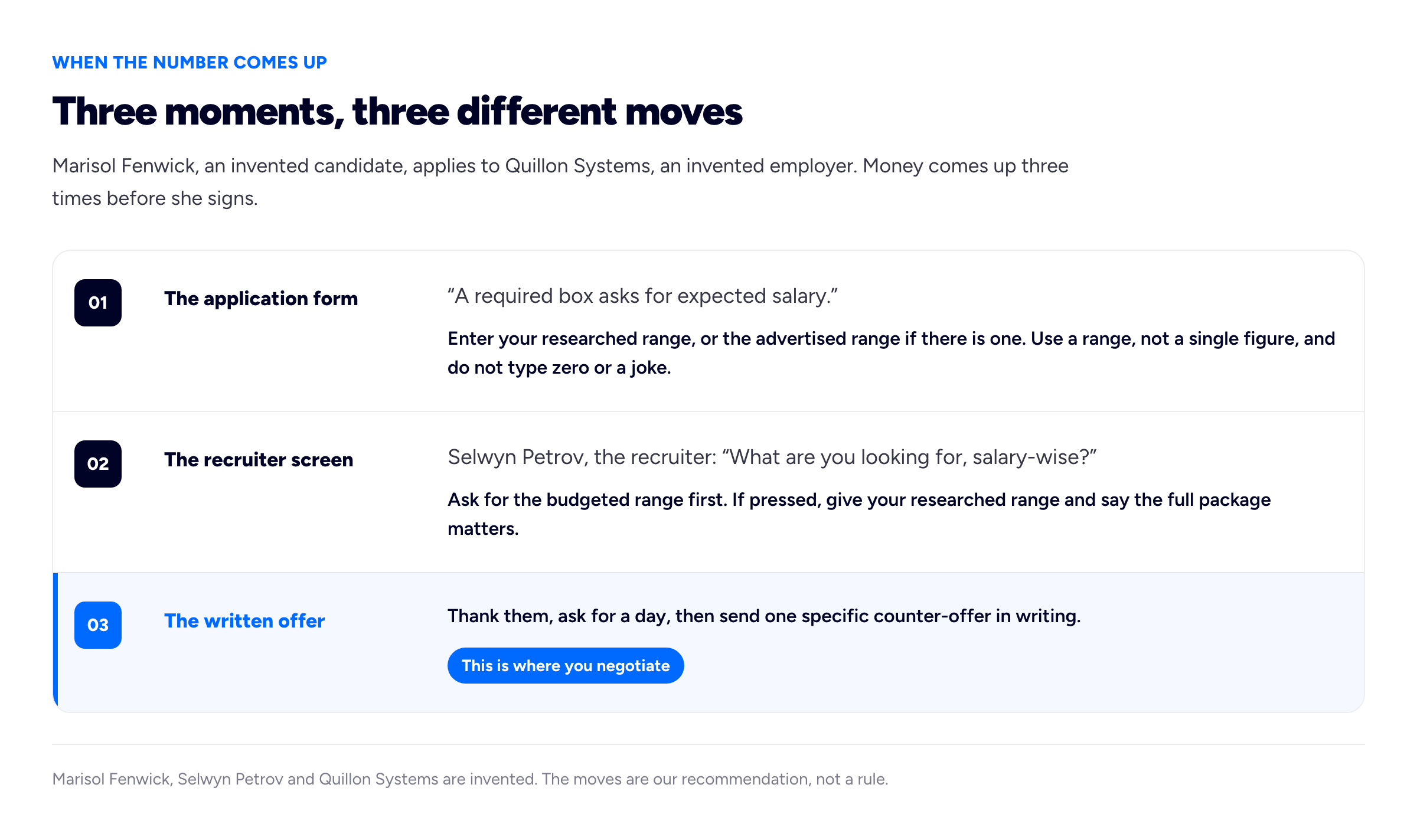
Steps one and two are about not boxing yourself in; the actual negotiating happens at step three.
1. The application form
Some applications have a required field for expected salary. If the advert published a range, enter it; otherwise enter your researched range. Avoid typing a single figure, which becomes an anchor you will struggle to move later, and avoid "0", "999999" or "negotiable" in a numbers-only field, which some screening systems reject or read literally. If there is a free-text box beside it, a short note helps: "Flexible depending on the full package."
2. The recruiter screen
The first phone call is often with a recruiter, and the salary question often comes early because they need to know if you fit the budget. That is a fair question and deserves a straight answer, but you can ask theirs first. In our example, Selwyn Petrov, a recruiter at Quillon Systems, asks Marisol Fenwick what she is looking for. She replies:
"That's a fair question. Before I give you a number, could you share the range budgeted for this role? I'd like to make sure we're in the same area."
Many recruiters will simply tell you. If Selwyn says the range is confidential, or asks again, give your range and keep it broad enough to leave room:
"Based on what I've seen for similar roles in this area, I'm looking for something in the range of [the bottom of your target] to [your ask], depending on the full package. Is that within what you have in mind?"
It names a researched range, brings the package in from the start, and ends with a question. Put the bottom of your range at or above your target, not your walk-away number, because the first figure you say will be treated as the floor.
3. The offer
The offer is where you have the most leverage, because they have chosen you and want you to accept. The counter-offer section below covers it in full. The one rule for the moment the offer arrives, often by phone, is not to accept or decline on the spot. Say thank you, say you are pleased, and ask when they need an answer.
"Thank you, I'm really pleased. Could you send the full offer over in writing? I'd like a day to look at it properly, and I'll come back to you by [day]."
How to answer "What are your salary requirements?"
This is the same question as the recruiter screen, but it often arrives in writing: a line in the advert asking you to include your requirements with your application, or an email after the first interview. The wording varies ("salary expectations", "desired salary", "compensation requirements") but the answer is the same: a researched range, a sentence about the package, and an openness to discuss.
In writing
If the advert asks you to state requirements in your cover letter, do so; ignoring an explicit instruction looks like you did not read it. One or two sentences near the end is enough:
"My salary expectation for this role is in the range of [bottom] to [top], based on published pay for similar positions in [city]. I'm open to discussing this in the context of the full package."
Aloud
Spoken, it helps to show your reasoning in one sentence. An interviewer who hears where a number comes from treats it as information rather than a demand:
"I've looked at advertised ranges for this kind of role locally and at the official wage data, and for someone with my experience I'd expect something in the region of [bottom] to [top]. That said, I'm more interested in getting the role right, and I'm flexible on how the package is put together."
Asked very early, before you know much about the job, you can say so once: "I'd like to understand the responsibilities better before I put a number on it. Could we come back to it?" If they ask again, answer.
The question that often follows in an interview is the one about what you bring. Our guide to answering "why should we hire you?" covers it; a strong answer there is what makes the top of your range sound reasonable later.
When they ask about your current or past salary
A question about your expectations is about the future. A question about your history is different, and in some places employers are not allowed to ask it.
New York State is one example. Its Department of Labor's salary history and pay equity page states that "New York employers cannot ask job applicants to provide their wage or salary history as a condition of employment", that the law "also prevents businesses from seeking similar information from other sources", and that it took effect on 6 January 2020. The same page explains how to file a complaint with the Department if a private-sector employer asked about your salary history or retaliated against you for refusing to provide it.
Several other US states and cities have their own rules, and they differ in what they cover and whom they protect. We are not going to list them from memory, because a wrong list is worse than none. If the question matters to you, search your own state or city labour department's website for "salary history", and read what it says on the official page. Outside the US, rules vary by country; your national labour or equality body is the place to check.
Where the question is allowed, you still do not have to anchor yourself to your old pay, especially if you were underpaid or are changing fields. A polite redirect usually works:
"I'd rather focus on what this role is worth than on my current package, which reflects a different job. For this position I'm looking for [range], based on what similar roles pay here."
If they insist and the question is lawful where you are, answer honestly and briefly, then return to your range. Never inflate a past salary; a discovered lie is a reason to withdraw an offer.
Negotiate the whole package, not just the base
Base pay is often the hardest lever to move, because it is fixed by a budget, a band, or fairness to people already doing the job. Other parts of an offer can be easier for a hiring manager to change. Know what each is worth to you, and ask for them in one message rather than one at a time.
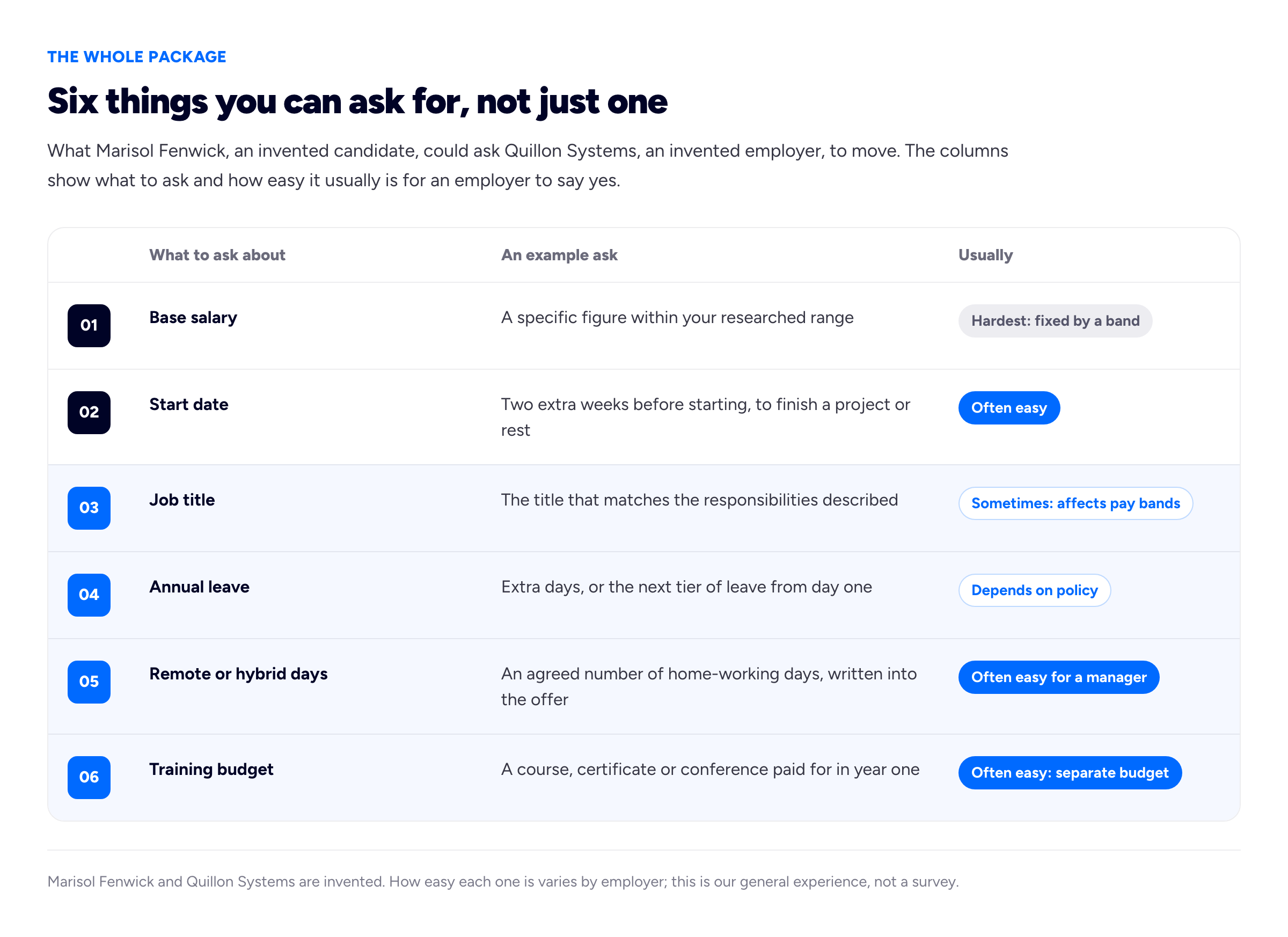
Base pay is usually the hardest thing to move; the rows below it are often where a hiring manager can say yes.
Base salary. Ask for one specific figure, not a range. You gave a range earlier to keep the door open; now you are asking for something they can say yes to. A specific, non-round number tends to read as researched rather than invented.
Start date. If you need to work out notice, finish a piece of work properly, or have a week off between jobs, ask. Notice periods are set by your contract and, depending on your country, by law, so check both before you promise a date.
Job title. If the responsibilities described in the interviews are a level above the title on the offer, say so. A title matters for your next move, and in companies with formal bands it can open a higher pay range.
Leave. Some employers add days with service, and an experienced hire can sometimes start further up that scale. Minimum leave is set by law in many countries; ask only about what sits above it.
Remote or hybrid days. If working from home some days matters to you, get the agreed number into the written offer. A verbal "we're flexible" can change when the manager does.
Training budget. A course, certificate or conference in your first year often comes from a separate budget and can be easier to approve than salary.
A signing bonus, relocation allowance or earlier salary review may also be on the table. Ask for the two or three things that matter most to you, not a list of twelve.
A worked counter-offer email
Marisol Fenwick has interviewed with Quillon Systems and received a written offer from Selwyn Petrov. She is pleased with the role. The base salary sits at the bottom of the range advertised, while her research and experience put her nearer the middle. She would also like a later start, to finish a project properly, and a training budget for a certification she has planned. She has said she will reply by Thursday, and on Wednesday she writes:
Subject: Re: Offer of employment, Senior Analyst
Dear Selwyn,
Thank you again for the offer, and please pass on my thanks to the team. I came away from the interviews even more keen on the role, especially the work on the new reporting platform.
Before I accept, I'd like to discuss two points. The base salary is at the bottom of the range in the advert. Given my five years leading reporting projects of the same size, and the published pay for similar roles in this area, I'd like to ask for a base salary of [your specific figure].
I'd also like to ask for a start date of [date], which lets me hand over my current project properly, and for support towards [certification], which I'd planned to take next year and which bears directly on the platform work.
If we can agree on these, I'll be ready to accept straight away. I'm happy to talk it through by phone if that's easier.
Best wishes,
Marisol Fenwick
The first paragraph is warm and specific, so the request lands on goodwill. The second gives one number and two reasons Selwyn can repeat to the hiring manager. The third adds two smaller asks that are easy to approve, and the fourth makes yes the simplest path. It never threatens, invents another offer, or explains Marisol's personal bills, which are not the employer's reason to pay more.
Put the counter in writing even if you discuss it by phone first, so the recruiter can forward it without paraphrasing.
If you have another offer
A competing offer is leverage only if it is real and you would take it. Mention it plainly: "I have another offer at [figure]. Quillon is my first choice, and I'd love to make the numbers closer." Never invent one.
What to do if they say no
Sometimes the answer to base salary will be no, or a smaller yes than you asked for. That is not a failure; it is information. You have four reasonable moves.
- Ask what is possible. "I understand. Is there any flexibility elsewhere in the package?" opens the other levers if you did not ask for them already.
- Ask for a review date. "Could we agree to review the salary after six months, against the objectives we set at the start?" Get it in the offer letter, not just an email, and agree what success looks like.
- Accept gracefully. If the offer is still above your walk-away number and the job is right, accept warmly. Do not sulk in the acceptance; you will be working with these people.
- Decline politely. If it is below your walk-away number and nothing else moves, thank them and decline. Keep it friendly; roles reopen and recruiters remember who was gracious.
Do not counter twice on the same item unless something has changed, such as a new offer. Pushing on a closed point reads as not having listened.
When not to negotiate
Negotiation is usually worth trying, but not always. Our recommendation is to think twice in these situations:
- The pay is fixed and published. Many public-sector jobs, graduate schemes and union-agreed roles pay on a set scale. You can sometimes ask where on the scale you start, given your experience, but the scale itself will not move.
- The offer already meets your target. If the evidence says the offer is fair and the package suits you, a token counter costs goodwill for very little.
- You have nothing to point to. If you have not researched a range, you are asking for more because you can. Do the research first, even if that means asking for an extra day.
- You would not walk away. You can still ask, but ask softly: a firm tone when you have no alternative is a bluff.
For freelancers: the same conversation, held more often
If you work for yourself, you negotiate pay every time you quote, and most of the ideas above transfer. A rate also needs a reason; it is better to know your walk-away number before the call; and asking for the whole package translates to negotiating scope, deadlines, payment terms and deposits, not just the day rate. If a client cannot meet your price, reduce the scope rather than the rate, so the hourly value of your work stays intact.
The research differs. OEWS does not cover the self-employed, and a salary does not include the overheads you carry: tax, equipment, software, admin time and the weeks between projects. Our guide to how much to charge as a freelancer walks through building a rate from those costs, which is the freelance equivalent of the range you research above. A clear portfolio with evidence of results does for a freelancer what the interview does for an employee: it makes the number sound reasonable before you say it.
Frequently asked questions
Should I give a number first in a salary negotiation?
If you can, ask for the employer's budgeted range first. If pressed, give a researched range rather than refusing, with its bottom at or above your target.
How do I answer "what are your salary requirements" on an application?
Enter the advertised range if there is one, or your researched range if not. Use a range rather than a single figure, and avoid zero or placeholder values in numbers-only fields. If there is a free-text box, add a short note that you are flexible depending on the full package.
How much should I ask for in a counter-offer?
Ask for one specific figure you can justify from your research and experience, a little above your target, so a compromise still lands where you want it. There is no reliable universal percentage; the right number is the one you can explain in one sentence.
Can an employer withdraw an offer if I negotiate?
It is possible but uncommon when the request is polite and reasoned. What tends to cause a withdrawal is an ultimatum, a bluff that is discovered, or an ask far outside the advertised range. A warm, evidence-based counter-offer is part of a normal hiring process.
Do I have to tell an employer my current salary?
Not always. Some US states and cities restrict employers from asking; New York State's Department of Labor, for example, says employers there cannot ask applicants for salary history as a condition of employment. Check your own state, city or national labour body.
What else can I negotiate besides salary?
Start date, job title, annual leave above the legal minimum, remote or hybrid days, a training budget, a signing or relocation payment, and an early salary review. These are often easier for a manager to approve than base pay. Pick the two or three that matter most to you.
How we put this guide together
Bunfolio builds portfolio websites and free career tools, so we read a lot of job adverts and the questions people ask about offers. To be clear about the status of what is here: the method is our recommendation, not a published standard. The three-number range, the three moments, the scripts, the order of the package levers, the counter-offer email and the advice on when not to negotiate are our view of good practice, and no official body publishes a correct way to negotiate.
The facts we do state come from primary sources we read for this guide: the description of the OEWS programme, its May 2025 data, its definition of wages and its exclusion of the self-employed from the US Bureau of Labor Statistics OEWS pages and their FAQ; and the New York salary history rules from the New York State Department of Labor. We have deliberately not listed other states' rules from memory, quoted any wage figure, or repeated the statistics about how many people negotiate and how much they gain, because we could not trace them to a method, a sample and a date. A figure that cannot be sourced looks like evidence and is not.
The people and company in the examples, Marisol Fenwick, Selwyn Petrov and Quillon Systems, are invented, and so is every quoted line. The email uses placeholders in brackets instead of figures on purpose: the right number is the one your own research supports, not one copied from an example.
Related reading: why should we hire you?, how much to charge as a freelancer, questions to ask the interviewer, thank-you email after an interview and signs an interview went well.
More from the blog

October 17, 2026 · 18 min read
Questions to Ask the Interviewer (and What Each Answer Tells You)
Everyone publishes fifty questions and nobody says which three to ask. Here is how to choose them from the role in front of you, grouped by what the answer reveals rather than by topic, with what a go...
August 20, 2026 · 25 min read
How to Ask Clients for Testimonials That Actually Persuade
Why an unattributed quote is worth nothing, the narrow window when the ask succeeds, and the questions that produce evidence instead of a compliment — with request emails you can copy.
August 25, 2026 · 13 min read
Turn Your LinkedIn Profile Into a Portfolio Website
Which profile fields transfer cleanly, which need rewriting, and the two things you have to write from scratch — with an evening-long plan for getting a real portfolio live.