
November 22, 2026 · 19 min read
Behavioral Interview Questions: STAR Answers, Examples, Story Bank
Behavioral interview questions ask what you actually did, usually starting "Tell me about a time…", because past behaviour is the best guide to how you will work. Answer with one real occasion in STAR: a short Situation and Task, most of your time on your own Actions, and a Result you can back up. Five to eight prepared stories cover most of the list.
Behavioral interview questions ask you to describe something you actually did, usually starting "Tell me about a time…" or "Give me an example of…", so the interviewer can judge how you are likely to behave in the job. Answer each one with a single real occasion, structured as Situation, Task, Action and Result, spending most of your time on what you personally did and ending with what changed because of it.
Most pages on this subject give you a list of fifty questions and a one-line definition of STAR. That is the easy half. The hard half is having a true story ready, telling it in the first person, keeping the result in, and surviving the follow-ups. This guide covers both, with worked answers you can adapt.
What behavioural interview questions are
A behavioural question asks about the past. It does not ask what you would do if a customer shouted at you; it asks what you did the last time one did. The US Office of Personnel Management, which sets assessment guidance for federal hiring, defines behavioural questions as ones that "ask applicants to describe a past behavior demonstrated in a situation relevant to the competency of interest", and explains that they rest on "the behavioral consistency principle that past behavior is the best predictor of future behavior."
The alternative is a situational question, which OPM describes as asking applicants "what they would do or how they would behave" and which, as it puts it, "relies on applicants' ability to project what they might do in a future situation." Anyone can describe a sensible plan; a made-up story tends to fall apart at the second follow-up question.
In the UK you will more often hear the phrase competency-based interview. It is the same idea. The University of Sheffield's careers service describes these as questions "based on the competencies or qualities that an employer is seeking for a particular job". The best-known British framework is the Civil Service's Success Profiles, which lists nine behaviours, from "Seeing the big picture" to "Delivering at pace". Its guidance says candidates "may be asked to give examples of when you have demonstrated a particular behaviour", that recruiting managers pick which behaviours suit each role, and that examples can come from work, volunteering or hobbies.
How to recognise one
The wording gives them away. Anything that starts with one of these is behavioural, and wants one specific occasion, not a summary of your habits:
- "Tell me about a time when…"
- "Give me an example of…"
- "Describe a situation where…"
- "Have you ever had to…? What happened?"
Asked "Tell me about a time you handled conflict", many candidates answer "I generally try to stay calm and see both sides." That is a habit, not the event they asked for.
What the interviewer is listening for
These questions usually come from a prepared list tied to the job description, and each answer is scored against what good evidence looks like (the guide to the panel interview explains that scoring). Interviewers are checking four things:
- Is it one real occasion? A specific time, place and problem, not "I often…".
- What was your part? They are hiring you, not your old team.
- Did it work? An action with no result is half an answer.
- Is it the competency they asked about? A good story about teamwork does not answer a question about a mistake.
The STAR method, done properly
STAR is the standard way to shape a behavioural answer. The National Careers Service defines the four parts as Situation, "the situation you had to deal with"; Task, "the task you were given to do"; Action, "the action you took"; and Result, "what happened as a result of your action and what you learned from the experience." Sheffield's careers service teaches STARR, adding Reflect.
Everybody knows the letters. Where answers go wrong is the proportions. MIT's Career Advising and Professional Development office suggests roughly 20% Situation, 10% Task, 60% Action and 10% Result, and says "most of your response should focus on your Actions." Our suggestion, below, gives the Result a little more room, because it is the part most candidates cut.
Situation: one occasion, two sentences
Just enough to follow: when, where, and what was going wrong. Two sentences is usually plenty; leave out company history and anyone who does not matter to the story.
Task: your job in it
One sentence on what you were responsible for. This is where you separate yourself from the team. "Our team had to fix it" is the team's task. "The account was mine, so keeping it was my job" is yours.
Action: what you did and why, with "I"
This is the bulk of the answer. Describe what you did, in order, and the reason for each decision. MIT's careers office puts it plainly: "It is important to show ownership of accomplishments by using 'I' statements", because "we" statements make it hard for an employer to understand what your skills are. You can still mention who else was involved, as long as it is clear which part was yours.
The reasons matter as much as the steps. "I phoned rather than emailed" is an action. "I phoned rather than emailed, because an email would have read like a form letter to someone who was already angry" shows judgement, which is what the interviewer is actually scoring.
Result: keep it, and quantify it honestly
Say what changed, and make it checkable. If there is a real number, use it: the client renewed for two years, the backlog fell from 140 tickets to 30, the report went out a day early. If there is no number, say what someone observed or decided: the process was adopted team-wide, the complaint was withdrawn.
Two rules about numbers. First, never invent or round one up to sound better. Interviewers ask "how did you measure that?", and a number you cannot explain does more harm than no number. Second, do not borrow the team's figure as yours. "The team cut churn by 12%" is fine if you then say which part of that was your work.
Reflection: optional, and short
One sentence on what you learned or would change. For failure and mistake questions it is the point of the question; elsewhere it is optional.
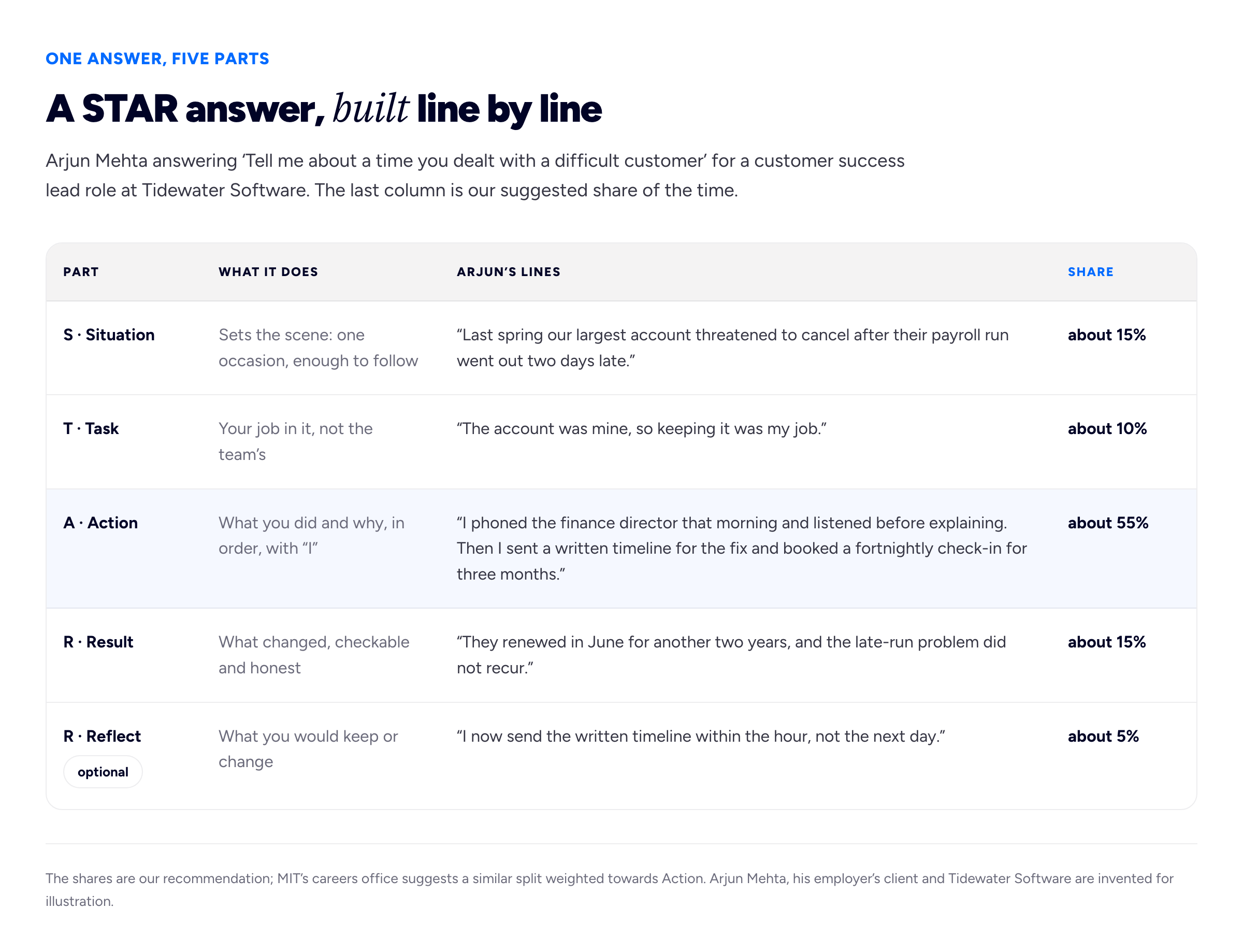
Most of the answer belongs in row three, and row four is the one people forget to say out loud.
The full answer, spoken
Here is that answer as it would actually be said. The example is invented: Arjun Mehta leads a small support team at a payroll software company and is interviewing for a customer success lead role at Tidewater Software. The interviewer is Fiona Gallagher, Tidewater's head of customer success. She asks: "Tell me about a time you dealt with a difficult customer."
"Last spring, our largest account threatened to cancel. A bug on our side meant their payroll went out two days late, and their finance director emailed our chief executive that evening. The account was mine, so keeping it was my job.
I phoned her first thing the next morning rather than replying by email, because an email would have read like a form letter to someone who was already angry. I let her talk for ten minutes without defending us, and noted the three things she cared about: a fix date, proof it would not happen again, and not having to chase us. Then I went to our engineering lead, got a realistic fix date, and sent her a written timeline the following day. I also booked a fortnightly fifteen-minute check-in for the next three months, so she never had to ask for an update.
They renewed in June for another two years, and the late-run problem did not come back. The one thing I would change is the gap: that timeline took a day, and I now send it within the hour, because the silence made the first call harder than it needed to be."
That takes about two minutes at a calm pace. There is no company history, no "we", and no claim to be "a people person"; every line is something Fiona could follow up.
Common behavioural interview questions, by competency
The question list is long, but it covers a handful of competencies phrased in different ways. Group them and you need far fewer stories. Each group below gives the usual wordings, what is being checked, and a worked answer or a skeleton to fill in.
Conflict with a colleague
"Tell me about a time you disagreed with a colleague." "Describe a conflict at work and how you resolved it." "Tell me about a time you worked with someone difficult."
They are checking whether you address disagreement directly and fairly, without making the other person the villain. A story that ends with you proved right and the colleague proved wrong fails.
"Two of my senior agents both asked for the same week off over Christmas, and both had a fair case. One had covered the previous year; the other had a family wedding abroad. It was my rota to sort out.
I spoke to each of them separately first, so neither had to argue their case in front of the other. Then I put the facts in one message to both: the cover we needed, who had worked which holidays over the last two years, and two options that would each give one of them the full week and the other four days. I asked them to agree between them by Friday and said I would decide if they could not.
They agreed the next day, and the agent who gave ground got first choice of Easter. I have used the same 'facts first, options second' message for every rota clash since."
A failure
"Tell me about a time you failed." "Describe a project that did not go to plan." "What is your biggest professional failure?"
They are checking honesty and learning. Choose a real failure with real consequences, but not one that would disqualify you from this job. Spend most of the answer on what you did once you realised, and finish with what you now do differently. A fake failure ("I worked too hard") reads like a fake weakness, which the guide to what are your weaknesses covers.
Skeleton: "I was responsible for [goal]. It did not work: [what went wrong, plainly]. The part that was mine was [your decision or omission]. When I realised, I [first action], then [second action]. In the end [honest outcome, including what could not be rescued]. Since then I [specific change in how you work]."
A mistake
"Tell me about a mistake you made." "Describe a time you got something wrong."
Close to failure, but smaller and more personal: the interviewer wants to hear you own it quickly. Mistake, moment you noticed, fix, safeguard.
"A customer reported on a Friday afternoon that they had been charged twice. I logged it but did not escalate it to engineering, because I assumed it was a one-off. By Monday, eleven more customers had been double-charged.
I told my manager first thing that the delay was mine, then escalated it as urgent and personally emailed all twelve customers before they noticed, with the refund date. Engineering fixed it that day and every refund went out within the week.
I wrote a one-line rule for the team that anything involving money is escalated the same day, however small it looks, and we have followed it since."
Leadership, including without authority
"Tell me about a time you led a team." "Describe a time you took the lead without being asked." "Give an example of motivating people."
You do not need a management title. Leading a project, organising volunteers or getting peers to adopt something all count.
Skeleton: "[Situation where nobody was steering]. I was not anyone's manager, but I [what you noticed]. I [how you got people involved: asked, showed, split the work]. When [someone pushed back], I [how you handled it]. The result was [outcome], and [one sign others valued it, such as the process being kept]."
A tight deadline or pressure
"Tell me about a time you worked under pressure." "Describe a time you had too much to do." "Give an example of meeting a tight deadline."
They are checking how you prioritise, not how many hours you can stay at your desk. The strongest answers show a decision about what not to do, and how you told people.
Skeleton: "[Deadline and why it moved or was tight]. There was more work than time, so I [how you listed and ranked it]. I decided to [what you dropped or delayed] and told [who] straight away. I [what you did on the critical part]. We [delivered what, when], and [what you would plan earlier next time]."
Persuading or influencing someone
"Tell me about a time you persuaded someone to change their mind." "Describe a time you had to sell an idea." "Give an example of influencing a decision."
They are checking whether you persuade with evidence and by understanding the other person's worry, rather than by repeating yourself louder.
Skeleton: "I wanted [change]; [person] was against it because [their real concern]. Instead of arguing the general case, I [evidence you gathered or trial you proposed] to answer that concern. [Their response.] We [what was agreed], and [result]."
A difficult customer or client
"Tell me about a time you dealt with an angry customer." "Describe a time you had to say no to a client."
The worked answer above is this one. Avoid stories where you simply gave the customer whatever they demanded.
Initiative and improvement
"Tell me about a time you improved a process." "Give an example of going beyond your job description." "Describe something you changed without being asked."
They are checking whether you spot problems and fix them, rather than just complaining about them. Arjun's version: he noticed the help-desk's forty saved replies contradicted each other on refund rules, rewrote them with two colleagues over a fortnight, and the number of refund tickets reopened by confused customers dropped noticeably. Without a figure, "noticeably" plus what he saw is honest.
Build a story bank: one story, several questions
You cannot prepare fifty answers, and you do not need to. Most behavioural questions can be answered by five to eight good stories, each told from a slightly different angle. A story about rescuing an angry client is also a story about pressure, about communication, and about putting a process in place afterwards. This is the single most useful piece of preparation for this kind of interview.
How we suggest building one:
- List the competencies. Go through the job advert and the person specification, and write down every skill or quality they ask for.
- List your stories. One line for every occasion in the last two or three years where something went wrong, changed or depended on you. Aim for ten to fifteen.
- Pick the strongest five to eight. Recent, with a clear part for you and a result you can state.
- Map stories to competencies. For each story, note which questions it could answer. Every competency should have at least one.
- Write each story in STAR, in note form. Five or six bullets, not a script.
- Say each one aloud. Time it. If it runs past about two and a half minutes, cut the Situation.
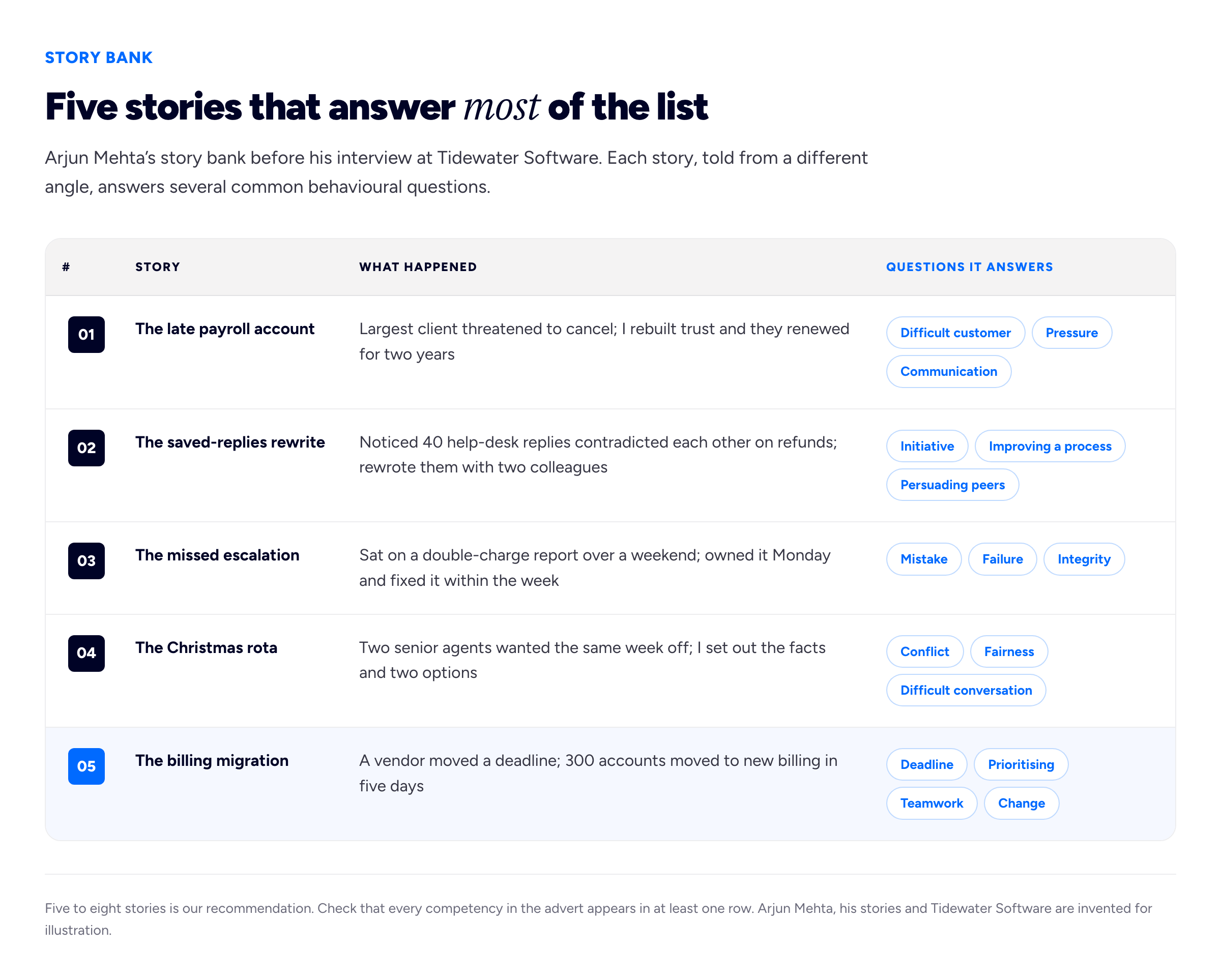
Five prepared stories, sixteen angles: the question changes, the facts never do.
Two warnings. Do not use the same story for every question in one interview, even if it would fit. A third mention of the billing migration suggests it is the only thing you have done. And the facts must not change with the angle: two years' renewal in one answer cannot become three in another.
Your story bank does double duty. The same stories answer "why should we hire you?", feed the past section of your answer to "tell me about yourself", and give you the material for a strong cover letter. If you do work that can be shown rather than described, such as reports, designs, code or campaigns, a career portfolio lets an interviewer see the evidence behind a story, which a CV line never quite manages.
Follow-up questions: where answers are really tested
The National Careers Service advises you to "be prepared to answer follow-up questions about the examples you give", and that advice deserves more weight than it usually gets. A good interviewer rarely moves on after your first answer. They probe, and the probing is where a rehearsed or borrowed story falls apart.
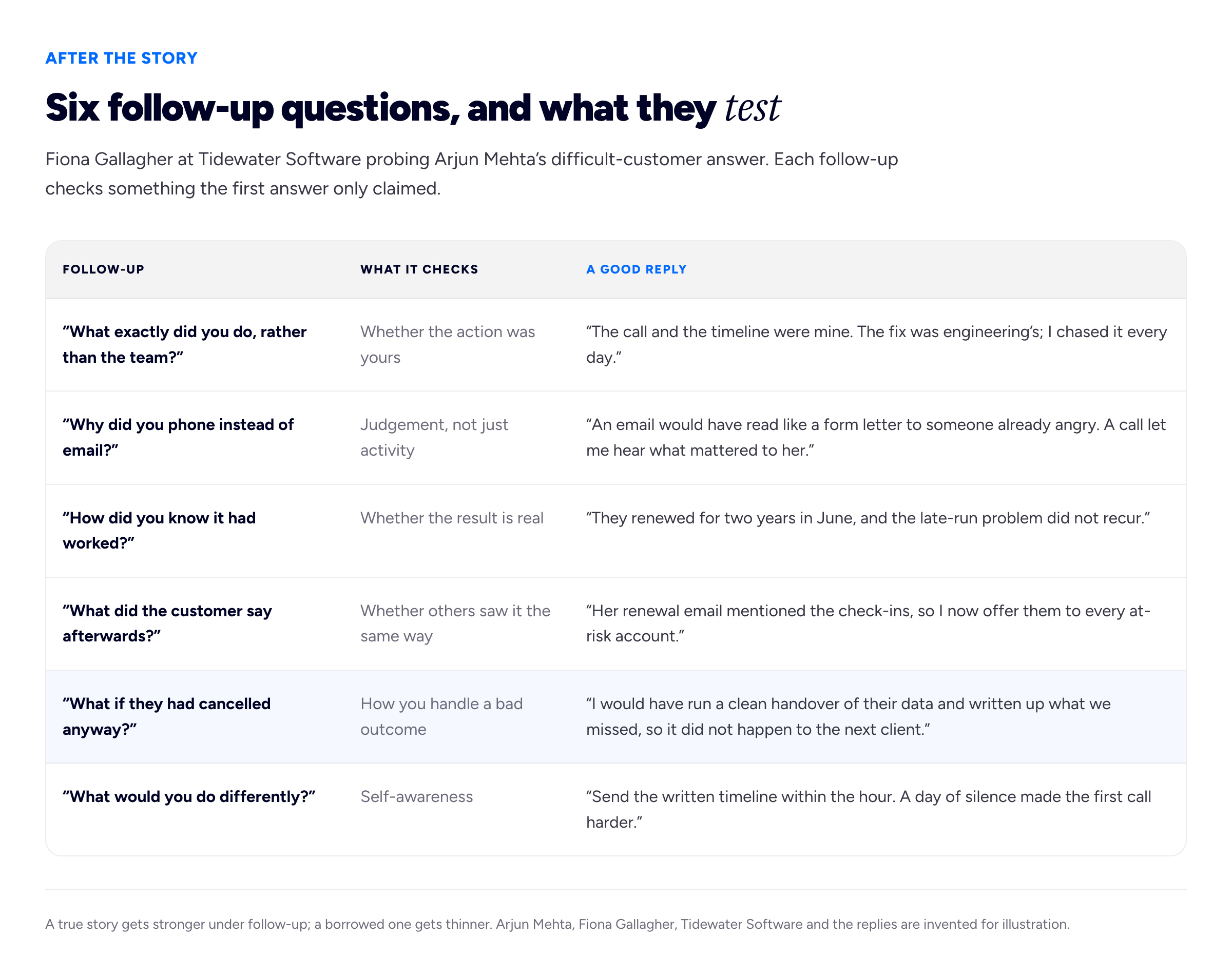
Every follow-up asks for a detail only the person who was there would know.
You can prepare for follow-ups without scripting them: for each story, make sure you can answer the six in the table. If one leaves you stuck, the story needs more thought. And an interviewer who keeps digging into one of your stories is usually interested, not suspicious; it is one of the stronger signs an interview went well.
If you are asked something you genuinely do not remember, say so. "I don't remember the exact figure, but it was roughly a third of the backlog" is fine. Inventing a precise number on the spot is not. If an answer came out muddled on the day, you can put it right in a sentence in your thank-you email.
When you do not have a work example
If you are a student, a graduate, returning after a break or changing career, you may not have a work story for every question. That is acceptable. The National Careers Service says examples "could be from work, home or volunteering", and the Civil Service guidance names volunteering and hobbies too. Group projects, clubs, caring, events and part-time jobs all produce genuine evidence.
"In my final-year group project, two members stopped contributing three weeks before the deadline" is a perfectly good opening to a conflict answer. If you are preparing for your first job, the guide on how to make a resume for your first job covers how to find these examples in the first place.
Avoid answering with a hypothetical. If you truly have no example, offer the closest thing: "I haven't managed a team, but I did coordinate the volunteers for a charity event last year, and the same problem came up."
Mistakes that sink good stories
- Answering with a habit instead of an event. "I always…" is not an example. Give one occasion.
- "We" all the way through. The interviewer cannot score your contribution if they cannot find it.
- Stopping before the Result. Many answers trail off after the Action. Finish with what changed.
- A result you cannot back up. A precise percentage invites "how did you measure that?". Use the figure you actually know.
- Reciting a script. The National Careers Service advises a conversational delivery "so as not to appear too rehearsed", and Sheffield's careers service warns against rehearsing answers "word-for-word". Learn the points, not the sentences.
Preparing in one evening
If your interview is soon, spend an evening on it: list the competencies (twenty minutes), pick five to eight stories (thirty), write each in STAR bullets (forty-five), say them aloud timed (thirty), then rehearse the six follow-ups on your two strongest (fifteen).
That is the behavioural part only. The guide on how to prepare for an interview covers the rest, including researching the employer and planning your questions to ask the interviewer. If the first round is by phone, the same stories work, but keep them a little shorter, as the guide to phone interviews explains.
Frequently asked questions
What is a behavioral interview question?
It is a question that asks you to describe a real situation from your past, usually starting "Tell me about a time…" or "Give me an example of…". Employers use them on the principle that how you behaved before is a good guide to how you will behave in the job. In the UK they are often called competency-based questions.
How do I answer "tell me about a time" questions?
Pick one specific occasion and use STAR: the Situation in a sentence or two, your Task in one sentence, then most of your answer on the Actions you took and why, and finish with the Result. Use "I" for your own part, and add a sentence on what you learned if the question is about a failure or mistake.
How long should a STAR answer be?
Our recommendation is about one and a half to two and a half minutes spoken. If you are running long, cut the Situation first.
How many stories should I prepare for a behavioral interview?
Five to eight well-prepared stories will cover most common questions, because each story can be told from several angles. Check that every competency in the job advert is covered by at least one story, and avoid using the same story more than once in a single interview.
How we put this guide together
Most of this guide is our recommendation rather than sourced fact. The grouping of questions by competency, the time shares in the first diagram, the story-bank method and its five-to-eight range, the six follow-up checks, the one-evening plan, the list of mistakes and every worked answer and skeleton are ours.
Where we cite published guidance, we read it ourselves on 17 November 2026: the US Office of Personnel Management's page on structured interviews, for the definitions of behavioural and situational questions and the behavioural consistency principle; the National Careers Service's guide to the STAR method, for the definitions of each part and the advice on follow-up questions, examples from outside work and conversational delivery; GOV.UK's Success Profiles: Civil Service behaviours, for the nine behaviours and how they are assessed; MIT Career Advising and Professional Development's page on the STAR method for behavioral interviews, for the suggested time split and the advice on "I" statements; and the University of Sheffield careers service's page on interview question types, for its description of competency-based questions and the STARR variant.
We have deliberately left out the statistics that often appear in articles on this subject: claims that behavioural interviews are a stated number of times more predictive than unstructured ones, percentages of employers said to use them, and figures for how many candidates forget the Result. We could not trace these to a published method, sample and date we were able to read, and a number nobody can source is worse than none. The figures inside Arjun's answers, such as forty saved replies and 300 accounts, belong to invented stories and are not statistics.
Arjun Mehta, Fiona Gallagher and Tidewater Software are invented for illustration, as are Arjun's current employer and its client, every story and quoted answer, and all the wording in the three diagrams. Tell your own stories: a borrowed one will not survive the second follow-up.
Related reading: panel interviews and how they are scored, how to answer "tell me about yourself", how to answer "what are your weaknesses?" and how to prepare for an interview.
More from the blog

November 24, 2026 · 19 min read
What Is a Letter of Interest? Template and 3 Full Examples
A letter of interest is a short letter to an employer that has not advertised a job, saying you would like to work there, what you could bring, and asking for a conversation. In the UK it is a specula...

November 23, 2026 · 19 min read
Short Bio Examples: How to Write a Simple Bio About Yourself
A simple short bio is two or three sentences: your name and job, who you do it for or where, one specific proof, and perhaps one human line. Here is a fill-in formula, the same bio at one line, 50 and...
November 21, 2026 · 18 min read
How to Prepare for an Interview: A Week-by-Week Plan That Works
To prepare for an interview, reread the advert and turn each requirement into the question it will become, research the employer enough to say why you want to work there, and build six to eight true s...