
November 24, 2026 · 19 min read
What Is a Letter of Interest? Template and 3 Full Examples
A letter of interest is a short letter to an employer that has not advertised a job, saying you would like to work there, what you could bring, and asking for a conversation. In the UK it is a speculative application. Address it to a named person, explain why this organisation, link one piece of work, and follow up once.
A letter of interest is a short letter you send to an employer that has not advertised a job, saying you would like to work there, what you could bring, and asking for a conversation. In the UK it is called a speculative application. Unlike a cover letter, it answers no advert, so it must explain why you chose this organisation.
The hard part is everything around that: when one is worth sending, finding the person who should read it, and following up without becoming a nuisance. This guide covers each, gives you a fill-in template, and shows three complete letters: a teacher changing career, a new graduate, and a freelancer pitching an agency.
What a letter of interest is, and the other names it goes by
The University of Cincinnati's careers guidance puts the distinction simply: "A cover letter is tailored to a specific job posting", while "a letter of interest is more general, demonstrating your enthusiasm for the company". The careers pages of UK universities describe the same thing under a different name. Prospects defines a speculative application as "getting in touch with an organisation to ask whether they have a suitable job for you", without a specific vacancy being advertised.
Letter of inquiry, prospecting letter, cold cover letter and expression of interest are the same thing again: an approach you start, rather than a reply to something the employer started. One near-namesake is different, though.
Letter of interest vs cover letter vs letter of intent
A cover letter answers an advert. The employer has written down what they need, and your letter argues that you match it. Our guide to the cover letter and the resume explains how the two divide the work.
A letter of interest answers nothing. The employer has not asked, so your letter has to supply the reason for writing as well as the evidence.
A letter of intent usually belongs to a different situation altogether. The careers centre at MCPHS, a US health sciences university, describes it as "a document that expresses your interest in completing a specific program", such as a residency or fellowship. Some job sites use the two names interchangeably, which is where the muddle comes from. If an institution asks for a letter of intent, write what its instructions describe; if you are writing to an employer who has advertised nothing, you want a letter of interest.
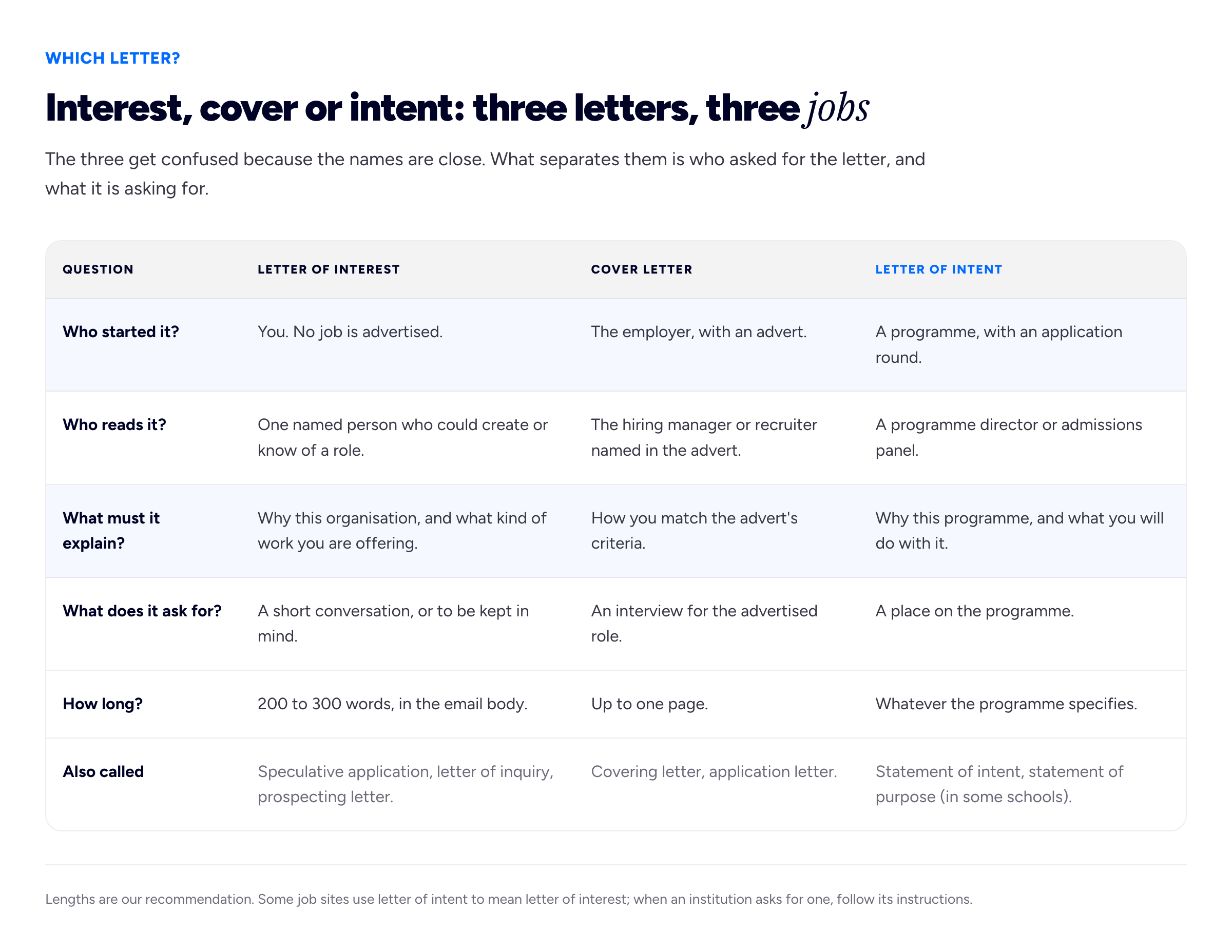
The first row decides the rest. If nobody asked for your letter, it has to carry its own reason for existing.
When a letter of interest is worth sending
A letter of interest is not a way to apply to fifty companies before lunch. The University of Nottingham's careers service is blunt about this: "Sending fewer, highly-targeted applications is often more effective than a blanket approach using the same CV and cover letter." It also says, fairly, that "not all speculative applications will lead to offers". Here is where we think they are worth the effort.
- Small organisations that rarely advertise. Studios, practices, charities and small museums often hire people they already know. A good letter makes you one of them.
- Organisations you can name a reason for. If you can write one sentence about a specific piece of their work and why it matters to you, you have the opening. If you cannot, you are not ready to write.
- Fields where the work can be seen. A link to something you made does more in a cold letter than any adjective.
- Freelance rosters. Agencies keep lists of freelancers they call when work spikes. Getting onto that list is almost always done by letter of interest, whether anyone calls it that or not.
- A move you are planning months ahead. Relocating or finishing a course: a letter sent early puts your name in front of someone before the role exists.
It is a poor fit for large employers that recruit only through graduate schemes or portals; expect to be pointed at the portal.
Finding the right named person
A letter of interest addressed to "Dear Sir or Madam" and sent to an info@ inbox is likely to be filed rather than answered, because nobody in particular owns it. The University of St Andrews' careers guidance tells students to "try to avoid using the impersonal address 'Dear Sir/Madam'. Instead, find a named person." Nottingham suggests contacting the company to find out "who is the best person".
The best person is not usually HR. It is whoever would feel the gap you want to fill: the head of the team, the creative director at a small studio, the manager of the department, the founder at a company of ten. Where to look, in order:
- The organisation's own site. Team, about and press pages, and annual reports.
- Their published work. Project credits, blog bylines, event speakers.
- LinkedIn. Search the organisation, filter by people, and look for a title that matches the team you want to join.
- Ask. Phone or email reception and say what you are writing about: "I'd like to write to whoever leads your learning team. Could you tell me the best person and address?" St Andrews suggests contacting the HR team for "a key contact's name and email address" for exactly this.
If none of that works, address the role: "Dear Head of Learning" is far better than "To whom it may concern". Our guide on how to address a cover letter goes through titles, names you are unsure of and every fallback in detail, and all of it applies here.
How to structure a letter of interest, paragraph by paragraph
The structure below is our recommendation. St Andrews asks you to "explain why you are writing", "make clear why you have chosen this organisation" and "describe the relevant skills and experience you have which would benefit the organisation". We add a pointer and a small ask.
The subject line
Most letters of interest are emails, so the subject line is the first thing read and may be the only thing. Prospects says it should make "your intentions clear". Say what you are and what you want, in the reader's terms: History teacher interested in your schools programme, not Opportunity? or Introduction.
Paragraph one: who you are and why them
Two or three sentences. One clause on who you are, then the sentence that matters most in the whole letter: why you are writing to this organisation. Make it specific enough that it could not be sent to anyone else: "your Saturday family workshops", not "your excellent reputation". Say plainly that you know no job is advertised; it shows you did not mass-mail every company in town.
Paragraph two: what you would bring
Two pieces of evidence, chosen for what this organisation does: what you did, for whom, and what came of it. If you are changing career, translate your past work into their vocabulary: a teacher does not "manage classrooms" in a museum letter, they "run sessions for groups of thirty with mixed attention spans".
Paragraph three: where to see more
One sentence and one link. A specific project page beats a homepage, because it is one click to the thing that proves your second paragraph. This is where a portfolio site earns its keep: a resume can claim that you designed a workshop or animated a campaign, but a page with the photos, the brief and the result shows it. If you do not have one, Bunfolio builds a free one from your LinkedIn profile.
Paragraph four: the ask
Ask for something small enough to say yes to: a twenty-minute call, a coffee, to be kept in mind, a place on a freelance list. "I would love to work for you" is not an ask. Then thank them and sign off. For the closing lines and sign-off themselves, see how to end a cover letter.
How long it should be
Shorter than a cover letter: we aim for 200 to 300 words in the email body, because every extra paragraph is time you are asking a stranger to give you. For what belongs in the letter and what does not, our guide to what to include in a cover letter applies with one change: there is no advert to mirror, so the organisation's own work takes its place.
A letter of interest template you can fill in
The structure above, as a skeleton. Every square bracket needs a fact. If you cannot fill one, do more research before you send.
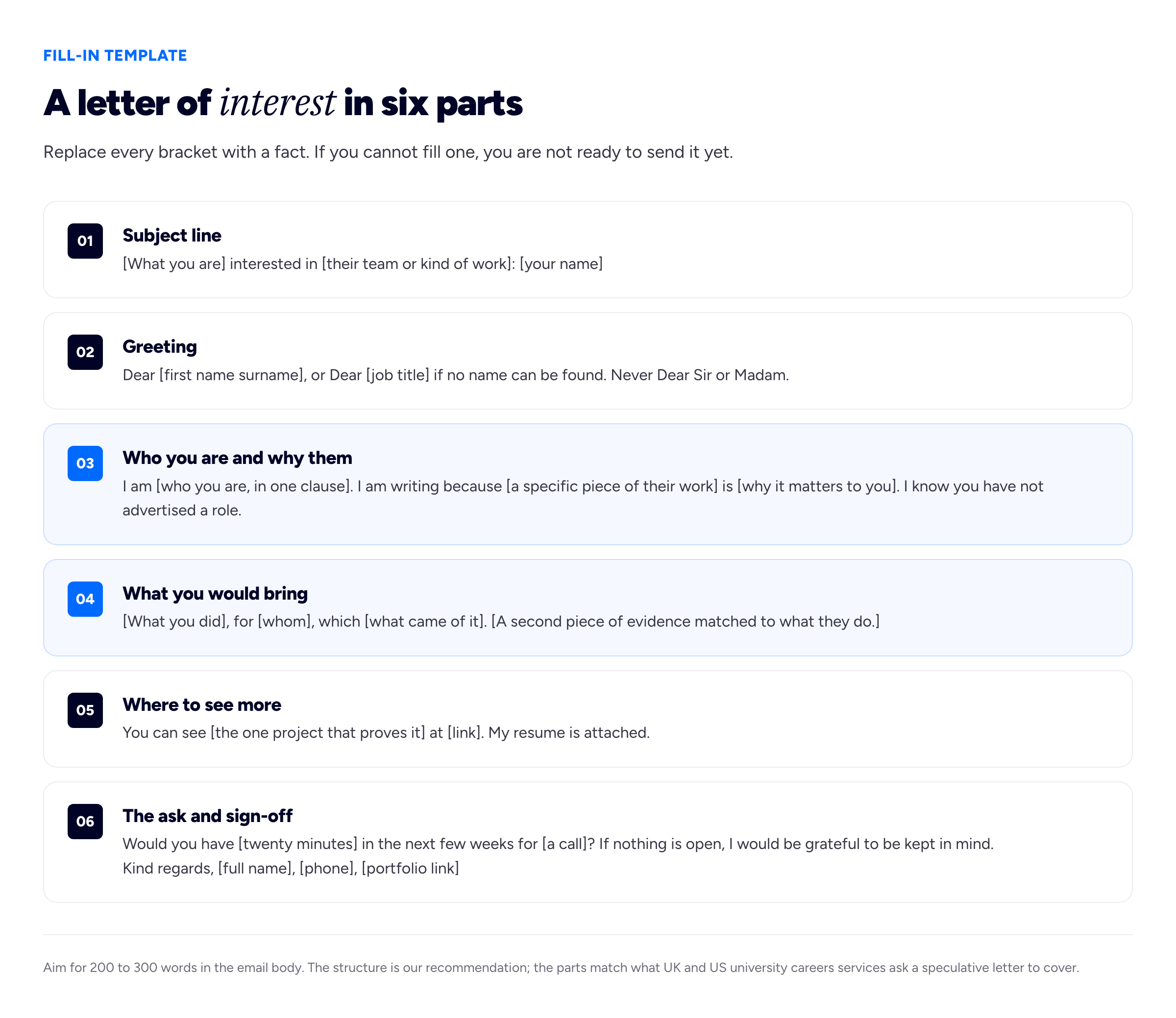
Cards three and four carry the letter. Everything else is there to get a stranger to read them.
The same template as plain text, ready to copy into an email:
Subject: [What you are] interested in [their team or kind of work]: [your name]
Dear [name],
I am [who you are, in one clause], and I am writing because [a specific piece of their work] [why it matters to you]. I know you have not advertised a role, but I would very much like to [the kind of work you want to do there].
[What you did], for [whom], which [what came of it]. [A second piece of evidence, matched to what they do.]
You can see [the one project that proves it] at [link]. My resume is attached.
Would you have [twenty minutes] in the next few weeks for [a call / a coffee]? If nothing is open now, I would be grateful to be kept in mind.
Kind regards,
[Full name]
[Phone] · [Portfolio link]
Letter of interest examples
Three complete letters follow; every person, organisation and detail is invented. Copy the moves, not the sentences.
Example 1: a career changer (teacher to museum learning)
Priyanka Rao has taught secondary history for seven years and wants to move into museum learning. Westmere Museum has not advertised a role and lists no staff names; its switchboard would not give one out, so she addresses the role.
Subject: History teacher interested in your schools programme: Priyanka Rao
Dear Head of Learning,
I have taught history at a secondary school for seven years, and I am writing because I would like to move into museum learning, and Westmere is the museum I would most like to do it at. I brought two Year 9 groups to your "Objects of the Docks" session last spring, and it was the only trip all year that students were still talking about a week later. I know you have not advertised a role.
Two things I have done that I think would be useful to you. I wrote and ran a local-history unit built around twelve photographs from our town archive, now taught by every history teacher in my department. And I plan sessions for groups of thirty with very mixed reading ages and attention spans, which I suspect is most of what a school visit is.
I have put the archive unit, with the lesson plans and photos of students working, at priyankarao.bunfolio.com/archive-unit. My CV is attached.
Would someone on the learning team have twenty minutes for a call in the next few weeks? I would like to understand how people usually come into the work, and I would be grateful to be kept in mind for sessional or freelance facilitation.
Kind regards,
Priyanka Rao
07700 900123 · priyankarao.bunfolio.com
Why it works:
- The reason for choosing Westmere is first-hand. She has used the museum's own product, as a customer.
- The evidence is translated. "Groups of thirty with very mixed reading ages" is a museum educator's daily problem, described in teacher language that a museum educator recognises.
- The ask has two sizes, a call for advice or sessional work, and either is easier to say yes to than "a job". The greeting is a job title she confirmed by asking.
Example 2: a new graduate
Elliot Shaw has just finished a graphic design degree. Harbourline Studio is a small design and motion studio whose site lists Callum Reid as creative director, at that size the person who reads approaches.
Subject: Design graduate interested in a junior role at Harbourline: Elliot Shaw
Dear Mr Reid,
I graduated in graphic design this summer and I am writing to ask whether Harbourline expects to take on a junior designer in the coming months. I know nothing is advertised. I am writing because your wayfinding system for the Westmere Museum, the one with the colour bands that run along the floor, is the project that made me want to work in environmental design, and I would like to learn from the studio that made it.
My final-year project was a signage system for my university's library, tested with twenty students who had never used it; the version I submitted cut the average time to find a set shelfmark by about a third in my own testing. Alongside the degree I designed posters and social graphics for the students' union for two years, usually with a deadline of the same week.
The library project, with the testing notes and the drafts that did not work, is at elliotshaw.bunfolio.com/library-wayfinding. My CV is attached.
Would you have fifteen minutes in the next few weeks for me to show you the project and ask how you look for junior designers? If there is nothing now, I would be very grateful to be kept in mind.
Kind regards,
Elliot Shaw
07700 900456 · elliotshaw.bunfolio.com
Why it works:
- The admiration is specific and checkable. Callum knows exactly which project Elliot means, and the detail of the floor bands shows he actually went and looked.
- The evidence is the strongest a graduate has: a tested project, with the number labelled as his own testing, and a job with real deadlines.
- The link goes to one project, process included, and the ask is about learning, which suits a graduate. Our guide to making a resume for your first job covers the CV that goes with it.
Example 3: a freelancer pitching an agency
Nadia Petrov, a freelance motion designer, wants Harbourline Studio to add her to the freelancers it calls when work spikes. Her letter is shorter, because agencies read these between deadlines.
Subject: Freelance motion designer for overflow work: Nadia Petrov
Dear Callum,
I am a freelance motion designer, and I am writing to ask whether Harbourline keeps a list of freelancers for busy periods. I have noticed your recent work has more animation in it, including the launch films for the Westmere Museum reopening, and I would like to be someone you can call when a project needs another pair of hands.
I work in After Effects and Cinema 4D, mostly on short explainers and social cut-downs. Over the past year I have animated eleven projects for three agencies, usually picking up from their storyboards and matching an existing style rather than imposing mine. Two of those were turned around in under a week.
My reel and three short case studies are at nadiapetrov.bunfolio.com. My day rate and availability for December and January are on the contact page.
If it would be useful, I am happy to do a short paid test from one of your existing style frames. Otherwise, I would be grateful to be added to your list.
Best regards,
Nadia Petrov
07700 900789 · nadiapetrov.bunfolio.com
Why it works:
- "Overflow work" in the subject line tells an agency exactly what she is offering and that she knows how they work.
- The evidence is about fitting in: working from someone else's storyboards and style is what an agency needs from a freelancer, more than a signature look.
- The ask is a paid test or a place on a list, both cheap for the agency. She uses his first name because his own posts sign off "Callum"; if unsure, use the full name. For more on pitching your services cold, see our guide to the letter of presentation, which covers introduction letters for freelancers in depth, and getting your first freelance clients.
Sending it by email
Put the letter in the body
A stranger may not open an attachment from someone they do not know, and an empty email with a file attached reads as mass-mailed. The body is the letter.
Attach the resume as a PDF
Attach your resume or CV as a PDF with a filename that makes sense in someone else's downloads folder: Priyanka-Rao-CV.pdf, not CV final 3.pdf. St Andrews asks you to "state that you are sending a CV", so mention it in the letter. Our guide to the resume header covers what goes at the top of that file so the two match.
Give one link, and make it a specific page
In the body, link the one project that proves your second paragraph; in the signature, the homepage. Check both from your phone. Send on a weekday morning, and if you write to more than a handful of organisations, log each one with the date to follow up.
Following up: when, and what to say
Careers services do not agree on an exact wait. St Andrews suggests following up if you have had no reply "after a week". Nottingham says to "give it a couple of weeks". The University of Cincinnati says to "send a polite follow-up email if you don't hear back within two weeks", and Prospects suggests a phone call "about one or two weeks after sending it", while warning that pestering reflects poorly on you.
Our recommendation: about two working weeks, then one follow-up that adds something, one closing note, then stop. Nobody asked for your letter, so the follow-up must give a new reason to reply, not a reminder that they have not.
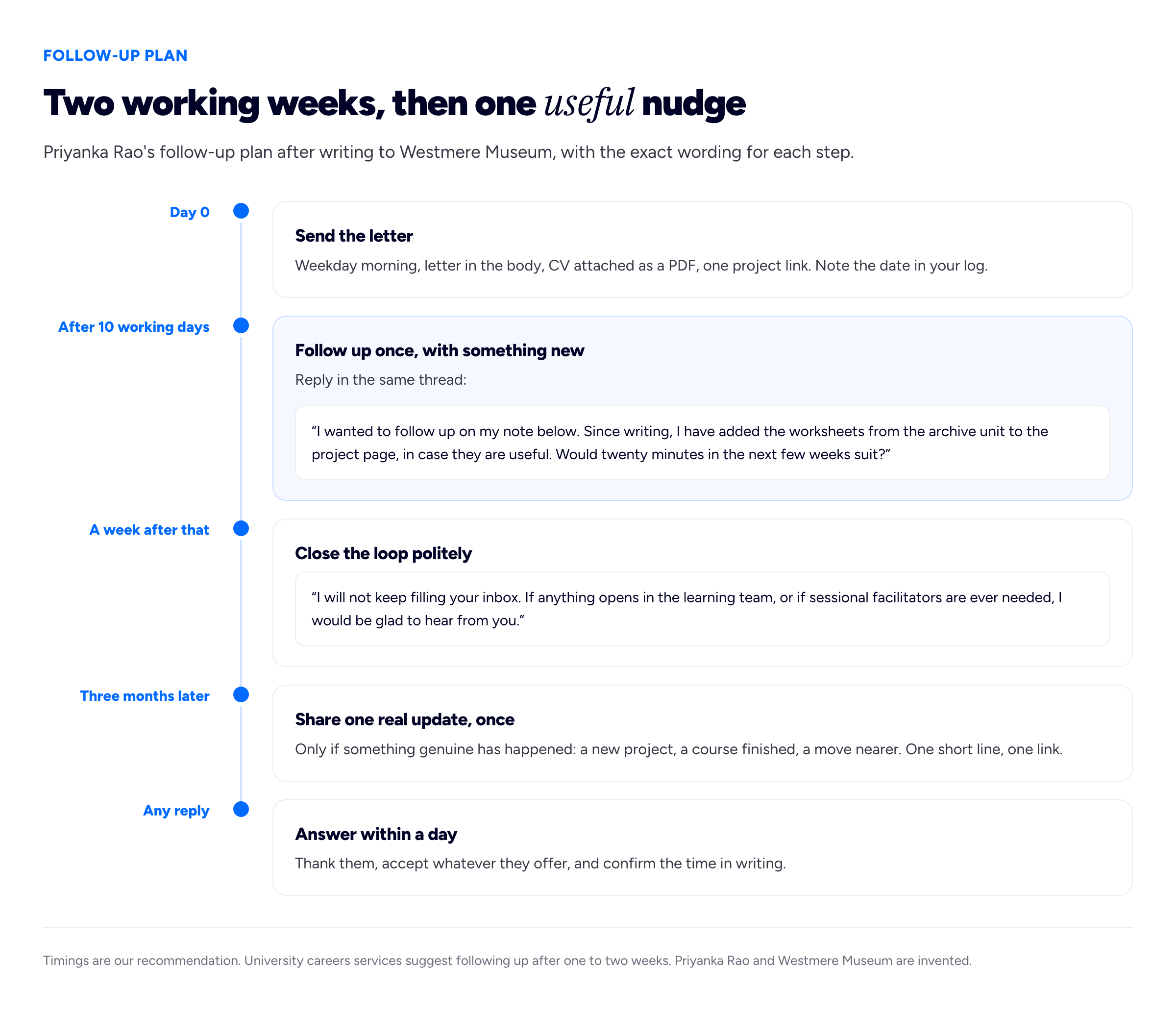
The second step does the work. A follow-up that adds something gives the reader a reason to reply, not a reason to feel guilty.
If someone says no, thank them and ask to be kept in mind. If someone agrees to a call, treat it as a short informal interview: our guide on how to prepare for an interview applies, and have two or three questions ready about how the team works and how people usually join it.
Common mistakes
- Writing the same letter to everyone. If the opening paragraph would work for any organisation, it works for none of them. Nottingham's advice on targeted rather than blanket applications applies most of all here.
- Asking for "any position". Name the kind of work you want, even if you are flexible.
- Retelling your resume. Pick two pieces and explain why they matter here.
- No ask, or an ask that is too big. "I hope to hear from you" is not an ask. "Please give me a job" is too big. A call, a coffee, a test or a place on a list is the right size.
- Following up with nothing new. Add a link, a finished project, or a date you will be nearby.
- Getting the name wrong. Check every spelling twice.
Frequently asked questions
What is the difference between a letter of interest and a cover letter?
A cover letter replies to a job advert and argues that you match it. A letter of interest is sent when no job is advertised, so it has to explain why you chose that organisation and what kind of work you are offering. It is usually shorter and asks for something smaller, such as a call.
Is a letter of interest the same as a letter of intent?
Not usually. A letter of intent most often goes with an application to a programme, such as a residency, fellowship or graduate course, and explains why you want a place. Some job sites use the two names interchangeably, so if an organisation asks for a "letter of intent", read its instructions and write what it describes.
How long should a letter of interest be?
We recommend 200 to 300 words in the body of an email: four short paragraphs. Put everything else in your resume and portfolio.
Who should I address a letter of interest to?
The person who leads the team you want to join, or at a small organisation, the founder or director. Check the website and LinkedIn, or ask reception. If you cannot find one, use the job title, such as "Dear Head of Learning", rather than "Dear Sir or Madam".
When should I follow up on a letter of interest?
University careers services suggest between one and two weeks. We recommend about two working weeks, then one follow-up that adds something new, such as a link to recent work, and one polite closing note after that. If there is still no reply, stop and move on.
Do letters of interest actually work?
Sometimes, mainly with small organisations that rarely advertise, freelance rosters, and fields where your work can be seen. Careers services say plainly that not every speculative application leads to an offer, and recommend a few targeted letters over many generic ones.
How we put this guide together
Most of this guide is our recommendation rather than sourced fact: the six-part structure, the 200 to 300 word length, the follow-up plan, the advice on where speculative letters fit and where they do not, and the mistakes list come from writing career tools and application guides at Bunfolio, not from a study.
The sourced statements come from university careers guidance, all read on 17 November 2026: the University of Cincinnati's How to write a strong letter of interest (the cover letter distinction and its two-week follow-up); the University of St Andrews Careers Centre's Speculative applications (what to cover, avoiding "Dear Sir/Madam", finding a named contact, following up after a week); the University of Nottingham's Making speculative applications (targeted over blanket applications, waiting a couple of weeks, and the caveat that not all lead to offers); Prospects' How to write a speculative job application (the definition, subject lines, and a follow-up call after one to two weeks); and MCPHS Career Development Center's Letters of Intent (the programme meaning of letter of intent). We tried to read the Imperial College and Oxford careers pages on speculative applications, but they would not load for us, so we have not cited them.
We have deliberately left out the figures that often appear in articles like this: the share of jobs said to be "hidden" or never advertised, response rates for cold applications, and claims about how many hiring managers prefer unsolicited letters. We could not trace any of them to a published sample, method and date, and a number nobody can source reads as evidence when it is not.
Priyanka Rao, Elliot Shaw, Nadia Petrov, Callum Reid, Harbourline Studio and Westmere Museum are invented, as are every project, number, phone number and link in the example letters and diagrams.
Related reading: letter of presentation, cover letter vs resume, how to address a cover letter, what to include in a cover letter and how to end a cover letter.
More from the blog
October 4, 2026 · 27 min read
How to Write a Cover Letter for an Internship (With 5 Examples)
Little or no work experience? Here is how to read an internship advert and match each requirement to your coursework, projects, societies or part-time job, with the format to copy, a fill-in template,...
October 2, 2026 · 19 min read
How to Start a Cover Letter: Greetings, Opening Lines and Examples
Start with a greeting to a named person, or 'Dear Hiring Manager', then an opening paragraph that names the role, gives one specific reason you fit and says why this employer. Greetings in order of pr...
September 27, 2026 · 24 min read
How to Write a Letter of Presentation (With 6 Examples)
A letter of presentation is what Spanish, Italian and Portuguese speakers call a cover letter, and it also means a letter introducing yourself or your services to a prospective client. What each meani...