
November 21, 2026 · 19 min read
Resume Header: What to Include, the Title Line, and Examples
A resume header holds your name, a one-line title naming the job you want, one phone number, one professional email, your city and state (or town in the UK) and a LinkedIn or portfolio link. Leave out a photo, date of birth and full street address, and type it into the body of the page, not Word's header region.
A resume header is the block at the top of page one that says who you are and how to reach you. Put in your name, a one-line title naming the job you want, one phone number, one professional email address, your city and state (or town in the UK), and a LinkedIn or portfolio link. Leave out a photo, your date of birth and your full street address, and type it all into the body of the page, not into Word's header region.
Most pages on this query stop near there. This guide covers what each line is for, what the "resume title" line should say and never claim, your address when you are moving or working remotely, formatting that tracking software reads, two worked headers, and copyable examples by situation.
What a resume header is, and what it is not
Three things get called a "header", and mixing them up causes the most common mistake on this page.
The first is the one you want: the top block of your resume, ordinary text at the start of the document. The second is the header region of a word processor, the strip above the margin in Word or Google Docs that repeats on every page; it is a separate part of the file, and putting contact details there is a risk. The third is a section heading such as "Experience" or "Skills", which our guide to ATS resume format covers.
When people search "resume title", they usually mean one specific line inside the first of these: the short line under your name that says what you do. We treat it as part of the header, because it is.
What goes in a resume header, line by line
Six lines, at most. Each answers a question the reader has straight away: who is this, are they the right kind of person, and how do I reach them? Anything else belongs further down, or nowhere.
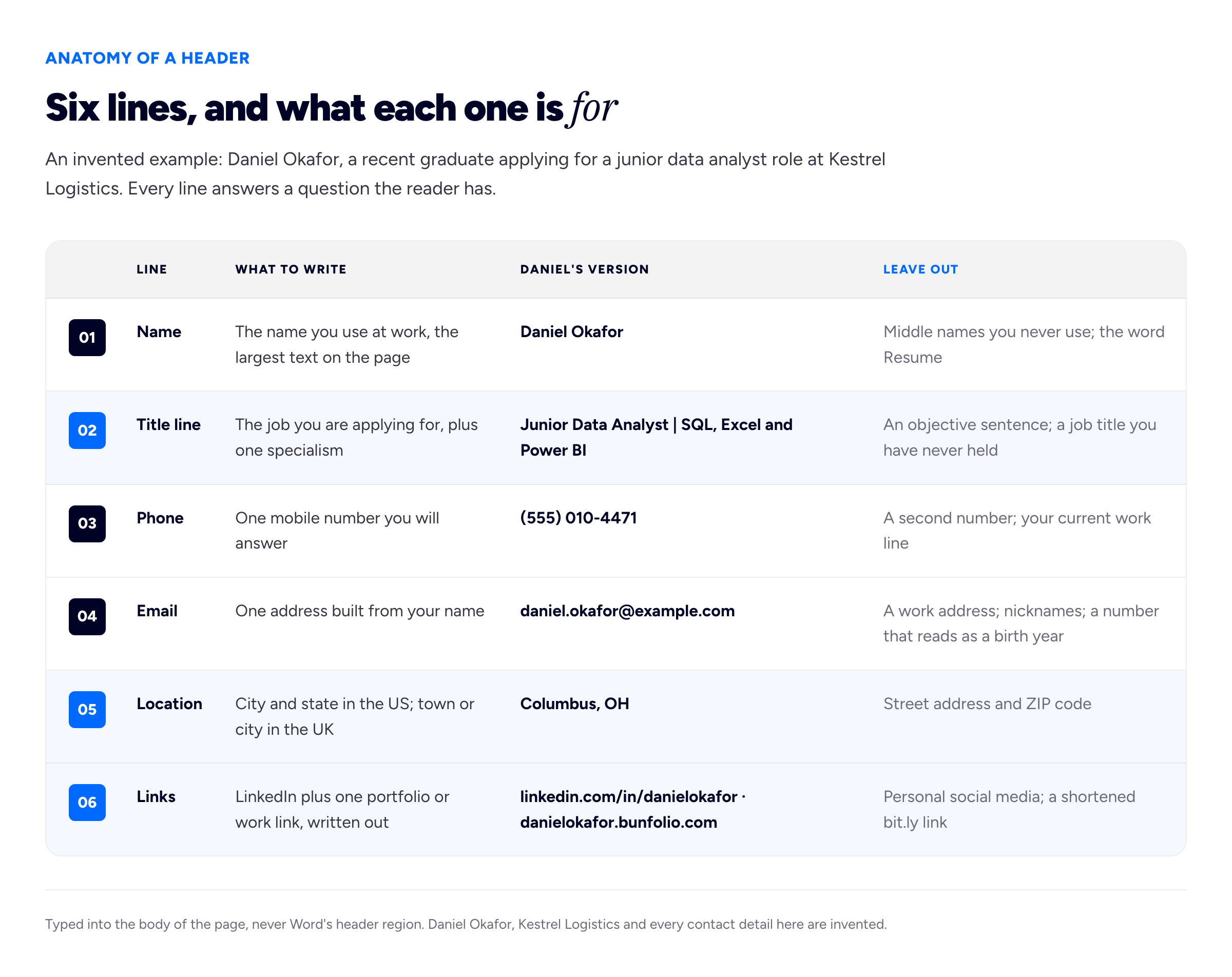
The six lines of a resume header, filled in for one invented applicant, with what to cut from each.
1. Your name
Use the name you go by at work, in the largest type on the page. If you are Daniel on every email, do not put "Chidiebere Daniel Okafor" at the top; the interviewer will greet you by the name they read. If your legal name differs from the one you use, the resume gets the one you use and the HR forms get the legal one later. You do not need to write "Resume" or "Curriculum Vitae" above or beside it. The reader knows what the document is.
Add a credential after your name only when the job requires it, such as "RN" or "CPA". One, never a string.
2. The title line
A short line saying what you are, aimed at the job you want. It has its own section below, because it is the line people get wrong most often and the one that does most work.
3. Phone number
One number: the mobile you will actually answer, with voicemail set up and a greeting you would be happy for a recruiter to hear. Include the country code only if you are applying across a border. Never give your current employer's line.
4. Email address
One personal address, built from your name. Harvard's careers office lists "missing email and phone information" among its top five resume mistakes, which tells you how often these two lines go missing or wrong. Avoid your current work address (your employer can read it, and you lose it the day you leave), nicknames, and numbers that look like a birth year, since they hand over the very information you have left off elsewhere. Prospects, the UK graduate careers site, puts it simply: make sure your email address sounds professional.
5. Location
City and state in the US ("Columbus, OH"); town or city, optionally with county, in the UK ("Leeds" or "Leeds, West Yorkshire"). That is enough for an employer to know whether you can commute, whether you are in the right time zone and whether relocation is part of the conversation. The full street address is a separate decision, covered below.
6. Links
LinkedIn, plus one link to your work if you have it: a portfolio, a GitHub profile for developers, a published-writing page for writers. The National Careers Service, the UK government's careers service, says to include "a link to your work network profile, if you have one" and names LinkedIn as the example. Prospects goes further and says that if you have a professional networking profile, website or online portfolio, you should link to it within your contact details. Write links out as readable text, without "https://" or "www", and clean up the LinkedIn address first so it ends in your name rather than a string of digits. Two links is usually right; three is the ceiling.
The portfolio link is the line in the header with the most upside, because it is the only one that leads to evidence a single page cannot hold: the dashboard you built, the case study behind the redesign, the writing itself. Our guide to putting a portfolio link on a resume covers where else it can go and why a PDF sometimes breaks it. If you do not have one yet, a free portfolio site takes less time to set up than the cover letter you are about to write.
What to leave out of a resume header
These are the items that turn up in headers and should not, at least on a US resume or a UK CV.
- A photograph. Harvard's careers office lists "include a picture" among the things not to do. In the US, the Equal Employment Opportunity Commission's guidance on prohibited practices says that "employers should not ask for a photograph of an applicant", and that a photo needed for identification can be obtained after an offer is made and accepted. Prospects says you don't need one in the UK unless you are applying for acting or modelling work.
- Date of birth or age. The National Careers Service says you should not include your age or your date of birth; Prospects calls the date of birth "irrelevant"; Harvard lists age among the things to leave off.
- Marital status and nationality. The National Careers Service also rules out whether you are married and your nationality. If your right to work is a genuine question for the employer, answer it plainly on the location line, as we show below, rather than listing a nationality.
- Gender. Harvard lists it with age as something not to include.
- Your full street address. Not forbidden, and Prospects still suggests a home address on a UK CV, but it is rarely needed at application stage and it is a privacy cost every time you upload a file. Prospects itself warns against putting your home address on a CV you post online, because you could be targeted by fraudsters.
- Second phone numbers and email addresses. Two of each makes the reader choose, and they will pick the one you check least.
- Personal social media. Instagram and TikTok belong in the header only if they are your portfolio: a photographer's Instagram, a creator's channel.
- References. Not in the header, and not on the resume at all in most cases. Harvard lists "list references" among the things to leave off.
Elsewhere, conventions differ: in parts of Europe, Latin America and Asia a photo and date of birth are still common, as our CV versus resume guide explains. The rule we recommend is short: follow the employer's written instructions first, follow the local convention where you know it, and with neither, leave personal details out. An employer who wants them will ask on a form.
The resume title: what the line under your name should say
The resume title (also called a headline or a target title) is the single line under your name. It does one job: tells the reader, before they read anything else, which job you are a candidate for. A recruiter screening for a junior data analyst who sees "Junior Data Analyst" keeps reading; one who sees "Results-Driven Professional" has to dig.
The formula
Our recommendation is target role, then one or two specialisms, separated by a vertical bar or a middle dot:
- Target role: the title from the job advert, or the nearest honest version of it. If the advert says "Data Analyst I" and you would describe yourself as a junior data analyst, either works; matching the advert's wording helps a human scanning for it and software searching for it.
- Specialism: the tools, sector or kind of work that narrows you down. "SQL, Excel and Power BI". "Design Systems and B2B SaaS". "Freight and Warehouse Operations".
Add a third element only if it is short and checkable: "Google Data Analytics Certificate", "8 years". Keep the line under about ten words. It is a label, not a sentence.
The honesty line
The title line describes the job you are applying for, which is not always a job you have held. That is fine as long as it reads as a target, not a claim. "Junior Data Analyst" at the top of a graduate's resume is understood as what Daniel is applying to be. "Senior Data Analyst at Kestrel Logistics" would be a claim, and a false one. If you are changing careers and the gap is wide, soften it: "Data Analyst (career change from logistics operations)" is honest and still names the target.
Title line versus summary versus LinkedIn headline
The title line is one line. The professional summary is two to four sentences underneath the header, and it carries the evidence the title line cannot. Your LinkedIn headline has more room and a different job, because it is how people find you in search; our LinkedIn headline examples cover it. They should agree with each other, but they should not be copies.
Resume title examples
- Junior Data Analyst | SQL, Excel and Power BI
- Senior Product Designer | Design Systems and B2B SaaS
- Logistics Coordinator · Freight Booking and Carrier Relations
- Registered Nurse | Emergency and Urgent Care
- Front-End Developer | React and TypeScript
- Marketing Assistant | Social Media and Email Campaigns
- Customer Success Manager | SaaS Onboarding and Retention
- Freelance Copywriter | B2B Technology and Finance
And a few to avoid, with the reason: "Hardworking Team Player" (says nothing a reader can check), "Aspiring Data Scientist Seeking Opportunities" (an objective sentence squeezed into a label), "Guru of All Things Digital" (no recruiter searches for it), and "Data Analyst / Developer / Designer / Consultant" (four targets is no target).
Formatting the header so people and software can read it
Type it into the body of the page
This is the formatting rule that matters most. Word and Google Docs both let you put text into a page header region that repeats on every page. It looks tidy, and some templates do it by default. The trouble is that it is stored separately from the body of the document, and applicant tracking systems do not all treat it the same way: some read it in a different order, some skip it because on longer documents it is usually repeated boilerplate. A skipped header means a candidate record with no name, phone or email. Our ATS resume format guide explains how to check what a parser sees; the short fix is to click into the header region, cut everything, close it and paste the text as the first lines of the body.
No text boxes, no icons standing in for words
The same applies to text boxes and floating shapes, which templates love for headers: they are drawn on top of the page rather than written into it, and parsers often lose or misplace them. Icons are the other trap. A little phone glyph next to your number looks clear to a person, but an icon is not a word, so if the number then lands in the wrong field there is no label to rescue it. Plain text with separators is safer: "Columbus, OH · (555) 010-4471 · daniel.okafor@example.com".
Layout, size and spacing
- Name: roughly 18 to 24 point, bold or semi-bold, in the same font family as the rest of the page. Our best font for a resume guide covers which fonts survive every machine.
- Title line: 11 to 13 point, regular weight or a colour accent, directly under the name.
- Contact line: the same size as your body text, on one or two lines, separated by middle dots or vertical bars.
- Alignment: left-aligned or centred are both fine. Avoid splitting the header into two columns with contact details floating on the right; it is the layout most likely to be read in the wrong order.
- Height: keep the block to the top eighth or so of the page; the rest is for your experience.
Links in a PDF
Make the visible text the address itself, so it works on paper and in a parser, then click each link in the exported PDF, since some export settings drop link targets.
Two headers, built from scratch
Daniel Okafor, junior data analyst
Daniel graduated in the spring and is applying for a junior data analyst role at Kestrel Logistics, a freight company with an office in his city. The advert asks for SQL, Excel and "experience with a BI tool such as Power BI or Tableau", and mentions a hybrid pattern of three days in the office.
His first draft looked like this:
DANIEL C. OKAFOR — RESUME
Recent graduate seeking an entry-level opportunity to grow my analytical skills
1180 Maple Ridge Drive, Apt 12, Columbus, OH 43215 · dannyo_2003@example.com
(555) 010-4471 · (555) 010-9932
"Resume" is redundant; the title line is an objective that names no job or skill; the street address is unnecessary; the email nickname carries a number that reads as a birth year; and two phone numbers make the recruiter guess. Missing entirely: the portfolio site holding the three dashboards from his capstone project.
The rewrite:
Daniel Okafor
Junior Data Analyst | SQL, Excel and Power BI
Columbus, OH · (555) 010-4471 · daniel.okafor@example.com
linkedin.com/in/danielokafor · danielokafor.bunfolio.com
The title line repeats the advert's three requirements in the advert's own words. "Columbus, OH" tells Kestrel he can manage three days in the office. The portfolio link gives the hiring manager the one thing a graduate resume cannot hold: work they can open and judge. See also how to make a resume for your first job.
Marisol Vega, senior product designer
Marisol has nine years of experience and a header that a template designed for her. It looks polished, and much of it is working against her.
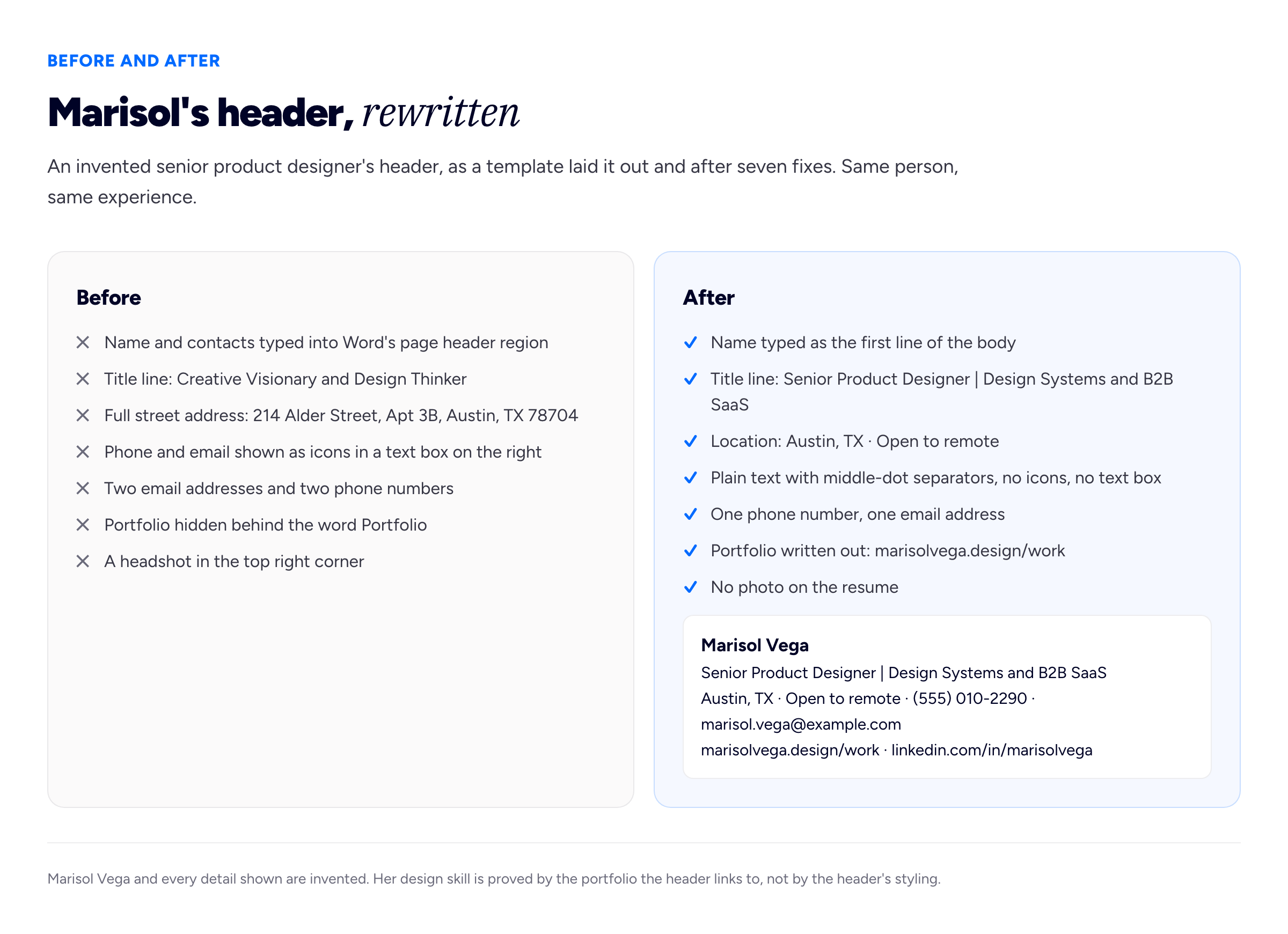
A template-built header against the plain version that reads correctly in every system and still looks considered.
A plain header can feel like a missed chance for a designer. Our view is that the header has to survive every parser and printer; the portfolio is where your craft is judged, and the header's job is to get the reader there. Marisol's "Creative Visionary and Design Thinker" also had to go for a plainer reason: no recruiter for a senior product designer searches for either phrase, and both claim a quality the reader cannot check from one line.
Where you live: the location line, by situation
Location is the line that changes most between applications, and the one people agonise over. Here is what we recommend in the situations that come up most.
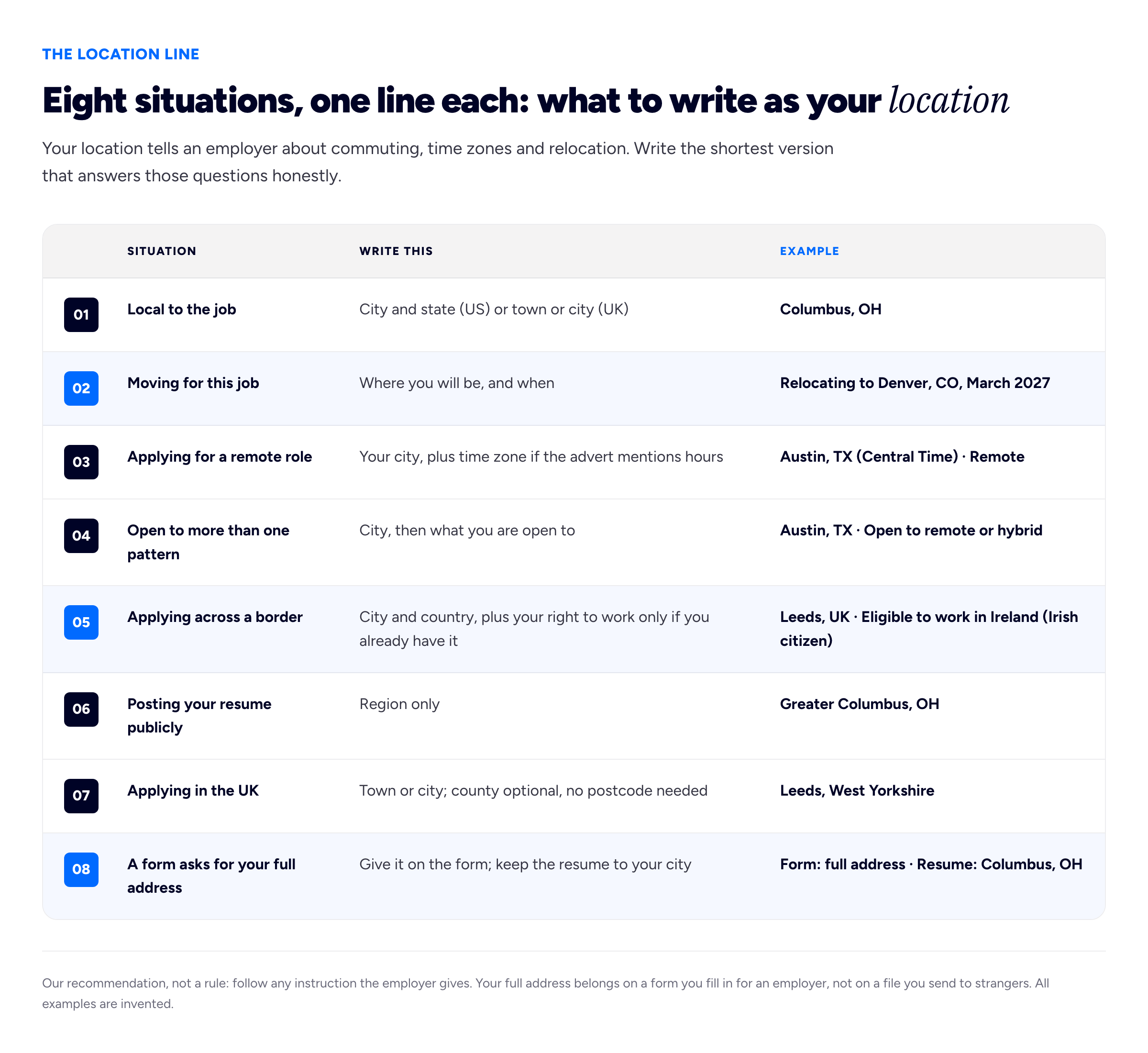
A quick reference for the location line, from a local application to a cross-border move.
Two of these deserve a word more. If you are relocating, say so with a date. Without one, an out-of-state city can read as an impossible commute. And if you are applying across a border, do not list your nationality (the line the National Careers Service tells you to leave out); state your right to work only if you have it. If you will need sponsorship, that is a conversation for the application form or the cover letter, not the header.
Resume header examples by situation
Copy the shape, not the details. Every name, number and address below is invented.
First job or student
Daniel Okafor
Junior Data Analyst | SQL, Excel and Power BI
Columbus, OH · (555) 010-4471 · daniel.okafor@example.com
linkedin.com/in/danielokafor · danielokafor.bunfolio.com
Student still finishing a degree
Daniel Okafor
Data Analytics Intern | B.S. Statistics, expected May 2027
Columbus, OH · (555) 010-4471 · daniel.okafor@example.com · linkedin.com/in/danielokafor
Senior or experienced
Marisol Vega
Senior Product Designer | Design Systems and B2B SaaS
Austin, TX · Open to remote · (555) 010-2290 · marisol.vega@example.com
marisolvega.design/work · linkedin.com/in/marisolvega
Career changer
Daniel Okafor
Data Analyst (career change from warehouse operations) | SQL and Excel
Columbus, OH · (555) 010-4471 · daniel.okafor@example.com · linkedin.com/in/danielokafor
Relocating
Marisol Vega
Senior Product Designer | Design Systems
Relocating to Denver, CO, March 2027 · (555) 010-2290 · marisol.vega@example.com
marisolvega.design/work
Freelancer applying for in-house work
Marisol Vega
Product Designer | Freelance since 2021, B2B SaaS clients
Austin, TX · (555) 010-2290 · marisol.vega@example.com · marisolvega.design/work
How to present the freelance years themselves is covered in freelance work on a resume.
UK CV
Daniel Okafor
Graduate Data Analyst | SQL, Excel and Power BI
Leeds · 07700 900471 · daniel.okafor@example.com · linkedin.com/in/danielokafor
Developer
Daniel Okafor
Junior Analytics Engineer | Python, SQL and dbt
Columbus, OH · (555) 010-4471 · daniel.okafor@example.com
github.com/danielokafor · linkedin.com/in/danielokafor
Returning after a career break
Marisol Vega
Product Designer | Returning after a family career break
Austin, TX · (555) 010-2290 · marisol.vega@example.com · marisolvega.design/work
Naming the break here is optional; the summary can explain it instead.
Mistakes that cost more than they look
- A typo in the email address. The most expensive mistake on the page, because nobody will tell you. Send yourself a test email from a different account, copying the address from the resume itself.
- A header that does not match the other documents. Use the same name, title, contact line and links on your resume, cover letter and portfolio. Our guide to what to include in a cover letter shows the matching header there, and cover letter vs resume covers what each document should say once the headers match.
- A dead link. A portfolio link that 404s, or a LinkedIn profile last touched four years ago, is worse than no link. Click every one before each batch of applications.
- A title line that does not change. The title line is the cheapest part of the resume to tailor. Rewrite it for every application whose advert words the role differently.
- The header made into a summary. If the title line grows past one line, the extra is a summary. Move it down into the professional summary.
Frequently asked questions
What should a resume header include?
Your name, a one-line title naming the job you want, one phone number, one professional email address, your city and state (or town in the UK), and a LinkedIn or portfolio link. That is enough for a reader to know who you are, whether you fit and how to reach you. Anything else usually belongs further down or nowhere.
What is a resume title?
A resume title is the short line under your name that says what job you are a candidate for, such as "Junior Data Analyst | SQL, Excel and Power BI". It works best as the job title from the advert plus one or two specialisms. It is a label, not a sentence, and it should describe your target honestly rather than claim a job you have not held.
Should I put my full address on my resume?
Usually not. City and state in the US, or town or city in the UK, tells an employer what they need to know about commuting and relocation. Your full address goes on application forms when an employer asks for it, and leaving it off a file you upload to job sites protects your privacy.
Should I put my contact information in the Word header?
No. The header region of a Word or Google Docs file is stored separately from the body text, and some applicant tracking systems read it out of order or skip it. Type your name and contact details as the first lines of the document body instead, so they are read wherever the file goes.
Should a resume header have a photo?
Not for jobs in the US or the UK, unless the employer asks. US equal-employment guidance says employers should not ask for applicant photographs, and UK careers services say a photo is unnecessary outside acting and modelling. In some other countries photos are still common, so follow the local convention or the employer's instructions.
How we put this guide together
Most of this guide is our recommendation rather than sourced fact. The six-line structure, the title-line formula, the honesty rule for target titles, the type sizes, the location-line advice for each situation, the list of mistakes, the two-minute check and every example header are ours, based on how resumes are read rather than on a published standard. The point about Word's header region being stored and parsed separately is explained in more depth, with its own sources, in our ATS resume format guide.
Where we cite published guidance, we read it ourselves on 17 November 2026: Harvard FAS Mignone Center for Career Success, create a strong resume, for the missing email and phone mistake and for leaving off pictures, age, gender and references; the National Careers Service, CV sections, for what contact details to include, the LinkedIn link, and leaving out age, date of birth, marital status and nationality; Prospects, how to write a CV, for the professional email address, linking a portfolio in your contact details, the photo exception for acting and modelling, and the warning about home addresses on CVs posted online; and the US Equal Employment Opportunity Commission, prohibited employment policies and practices, for its guidance on applicant photographs.
We have deliberately left out the figures that decorate many articles on this subject: the number of seconds a recruiter is said to spend on a resume, the share of resumes supposedly rejected by software because of the header, and percentages of hiring managers said to dislike photos or prefer a given layout. We could not trace them to a published method, sample and date, and a number nobody can source is worse than none.
Daniel Okafor, Marisol Vega and Kestrel Logistics are invented for illustration, as are every phone number, email address, street address, LinkedIn profile, portfolio address and example header in this guide and its three diagrams. Adapt the shapes; do not copy the details.
Related reading: ATS resume format, how to put a portfolio link on your resume, how to write a professional summary, the best font for a resume and LinkedIn headline examples.
More from the blog
November 25, 2026 · 19 min read
What to Include in a Cover Letter: Every Part, With an Example
A cover letter should include a header with your contact details, the date and the employer's details; a greeting to a named person; an opening naming the job; one or two paragraphs of evidence; why t...

November 24, 2026 · 19 min read
What Is a Letter of Interest? Template and 3 Full Examples
A letter of interest is a short letter to an employer that has not advertised a job, saying you would like to work there, what you could bring, and asking for a conversation. In the UK it is a specula...
November 23, 2026 · 19 min read
How to Make a Resume for Your First Job (With Two Samples)
List everything that involved turning up, being trusted or finishing something: school, volunteering, clubs, sport, babysitting, odd jobs, caring at home. Put education near the top, include unpaid wo...