
November 23, 2026 · 19 min read
Short Bio Examples: How to Write a Simple Bio About Yourself
A simple short bio is two or three sentences: your name and job, who you do it for or where, one specific proof, and perhaps one human line. Here is a fill-in formula, the same bio at one line, 50 and 100 words, when to use first or third person, and examples for LinkedIn, team pages, events, Instagram and more.

A simple short bio is two or three sentences: your name and job, who you do it for or where, one specific proof, and perhaps one human line. For example: "Ben Thornton is an electrician on Northgate Council's housing repairs team. He trains the team's apprentices. Off shift, he restores old valve radios."
That is the whole formula. This guide adds a fill-in template, the same bio written at one line, fifty words and a hundred words, a plain rule for first person versus third, short bio examples for each place you will be asked for one, more than twenty copyable examples across different jobs, and a method for cutting a long bio down without losing the part that matters.
If what you need is the About section of your own portfolio website, that has its own guide, with thirty examples written for clients rather than colleagues: portfolio bio examples. This post is for every other box that says "Tell us a little about yourself".
What a short bio is for
A short bio is an introduction someone else will read before they meet you, hear you, hire you or reply to you. It is not a CV in paragraph form and it is not a personality test. It answers three questions in the order a reader asks them: who is this, why should I listen to them here, and is there anything that makes them a person rather than a job title?
That last question is optional, and people over-answer it. A bio that is half hobbies says you were not sure what to say about your work. One true, specific detail is the right dose.
The Boise State University Writing Center's guide to professional bios makes a point worth borrowing: each bio "should be tailored to your specific audience and purpose", and versions for different audiences do not need to share every detail, though what they do share must agree. So expect to keep several short bios, not one.
The fill-in formula: five slots
Every short bio below is built from the same five slots. The first three are required; the last two earn their place only if you have the words to spare.
- Name and role. The job as an outsider would describe it. "UX researcher", not "Insight Lead, Squad 4".
- Where, or for whom. The setting or the people you serve. This is what turns a title into a picture: an electrician on a council housing team is a different person from an electrician who wires restaurant kitchens.
- One proof. A number, a project, a credential or a result. One, not five. Pick the one most relevant to this reader.
- One human line (optional). Something true and specific that a colleague would recognise. Not "loves travel".
- Next step (optional). Where to find you or what to do next, when the reader can act on it.
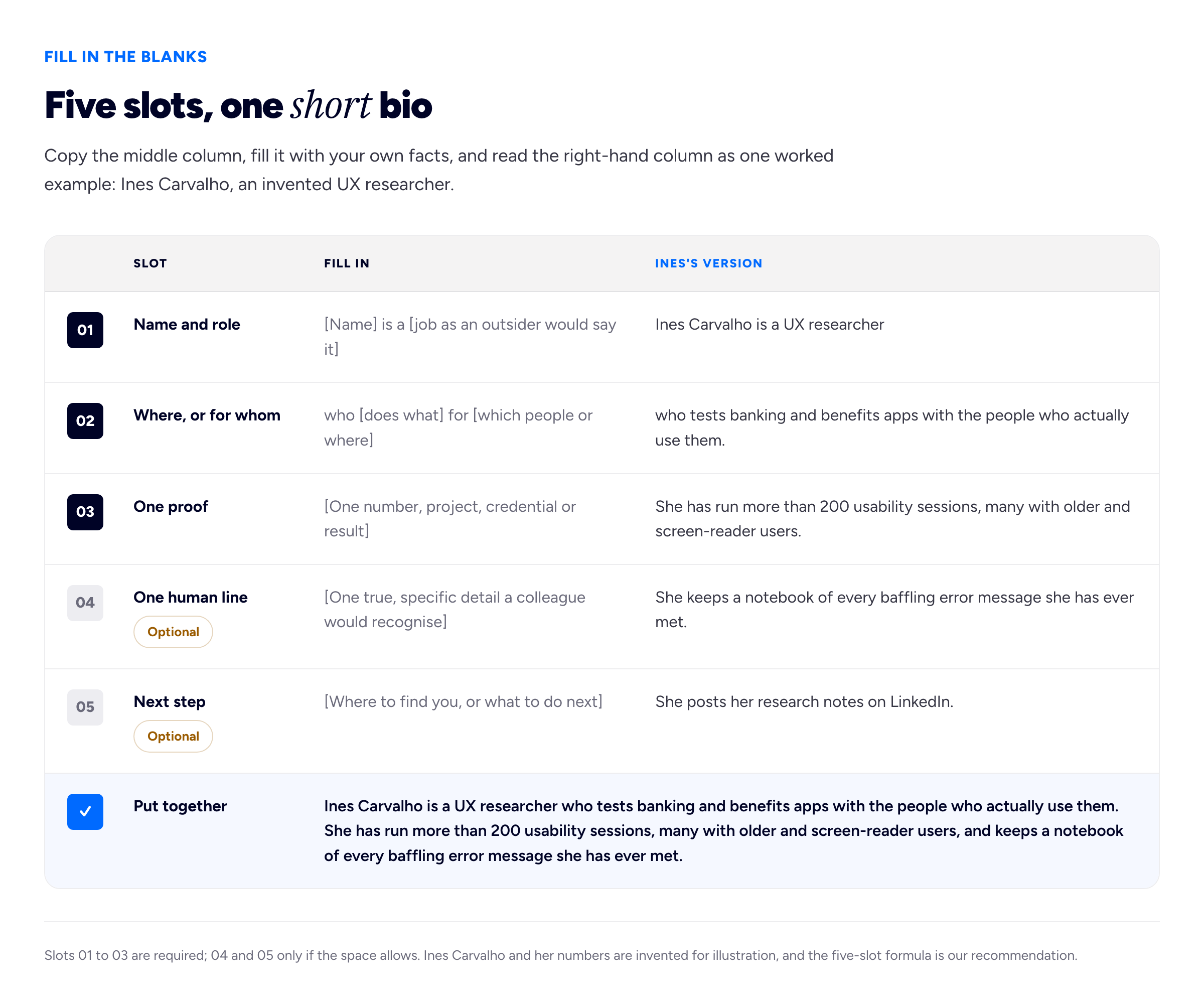
Fill the middle column with your own facts; the right-hand column shows one invented researcher doing it.
Two things make the formula work. First, the order: role before proof, proof before personality. A reader who stops after the first sentence still knows what you do. Second, the restraint: one proof and one human line. A list of qualifications is remembered as none of them.
How to find your one proof
Ask yourself what you were proud of last year. It is usually a number (patients, projects, sessions, flats, clients), a thing you made that other people now use, a responsibility someone trusted you with, or a qualification that matters in your field. "Experienced" is not a proof. "Twelve years in acute medicine" is.
How to find your human line
Pick something a colleague would say about you if asked, or something you do that shows how you think. A thing you collect, fix, grow, cook or keep a record of usually works. If you are stuck, our guide to fun facts about yourself has six places to dig. In a formal setting, such as a board paper or a regulatory directory, leave it out.
One line, fifty words, a hundred words
You will be asked for bios of very different lengths, often with a word or character count attached. Boise State describes three common formats: a long one of several paragraphs, a short one of a single paragraph, and a two-line "elevator pitch" you could say in about fifteen seconds. For short bios, the sizes that come up most are these:
- One line, roughly 15 to 25 words. Slots one and two only. Used under a name on a speaker list, in a social profile, in an email signature, on a name badge introduction.
- Fifty words, give or take. Slots one to three, plus either four or five. The standard conference programme, team page or newsletter "about the author".
- A hundred words. All five slots, with a second proof. Panel introductions, guest posts, award entries, the opening of a LinkedIn About section.
Do not write the hundred-word version and trim it to fit. Write the one-liner first; if you cannot, the long version will be vague too.
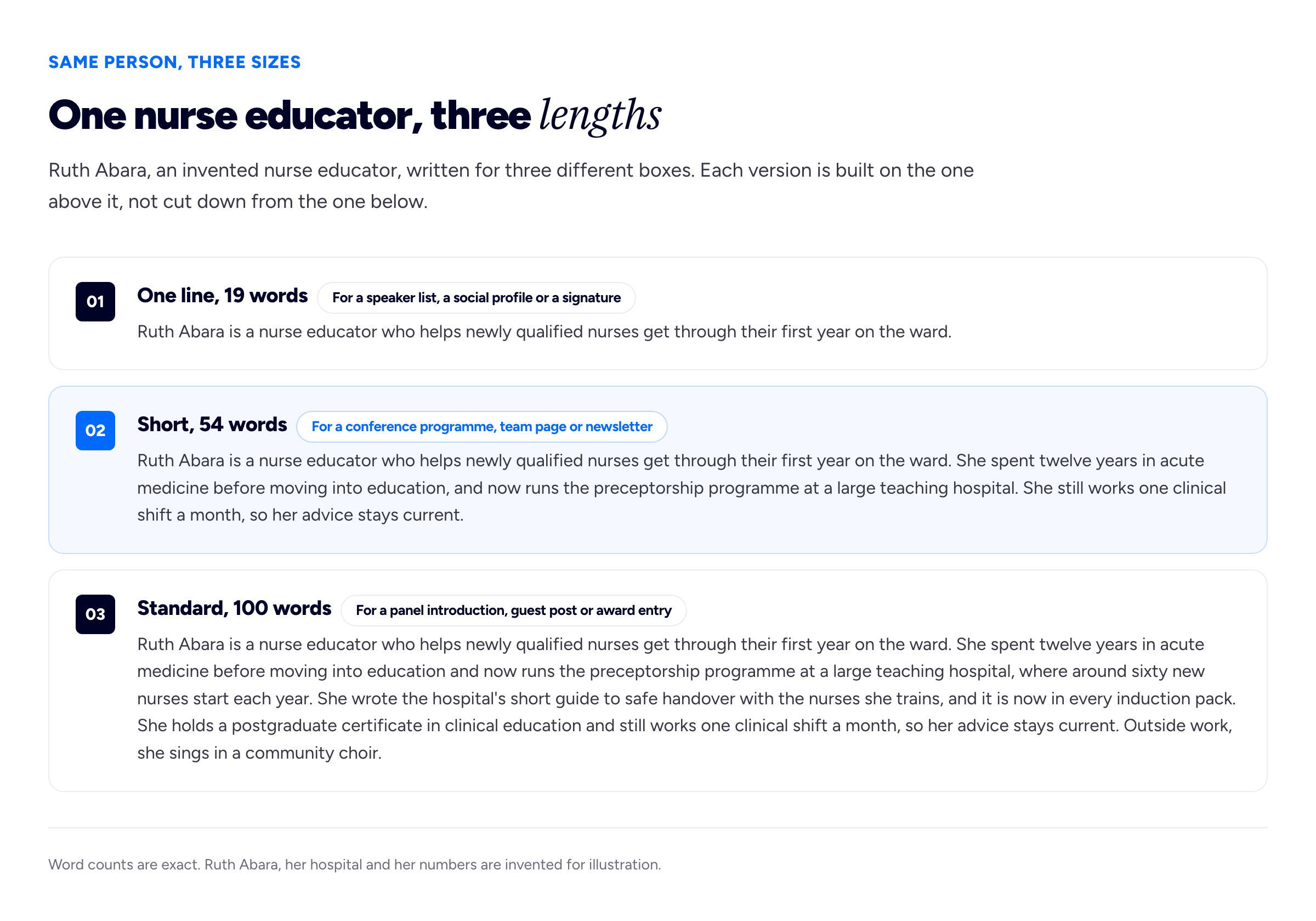
Each version adds a slot to the one above it; none of them is the long bio with words removed.
First person or third person?
The rule is about who is speaking. If someone else will introduce you, or your bio sits among other people's on a page someone else publishes, write in the third person: "Ruth Abara is…". If the bio sits on your own profile, your own site or your own social account, write in the first person: "I'm a nurse educator…". A third-person bio on your own Instagram reads as if you have hired a publicist.
Where the publisher has a house style, follow it. Conference programmes, journal author notes, award shortlists and most company team pages use third person, because every entry has to sit next to the others. LinkedIn About sections, Instagram, X and most personal websites use first person, because the reader knows you wrote it. When in doubt, look at three other bios on the same page and match them.
Converting is not quite a find-and-replace. "Daniel Mbeki is an accountant who…" becomes "I'm an accountant who…", not "I, Daniel Mbeki, am an accountant…". Use your full name once in third person, then the surname or "he", "she" or "they" after that, consistently.
Which bio goes where
The table below is the short version of the next section: for each place you are likely to be asked for a bio, which person to write in, roughly how long, and what to put first.
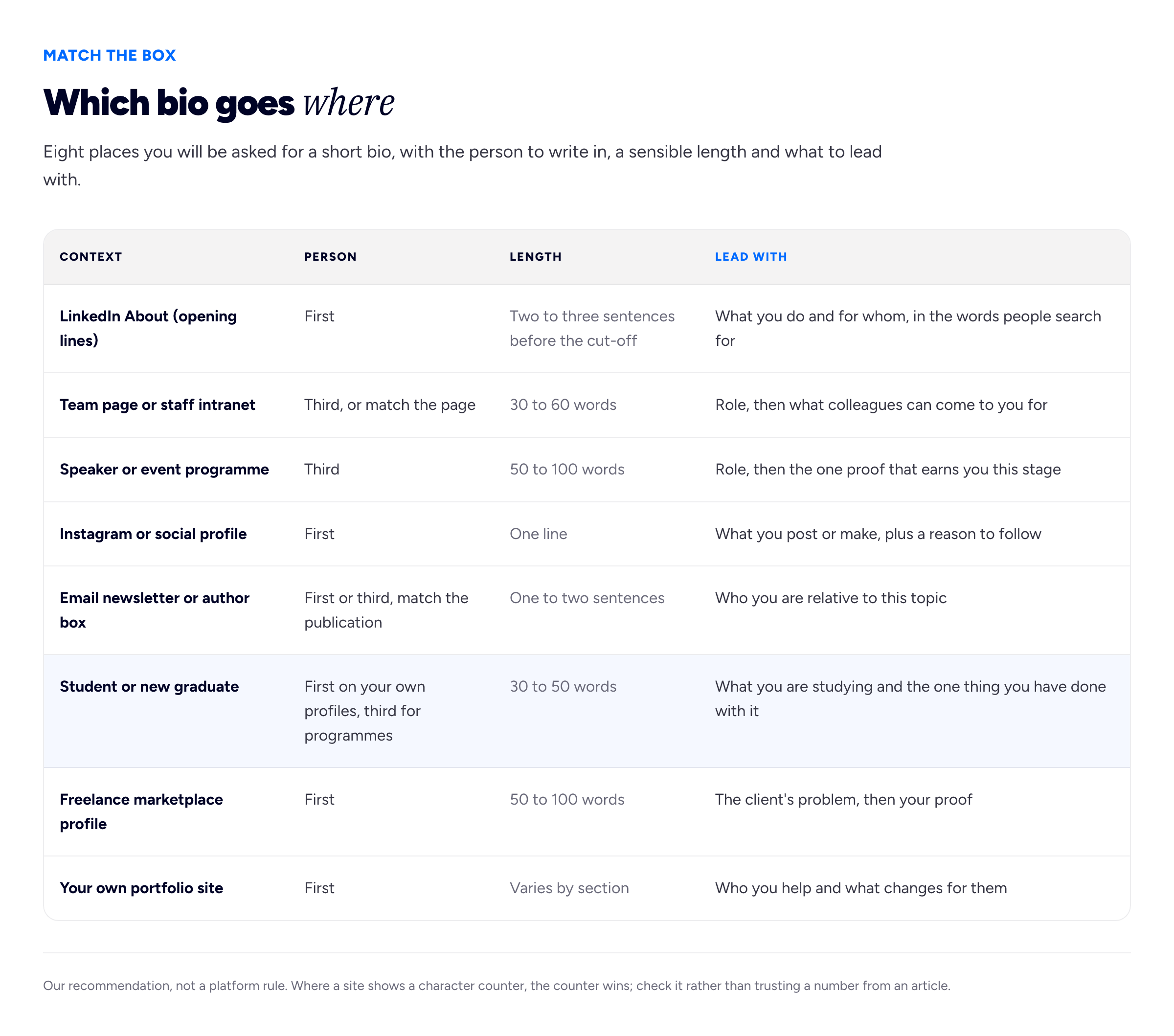
When the publisher has a house style or a character counter, it overrides this table.
Short bio examples by context
LinkedIn About section
Your About section can be long, but only its opening lines show before readers have to click to see more, so those lines work as a short bio. Write in the first person and put the words people would search for near the start. Your headline does a related job in fewer words; see LinkedIn headline examples for that. Here are Ines Carvalho's opening and Daniel Mbeki's:
I'm a UX researcher who tests banking and benefits apps with the people who actually use them, including older and screen-reader users. Over 200 usability sessions in, I'm still surprised by what people do with a form we thought was simple.
I'm a chartered accountant working with small building and trades firms: sole traders, partnerships and limited companies with a van or two and no finance department. I keep the books ready for tax season so the people who own them can get on with the job.
Team page or staff intranet
Colleagues read these to work out who to ask about what. Lead with the role and finish with what people can come to you for. A human line is welcome; a sales pitch is not.
Ben Thornton is a maintenance electrician on Northgate Council's housing repairs team, where he has worked for eight years. He leads on rewires and fire-alarm upgrades in the council's older blocks and mentors the team's apprentices. Ask him about anything with a fuse box older than you are.
Speaker or event bio
An organiser will read this aloud or print it in a programme, so write it in the third person and lead with the reason you are on this stage. Keep one proof that relates to your talk, not your whole career. Give the organiser a pronunciation note separately if your name is often mispronounced.
Ruth Abara is a nurse educator who runs the preceptorship programme for newly qualified nurses at a large teaching hospital. Her session draws on the handover guide she wrote with the nurses she trains, now part of every new starter's induction.
Instagram or social media bio
Social platforms give you a small box and readers who scroll fast. Write in the first person or in fragments, say what you post or make, and give a reason to follow. Line breaks and a single emoji can work here in a way they would not on a team page. The platform's own character counter tells you how much room you have; trust it over any number you read online. Three examples, from Mai Tran, Ben Thornton and Ruth Abara:
Illustrator. Picture books, science magazines and a lot of drawings of beetles. Weekend drawing class for teens in the link below.
Electrician fixing up old valve radios one solder joint at a time. Before-and-after posts every Sunday.
Nurse educator. Short, practical tips for your first year on the ward. Not medical advice for patients.
Email newsletter or author box
Here the bio's job is to tell the reader why you are worth listening to on this topic. One or two sentences. If the newsletter is yours, use the first person; if you are a guest, match the publication.
I'm Daniel, an accountant who works with small trades firms. Each month I explain one tax deadline in plain English, before it arrives rather than after.
Student or new graduate
When you do not have much work experience, the course is your role and one thing you did inside it is your proof: a project, a placement, a society you ran or a part-time job. Do not apologise for being early in your career, and do not inflate it either. The same thinking applies to your first resume; see how to make a resume for your first job.
Leo Fischer is a second-year civil engineering student. He led his course's bridge-building competition team, whose timber truss carried the heaviest load in its year, and is looking for a summer placement in structural design.
Freelancer or marketplace profile
On a freelance marketplace, buyers compare you with dozens of others in seconds. Lead with the problem you solve for them, then your proof, then what happens next. Write in the first person; it is your listing. Mai Tran's reads like this. If you are just starting out with this kind of work, our guides to gig work and side hustles from home cover the wider picture.
I draw clear, friendly illustrations for science explainers, school resources and picture books. Six books published, plus regular work for science magazines. Send me your brief and I will reply within two working days with a sketch approach and a price.
Short bio examples across professions
These are written without names so you can drop your own in. Each one follows the formula: role and setting, one proof, and sometimes a human line. Change the numbers and details to your own; an example with somebody else's facts in it is not your bio.
- Teacher: "[Name] teaches maths to 11 to 16-year-olds at a large comprehensive school, where she also runs the after-school puzzle club. Her classes have a habit of asking for harder problems."
- Software developer: "I'm a backend developer who builds booking and payment systems for small travel firms. I care about the boring parts, like what happens when a card payment fails at 2am."
- Project manager: "[Name] is a project manager who runs office moves and refurbishments for organisations that cannot close while the work happens. He has moved fourteen teams without losing a day of service."
- Marketing: "[Name] plans email and social campaigns for independent bookshops. She writes everything as if she were talking to one reader at the till."
- Chef: "[Name] is head chef at a forty-cover neighbourhood restaurant that changes its menu every week. He trained in hotel kitchens and still bakes all the bread himself."
- Data analyst: "[Name] is a data analyst who turns hospital waiting-list data into one-page reports that managers actually read. She will happily talk about spreadsheets for longer than you would like."
- Social worker: "I'm a children's social worker in a busy assessment team. I've spent six years learning that most families need someone who listens before they need a plan."
- Personal trainer: "[Name] is a personal trainer who works with people coming back to exercise after injury or a long break. He would rather you could carry your shopping comfortably than lift a record."
- Researcher or academic: "[Name] is a postdoctoral researcher studying how rivers recover after flooding. She spends her summers in waders and her winters in spreadsheets."
- Tradesperson: "I'm a plumber and heating engineer covering the town and nearby villages. Most of my work comes from people whose neighbours recommended me, which is how I'd like to keep it."
"About me" examples for forms and introductions
Some boxes are not called a bio at all: "About me" on an application form, a volunteer sign-up, a new course or an internal skills directory. The same formula applies, in the first person, with a little more emphasis on why you are here.
About me: I'm an electrician with eight years on a council housing repairs team. I'm applying to volunteer with the repair café because I enjoy fixing things that other people have given up on, especially old radios and lamps.
About me: I'm a second-year engineering student, and my favourite part of the course so far was the bridge-building competition. I'm looking for a placement where I can see a real structure designed from the first calculation onwards.
If the box comes with an interview attached, the spoken version is a separate skill. Our guide to answering "tell me about yourself" covers that, and how to prepare for an interview covers the rest.
How to shorten a long bio
Most people already have a long bio somewhere: an old About page, a grant application, the paragraph a manager once wrote for them. Shortening it well is a matter of deciding what to keep, not what to cut. Here is the method we use.
- Underline the role sentence. Find the sentence that says what you do and for whom. If there is not one, write it. That is your one-liner.
- Circle every proof. Numbers, projects, credentials, results. Choose the single one most relevant to this reader and drop the rest.
- Delete history. Where you grew up, your first job, the order things happened in. Keep history only when it is the proof ("twelve years in acute medicine").
- Delete adjectives you would not let a colleague say about you without an example. "Passionate", "dynamic", "results-driven" go first. If you need help finding a specific replacement, our guide to words to describe yourself pairs each word with evidence.
- Swap abstract verbs for plain ones. The GOV.UK style guide, which makes plain English mandatory across government pages, tells its writers to avoid words such as "deliver", "facilitate", "leverage" and "robust", and to use the active voice because it is more concise and clear. Bios full of those words read as if no one wrote them.
- Keep one human line, or none. If three hobbies survive to this point, pick the most specific.
- Read it aloud. If you run out of breath, the sentence is too long. If it sounds like a press release, it is too formal for anywhere but a press release.
A worked example
Here is a long bio for Daniel Mbeki, the invented accountant, of the kind people paste into every box:
Daniel Mbeki is a highly motivated and results-driven chartered accountant with a passion for delivering robust financial solutions. Born and raised in Leicester, he studied economics at university before joining a mid-sized accountancy practice, where he spent nine years working across a diverse portfolio of clients in a variety of sectors, specialising latterly in small construction and trades businesses. He has extensive experience of bookkeeping, VAT, payroll and year-end accounts, and is committed to leveraging technology to streamline his clients' processes. In his spare time Daniel enjoys football, cooking, travelling and spending time with his family.
After the seven steps, the fifty-word version:
Daniel Mbeki is a chartered accountant who works with small building and trades firms. He spent nine years in practice keeping the books for sole traders and partnerships with a van or two and no finance department, and moved them all onto online bookkeeping. He referees youth football on Sundays.
And the one-liner: "Daniel Mbeki is a chartered accountant for small building and trades firms." Notice what went: Leicester, the degree, "diverse portfolio", every adjective, and three of the four hobbies. Notice what changed: "football" became something specific, refereeing, which says more about him than the word "football" did. And notice what survived: the setting, which was buried in the original, is now the second half of the first sentence, because it is the most useful thing a reader can know about him.
Mistakes that make a short bio forgettable
- Opening with your life story. Birthplace and childhood belong in a long bio at most. In a short one, the first sentence must be the role.
- A title with no setting. "Ben is an electrician" is accurate and tells the reader almost nothing. Add where or for whom.
- Three proofs where one would do. Readers remember one fact. Make it the right one.
- Personality by adjective. "Friendly and approachable" is a claim. "Ask him about anything with a fuse box older than you are" shows it.
- Mixing first and third person. Pick one and keep it from the first word to the last.
- Using the same bio everywhere. The newsletter, the intranet and Instagram are different rooms. Adjust the length, the person and the lead, and keep the facts consistent.
- Letting it go stale. Boise State suggests checking your bios at least every six months. A bio with last year's job in it is worse than a short one.
When a short bio is not enough
A short bio is a promise: it says you have done something worth reading about. Sooner or later someone will want to see it. A resume can list what you did; a portfolio website can show it, and every short bio can link there. Our guide to portfolio bio examples covers the About section for that site, and the resume header guide covers where the link goes on your CV.
Frequently asked questions
How do I write a short bio about myself?
Write two or three sentences: your name and role, who you do it for or where, and one specific proof such as a number, project or credential. Add one true personal detail or a next step if there is room. Write in the third person when someone else publishes or reads it, and the first person on your own profiles.
What is a good short bio example?
"Ruth Abara is a nurse educator who helps newly qualified nurses get through their first year on the ward. She spent twelve years in acute medicine and still works one clinical shift a month." It works because it names the role, the people she serves and one proof, in under forty words.
Should a short bio be in first or third person?
Use the third person when your bio appears alongside other people's on a page someone else publishes, such as a conference programme, team page or author note. Use the first person on your own LinkedIn, social accounts, website and marketplace profiles. If the publisher has a house style, follow it.
How long is a short bio?
Usually between one line (about 15 to 25 words) and a short paragraph of around 50 to 100 words. If you are given a word or character limit, write to it rather than going over. Write the one-line version first, because it forces you to decide what matters most.
What should I write in "about me"?
Say what you do or study, one specific thing you have done that is relevant to whoever is asking, and why you are filling in this form. Keep it in the first person and to a few sentences. Hobbies belong only if they connect to the reason for the form.
How we put this guide together
Most of this guide is our recommendation rather than sourced fact. The five-slot formula, the suggested lengths for each context, the first-versus-third-person rule, the "which bio goes where" table, the seven-step shortening method and every example bio are ours, drawn from writing and editing career copy at Bunfolio. Where the table gives a length, it is a sensible range, not a platform rule.
Two published sources informed specific points, and we read both on 17 November 2026. The Boise State University Writing Center's professional bio guide is the source of the three formats (long, short and two-line "elevator pitch"), the advice to tailor each bio to its audience while keeping shared details consistent, and the suggestion to review bios at least every six months. The GOV.UK A to Z style guide is the source of the plain-English word list and the advice on the active voice.
We have deliberately not given character limits for LinkedIn, Instagram or other platforms. The figures that circulate in articles could not be confirmed on the platforms' own help pages when we checked, and limits change; the counter in the field you are typing into is the authority. We have also left out the statistics that often decorate articles on bios, such as how many seconds a reader spends on one or what share of recruiters read them, because we could not trace any of them to a published method, sample and date.
Ines Carvalho, Ben Thornton, Ruth Abara, Leo Fischer, Mai Tran and Daniel Mbeki are invented, as are their employers, numbers and every quoted bio in this post and its diagrams. Northgate Council is an invented employer, not a reference to any real authority. The unnamed examples are also ours. Use them as shapes to fill with your own facts.
Related reading: portfolio bio examples, LinkedIn headline examples, words to describe yourself, how to write a professional summary and fun facts about me.
More from the blog
November 16, 2026 · 19 min read
How to Answer "Tell Me About Yourself" (With Worked Answers)
Answer "tell me about yourself" in 60 to 90 seconds: one sentence on what you do now, one or two things you have done that match the job advert, and why this job is your next step. Leave out your life...
October 31, 2026 · 22 min read
Professional Summary: How to Write One (With Examples)
A professional summary is two to four sentences under your name: your role and level, two pieces of proof, and what you bring to this job, written from the advert. Here are 20 fill-in examples by care...
October 24, 2026 · 24 min read
Artist Statement Examples (and How to Write One Without Artspeak)
Artist statement examples for ten mediums, from painting and ceramics to printmaking and a student statement, plus one-line versions and a fill-in template. Then how a statement differs from a bio, wh...