
November 24, 2026 · 19 min read
Gig Work: What It Is, the Main Types and What It Really Pays
Gig work is paid work done one short job at a time, usually found and paid through an app or website: deliveries, rides, tasks, tutoring, event shoots, user tests. You choose when to work, but you are normally self-employed, so your costs, insurance and tax come out of every payout, and your real hourly rate is lower than the app suggests.
Gig work is paid work done one short job at a time, usually found and paid through an app or website, instead of through a regular employer. A gig might be a food delivery, a ride, a flat-pack assembly, an hour of online tutoring or a single event shoot. You choose when to work, but you are normally treated as self-employed: no guaranteed hours, no employer benefits, and your own costs and tax to cover.
Most pages ranking for "gig jobs" stop there and list some apps. This guide sorts gig work into seven types, explains how each pays and what quietly comes out of every payout, sets out your legal status in the US and UK from official sources, and shows how to work out your real hourly rate. Then it covers what most guides skip: moving from app gigs to clients of your own, and the scams aimed at people looking for gigs.
What counts as gig work
The IRS uses a useful plain definition. It describes the gig economy as activity "where people earn income providing on-demand work, services or goods", often through a digital platform like an app or website, and gives driving for booked rides or deliveries, renting out property and selling goods online as examples.
Most gigs share four features:
- The unit is the task, not the hour. You are paid per delivery, per ride, per job, per lesson or per booking.
- A platform sits in the middle. It finds the customer, sets or caps the price, takes a fee and pays you out.
- You bring the tools. The car, the bike, the phone, the camera, the laptop and the data plan are yours, and so are their running costs.
- You can stop at any time, and so can they. There is no notice period on either side.
Gig work overlaps with freelancing but is not the same thing. A freelancer sells a skilled service to several clients and sets their own price; a gig worker usually takes standardised tasks at a price the app sets. Online marketplaces sit between the two. If you want the fuller comparison, our guide to what freelancing is lays out freelancer, employee, contractor and gig worker side by side. Gig work is also different from a side hustle in general: side hustles from home covers ways to earn alongside a job, many of which are not gigs at all. This guide is about the gig model itself.
The seven main types of gig work
A delivery shift and an online tutoring session have almost nothing in common except the app. Here are the seven groups we use.
1. Delivery and driving
Food and grocery delivery, parcel drops and passenger rides. The barrier to entry is low (a vehicle or bike, a phone, the platform's checks). The catch is that your biggest cost, the vehicle, travels with every job, and demand clusters at mealtimes, weekends and bad weather.
2. Task and errand apps
Furniture assembly, mounting a TV, garden clearance, moving help, queueing, cleaning. You list the tasks you will do and often set a rate within the platform's range. Customers choose you by name, so reviews matter more.
3. Online freelance skills
Writing, design, translation, bookkeeping, data entry, video editing and development, sold through marketplaces such as Upwork and Fiverr. Our comparison of Upwork vs Fiverr explains how the two main models differ for a newcomer.
4. Creative and event work
Photography, videography, DJing, hair and make-up, waiting and bar staff for events. Early work often comes through booking apps or staffing agencies, later work through word of mouth. Bookings are lumpy and seasonal.
5. Care, pet and home
Babysitting, pet sitting, dog walking, house sitting and some forms of companionship or support work. Trust is the whole product here, so platforms usually ask for more checks.
6. Tutoring and teaching
Online or in-person lessons in school subjects, languages, music or exam preparation, booked through tutoring platforms or directly. Weekly lessons make it one of the more predictable types.
7. Testing and research
Usability tests on websites and apps, paid surveys, focus groups and research studies. It needs no kit beyond a computer and a microphone, but the supply of studies is set by the platform and the people running them, not by you. Treat it as top-up income rather than a plan.
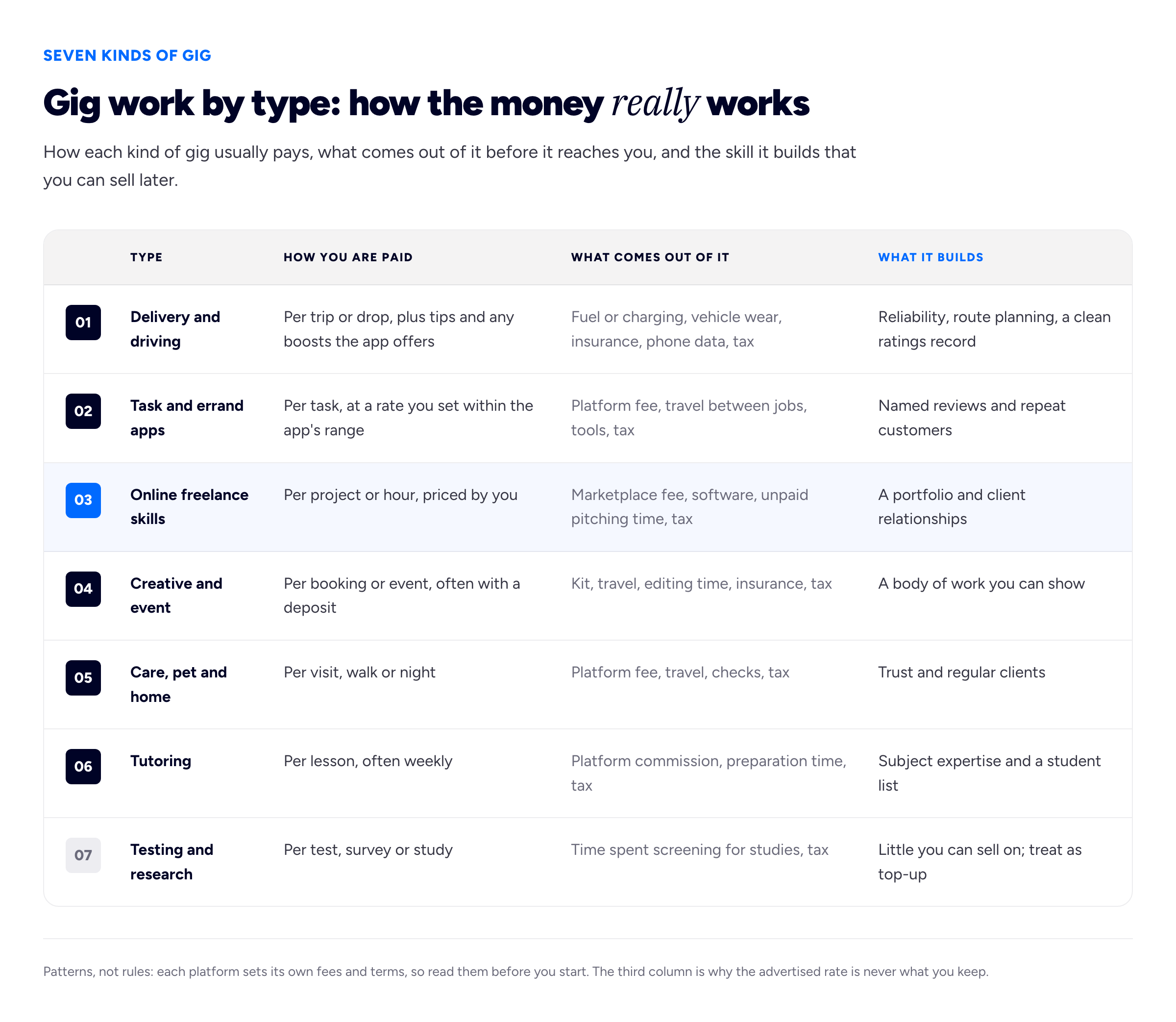
The third column is the one most gig guides leave out, and it decides what you actually keep.
How gig work really pays
We are not going to quote "you can earn up to" figures. Pay depends on the platform, city, hour and season, and the figures circulating online are rarely traceable. The structure, though, is the same everywhere, and it is what you need to judge any offer.
The payout is not the pay
An app shows you a figure per job. That figure is gross: it is what the platform pays out after its own cut, but before your costs and your tax. Three things sit between the payout and your actual pay.
- Running costs. Fuel or charging, tyres, servicing, parking, phone data, bike repairs, cleaning supplies, the camera that wears out. Some are per job; some are monthly whether you work or not.
- Unpaid time. Waiting for a ping, travelling between tasks, preparing lessons, editing photos, writing proposals that win nothing. Divide payouts only by paid minutes and your hourly figure is flattering and false.
- Tax and insurance. No employer is deducting tax for you, and your personal car or home insurance may not cover business use. Both come out of the payout too, just later.
Fees and how the price is set
Platforms make money in one of a few ways: a commission on each job, a service fee charged to the customer, a subscription you pay to list, or a fee to bid for work. On delivery and ride apps the platform usually sets the price; on task, tutoring and freelance marketplaces you usually set it within limits. Read the fee page before you sign up and note whose side the fee comes from.
Tax: you are the payroll department
In the US, the IRS is clear that gig income is taxable even if no form arrives: you must report it even when it is not reported on an information return, including part-time, temporary or side work, and payments in cash, goods or virtual currency. Payment apps and online marketplaces send a Form 1099-K once your payments exceed the IRS threshold, which its page currently gives as over $20,000 in more than 200 transactions, though you may receive one below that, and the IRS says that whether or not you receive the form, you must still report the income.
If you are self-employed you also owe self-employment tax, which the IRS describes as Social Security and Medicare taxes for people who work for themselves, at a rate of 15.3%. You must file Schedule SE once your net earnings from self-employment reach $400. And because nobody withholds it, the IRS says that if you are in business for yourself you generally need to make estimated tax payments during the year, using Form 1040-ES, if you expect to owe $1,000 or more.
In the UK, HMRC's trading allowance lets individuals earn up to £1,000 a year from self-employment, casual services such as babysitting or gardening, or hiring out personal equipment, without telling HMRC, unless other conditions apply. Above that, you register for Self Assessment, and you can choose either the £1,000 allowance or your actual expenses, but not both. With high costs, as in driving work, actual expenses usually win.
Our recommendation for both countries: open a separate account, move a fixed share of every payout into it the day it lands, and keep every receipt. The right share depends on your total income, so check it before your first filing, not after.
Work out your real hourly rate
The most useful habit in gig work is a ten-minute weekly sum that turns payouts into a true hourly figure. Within a month it shows which app, hours and jobs are worth your time.
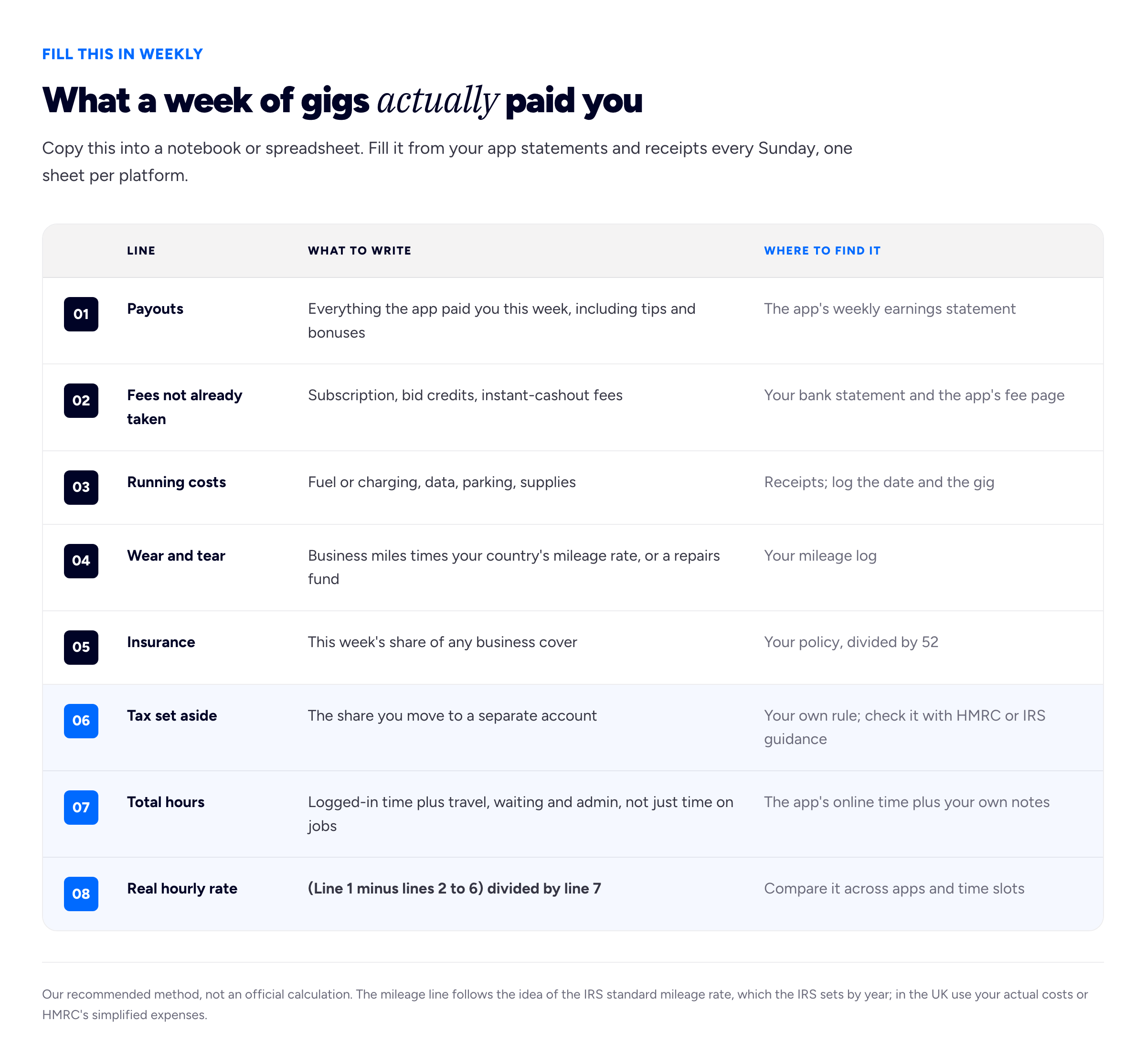
Line 7 is where most people fool themselves: count every hour you were working for the app, not just the minutes it paid you for.
Run it for four weeks before changing anything; one good Friday tells you nothing. Then cut the slots at the bottom and move those hours to the top ones, or into the next step in this guide.
Are gig workers employees? Your status in the US and UK
Most platforms call you an independent contractor or self-employed. That is their position, not necessarily the legal answer: in both countries the facts of the work decide, not the contract's wording.
United States: independent contractor, 1099, and two different tests
For minimum wage and overtime, the Department of Labor applies its own "economic reality" test under the Fair Labor Standards Act, using six factors: opportunity for profit or loss depending on managerial skill; investments by the worker and the employer; permanence of the work relationship; nature and degree of control; whether the work is integral to the employer's business; and skill and initiative.
The DOL's fact sheet (revised March 2024) is blunt about labels: what a worker is called "is not relevant", a worker paid off the books or who receives a 1099 "is not necessarily an independent contractor", and signing an independent contractor agreement does not make you one under the FLSA. If the facts of your work look more like employment, the DOL's Wage and Hour Division is the place to ask.
United Kingdom: worker or self-employed
UK law has three main categories: employee, worker and self-employed. The middle one matters most for gig work. GOV.UK says you are generally a worker if you have a contract or other arrangement to do work or services personally for a reward, the employer has work for you as long as the arrangement lasts, and you only have a limited right to send someone else in your place. It adds that someone is likely to be a worker if, among other things, their contract uses terms like "casual", "freelance", "zero hours" or "as required".
Workers are entitled to the National Minimum Wage, the statutory minimum paid holiday and rest breaks, protection against unlawful deductions and discrimination, and may qualify for Statutory Sick Pay. They are usually not entitled to minimum notice, protection against unfair dismissal or statutory redundancy pay.
You are self-employed, GOV.UK says, if you run your business for yourself and take responsibility for its success or failure. Signs include quoting for work, no direct supervision, sending invoices and paying your own tax and National Insurance. Employment law mostly does not cover you beyond health and safety, some discrimination protection and your contract. GOV.UK also notes you can be employed and self-employed at the same time, which is the position of many people doing gigs in the evening.
Either way, keep your own records of hours, pay and how the app directs you. The facts decide status, and a platform's dashboard can change or vanish.
How to choose a gig and get started
Pick by what you already have, not by what pays best in a headline. Four questions do most of the work:
- What do you own? A car points to driving; a bike to local delivery; a laptop and a skill to online work; a good camera to events.
- When can you work? Delivery pays when people eat. Tutoring fits after school. Event work is weekends. Testing fits anywhere.
- Do you want to build something? For short-term cash, choose the lowest-friction option. If you want it to lead somewhere, pick a type where reviews, a portfolio or regular clients pile up.
- What can you afford to lose? Gig income can drop overnight when an app changes its pricing or pauses an account. Do not commit fixed costs, such as a car lease, against income that has no notice period.
Then start small and deliberately:
- Sign up to two platforms in the same type, not one. Comparing them shows you what is normal, and a second account insures against the first being paused.
- Read the terms on fees, cancellations, ratings and deactivation before your first job. Screenshot them; terms change.
- Check your insurance. Ask your insurer in writing whether your car, home or equipment cover includes business use, and add it if not.
- Start the weekly sheet on day one. You cannot reconstruct mileage and waiting time from memory in April.
- Write a short profile with specifics. On task, tutoring and freelance platforms, the profile is your shop window. "Assembles flat-pack furniture, brings own tools, available weekday evenings in north Leeds" beats "Hard-working and reliable". Our short bio examples show how to write one that sounds like a person.
If you want to sell a skill rather than your time, and you have nothing to show yet, our guide to starting freelancing with no experience walks through building proof before your first client.
Three people, three routes
These three are invented, but their routes are the common ones.
Jordan Ellis delivered food by bike on weekday evenings while studying bookkeeping. His weekly sheet showed that weeknight waiting time dragged his real rate far below what the payouts suggested, while Saturday lunchtimes were steady. He kept Saturdays and used the freed evenings for small bookkeeping jobs on a freelance marketplace. A year on, delivery is a backup and most of his income comes from bookkeeping clients he invoices directly.
Amara Nwosu tutors GCSE maths and chemistry online. A tutoring platform brought her first students without any marketing. Later she noticed the families who stayed longest came through referrals, and that commission was her biggest cost. She kept platform students on the platform, as its terms required, and took new referrals directly with her own booking form.
Felix Brandt photographs events. His first bookings came through a staffing agency for corporate evenings. He put the images he was allowed to use on a simple portfolio site with what he covers and how to book, so when planners went looking for "the photographer from last time", they found him.
In each case the app was a way in, and something they owned (a skill, a reputation, a body of work) turned the gig into a business.
From app gigs to your own clients
Apps are excellent at finding you a first customer and terrible at letting you keep one: the customer, the price and your ratings all belong to the platform. The goal is to build things that travel with you. Do it inside the rules: many platforms prohibit taking clients you met there off the platform, sometimes for a set period, so read the terms and use the routes they allow.
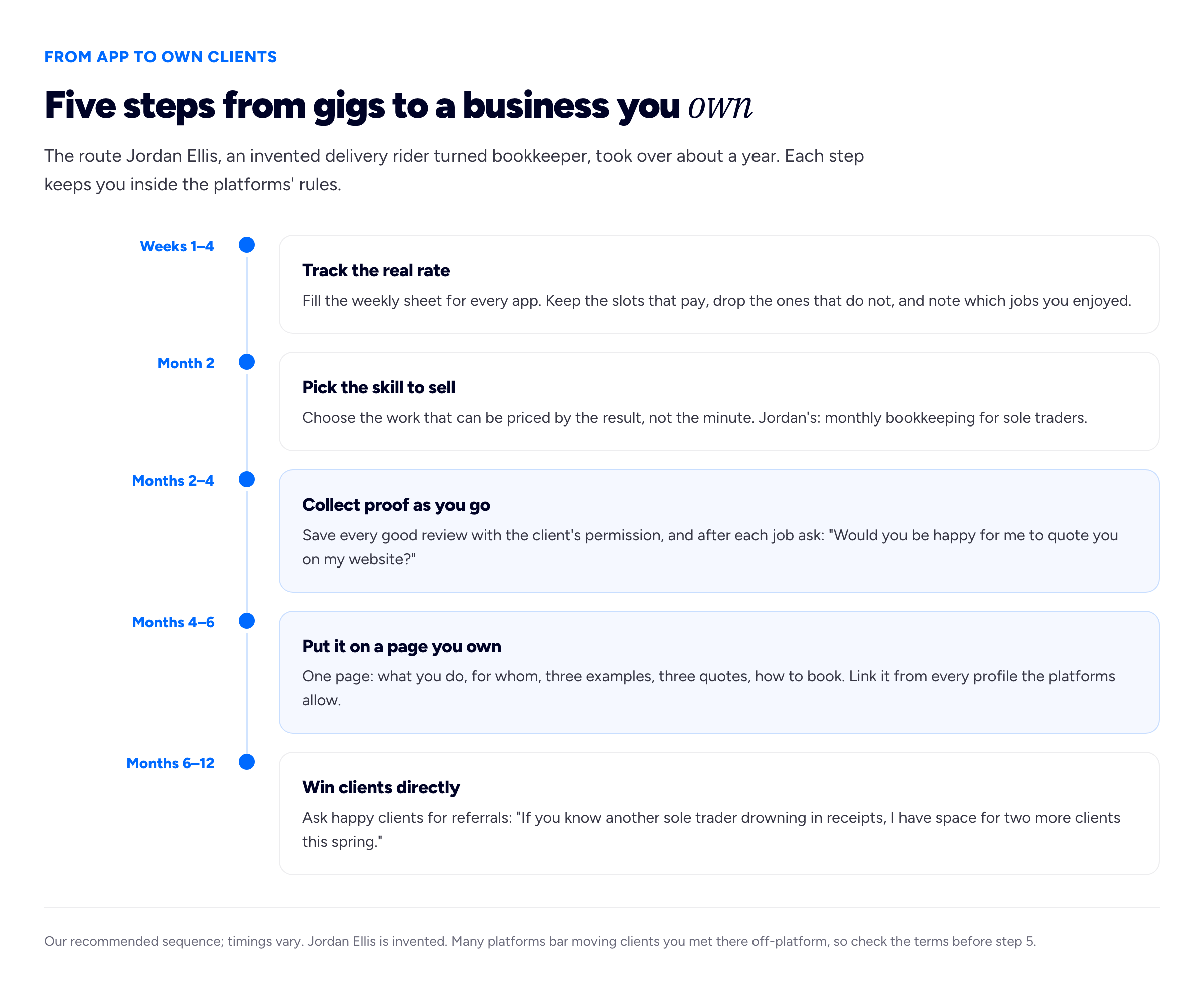
Step 3 is the one people skip, and it is the one that makes steps 4 and 5 work.
Reviews: ask, then save them
Platform reviews stay on the platform. Ask the customer, at the end of a job that went well, for a sentence you may quote elsewhere, and save it with their first name, the date and the job. Wording that works: "Thanks again for today. If you were happy with it, would you mind if I quoted your review on my own website, with your first name only?" Our guide to asking clients for testimonials has more versions.
A portfolio, even for practical work
A portfolio sounds like something for designers, but a cleaner, a tutor or a furniture assembler can show work too: before-and-after photos, a sample lesson plan, a list of the jobs you do and the areas you cover. A page you own shows the work itself, evidence a star rating or a CV cannot give. That page is what Bunfolio builds for free, but any simple site you control does the job.
Price for the result, not the minute
Once clients come to you directly, stop pricing like an app: price the outcome (a month of bookkeeping, a wedding covered, a term of weekly lessons) and include the preparation and travel the app never paid for. Our guide to how much to charge as a freelancer shows how to build a rate from your costs upward.
Keep one foot on the platform
Do not leave the apps the week you win your first direct client. Keep the best slots as a floor until direct work has been steady for a few months.
Red flags and gig scams
People seeking flexible work are a favourite target, because a scam pitch (easy money, start today) sounds like a real gig. The US Federal Trade Commission lists the patterns, and they apply in the UK too:
- You are asked to pay to get the job. The FTC says honest employers "will never ask you to pay to get a job", and placement firms demanding an advance fee are likely scams. That includes paying for "starter kits", training or certifications that turn out to be useless.
- You are sent a cheque and asked to send some back. In the FTC's words, no honest potential employer will ever send you a cheque to deposit and then tell you to send part of the money on. The cheque bounces later and the money you sent is gone.
- The job is receiving and forwarding parcels. The FTC says reshipping goods "is never a real job"; the goods are often bought with stolen cards.
- The offer arrives out of the blue. The FTC warns of calls from strangers offering a job opportunity, and messages that seem to come from an organisation you know.
Our own additions, from how real platforms work: a genuine gig app pays you; it never asks you to deposit money, buy anything with your own card or "top up" an account to unlock earnings. If a "gig" involves rating products or liking posts for rising pay that you must pay in to collect, walk away. Report job scams in the US at ReportFraud.ftc.gov; in England and Wales, GOV.UK points you to Report Fraud if you have lost money to a scam, and in Scotland to Police Scotland. GOV.UK also says you can forward a suspicious text message to 7726 for free.
Some red flags are just bad gigs: unannounced fee changes, a client adding tasks after agreeing a price, a customer asking to finish off the app to skip the fee. Our list of freelance client red flags covers how to spot and handle those.
Is gig work worth it?
Gig work is good at earning money quickly with little setup, fitting around study or care, and testing a kind of work before committing. It is poor at steady income, benefits and progression: the app promotes nobody.
Our view: use it as a bridge or a floor, not a destination, unless your weekly sheet says otherwise. If you later apply for a job, gig work belongs on your CV like any other work; our guides to listing freelance work on a resume and making a resume for your first job show how.
Frequently asked questions
What is an example of gig work?
Common examples are delivering food or parcels, driving passengers through a ride app, assembling furniture through a task app, walking dogs, tutoring online, photographing events and taking paid usability tests.
Do gig workers pay taxes?
Yes. In the US, the IRS says gig income is taxable even if you receive no form for it, and self-employed people owe self-employment tax and generally need to make estimated payments. In the UK, income above the £1,000 trading allowance means registering for Self Assessment. Set money aside from every payout.
Are gig workers employees?
Usually they are treated as independent contractors or self-employed, but the label in the contract does not decide it. In the US, the Department of Labor looks at the economic reality of the relationship; in the UK, many gig workers may count as "workers", with rights such as the minimum wage and paid holiday. The facts of how you work decide your status.
Can you do gig work alongside a full-time job?
Yes, and many people do. Check your contract for rules on outside work, and remember gig income is taxed on top of your salary. GOV.UK notes you can be employed and self-employed at the same time.
What gig jobs need no experience?
Delivery, errands, simple task work, pet sitting and usability testing usually need no formal experience, though they may need checks, a vehicle or a smartphone. Tutoring and online freelance work need a skill you can show.
How we put this guide together
Most of this guide is our recommendation, not sourced fact: the seven types, the weekly real-rate sheet, the choosing questions, the five-step route to your own clients, the request wording and the scam advice beyond the FTC's list are ours. Timings in the third diagram are illustrative.
The sourced facts come from official pages we read on 17 November 2026: the IRS Gig Economy Tax Center (the definition, the examples, and that gig income is taxable without an information return); the IRS page understanding your Form 1099-K (the threshold of over $20,000 in more than 200 transactions, and that income must be reported whether or not the form arrives); the IRS self-employment tax page (the 15.3% rate, the $400 threshold and Schedule SE); the IRS estimated taxes page (the $1,000 expectation and Form 1040-ES); the IRS standard mileage rates table, which sets rates by year; the US Department of Labor's Fact Sheet 13 on the FLSA employment relationship (the six economic-reality factors and the statements on labels, 1099s and agreements); GOV.UK's pages on worker status and self-employed status; HMRC's guidance on the trading allowance; the FTC's guide to job scams; and GOV.UK's page on reporting scams (Report Fraud, Police Scotland and the 7726 text service). Thresholds change; check the current page before relying on any figure.
We have deliberately left out the numbers that usually fill articles about gig work: average hourly earnings for named apps, "top earners make" figures, estimates of how many people do gig work, and the share of gig workers said to do it full-time. We could not trace any of them to a published method, sample and date we were willing to stand behind, and pay on these platforms changes too often for a quoted figure to stay true.
Jordan Ellis, Amara Nwosu and Felix Brandt are invented for illustration, as are their routes, the example profile line, the request wording and every detail in the three diagrams.
Related reading: what freelancing is, Upwork vs Fiverr for a new freelancer, how to start freelancing with no experience, how much to charge as a freelancer and side hustles from home.
More from the blog

November 22, 2026 · 19 min read
How to Call Out of Work: What to Say, Scripts and Your Rights
To call out of work, tell your manager before your shift starts, using the method your absence policy names (usually a phone call for same-day absence). Say you cannot come in, give the reason in one...

November 19, 2026 · 18 min read
LinkedIn Headline Examples: 30+ Headlines and Why They Work
A strong LinkedIn headline names the role you want to be found for, narrows it with a specialism, and adds one piece of proof or the people you help. Here are more than thirty examples for job-seekers...
November 2, 2026 · 20 min read
Upwork vs Fiverr: Which Suits the Way You Work?
Upwork has you pitch for posted jobs with Connects; Fiverr has buyers order a fixed-price Gig you defined. Who each suits by service and experience, how the first job happens on each, the fees, paymen...