
November 22, 2026 · 19 min read
How to Call Out of Work: What to Say, Scripts and Your Rights
To call out of work, tell your manager before your shift starts, using the method your absence policy names (usually a phone call for same-day absence). Say you cannot come in, give the reason in one plain sentence, say when you expect to be back and point to anything that needs covering. You do not owe a diagnosis or an elaborate story.
To call out of work, contact your manager as early as you can, ideally before your shift or working day starts, using the method your absence policy names (usually a phone call for same-day absence). Say that you cannot come in, give the reason in one plain sentence, say when you expect to be back, and point to anything urgent that needs covering. You do not owe anyone a diagnosis, and you do not need an elaborate story.
The rest of this guide is the detail that makes it easy on the day: when a call beats a text, exact wording for the common reasons, what to say to a client if you work for yourself, why invented excuses backfire, the hand-over note that keeps your team from scrambling, and what the law in the UK and the US gives you.
Before the morning you need it: read your absence policy
The worst time to learn how your employer wants absence reported is at 5.40am with a temperature. Spend ten minutes on it now, while you are well. Your contract, staff handbook or intranet will usually answer four questions:
- Who do you tell? Your line manager, a shift lead, a central absence line, an HR system, or more than one of these.
- How? Many policies ask for a phone call for same-day absence and do not accept a text or email on its own. Some workplaces use an app instead.
- By when? A common rule is "before the start of your shift" or "within an hour of your start time". Shift-based workplaces often want more notice so cover can be found.
- What happens next? Whether you need to call again each day, when a doctor's note is needed, and whether there is a return-to-work conversation.
Save your manager's number and the absence line in your phone now. If the policy says "call", call: following the stated procedure is what keeps an ordinary sick day from turning into a conduct question.
Take Hannah Lindqvist, a warehouse supervisor at Oakhurst Distribution. Her shift starts at 6am and her team of eight cannot load the morning trailers without someone running the floor. Oakhurst's policy asks supervisors to phone their manager, Marcus Bell, by 5am, then log the absence in the HR app. For Hannah, calling out means a two-minute call at 4.50am, not a polite email at nine.
Call, text or email: choosing the channel
The policy wins. Where it is silent, choose the channel that gets the message to the person who has to act on it, in time for them to act. The diagram below is the rule of thumb we would use.
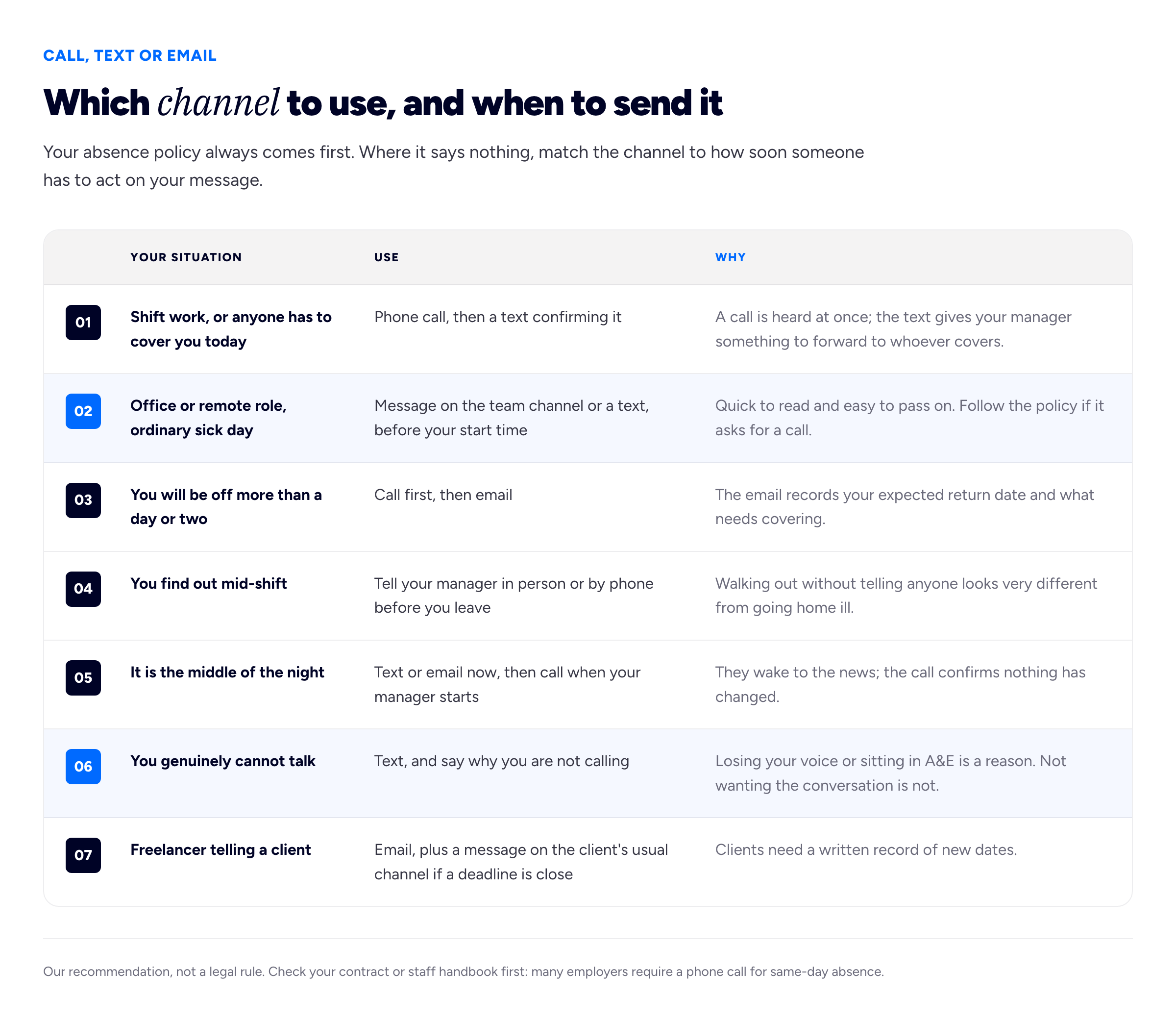
When the policy is silent, the deciding question is how soon someone has to act on your message.
Why a phone call still matters for same-day absence
A text can sit unread while a manager is driving in. If someone has to find cover before a shift starts, a call is the only way you know the message has landed. If your manager does not answer, leave a voicemail with the same three facts and send a text saying you have done so.
In many office and remote jobs, a team-channel message before your start time is normal. The test is not formality but whether the person who has to rearrange the day will see it in time.
When to send it
As early as you know, and before your start time at the latest. If you know at 3am, send the message then and call when your manager is up. If you are unsure, because you might feel better by eight, say exactly that: "I'm unwell and may not make it in. I'll confirm by 7am either way." Then confirm at 7am.
What to say: the three facts and nothing else
Every good call-out message carries the same three things:
- That you are not coming in, and for how long as best you can tell: today, today and tomorrow, or "I'll update you tomorrow morning".
- The reason, in one plain sentence. "I'm ill." "My son is sick and his nursery won't take him." "There's a family emergency."
- What needs covering, or where to find it.
What it does not need is a detailed account of your symptoms, an apology repeated three times, or reassurance that you are "not someone who usually does this". Over-explaining makes a true reason sound invented.
How much medical detail you owe
For a short absence you do not owe your manager a diagnosis. "I'm unwell" or "I've got a stomach bug" is enough. There are only a few cases where more detail genuinely helps: when what you have is contagious and colleagues should know they may have been exposed, when the illness affects the work you can do when you return (a back injury in a job that involves lifting), or when you want adjustments or protected leave and your employer needs to understand why. In each of those cases, share what is needed for that purpose and stop there.
If your manager asks for more than you want to give, a calm line works: "I'd rather keep the details private, but I'm seeing a doctor and I'll let you know if it's going to be more than a couple of days." For longer absences, the fit note (UK) or FMLA certification (US) is how your employer gets evidence; both are covered below.
Scripts for each reason you can copy
Here is the wording we would use for the common real reasons, written as messages or the opening of a call. Change the details, keep the shape.
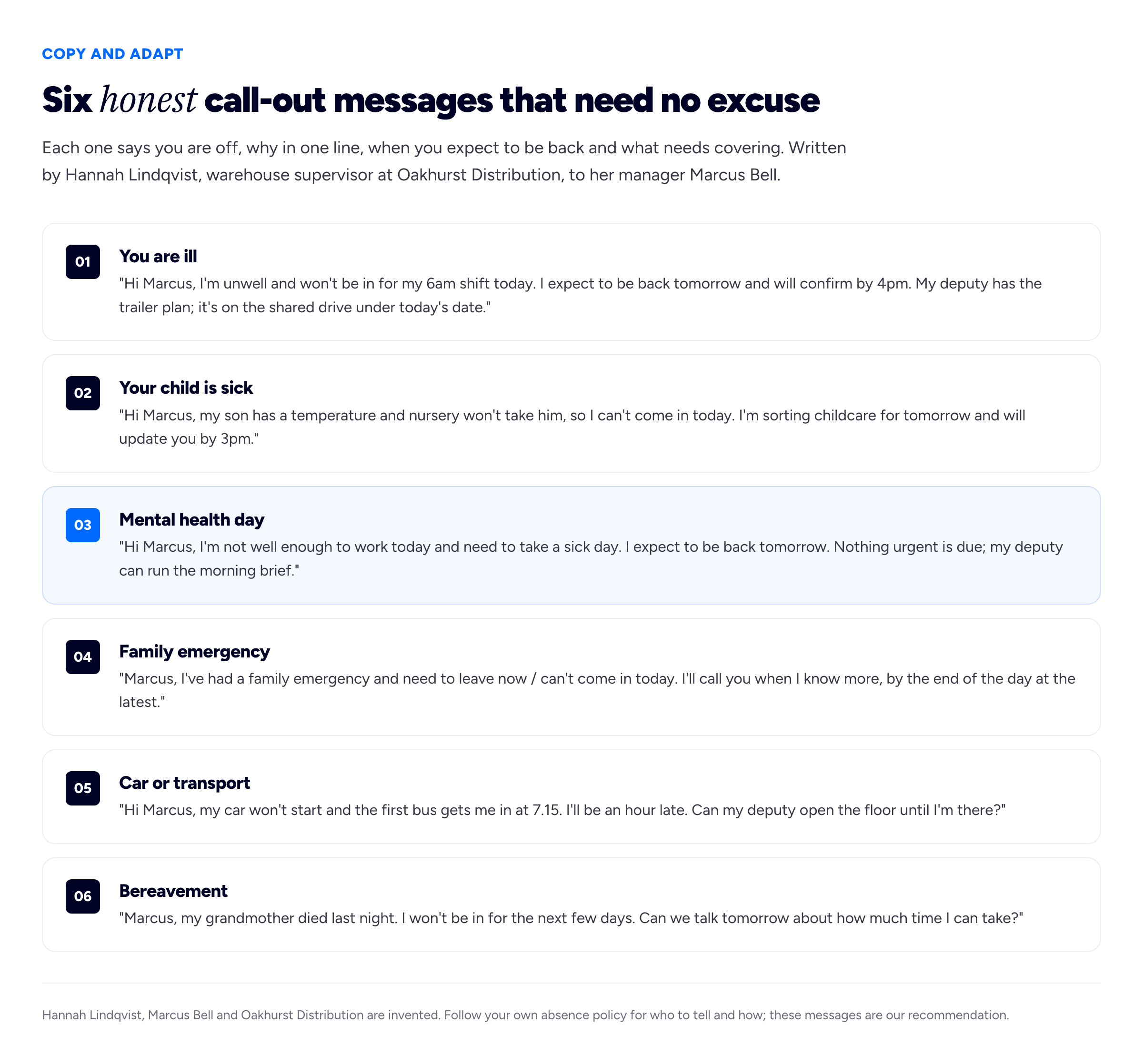
Every message carries the same three facts: you are off, why in one line, and what needs covering.
When you are ill
"Hi Marcus, it's Hannah. I'm ill and won't be in for my shift today. I expect to be back tomorrow and I'll confirm by 4pm. My deputy can run the floor; the trailer plan is on the shared drive under today's date."
If you are not sure how long you will be off, say so and promise an update at a set time, rather than guessing at "back tomorrow" and having to call out again.
When your child or someone you care for is sick
"Hi Marcus, my son has a temperature and his nursery won't take him, so I can't come in today. I'm arranging childcare for tomorrow and will update you by 3pm."
Note that this is not a sick day for you, and your employer may treat it differently. In the UK it is usually time off for dependants, a separate right covered in the rights section below.
When you need a mental health day
A mental health day is a sick day. If you are not well enough to work because of anxiety, low mood, exhaustion or a mental health condition, that is an illness, and the honest message is the same as for a cold:
"Hi Marcus, I'm not well enough to work today and need to take a sick day. I expect to be back tomorrow. Nothing urgent is due; my deputy can take the morning brief."
You do not have to say "mental health" if you would rather not. "I'm unwell" is true. If you trust your manager and want them to know: "I've been struggling this week and need a day to reset. Happy to talk when I'm back." Avoid inventing a physical illness to cover a mental one; it stops anyone offering support. If you need these days often, talk to your doctor.
When there is a family emergency
"Marcus, I've had a family emergency and I need to leave now. I'll call you when I know more, and by the end of the day at the latest."
"Family emergency" is a complete reason. In the moment you do not need to say more, and most managers will not ask. When things are calmer, update them on tomorrow.
When your car breaks down or transport fails
"Hi Marcus, my car won't start and the first bus gets me in at 7.15, so I'll be about an hour late. Can my deputy open the floor until I'm there?"
Transport problems usually make you late rather than absent, so offer the realistic arrival time and a way to cover the gap. If you cannot get in at all, offer to work remotely or swap the shift. This is the reason most often doubted, so be specific.
When someone has died
"Marcus, my grandmother died last night. I won't be in for the next few days. Can we talk tomorrow about how much time I can take?"
You do not need to have the leave worked out when you send this. Most employers have a compassionate or bereavement policy, and asking your manager or HR what it allows is a normal question. If you are too upset to call, a message is fine.
When you work for yourself and have to tell a client
Freelancers have no sick pay and no manager, but they do have deadlines. Sana Qureshi, a freelance illustrator, wakes with flu two days before she is due to deliver a set of spot illustrations. Her message, sent by email and repeated in a short note on the client's usual chat channel, looks like this:
"Hi, I'm ill and won't be able to work for the next day or two. The spot illustrations due on Thursday will now come on Monday instead. The first four are finished and attached so your designer can start on the layout. I'll confirm on Friday that Monday still holds. Sorry for the change, and thank you for your patience."
Three things make that work: a new date rather than an open-ended delay, something delivered now if anything is ready, and a promised update. If your contract has no clause covering illness and rescheduling, the guide to freelance contract essentials covers what to add. If a client answers an honest sick message with threats, see how to fire a freelance client.
Real reasons, and why invented excuses backfire
Plenty of pages offer lists of plausible excuses. We will not, and not only on principle. Invented excuses fail in practical ways:
- They need maintaining. The plumber who did not come, the relative who was ill: colleagues ask how it went, and you have to remember what you said.
- They get checked. Social media posts, a colleague who saw you in town, an excuse that did not match the day's weather. One discovered lie turns an ordinary absence into a question about your honesty.
- They are usually worse than the truth. "I'm not well enough to work today" is acceptable in almost every workplace. An elaborate cover story is a risk you take to avoid a sentence that would have been fine.
- They hide the real problem. If you keep needing days because of childcare, burnout or a manager you dread, invented excuses stop anyone from fixing it.
Legitimate reasons to call out of work include your own illness or injury, physical or mental; a dependant who is ill or whose care has broken down; a family emergency; a death; a medical appointment you could not schedule outside work; a home emergency such as a flood or break-in; transport failure you could not reasonably avoid; and jury service or other legal duties. Each one can be stated honestly in a line.
And if what you actually want is a day off because you are tired of work but not ill, the honest route is annual leave. Ask for it, even at short notice: "Could I take tomorrow as holiday? Nothing is due, and my deputy has agreed to cover the brief."
The hand-over note: what makes your absence easy to cover
The difference between a call-out that annoys your team and one that does not is rarely the reason. It is whether anyone knows what you were going to do today. A three-line hand-over, sent with or straight after your message, is the most useful thing you can do from your sickbed.
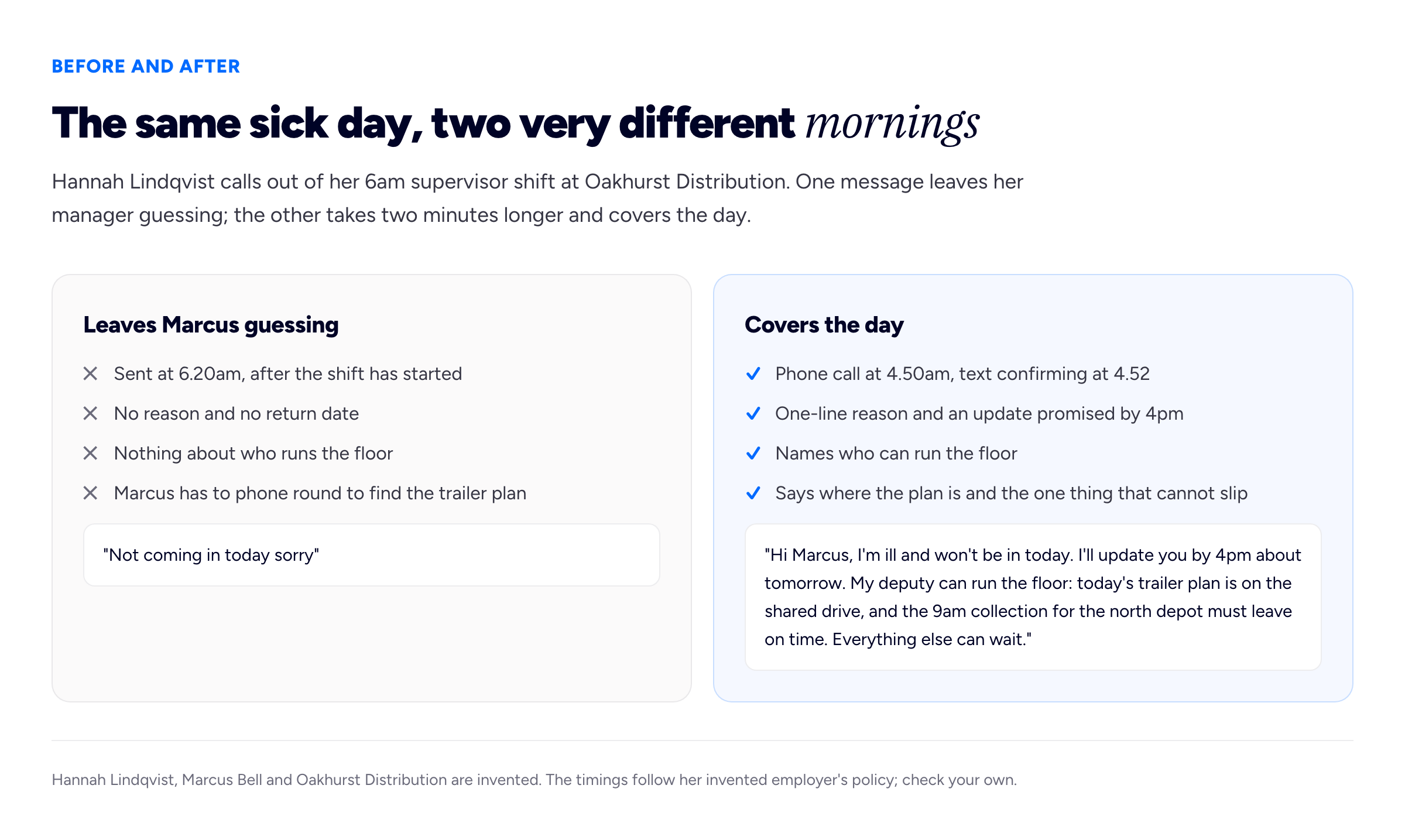
Two extra minutes on the message saves your manager an hour of phoning round.
A good hand-over answers three questions. Who can cover, if you know and it is your place to suggest it. Where is the work, meaning the file, the folder, the plan. And what cannot slip, the one deadline or delivery that has to happen today, so that everything else can be safely left. If nothing is urgent, say that too: "Nothing is due today" is the sentence your manager most wants to read.
Do not use the hand-over as a reason to keep working. You are off. Send it, switch off notifications if you can, and answer only if something genuinely needs you.
What the law gives you
Your rights depend on where you work and your employment status, and your contract may give you more than the legal minimum. The points below are what we read on official government and advisory sources; they are a starting point, not legal advice.
In the UK
Self-certification for the first seven days. GOV.UK's guidance on taking sick leave says that if you are off work for seven days or less you do not need to give your employer a fit note. Your employer can ask you to confirm you were off sick when you return, which is called self-certification. If you are ill for more than seven days in a row, including non-working days, you must give your employer a fit note.
Statutory Sick Pay. According to GOV.UK's Statutory Sick Pay pages, SSP is £123.25 a week or 80% of your normal weekly earnings, whichever is lower, paid by your employer for up to 28 weeks. To qualify you must be classed as an employee, have done some work for your employer and have been ill for at least one full working day, according to the eligibility page. You claim by telling your employer by their deadline, and GOV.UK notes that form SC2 can be used if they need it in writing. Your employer may pay more under its own sick pay scheme; check your contract.
Time off for dependants. Acas explains that employees can take time off to help a dependant with an emergency, such as a dependant falling ill or a child's school closing unexpectedly. The law does not set a fixed amount; it should be reasonable. It is not necessarily paid. A dependant includes a spouse, civil partner or partner, a child or parent, someone living in your household (not a tenant or lodger) and someone who relies on you. Acas says to tell your employer as soon as possible, explaining the reason and how long you expect to be off, before the start of the working day where possible.
Bereavement. Acas's page on time off for bereavement says employees have a right to two weeks off if their child dies under the age of 18, and a right to reasonable time off when a dependant dies, which can cover arranging or attending a funeral. There is no legal right to paid time off for bereavement, though many employers offer pay under a compassionate or special leave policy.
In the US
No federal paid sick leave requirement. The Department of Labor's page on sick leave says plainly that there are currently no federal legal requirements for paid sick leave. Whether you get paid sick days depends on your employer's policy and on state and local law, which varies a great deal. Check your state's labour department or your employee handbook rather than relying on a summary.
The FMLA, for longer and serious absences. The DOL's FMLA page explains that the Family and Medical Leave Act gives eligible employees up to 12 workweeks of unpaid, job-protected leave in a 12-month period for qualifying reasons, including your own serious health condition or that of your child, parent or spouse. You are eligible if you have worked for a covered employer for at least 12 months, have at least 1,250 hours of service in the 12 months before leave starts, and work at a location where the employer has at least 50 employees within 75 miles. The DOL's FMLA fact sheet adds that you do not have to ask for FMLA leave by name, that notice should be given as soon as possible and practical, and that if your employer asks for medical certification you must be allowed 15 calendar days to provide it.
FMLA is not usually what you rely on for a one-day cold. It matters when an absence is longer or keeps recurring because of a serious condition, and in that case it is worth asking HR early whether it applies.
Mistakes that turn a sick day into a problem
- Telling the wrong person. A message to a colleague, asking them to "let Marcus know", is not notice. Tell the person your policy names.
- Telling them late. An absence reported after the shift has started often costs more goodwill than the absence itself.
- Going silent on day two. If you said you would update at 4pm, update at 4pm, even if the update is "still ill, same again tomorrow".
- Posting publicly. If you are off sick and well enough to be at a friend's barbecue, it will be noticed.
- Apologising too much. One "sorry for the short notice" is courteous. Five reads as guilt.
Coming back the next day
On your first morning back, thank whoever covered and complete whatever your employer uses to record the absence. Keep any return-to-work conversation as factual as the original message: what you had, that you are fit now, anything you need.
If you are calling out often enough that it has become a pattern, look at the cause. Repeated illness means a doctor and perhaps adjustments; repeated childcare gaps mean a talk about flexible hours. Repeated dread means asking whether the job is right, and if not, the guides to reasons for leaving a job and how to prepare for an interview are the next step. Some people in that position build a small freelance practice alongside the job first; if that is you, a simple portfolio website shows prospective clients your actual work in a way a CV cannot.
Frequently asked questions
What is the best way to call out of work?
Use the method your absence policy names, which for same-day absence is usually a phone call to your manager before your shift starts. Say you cannot come in, give the reason in one sentence, say when you expect to be back, and point to anything that needs covering. Follow up with a text or email if the details matter.
Is it OK to call out of work by text?
It depends on your employer's policy. Many workplaces accept a text or team message for an ordinary sick day, especially in office and remote roles, but some require a phone call for same-day absence. If you have to text because you cannot talk, say why you are not calling.
Do I have to tell my employer why I am sick?
For a short absence you generally only need to say that you are ill, not give a diagnosis. Share more only if it helps, for example when an illness is contagious or affects the work you can do. In the UK you need a fit note for absences of more than seven days in a row, and in the US an employer can ask for medical certification for FMLA leave.
What are good reasons to call out of work?
Your own illness or injury, including mental health; a sick child or dependant; a family emergency; a bereavement; a medical appointment you could not move; a home emergency; or transport failure. Each can be stated honestly in one line, which is safer than any invented excuse.
Can I call out of work for a mental health day?
Yes. If you are not well enough to work, it is a sick day like any other, and "I'm unwell and need to take a sick day" is an honest message. You do not have to say it is mental health if you would rather not. If you need these days often, speak to your doctor and consider talking to your manager or HR about support.
How much notice should I give when calling out of work?
As much as you can, and at least before your shift or working day starts. Check your policy, because many employers set a deadline such as an hour before your start time. If you are unsure whether you will be well enough, say so early and promise a firm answer by a set time.
How we put this guide together
Most of this guide is our recommendation, not sourced fact. The three facts every message needs, the channel table, the scripts, the hand-over note, the advice on how much medical detail to share and the view that invented excuses backfire come from writing career guidance at Bunfolio and from how absence is usually handled by managers who have to find cover, not from a study.
The legal points are sourced, and we read every page on 17 November 2026: GOV.UK's taking sick leave (self-certification for seven days or less, fit notes after seven days in a row), and its Statutory Sick Pay pages on what you'll get (£123.25 a week or 80% of normal weekly earnings, whichever is lower, up to 28 weeks), eligibility and how to claim (form SC2); Acas on time off for dependants and time off for bereavement; and the US Department of Labor's sick leave page, FMLA overview and FMLA fact sheet. SSP rates and rules change; check the GOV.UK page for the current figure. We have not summarised individual US state paid sick leave laws, because we did not read each state's own source, and a half-right list would be worse than pointing you to your state's labour department.
We have deliberately left out the numbers that usually decorate articles on this subject: the share of employees said to have lied about being sick, the "most believable excuses" ranked by survey, and the cost of absence to employers. We could not trace any of them to a sample, method and date we were willing to stand behind, and a number nobody can source reads as evidence when it is not.
Hannah Lindqvist, Marcus Bell, Oakhurst Distribution and Sana Qureshi are invented for illustration, as is every message and timing in the three diagrams.
Related reading: how to sign off an email, how to ask for a raise, reasons for leaving a job, freelance contract essentials and side hustles from home.
More from the blog
September 26, 2026 · 21 min read
What Is a Freelance Artist? How the Work, Pay and Rights Actually Work
A freelance artist is a self-employed artist paid per job instead of a salary, who keeps the copyright unless they sign it away. What freelance artists do, the types of work they sell, how they earn a...
November 24, 2026 · 19 min read
Gig Work: What It Is, the Main Types and What It Really Pays
Gig work is paid work done one short job at a time, usually found and paid through an app or website: deliveries, rides, tasks, tutoring, event shoots, user tests. You choose when to work, but you are...
November 19, 2026 · 18 min read
LinkedIn Headline Examples: 30+ Headlines and Why They Work
A strong LinkedIn headline names the role you want to be found for, narrows it with a specialism, and adds one piece of proof or the people you help. Here are more than thirty examples for job-seekers...