
November 18, 2026 · 19 min read
How to Ask for a Raise: The Case, the Script and the Follow-Up
Book a dedicated meeting a month or two before pay budgets are set, bring a one-page case showing how your job has grown, what you delivered and what the role pays elsewhere, and ask for one specific number. If the answer is "not now", agree the conditions for a yes and a date, and get both in writing.
To ask for a raise, book a dedicated meeting with your manager a few weeks before pay decisions are made, bring a one-page case that shows how your job has grown, what you have delivered and what the role pays elsewhere, and ask for a specific number rather than "a bit more". Say the number early, explain it in two or three sentences, then stop talking and let your manager respond. If the answer is "not now", agree what would have to be true for a yes, and get that agreement, the figure and the date written down before you leave the conversation.
Most of the difficulty is in the preparation, not the meeting. This guide covers when to ask, how to build the evidence page, how to check market pay yourself in official sources, how to choose the number, the email and the conversation word for word, what to say to "no budget", a new title or a one-off bonus, and when to stop waiting. It ends with a section for freelancers raising rates with existing clients.
Asking for a raise is not the same as negotiating an offer
When you negotiate a job offer, you hold something the employer has not yet secured, your acceptance, and you can walk away at no cost. That conversation has its own rules, covered in the guide to salary negotiation, and this guide does not repeat them.
Asking for a raise in a job you already have is different. You will still be working with this manager on Monday, whatever the answer. And your manager usually cannot approve the money alone: they have to argue for it to a finance director, an HR pay committee or their own boss. So you are not trying to win an argument with your manager. You are trying to give them a case they can carry into a room you will not be in.
The test of everything you prepare is simple: could Owen Pryce, Nadia Haddad's manager at Steadfold Insurance, forward this to his director without rewriting it? If he would have to translate it first, he probably will not get round to it.
Timing: read the calendar, then use judgement
Find out when pay is actually decided
Most organisations of any size set pay on a cycle: an annual review where raises are agreed, and before it a budget round where the total available for raises is fixed. The trap is that the review meeting is often too late. By the time your manager sits down with you, the pot has been set and much of it allocated.
If you do not know your employer's cycle, ask your manager or HR, or check your handbook or intranet. It is a normal question. Our recommendation is to raise the subject a month or two before the budget is fixed, so your manager can include you in what they ask for.
After a visible win, while people remember it
A finished project, a client kept, a problem solved: the evidence is fresh and other people saw it. A week or two later, once the result has settled, is a good time. Leave it six months and you are asking someone to remember a success they have since been distracted from.
When your job has quietly grown
The strongest case is often not a single win but drift: you took on a second team's work when someone left, you now approve things you used to submit, you train the new starters. If your job description no longer matches what you do, that mismatch is the case, and it is worth raising when you notice it rather than waiting for the review.
When to wait
If the company has just announced redundancies, missed its numbers badly or frozen hiring, a request for more money is likely to be refused and can make you look out of touch. Change the request instead: ask what the plan is for pay once things settle, and ask for your case to be noted now. And if you have had a rough quarter yourself, fix that first. A raise conversation that turns into a performance conversation is hard to recover.
Build the case on one page
A one-page evidence document makes you prepare properly, because vague claims look thin when written down. It keeps you on track when nerves make you forget your best points. And it gives your manager something to forward. One page is the limit, because nobody upstream will read three.
- The job as hired. One or two lines on what you were taken on to do, from your original job description.
- The job now. Everything you do today that was not in that description, and when each addition started.
- Results. Two to four outcomes, in the measures your team already reports: turnaround time, errors, renewals, cost, complaints, hours saved. Your team's own numbers are hard to dispute.
- What others have said. A line from a client email, a review or another department. Optional, but useful.
- The market. What the role pays elsewhere, with the source named so your manager can check it. The next section explains how.
- The ask, and what comes next. The number, and what you will take on in the next year. A raise is easier to approve when it pays for the future as well as the past.
Here is how that looks for Nadia, a claims handler at Steadfold Insurance whose job has outgrown its title.
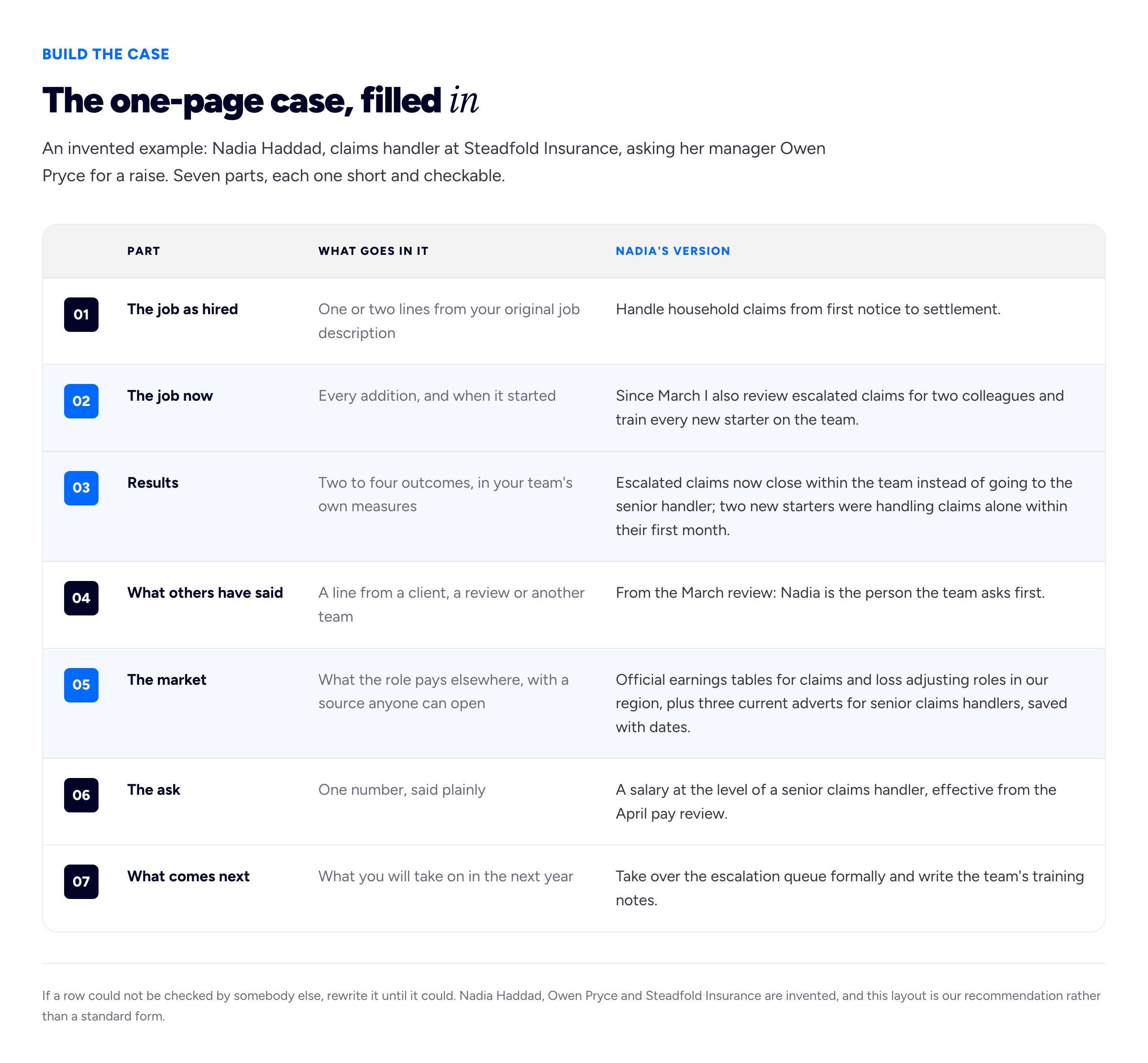
Rows 02, 03 and 05 decide most raise conversations; the rest makes them easy to approve.
Notice what is not on the page: Nadia's rent, a colleague's salary, how long since her last raise. Those may matter to her, but a manager arguing her case cannot repeat them upstairs. Personal circumstances can come up in conversation if you choose. They do not belong in the case.
How to check the market rate yourself
Most advice says "research the market rate" and stops, or quotes a figure from a salary website without saying where it came from. The first question a careful manager asks about a number is "where is that from?", so use sources they can open themselves.
In the United States: BLS Occupational Employment and Wage Statistics
The Bureau of Labor Statistics' OEWS programme publishes wage estimates every year for roughly 830 occupations, nationally, for each state and for metropolitan and non-metropolitan areas. When we checked on 16 November 2026, the latest estimates were for May 2025. Browse the occupation profiles or use the data search to pick an occupation and an area. Match the occupation to what you actually do now, not your job title, since titles vary between employers. Then read the median and the percentiles around it rather than the mean, which a few very high earners can pull upwards.
Read the definition before you rely on it. The BLS describes OEWS wages as "straight-time, gross pay, exclusive of premium pay": base rates and commissions are in, overtime and year-end bonuses are out. If your pay includes a large annual bonus, compare base with base. OEWS also excludes the self-employed.
In the United Kingdom: the ONS Annual Survey of Hours and Earnings
The Office for National Statistics' ASHE is based on employer returns for a 1% sample of employees, recording pay for a reference date in April each year. Its headline measure is the median, because the median is less distorted by a few very high earners. Use the median too.
The useful tables for a raise are broken down by occupation using the Standard Occupational Classification (SOC), with splits by region, age and industry linked from the annual bulletin. Find the four-digit code that best matches your work, then look at your region and at full-time employees. Three cautions: the latest year is provisional and revised the following year; coding moved to SOC 2020 from 2021, so earlier years are not directly comparable; and the ONS sometimes withholds an estimate where the sample is too small to be reliable. If there is no figure, use the next level up rather than guessing.
Job adverts, used properly
Official statistics describe a whole market; adverts show what employers like yours are offering this month. Save three to five adverts for the job you are actually doing, at the level you are asking to be paid at, with the date and a screenshot, since adverts come down. Leave out any that list no pay. Put the official figure and the adverts side by side on your page with the sources named. You are not proving you are underpaid to the penny, only that your number came from somewhere real.
Choosing the number
Ask for one number, not a range. Your manager hears only the bottom of a range, and that is what goes into the budget request. Work out three figures privately first:
- Your ask. The number you say out loud, where your evidence points: the market rate for the job you now do, at your level, in your area. If your job has grown into a more senior role, ask for that role's pay, not your current pay plus a little.
- Your target. What you would genuinely be pleased with. Somewhat below the ask, so you have room if your manager comes back lower.
- Your floor. The figure below which you would start looking elsewhere. You never say it, but knowing it stops you agreeing to something in the room that you will resent by Friday.
Two checks. Ask HR whether there are pay bands and where you sit in yours. If your ask is above the top of your band, the real request is a regrade or a promotion, so say that rather than asking for a raise that cannot be approved. And say the number aloud a few times beforehand. People who have not practised it soften it with "something like" or "around", and that is heard as doubt.
The email that asks for the meeting
Do not ambush your manager in a one-to-one booked for something else. Ask for a dedicated meeting in writing and say what it is about. A surprised manager says "let me look into it"; a warned one arrives knowing what is possible. Here is Nadia's email:
Subject: Time to discuss my role and pay
Hi Owen,
Could we book thirty minutes in the next couple of weeks to talk about my role and my salary? Since March I've been reviewing escalated claims and training new starters, and I'd like to discuss how my pay reflects that before the April review is planned.
I'll bring a one-page summary so it's easy to share if you need to take it to anyone else.
Thanks,
Nadia
It names the subject, ties the request to the pay calendar, gives one concrete reason and offers the page. It does not make the full case or mention a number: both belong in the room, where you can see the reaction. If the tone between apologetic and demanding is hard to strike, the free professional email generator will draft a version you can edit.
The conversation, word for word
The meeting has four parts: open, case, ask, silence. You should be finished in under ten minutes. The longer you talk, the more it sounds as if you are convincing yourself.
1. Open: say why you are there
"Thanks for making the time. As I said in my email, I'd like to talk about my salary. I've put the main points on one page, so I'll go through it quickly and then I'd like to hear what you think."
2. Case: the job then, the job now, the results, the market
"When I joined, the job was handling household claims from start to finish. Since March I've also been reviewing escalated claims for two colleagues, and I've trained both new starters. The escalations now close within the team instead of going up to the senior handler, and both new starters were working alone within their first month. I looked at what this kind of role pays, using the ONS earnings tables for our region and three current adverts for senior claims handlers. The sources are on the page."
Each claim is something Owen saw or can check. Nothing about effort, loyalty or how hard the year was.
3. Ask: one number, said plainly
"Based on that, I'm asking for my salary to move to [your number] from the April review."
4. Silence
This is the hardest part. After the number there is usually a pause while your manager thinks. Do not fill it: people who do almost always fill it by lowering their own ask ("but obviously I'm flexible") or apologising. The next words should be your manager's.
Whatever comes back, your next question is the same: "What would you need from me to take this forward, and who else needs to agree it?" It turns "will you" into "how do we", and it tells you whether your manager can approve this or only recommend it.
When the answer is not yes
Most raise conversations do not end in a clean yes in the room. What matters is leaving with something specific rather than a vague promise.
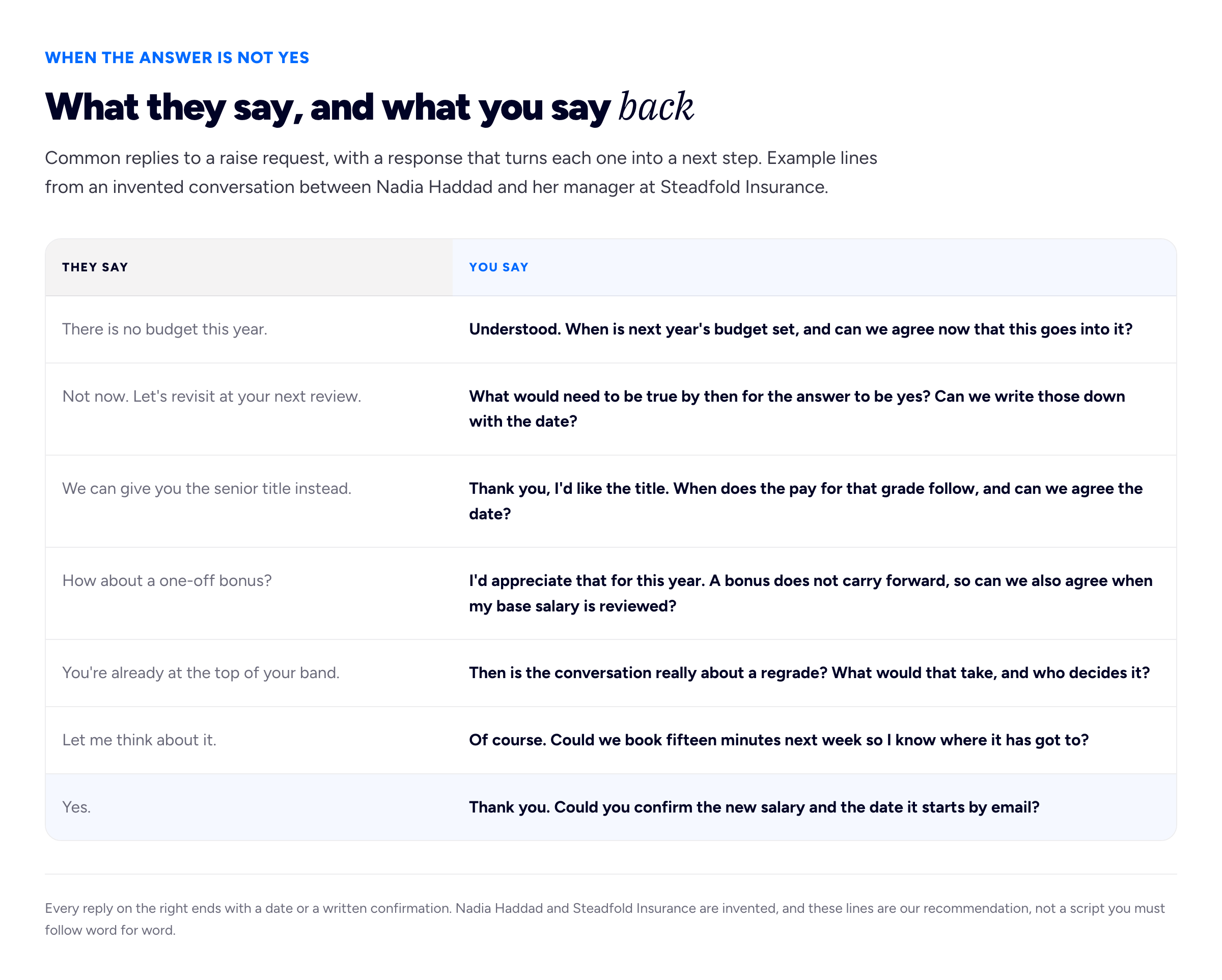
Every response on the right ends with a date, a condition or something in writing, never just "OK".
"There is no budget"
Sometimes this is true and sometimes it means "I have not looked". Do not argue with it. Ask when the next budget is set and ask for your raise to be included. You have then secured a place in the next round, which is more than you had when you walked in.
"Not now"
"Not now" without conditions is how raise requests disappear. Turn it into conditions and a date: "So if I've formally taken over the escalation queue by September, we'll review my salary then?" If your manager will not agree to any condition at all, that tells you something too.
A title instead of money
A new title can be worth having, internally and on your CV. But a title without pay means more responsibility at the same salary, which leaves you underpaid for a more senior job. Accept it if you want it, and in the same breath ask when the pay for that grade follows.
A one-off bonus
A bonus is paid once; a raise is paid every year, and later raises and often pension contributions are calculated from it. That is why bonuses are the cheaper way to recognise good work. Take the bonus, thank them, and keep the base salary conversation open with a date.
A counter-offer to an outside offer
If you have an offer elsewhere and your employer offers to match it, think about why you started looking. If it was only money, a match may solve it. If it was the manager, the work or the lack of progression, it will not. And never mention an outside offer you do not have: if your manager says "then you should take it", you are stuck.
Get it in writing, with a date
A spoken yes is not yet a raise. Managers move on and budgets get cut. Within a day, send a short summary:
Hi Owen,
Thanks for this afternoon. To check I've understood: you're going to put forward my salary moving to [the agreed figure] for the April review, and you'll let me know the outcome by the end of February. If it isn't approved, we'll look at it again in September, once I've formally taken on the escalation queue.
Let me know if I've got any of that wrong.
Nadia
It fixes the figure, the date and any conditions, and good managers send summaries like it themselves. If the raise is approved, check the new figure appears in a formal letter or on your payslip from the agreed date. If the date passes with no news, you have a polite reason to follow up.
Mistakes that quietly lose the raise
- Making it about need. A manager cannot take "her rent has gone up" to a pay committee. Keep the case about the job.
- Comparing yourself with a named colleague. It turns your request into a complaint about someone else. Use market figures instead.
- Asking in the review meeting itself. The money is usually allocated by then.
- Softening the number. "Maybe somewhere around" is heard as "less would be fine".
- Bluffing about leaving. Only say it if you mean it and have somewhere to go.
- Accepting "later" with no date. Every outcome should end with a date in writing.
When to look elsewhere
One refusal is not a reason to leave. A manager who is honest about a tight budget and commits to a date is worth something. But some patterns suggest the raise is not coming:
- The agreed date passes, and the next date is vague.
- Your manager will not name any condition that would lead to a yes.
- Each time you ask, you get more responsibility and no money.
- The market evidence shows a wide gap, and the answer is still "that's what the role pays here".
If two or more apply, start looking quietly. Put the results from your raise case on your CV, because they are exactly what a new employer wants to see, and if your work can be shown, a simple portfolio site gives a recruiter somewhere to check it. Interviewers will ask why you are moving on: the guide to reasons for leaving a job covers answering honestly without criticising your employer, and once you have an offer in writing, the guide to writing a resignation letter covers the last step. Do not resign before that offer is in writing.
For freelancers: raising rates with existing clients
Nobody gives a freelancer an annual review, so nobody will raise your rate for you. Pick a natural point, such as a new project, contract or year, and never the middle of an agreed fixed-price job. Give notice in writing, ideally a month or more, and say the new rate plainly without apologising:
"From 1 February, my rate for new work will be [new rate]. Anything already agreed stays at the current rate. I'm happy to talk it through if that's useful."
Some clients will accept without comment and a few will leave; that group is often the one you were undercharging most. For setting the rate in the first place and phasing increases for long-standing clients, see how much to charge as a freelancer. Remember that the BLS figures above exclude the self-employed, so treat them only as a rough employee benchmark.
Frequently asked questions
How do you ask for a raise politely?
Ask for a dedicated meeting by email, say it is about your pay, and bring a short page of evidence about how your role has grown and what you have delivered. In the meeting, state one specific number calmly and let your manager respond. Polite means prepared and clear, not apologetic.
How much should I ask for in a raise?
Ask for what your evidence supports: what the job you now do pays in your market, at your level, from sources your manager can check, such as BLS OEWS in the US or ONS ASHE in the UK. If your job has grown into a more senior role, ask for that role's pay. We give no standard percentage, because none we found was traceable to a reliable source.
When is the best time to ask for a raise?
A month or two before your employer sets its pay budget, while the money can still be allocated to you, or shortly after a visible success. Avoid the weeks after announced cuts or redundancies, unless you only want your case on record for later.
Should I ask for a raise by email or in person?
Request the meeting by email and make the case in person or on a video call. The email gives your manager time to prepare, and the conversation lets you respond to their reaction. Afterwards, confirm what was agreed by email.
What should I do if my manager says no?
Ask what would need to be true for a yes, and agree a date to review it. Write both down in a follow-up email. If that date passes without progress, or your manager will not name any conditions, it may be time to look at other roles.
Should I accept a title change instead of a raise?
Accept the title if you want it, but ask in the same conversation when the pay for that grade will follow. A senior title at the same salary can leave you further underpaid for the job you now do. Get the pay review date in writing alongside the title.
How we put this guide together
Most of this guide is our recommendation, not sourced fact. The one-page case, the order of the conversation, the three private figures, the replies in the second diagram, the follow-up email and the signs that a raise is not coming come from writing career tools at Bunfolio and from how pay decisions usually move through an organisation, not from a study. Timings such as "a month or two before budgets are set" are recommendations.
The sourced facts concern the two official pay datasets, which we read on 16 November 2026: the BLS Occupational Employment and Wage Statistics home page (about 830 occupations, national, state and metropolitan estimates, latest reference period May 2025), its frequently asked questions (the wage definition quoted above) and its scope page (the exclusion of the self-employed); and the ONS Annual Survey of Hours and Earnings 2025 bulletin (the 1% sample, the April reference date, the median as headline measure, the move to SOC 2020, provisional estimates) and its earnings by four-digit occupation dataset, which notes estimates withheld for quality reasons. We quote no pay figures from either, because the right one depends on your occupation and area, and you should open it yourself.
We have deliberately left out the numbers that usually fill articles like this: the "typical" raise percentage, the share of people said to get a raise when they ask, the claim that changing jobs pays a set amount more than staying, and averages from salary websites with no published method. We could not trace any of them to a sample, method and date we were willing to stand behind, and a number nobody can source is worse than none, because it reads as evidence.
Nadia Haddad, Owen Pryce and Steadfold Insurance are invented for illustration, as are Nadia's role, her colleagues, her results and every detail in both diagrams.
Related reading: salary negotiation for a new job, how much to charge as a freelancer, reasons for leaving a job and how to write a resignation letter.
More from the blog
October 26, 2026 · 21 min read
Salary Negotiation: How to Ask for More, Politely
Research a range you can defend from sources you can name, answer "what are your salary requirements" on a form, a recruiter call and in writing, handle questions about your current pay, negotiate the...
October 19, 2026 · 22 min read
Thank You Email After an Interview (and How to Follow Up)
Send it the same day, keep it under 150 words, and make it about one thing the interviewer actually said. What to reference, one email or several after a panel, subject lines, what to leave out, and w...

October 17, 2026 · 18 min read
Questions to Ask the Interviewer (and What Each Answer Tells You)
Everyone publishes fifty questions and nobody says which three to ask. Here is how to choose them from the role in front of you, grouped by what the answer reveals rather than by topic, with what a go...