
November 20, 2026 · 19 min read
How to Sign Off an Email: Sign-Offs by Situation, With Examples
For most professional email, end with "Kind regards" or "Best regards" and your full name: polite, neutral and never wrong. Then adjust: "Thanks" when you are asking for something, "Best" or just your name once a thread is friendly and fast, and in a formal UK email "Yours sincerely" to a named person or "Yours faithfully" after "Dear Sir or Madam".
To sign off an email, end with a short closing phrase, a comma, and your name on the next line. For most professional email, "Kind regards" or "Best regards" followed by your first and last name is the safe default: it is polite without being stiff, and nobody reads anything into it. Adjust from there with three questions. Who are you writing to and how well do you know them? Use "Best wishes" or just "Best" once a thread is friendly, and "Yours sincerely" in a formal letter-style email to a named person. What are you asking for? "Thanks" works well when the email asks for something. And how fast is the conversation moving? In a quick back-and-forth, your name alone, or nothing at all, is normal.
The rule that trips people up is British. In a formal letter, or an email written like one, UK careers services advise "Yours sincerely" when you have opened with the person's name and "Yours faithfully" when you have opened with "Dear Sir or Madam". American English uses "Sincerely" either way. Below the closing line sits your signature block, which for a freelancer or job-seeker should be your name, what you do, and one link to your work. That is the whole answer; the rest of this guide shows each sign-off in context, with the full closing line and name block written out, and explains which ones misfire and why.
What a sign-off is actually doing
The last two lines of an email do three small jobs. They tell the reader the message has ended, so they are not scrolling for a missing paragraph. They set the temperature: "Yours faithfully" and "Cheers" are both polite, but they describe very different relationships. And they tell the reader what to call you, because the name you sign with is the name they will use in their reply.
That last job is the one people forget. If you sign "Elif Kaya", a new client will write back "Hi Elif". Sign "E. Kaya" and some will write "Dear Ms Kaya" for months. Choose the version you want used.
How to choose: three questions
You do not need a list of fifty sign-offs. You need a way to pick one in five seconds. Ask these three questions in order.
1. How formal is the opening? Match the closing to the greeting you used. "Dear Mr Reyes" calls for "Yours sincerely" or "Kind regards". "Hi Dominic" calls for "Best regards", "Best wishes" or "Thanks". "Dominic," with no greeting word, sits between the two. A formal greeting with a casual sign-off, or the other way round, reads as if two people wrote the email.
2. How well do you know them? On first contact, stay one step more formal than you think you need to. It is easy to relax later, when they reply with "Cheers, Dom", and awkward to pull back after you have been too familiar. Once the other person has set a tone, mirroring it is almost always right.
3. What does the email ask for? If you are asking for something — a decision, a document, a payment — "Thanks" or "Many thanks" puts the request and the gratitude side by side, which is natural. If you are delivering something, "Best regards" is enough. If you are delivering bad news, a warmer and slightly more formal closing ("Kind regards", "With best wishes") softens the end without pretending the news is good.
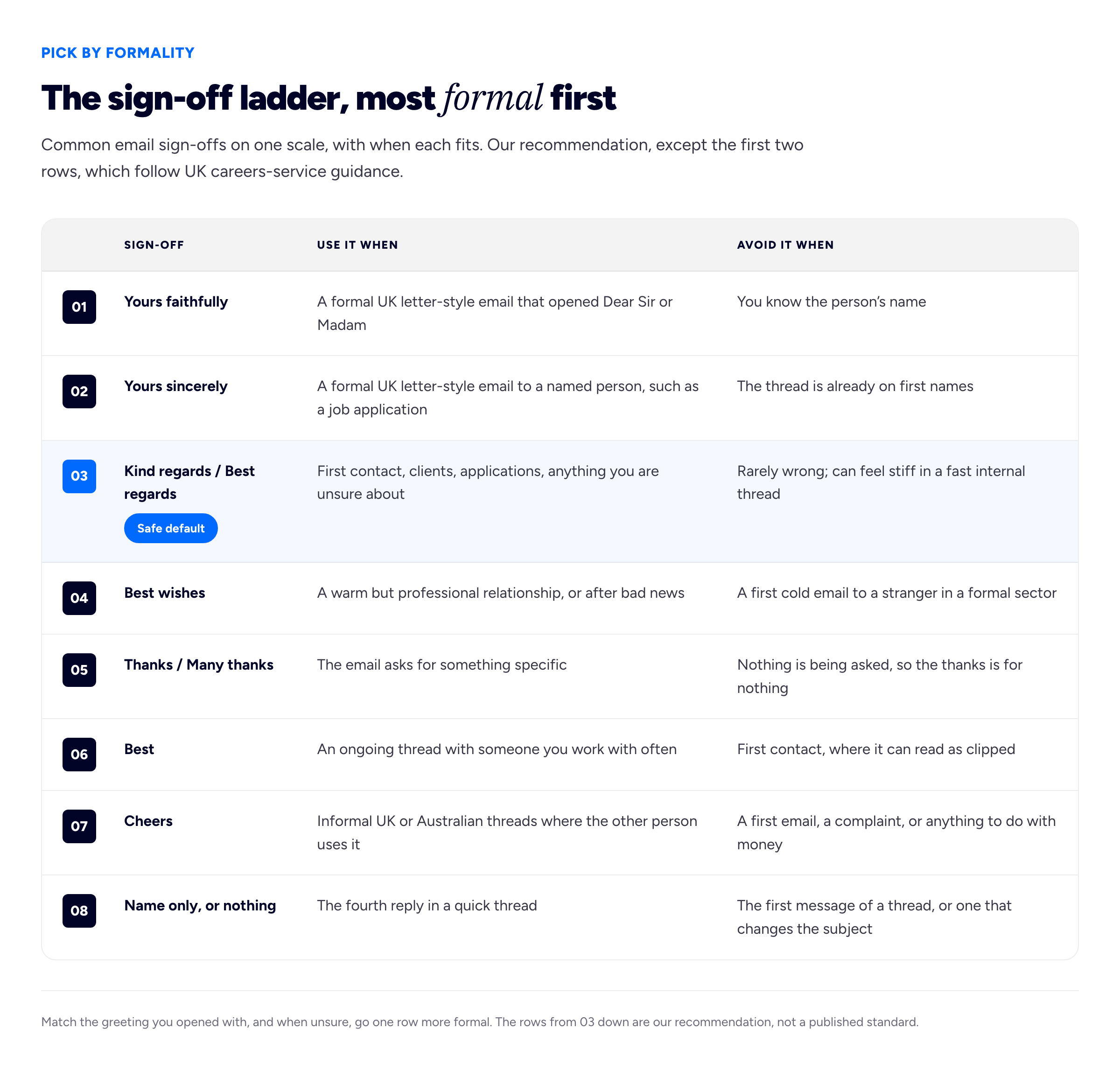
When in doubt, use row 03 and go one row more formal than feels necessary; relaxing later is easier than pulling back.
Sign-offs by situation, written out in full
A sign-off only makes sense next to the sentence above it and the name below it. Each example here follows the same invented freelancer, Elif Kaya, a copywriter, through one client relationship with Dominic Reyes at an agency called Marlow & Finch, plus one job application. Every block shows the last sentence of the email, the closing line and the name block.
First contact with a potential client
A first email to someone who has never heard of you should be warm, plain and slightly formal, and should sign with your full name so they can look you up.
If it would help, I can send two short samples from similar brand projects before we speak.
Kind regards,
Elif Kaya
Freelance copywriter
elifkaya.bunfolio.com
There is no "Thanks in advance", because they have not agreed to anything; the offer in the last sentence does the work a pushy closing would try to do.
An ongoing thread with a client
Once Dominic has replied and you are on first names, drop a step. Sign with your first name only; the full name is already in your signature block and the thread above.
Second draft attached, with the changes to the headline and the longer product section.
Best,
Elif
"Best" works here because the relationship already exists. On a first email the same word can feel clipped, as if the writer could not spare the second word.
Applying for a job by email
An application is the one place where the older, letter-style closings still earn their place, because the email often is the cover letter. In the UK, if you opened with the hiring manager's name, close with "Yours sincerely". In the US, "Sincerely" does the same job. "Kind regards" is also widely accepted and is a reasonable choice if "Yours sincerely" feels too old-fashioned for a creative agency.
I have attached my CV, and my recent work is on my portfolio at the link below. I would welcome the chance to talk about the role.
Yours sincerely,
Elif Kaya
07700 900123
elifkaya.bunfolio.com
The closing paragraph matters more than the closing word, and we have covered the whole of it — passive, confident and pushy endings, and which sign-off fits which letter — in how to end a cover letter.
Chasing an unpaid invoice
Money is where casual sign-offs cause the most damage. "Cheers" on a payment reminder reads as if you do not expect to be taken seriously. "Many thanks" is the right register: it is polite, and it quietly treats the payment as something that is going to happen.
Invoice MF-0412 for £1,800 was due on 3 November. Could you let me know when it is scheduled for payment? I have attached a copy in case it went astray.
Many thanks,
Elif Kaya
Freelance copywriter
elifkaya.bunfolio.com
Sign with your full name on a reminder, even in a first-name thread, because invoices are often forwarded to an accounts team who have never seen your other emails. The reminder sequence itself, and when to escalate, is in how to get paid on time as a freelancer.
Declining work
When you turn down a brief, the sign-off should leave the door open without promising anything. "Best wishes" is good here because it reads as goodwill rather than business.
I am fully booked until February, so I will not be able to take this one on. If the timing moves, I would be glad to hear from you again.
Best wishes,
Elif
Avoid "Sorry again" as a closing line. Apologising twice for something that is not a fault makes a reasonable decision sound like a failure.
Apologising for a mistake
When something really is your fault, say so once in the body, fix it, and close normally. The sign-off is not the place to apologise again; "Apologies again," at the bottom repeats the error and ends the email on it.
I sent the draft with last week's pricing table. The corrected version is attached, and I have checked the figures against your brief.
Kind regards,
Elif
Going one step more formal than usual — "Kind regards" in a thread that had reached "Best" — signals that you are taking it seriously, without any extra words.
After an interview
A thank-you email after an interview is short and specific, and the sign-off is usually the obvious one: "Thank you again" in the last sentence, then "Best regards" or "Kind regards". Do not repeat the thanks in the closing line itself, because "Thanks again, thanks, Elif" is two thank-yous too many.
Thank you again for the time today. The discussion about the rebrand timetable made me even keener on the role.
Best regards,
Elif Kaya
What to reference in the body, when to send it and what to do if you hear nothing are all in the thank-you email after an interview.
US and UK conventions
Most professional email sign-offs travel between British and American English without trouble. "Best regards", "Kind regards", "Best wishes", "Thanks" and "Best" are used on both sides of the Atlantic. The difference is concentrated in two places: formal letter-style closings, and how casual you can get.
"Yours sincerely" and "Yours faithfully"
The British pairing is consistent across the UK sources we checked. The National Careers Service puts it this way: "If you know the name of the person you're writing to, you should end the letter with 'Yours sincerely'." If you opened with "Dear Sir or Madam", it advises "Yours faithfully" instead. The University of St Andrews careers service and the Open University give the same rule, and a University of Birmingham guide to email etiquette notes that the rule can be applied to formal email as well as letters.
Two practical points follow. First, the rule applies to formal, letter-style messages: applications, complaints, letters to an organisation. Nobody expects "Yours sincerely" on a reply about a meeting time. Second, every one of those sources also pushes you to find a name before falling back on "Dear Sir or Madam", so in practice "Yours faithfully" should be rare. On a job application, if you can find the hiring manager's name, use it and close with "Yours sincerely".
American usage
In American English the formal close is "Sincerely", used whether or not you know the person's name; there is no equivalent to "faithfully". "Respectfully" turns up in some formal contexts, such as letters to officials, but in an ordinary business email it can sound oddly ceremonial. For everyday US business email, "Best", "Best regards" and "Thanks" are the safe choices.
Writing across the two
Writing to the other side of the Atlantic, you do not need to switch dialects: "Kind regards" and "Best regards" are understood everywhere. The two to drop are "Cheers", which can read to an American as a toast rather than a closing, and "Yours faithfully". Our recommendation is to stay with "regards" or "best" until the other person shows you their habit, then mirror it.
Sign-offs that misfire, and why
None of these is forbidden. Each carries a meaning that the writer usually did not intend, which is why they get noticed.
"Thanks in advance." It thanks someone for something they have not agreed to do, which reads as an assumption that they will. To a colleague it is harmless; to a client, a stranger or someone senior it can sound like pressure. "Thanks" on its own, after a clear request, does the same job without presuming.
"Regards" on its own. Without "Kind" or "Best", "Regards" is noticeably cooler. Some readers take it as neutral; others read it as a signal that the writer is annoyed. If you want neutral, add the adjective.
"Warmest regards" on routine email. Strong warmth on a message about a file format reads as performance. Save it for when it is earned, such as thanking someone for a reference.
"Looking forward to hearing from you." On its own line, as the closing, it often reads as a nudge. As the last sentence of the body, followed by a normal sign-off, it is fine. The difference is whether it replaces the courtesy or comes before it.
Kisses, "Love" and emoji. In some industries and some friendships these are normal. In a first email, a payment reminder or an application, they are not, and the Ohio State career guide gives exactly this warning about a casual closing: "you obviously wouldn't want to send the last one to your manager."
No name at all on a first email. Leaving off your name in a quick internal thread is normal. On the first message to someone, it reads as if the email was sent before it was finished.
The signature block: what to include
The sign-off is the phrase and your name. The signature block is the reference card underneath: the lines that tell a reader who you are and how to reach you, and which usually appear automatically. Purdue's Online Writing Lab advises including "a signature block that contains the necessary information for someone to reach you". For a freelancer or job-seeker, that information is small.
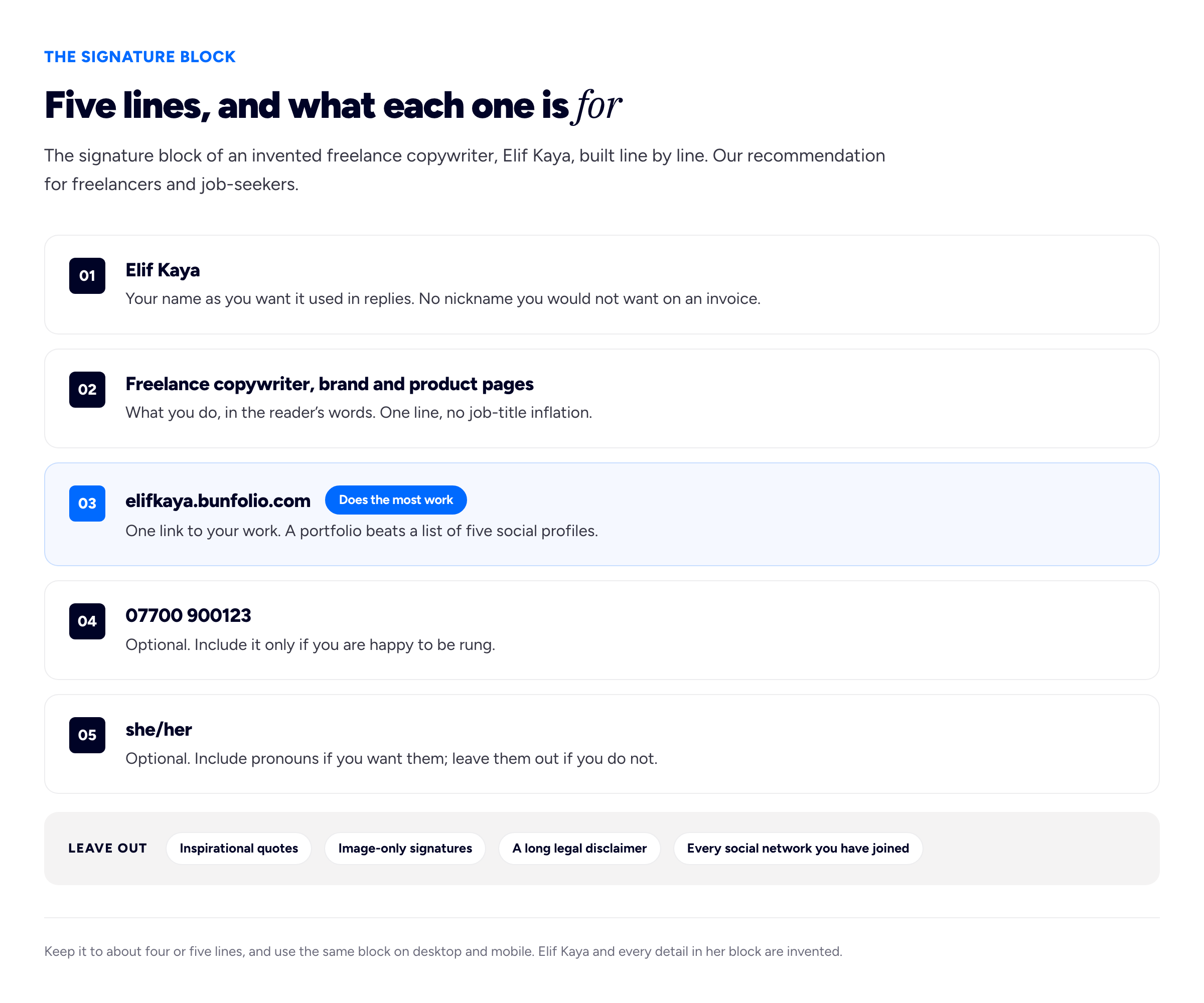
One link to your work does more than any other line, because it lets the reader check what you do without having to ask.
Name, and what you do
Your full name, as you want it used, comes first. The second line says what you do in words the reader would use: "Freelance copywriter" is better than "Word wizard", and "Graphic designer, packaging and print" is better than a stack of three job titles. Job-seekers can use the role they are targeting, or the one they hold, but should not put "Open to work" in a signature, because it goes on every email, including the ones to your current employer.
One link
A single link to your work is the most useful line in the block. A client who is unsure whether to reply, or a recruiter deciding whether to forward you, can click once and see what you have made. A portfolio site gives them somewhere to check your work without having to ask for samples; it is the same reason we recommend putting a portfolio link on your resume. If you are a copywriter, the page it points to should show writing, which is the point of a copywriter portfolio. One link beats five. A row of icons for every social network turns the block into a menu and dilutes the one place you actually want people to go.
Phone and pronouns
A phone number is optional. Include it if you want calls, leave it out if you do not; nobody is offended by its absence. Pronouns are also optional. Some people add them so that they are referred to correctly, and some add them as a courtesy to colleagues; either is fine, and so is leaving them out. If you include them, a short line such as "she/her" is enough.
What to leave out
Quotes go first. A line from Maya Angelou under a message about a late invoice changes the tone of every email you send, and you cannot choose which ones it appears on. Image-only signatures often arrive blocked, so the reader sees an empty box where your details should be. A sole trader does not need a long legal disclaimer under a two-line email. Finally, keep the block short. Our recommendation is four or five lines. Anything longer starts to be scrolled past.
Mobile signatures
The phone's default — "Sent from my iPhone" or the equivalent — is technically a signature, and it is the one that most often goes out by accident. Some keep it as an excuse for a short reply or a typo; it is better written as yourself. Replace it with your name, or with "Elif, on my phone" if you want to signal brevity.
The bigger problem is inconsistency. If your desktop block includes your portfolio link and your phone sends nothing at all, half of your emails to a client carry the one line you most want them to see, and half do not. Copy the same text-only block into the mail app on your phone. Keep it plain text: formatting and images set up on a desktop often break on a phone, and a broken signature looks worse than none.
When to drop the sign-off entirely
In a quick back-and-forth, writing "Best regards, Elif" on every reply starts to feel like formal dress at a kitchen table. Once a thread has turned into short replies a few minutes apart, it is normal to sign with your initial, your first name or nothing at all, and most people do.
Our rules of thumb for this:
- The first email in any thread gets a full sign-off. So does the first reply to someone new.
- Follow the other person down, not ahead of them. When Dominic replies with just "Thanks — D", Elif can drop to "Elif". She should not drop first.
- Go back up when the subject changes. If a fast thread about headlines suddenly turns to an overdue invoice, a revised fee or bad news, return to a full sign-off and your full name. The change in register tells the reader this message is different.
- Anyone new on the thread gets a full sign-off. When someone from accounts is copied in, they have not seen the earlier messages, and your full name and block help them place you.
One ending, rewritten
Here is how a single email end changes when you apply all of this. Elif's first draft of an invoice reminder to Dominic, sent after a friendly thread:
Just a gentle nudge on the invoice, no rush at all!! Sorry to chase.
Cheers x
E
Sent from my iPhone
Every line works against her. "No rush at all" contradicts the reason for writing. "Sorry to chase" apologises for asking to be paid on time. "Cheers x" is warm for a payment request. "E" gives an accounts team, if Dominic forwards it, nothing to search on. And the phone's default replaces the block with the portfolio link and invoice details. The rewrite:
Invoice MF-0412 for £1,800 was due on 3 November. Could you let me know when it is scheduled for payment? A copy is attached.
Many thanks,
Elif Kaya
Freelance copywriter
elifkaya.bunfolio.com
It is shorter, it is no less friendly, and it gives Dominic everything he needs to forward it. If you want to draft emails like this from a short brief, our free professional email generator writes invoice reminders, follow-ups and polite refusals, and you can adjust the sign-off to match the thread. For the invoice itself, see how to write an invoice.
Frequently asked questions
What is the most professional way to sign off an email?
"Kind regards" or "Best regards", followed by your full name, is the safest professional sign-off for almost any email. In a formal UK letter-style email, such as a job application to a named person, "Yours sincerely" is more formal still. In the US, "Sincerely" plays the same role.
When should I use "Yours sincerely" or "Yours faithfully"?
Use "Yours sincerely" when you opened with the person's name, and "Yours faithfully" when you opened with "Dear Sir or Madam". This is the British rule given by the National Careers Service and university careers services, and it applies to formal, letter-style emails. Ordinary day-to-day email does not need either.
Is "Best" too casual to end an email?
Not in an ongoing thread with someone you work with. On a first email to a stranger it can read as clipped, so "Best regards" or "Best wishes" is safer until the other person has replied.
Is it rude to end an email without a sign-off?
Not in a fast reply chain, where dropping the sign-off is normal once both people are doing it. It can feel abrupt on the first message of a thread, on a message to someone new, or on anything serious, such as a payment reminder or bad news.
Should I write "Thanks in advance"?
It is best avoided with clients, senior people and strangers, because it thanks them for something they have not agreed to do. Put the request clearly in the body and close with "Thanks" or "Many thanks" instead.
What should a professional email signature include?
Your name, a short line saying what you do, and one link to your work, with a phone number and pronouns as optional extras. Keep it to about four or five lines of plain text, and leave out quotes, image-only signatures and long disclaimers.
Should I sign with my first name or my full name?
Use your full name on first contact, on applications and on anything that might be forwarded, such as an invoice reminder. Once you are on first names in a thread, sign with your first name only; your full name is already in the signature block.
How we put this guide together
Most of this guide is recommendation, and we would rather label it than dress it up. There is no standards body for email etiquette, so the sign-off ladder from "Kind regards" downwards, the three questions for choosing, the advice on when to drop a sign-off, the four-or-five-line signature and every rewrite are our judgement, drawn from writing career and freelance tools at Bunfolio and from reading a great deal of client and application email. Where we say a closing "reads as" cold or pushy, that is our reading, not a measured finding.
The parts that are sourced are these. The "Yours sincerely" and "Yours faithfully" pairing comes from the National Careers Service guide to covering letters, the University of St Andrews careers service and the Open University help centre; the point that it extends to formal email comes from Professor Mark Lee's short guide to email etiquette written at the University of Birmingham. The signature-block advice quoted from Purdue is from the Purdue OWL email etiquette page, and the line about casual closings is from Ohio State's career guide on email etiquette. We read all of these on 16 November 2026. The American usage notes are general usage rather than a single source.
We have deliberately left out the statistics that usually appear in articles like this: the share of people who say a particular sign-off annoys them, the claimed reply-rate advantage of "Thanks" over "Regards", and figures for how many emails a worker receives each day. We could not trace any of them to a published method, sample and date we were prepared to stand behind, and a number nobody can source reads as evidence when it is not.
Elif Kaya, Dominic Reyes and Marlow & Finch are invented for illustration, as are the invoice number, the amount, the web address, the phone number and every email quoted here.
Related reading: how to end a cover letter, the thank-you email after an interview, how to get paid on time as a freelancer and putting a portfolio link on your resume.
More from the blog
November 19, 2026 · 18 min read
LinkedIn Headline Examples: 30+ Headlines and Why They Work
A strong LinkedIn headline names the role you want to be found for, narrows it with a specialism, and adds one piece of proof or the people you help. Here are more than thirty examples for job-seekers...
November 5, 2026 · 19 min read
Student Portfolio Examples: How to Build One From Coursework
What counts as work when you have no clients, from coursework and group projects to societies and part-time jobs, how to write each project up in five short parts, how many pieces to show, how to stru...
October 31, 2026 · 19 min read
Professional Summary: How to Write One (With Examples)
A professional summary is three or four lines built from the job advert: your role and level, two pieces of proof, and what you bring to this employer. Summary, profile and objective compared, when an...