
November 25, 2026 · 19 min read
Side Hustles From Home: 11 That Fit Around a Full-Time Job
The side hustles from home that fit a full-time job use a skill you already have and come in small jobs with no fixed hours: editing, bookkeeping, design, tutoring, virtual assistance, web builds, video editing, transcription, digital products, UGC and consulting. Check your contract first, fix your hours each week, and register for tax above the threshold.

The side hustles from home that fit a full-time job use a skill you already have and come in small jobs with no fixed hours: editing, bookkeeping, design, tutoring, virtual assistance, web builds, video editing, transcription, digital products, UGC and consulting. Check your employment contract first, fix your hours each week, and register for tax above the threshold.
This guide takes eleven of those side hustles one at a time: who each one suits, what it costs to start, where the first paying customer usually comes from and how much time it honestly takes. Then it covers what most lists skip: your contract, a weekly schedule, UK and US tax basics, scams, and making your work findable. It is not about delivery and ride-hailing apps; that is a different kind of work, covered in the guide to gig work. There are no income figures here; none we found could be traced.
What makes a side hustle work when you already have a job
Most lists of side hustles are written for someone with free days. You do not have free days. You have perhaps two evenings and part of a weekend, a tired brain after work, and an employer who expects you to be on form at nine on Monday. Four tests separate the side hustles that survive from the ones abandoned in month two.
- It runs on your timetable, not the customer's. Work you can do at 8pm on a Tuesday and hand back on Thursday fits. Work that needs you on the phone at 11am does not.
- It uses a skill you already have. Selling something you already do well, often at work, reaches a first paid job far sooner than learning a new trade.
- It comes in pieces you can finish. A document to edit, a month of books to reconcile, a one-hour lesson. Open-ended "help us with marketing" arrangements swallow them.
- It costs little to start. Expensive equipment or stock means betting money before anyone has bought. The best ones start with the laptop you own.
The table sorts eight common options by those tests.
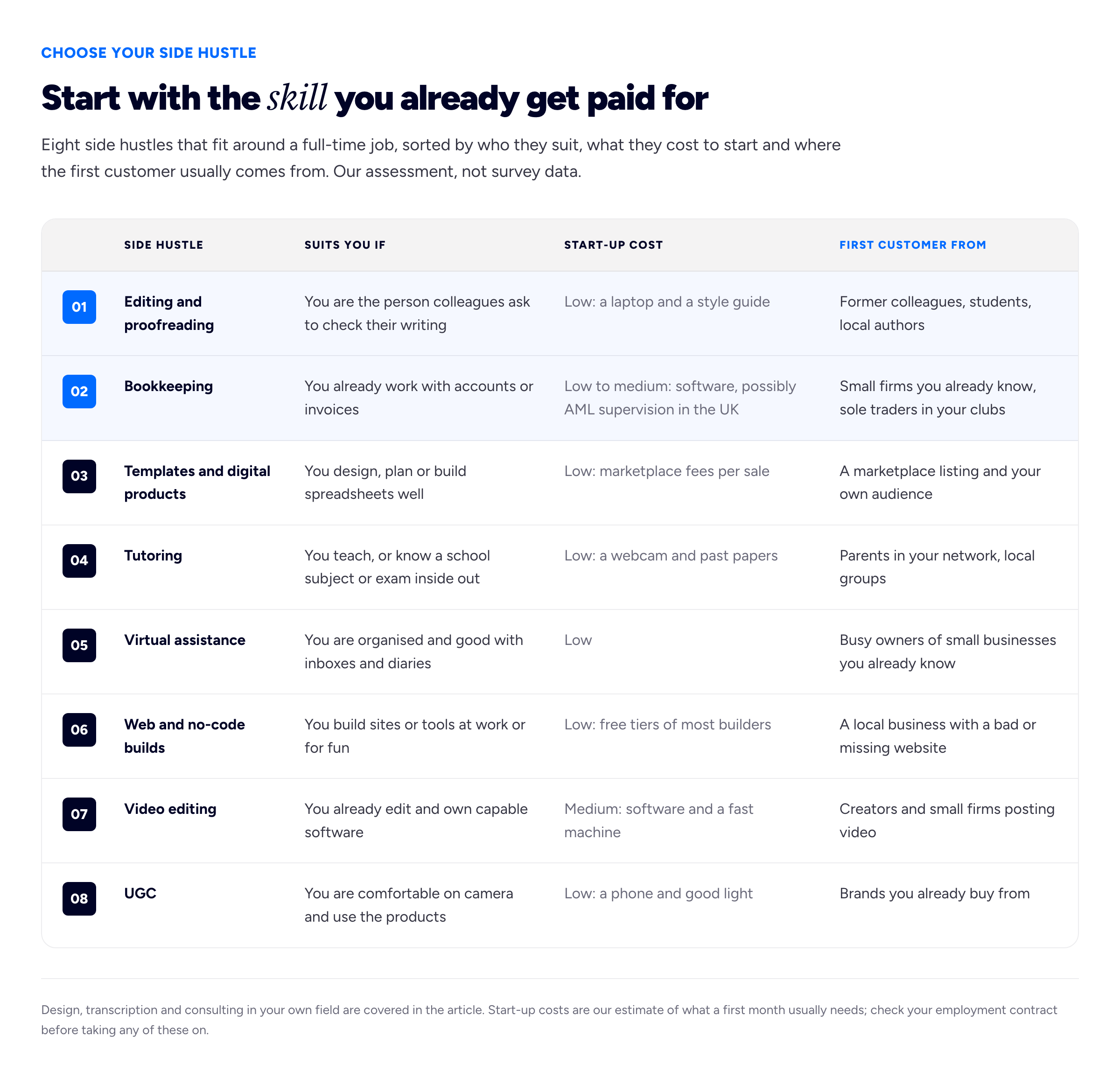
Rows 01 and 02 are the quickest starts for most people, because the skill and the first customers already exist.
Eleven side hustles you can run from home
For each one: who it suits, what it costs to start, how the first customer usually arrives, and an honest view of the time involved. The time notes are our judgement from working with freelancers, not measured averages.
1. Editing and proofreading
Suits: people whose day job involves careful writing, such as teachers, civil servants, lawyers, researchers and marketers. Start-up cost: close to nothing, beyond a laptop and a style guide you trust. First customer: someone who already knows you write well. Chloe Dunmore, a secondary-school English teacher, got her first job by telling two former colleagues doing master's degrees that she was now proofreading dissertations at weekends. One of them passed her name on. Time: highly variable, because a clean manuscript and a messy one take very different hours. Quote per job after seeing a sample, not per hour blind, and never promise a turnaround that depends on a free weekend you do not have yet.
One rule for academic work: proofreading is checking spelling, grammar, consistency and formatting. Rewriting someone's argument for an assessed piece is a different thing, and many universities forbid it. Ask the student for their institution's proofreading policy before you start, and keep your edits on the right side of it.
2. Bookkeeping for small businesses
Suits: people who already work in finance, accounts or administration. Start-up cost: low to medium, because you will need to be fluent in the software your clients use, and in the UK there is a compliance step. GOV.UK lists "professional bookkeeping services" among the services that make a business an accountancy service provider, which means you must register with HMRC for anti-money laundering supervision unless you are already supervised by a professional body or another exception applies. First customer: a small firm that already trusts you. Rafael Ortiz, an accountant at a mid-sized practice, picked up his first two bookkeeping clients through a sports club he plays for, both sole traders who had been doing their own books badly. Time: steady and predictable once set up, which is why it suits a full-time job; the first month with any new client takes longer, because you are cleaning up what came before.
3. Templates and digital products
Suits: designers, planners and spreadsheet people. The product might be a set of presentation slides, a wedding budget spreadsheet, a social media template pack, a CV layout or a lesson plan bundle. Start-up cost: low, as marketplaces mostly take a fee per sale rather than a monthly charge; read the current fee page of whichever one you choose. First customer: slower than a service, because a stranger has to find the listing. Yuki Sato, a product designer, made her first sale from a template pack she had built for her own freelance proposals, then listed with screenshots showing it in use. Time: front-loaded. You do the work once, then spend small amounts of time on listings, updates and customer questions. It rarely starts quickly; treat the first months as building stock.
4. Online tutoring
Suits: teachers, and anyone with deep knowledge of a school subject, an exam or a language. Start-up cost: low: a webcam, a headset, a shared whiteboard tool and past papers. First customer: a parent in your own network, then their friends. Time: fixed sessions at fixed times, usually after school, which clashes less with an office job than with teaching. Add preparation time to every session in your head. If you work with children, check what background checks are expected.
5. Virtual assistance
Suits: organised people good with inboxes, calendars, travel booking and admin. Start-up cost: low. First customer: a busy small-business owner you already know. Time: the catch is availability. Many clients want a reply within the working day, which is exactly when you cannot give it. Sell defined tasks with an evening turnaround, such as weekly inbox triage, invoicing runs or research, rather than "being available". The virtual assistant portfolio guide shows how to present those tasks as services.
6. Website and no-code builds
Suits: developers, and designers who build in no-code tools. Start-up cost: low, as most builders have a free tier for drafting. First customer: a local business with an out-of-date site, or none. Time: lumpy. A small site is a few weekends; the risk is the client who keeps adding pages. Agree the number of pages and rounds of changes in writing before you start, and charge separately for ongoing updates.
7. Video editing
Suits: people who already edit and own capable software. Start-up cost: medium, if you do not have a machine that handles video. First customer: a creator or small firm already posting video and short of time. Time: heavier than it looks, because exporting, revisions and file transfers eat evenings.
8. Transcription and captioning
Suits: fast, accurate typists with good listening and spelling, especially in specialist vocabulary such as legal, medical or academic. Start-up cost: low: good headphones and a foot pedal later if you stick with it. First customer: researchers, podcasters and journalists in your network. Time: flexible, but automatic transcription has taken much of the plain work, so the paid work left is checking and correcting machine output, or specialist and poor-quality audio. Be wary of sites that ask you to pay for a test or for "certification" before work.
9. UGC (user-generated content)
Suits: people comfortable on camera who already use the products. You make short videos brands use in their own ads; you do not need a following. Start-up cost: a phone, natural light and a quiet room. First customer: a small brand you already buy from, approached with a sample video. Time: short bursts, which fits weekends well. Read the usage rights in every brief, because a video used in paid ads for a year is worth more than one posted once. The UGC portfolio guide covers what to show brands.
10. Design for small businesses
Suits: designers. Start-up cost: the software you probably already have. First customer: local businesses and friends starting something. Time: predictable if you fix revisions; endless if you do not. Two rounds of changes, written into the quote, is the line that keeps this a side hustle and not a second job.
11. Consulting in your own field
Suits: anyone with several years in a specialism, such as HR, procurement, compliance or grant writing. Start-up cost: nil, apart from insurance in some fields. First customer: a smaller organisation that cannot afford a full-time specialist. Time: small, well-paid pieces, which suits a busy person. But this is the hustle most likely to collide with your employer, because your expertise is their business too. Read the next section before you take a single client.
Read your employment contract first
GOV.UK states plainly that you can run a business and be employed at the same time. Whether you can run this business alongside this job depends on what you signed. Get your contract and handbook out and look for five things.
- A second-job or exclusivity clause. Some contracts say you must not take other work without permission, or must not work for anyone else at all. Permission clauses are common and usually just mean asking.
- Conflict of interest. Work for your employer's clients, competitors or suppliers is the classic problem. Rafael could not take bookkeeping clients from his employer's own client list, and he checked that none of his sports-club clients were on it.
- Confidentiality. You cannot use your employer's client lists, pricing, templates or internal documents in your side work, even ones you wrote.
- Intellectual property. Many contracts give the employer the rights to anything you create "in the course of employment", and some reach further than that. If your side hustle is close to your job, as Yuki's templates were to her design work, read this clause twice. Build side work on your own time and your own equipment, never on a work laptop.
- Use of time and equipment. No side work in paid hours, on the work laptop, the work phone or the work email address. That is the easiest line to prove you stayed behind.
If anything is unclear, ask in writing. Most managers worry about two things, tiredness and competition, so answer both. Here is the email Chloe sent to her head teacher, which you can adapt:
Subject: Weekend proofreading work
Hi [head teacher's name],
I wanted to let you know that I have started proofreading academic writing for adults at weekends, from home. It does not involve any of our students or their families, I will not do it during school hours or on school equipment, and it will not affect my marking or planning. My contract asks staff to mention outside work, so I am letting you know now. Happy to talk about it if you have any concerns.
Kind regards,
Chloe Dunmore
It names the work, rules out conflict, time and equipment, and points to the clause. If the answer is no, or the contract forbids it, take advice before going ahead; a side hustle is not worth a disciplinary process.
Budget your time: a week that does not break you
Side hustles usually fail not for lack of customers but from the slow erosion of sleep and evenings, until you quit the one that does not pay the mortgage. The fix is a fixed weekly budget of hours, decided before the work arrives, with at least one evening that is never touched.
Here is the week Chloe settled on after a term of trial and error.
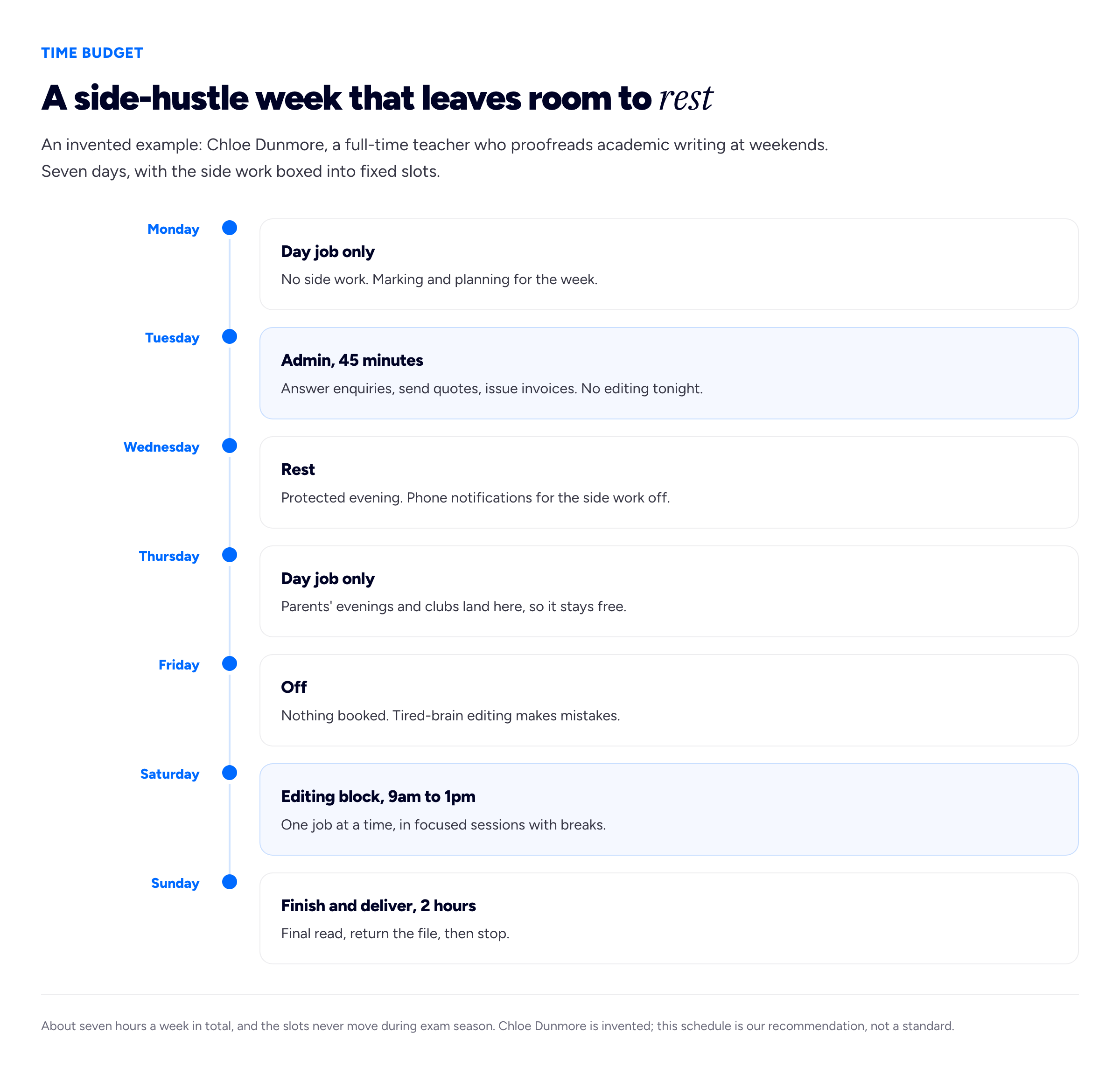
Admin gets its own short evening, so enquiries never leak into the protected nights.
Three rules make a schedule like this hold:
- Quote turnarounds from your calendar, not from the job. If a job would take four hours and your next free block is Saturday, the honest turnaround is Monday, not "two days".
- Batch the admin. Replying to enquiries the moment they arrive is what turns a side hustle into constant low-level work. One fixed slot, and an auto-reply that says when you answer.
- Plan for your job's busy season. Year-end for Rafael, exam marking for Chloe, launches for Yuki. Take on less work in those weeks, and tell regular clients in advance.
Pricing also protects your time. A side hustle priced too low fills every slot and still feels poor value; the guide to how much to charge as a freelancer walks through setting a rate from the hours you actually have.
Tax basics for extra income
This is the basics from official pages, not tax advice for your situation. Keep records from the first payment either way: what you were paid, by whom, when, and what you spent to earn it.
In the UK
HMRC gives individuals a trading allowance of up to £1,000 a year for income from self-employment, casual services or hiring out personal equipment. According to GOV.UK, if your gross trading income (before expenses) is £1,000 or less, you generally do not need to tell HMRC, though you must still keep records. If it is over £1,000, you must register for Self Assessment by 5 October in the following tax year. At that point you can either deduct the £1,000 allowance from your income or claim your actual expenses, not both.
Two catches matter for people with a job. First, the allowance cannot be used for trading income from your own employer, or from your spouse's or civil partner's employer, so you cannot do freelance work for your employer and shelter it this way. Second, it does not apply to income from a partnership. The figure is gross income, not profit, so a template seller who takes £1,200 in sales but spends £400 on fees is still over the line.
In the US
Side income from freelance work is generally self-employment income. The IRS says you must file and pay self-employment tax if your net earnings from self-employment were $400 or more. The rate is 15.3%: 12.4% for Social Security and 2.9% for Medicare, calculated on Schedule SE, and you can deduct the employer-equivalent portion of it when working out your adjusted gross income. It is on top of ordinary income tax.
Clients who pay you as a contractor may send you a Form 1099-NEC. The IRS page on 1099-NEC gives the reporting threshold as $600, rising to $2,000 for payments made after 31 December 2025. But do not treat the form as the trigger: the IRS states that you must report all income on your tax return, even if you do not receive Forms 1099 from the businesses that pay you.
Because no employer is withholding tax from side income, the IRS says you may have to make estimated tax payments quarterly. If you have a regular job, there is a simpler route it describes: withhold more from your employee paycheck instead, by using the IRS Tax Withholding Estimator and giving your employer a new Form W-4.
Scams aimed at people looking for extra income
Searching for work from home puts you in front of a lot of people who want your money rather than your skills. The US Federal Trade Commission's guidance is blunt, and its rules apply wherever you live.
- Paying to get work. The FTC says honest employers will never ask you to pay to get a job, and that if someone asks you to pay to get a job, that is a scam. That includes "starter kits", paid certification to unlock work, and placement fees paid in advance.
- Reshipping. Your "job" is to receive packages at home and send them on, sometimes overseas. The FTC states that reshipping goods is never a real job; the goods are typically bought with stolen card details.
- Fake cheques. A new "client" sends a cheque, asks you to deposit it and send part of the money on to someone else. The FTC warns the cheque will bounce and the bank will want you to repay the full amount.
- Task scams. These begin with an unexpected message offering "work" liking videos or rating products. The FTC describes scammers paying a small amount first to gain your trust, then telling you to deposit your own money, usually in crypto, to unlock earnings that were never real.
Here is a real first enquiry next to a scam one.
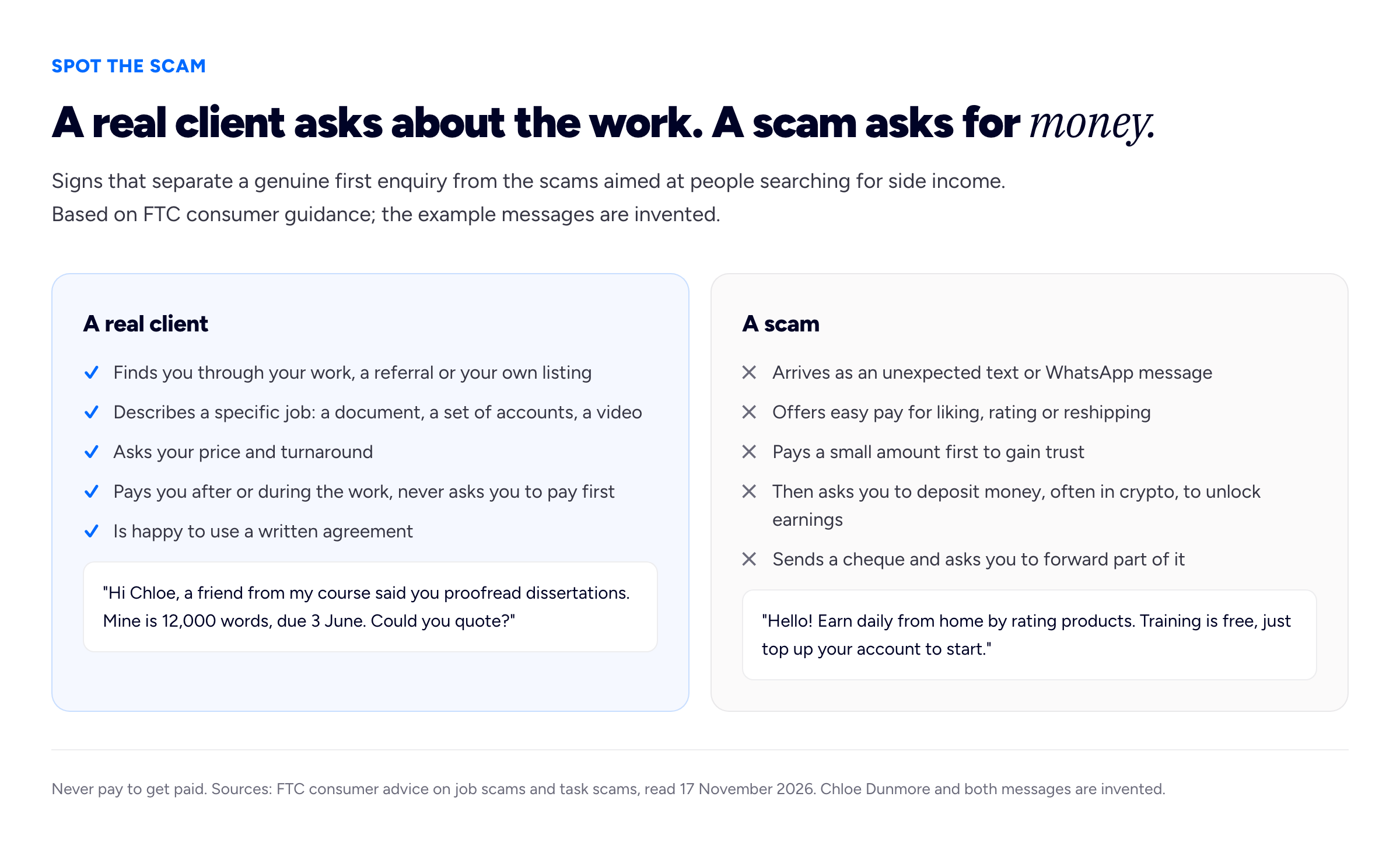
Any message that ends with you sending money is not a job, however it starts.
Make the work findable
The first two or three customers for almost every side hustle on this list come from people who already know you. After that, word of mouth slows, and strangers need somewhere to check you are real and good. A marketplace profile helps, but sits beside hundreds of near-identical ones.
Your own short portfolio site does three jobs a CV or a marketplace profile cannot. It shows the work itself: before-and-after edits with the client's permission, a sample set of books with the names removed, a template in use, a site you built. It lets a referral check you out in two minutes. And it gives you one link to put in your email signature, your marketplace bio and your social profiles. Keep it simple: what you do, for whom, three examples, how to book, and your turnaround. A free one takes an afternoon with Bunfolio, and the guides to getting your first freelance clients and starting freelancing with no experience cover the outreach side.
Keep the portfolio separate from your work identity: no employer logo, no work email, nothing implying endorsement.
Mistakes that end side hustles early
- Starting with three at once. Pick one, get to five paying customers, then decide whether to add another.
- No written scope. A short email that says what is included, how many revisions, the price and the date saves arguments in a field where you have no evenings to spare.
- Ignoring the tax until April. Put a share of every payment aside in a separate account from the start.
- Hiding it from your employer when the contract requires disclosure. The work is rarely the problem; the concealment is.
If the side hustle grows to the point where you are thinking of going full-time, the guide to what freelancing actually involves is the next read.
Frequently asked questions
What is the best side hustle to do from home?
The best one is built on a skill you already use at work or know deeply, because it reaches a first paying customer fastest and needs little or no spending to start. For many people that means editing, bookkeeping, tutoring, design or consulting in their own field. Choose something you can deliver in the evenings without answering calls during work hours.
How can I make extra income while working full-time?
Pick one skill-based service, check your employment contract for second-job, conflict-of-interest and intellectual property clauses, and set a fixed number of hours a week with at least one evening kept free. Get your first customers from people who already know your work, then put examples on a simple portfolio site so referrals can check you out.
Do I have to tell my employer about my side hustle?
It depends on your contract. Some contracts require you to ask permission or declare outside work, and almost all forbid competing with your employer or using its time, equipment or confidential information. Where disclosure is required, a short email that names the work and rules out any conflict is usually enough.
Do I pay tax on a small side hustle in the UK?
If your gross trading income is £1,000 or less in a tax year, the trading allowance generally means you do not need to tell HMRC, though you should keep records. Above £1,000, you must register for Self Assessment by 5 October following the end of the tax year. The allowance cannot be used for income from your own employer.
Do I need to report side income in the US if I did not get a 1099?
Yes. The IRS says you must report all income on your tax return even if you do not receive Forms 1099. If your net earnings from self-employment are $400 or more, you also owe self-employment tax, filed on Schedule SE.
Are side hustles that ask for an upfront fee legitimate?
Treat any opportunity that asks you to pay to start work as a scam. The FTC says honest employers will never ask you to pay to get a job, and task scams typically ask for a deposit, often in crypto, to unlock earnings that never arrive.
How we put this guide together
Most of this guide is our recommendation, not sourced fact. The four tests for a good side hustle, the choice of eleven hustles, the start-up cost and time assessments, the first-customer routes, the contract checklist, the disclosure email, the weekly schedule and the mistakes come from working with freelancers at Bunfolio, not from a study.
The sourced facts come from official pages, all read on 17 November 2026: GOV.UK's Working for yourself (being employed and running a business at the same time) and Tax-free allowances on property and trading income (the £1,000 trading allowance, the 5 October registration date and the exclusions); GOV.UK's guidance on money laundering supervision for accountancy service providers (bookkeeping in scope, and the professional body exception); the IRS pages on self-employment tax (the $400 threshold, the 15.3% rate and its split, Schedule SE, quarterly estimated tax), Form 1099-NEC and independent contractors (the $600 and $2,000 thresholds) and managing taxes for gig work (reporting income without a 1099, and adjusting W-4 withholding instead of paying estimated tax); and the FTC's consumer advice on job scams and task scams. Tax rules change; check the current pages before you rely on them.
We have deliberately left out the numbers that fill most side-hustle lists: monthly income claims for each hustle, the share of workers said to have a side hustle, average hourly rates from unnamed surveys and "make £X in your first month" promises. We could not trace any of them to a sample, method and date we were willing to stand behind.
Chloe Dunmore, Rafael Ortiz and Yuki Sato are invented for illustration, as are their jobs, their clients, Chloe's email and schedule, and both messages in the scam diagram.
Related reading: gig work and how app-based platforms differ, how to start freelancing with no experience, getting your first freelance clients, how much to charge as a freelancer and building a virtual assistant portfolio.
More from the blog

November 24, 2026 · 19 min read
What Is a Letter of Interest? Template and 3 Full Examples
A letter of interest is a short letter to an employer that has not advertised a job, saying you would like to work there, what you could bring, and asking for a conversation. In the UK it is a specula...

November 23, 2026 · 19 min read
How to Make a Resume for Your First Job (With Two Samples)
List everything that involved turning up, being trusted or finishing something: school, volunteering, clubs, sport, babysitting, odd jobs, caring at home. Put education near the top, include unpaid wo...
October 30, 2026 · 21 min read
Reasons for Leaving a Job: What to Say and Write
Sixteen good reasons for leaving a job, from growth and relocation to redundancy, pay and family needs, each with a short line for the application form and what to say in the interview. Plus honest wo...