
November 27, 2026 · 19 min read
What to Put on a Resume: Every Section, What to Leave Off and the Order
Every resume needs five sections: a header with your contact details, a short summary, work experience, education and skills. Add projects, certifications, volunteering or languages only when they prove something the job asks for, and leave off your photo, date of birth, full address and references.
Every resume needs five sections: a header with your name and contact details, a short summary, your work experience, your education and your skills. Add optional sections such as projects, certifications, volunteering or languages only when they prove something the job asks for. Leave off your photo, date of birth, marital status, full street address and references, and put whichever section best proves you can do this job nearest the top.
This guide is the complete checklist: each must-have section, the optional sections and when they earn their space, the personal details to leave out (and where US and UK practice differ), the right order for an experienced candidate, a student and a career changer, and how to start writing, which is not by opening a template. It ends with one full resume, annotated line by line.
The five sections every resume needs
Career services agree on the core far more than the internet suggests. Harvard's guide to creating a strong resume builds its templates on a contact header, Education, Experience, Leadership and Activities, and Skills and Interests. Ohio State's career guide lists contact information, an optional objective or summary, education, experience and skills, with activities and honours as extras. The UK's National Careers Service says a CV "should include a section for your contact details, an introduction, your education history, your work history and references". Strip out the student-specific headings and the UK's references section, and you have the same five building blocks.
Here is the whole checklist on one page before we go through it.
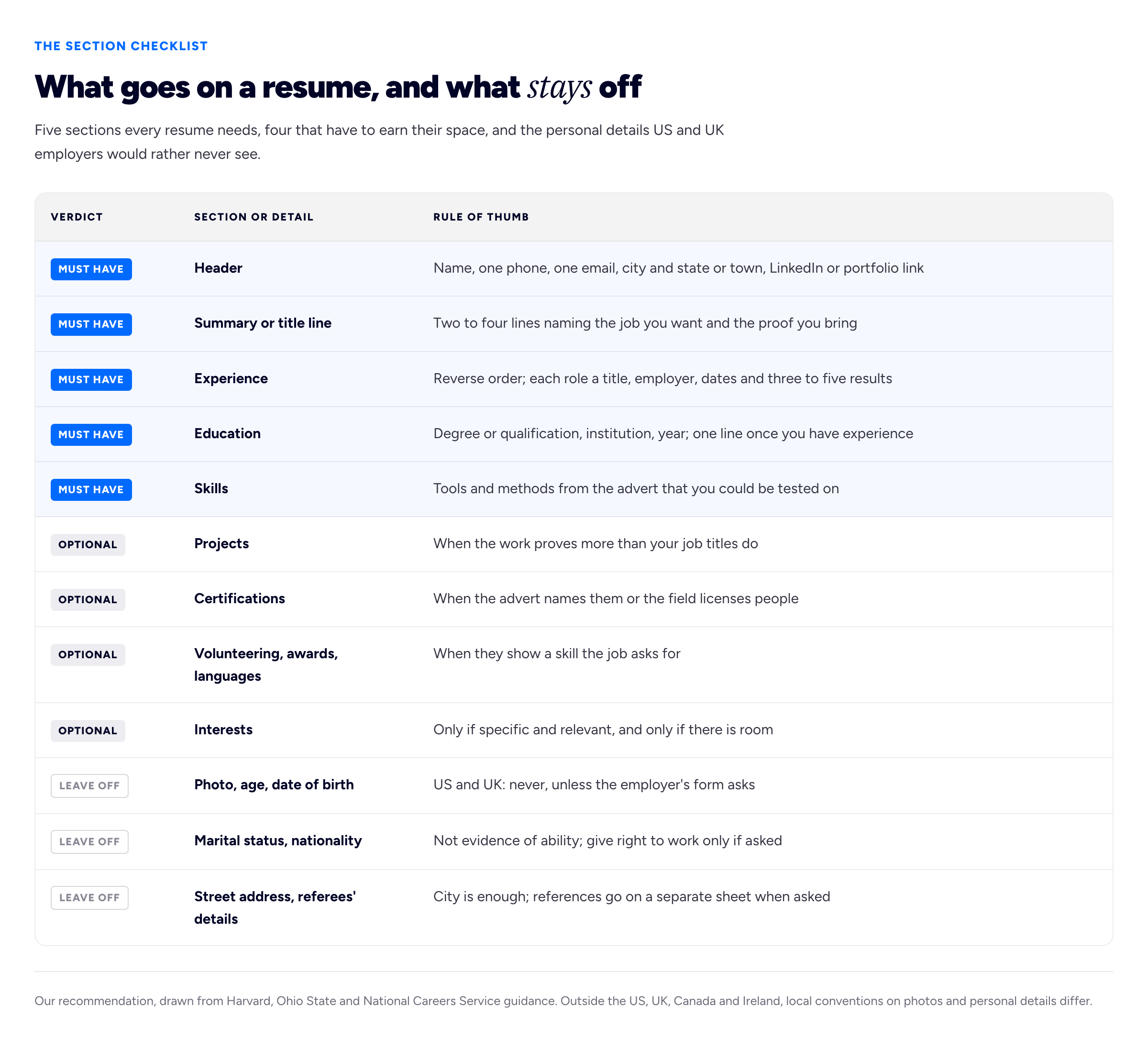
Five rows you cannot skip, four you add on merit, and three that do you no favours.
1. The header
The header answers one question: how do I reach this person? It holds your name, a title line that names the job you are going for, one phone number you will answer, one professional email address, your city and state (or town, in the UK), and a LinkedIn profile or portfolio link. Ohio State's guide asks for exactly that list and adds "use a professional email address", which in practice means one built from your name.
Type the header into the body of the document rather than Word's header region, because some applicant tracking software skips that region. The full line-by-line treatment, including what to do about your location if you are relocating, is in our guide to the resume header.
2. The summary
The summary is two to four lines under the header that say who you are professionally, what kind of work you do, one piece of proof and what you want next. Ohio State calls this section optional, and for a student with one internship a single title line can do the same job. For anyone with a few years of experience, or anyone changing direction, it is the most-read paragraph on the page, so it belongs on the must-have list.
A usable formula: [job title] with [years] in [field or setting], [what you do]. [One result.] [What you are looking for.]
Marketing coordinator with four years in B2B software, running email and webinar programmes from brief to report. Rebuilt the onboarding email sequence at Larkspur Analytics. Looking to lead a small campaigns team.
Ten more worked examples, and the words to cut, are in our guide to the professional summary.
3. Work experience
This is the section that gets read most closely, and the one that most often wastes space. List roles newest first, which is what both Harvard and Ohio State advise. For each role give the job title, the employer, the location if it helps, and the years (month and year if the dates are recent or short). Then three to five bullet points for a recent role, fewer for older ones.
Each bullet should describe a result, not a duty. Your job description already says what you were supposed to do; the reader wants to know what happened because you did it. A reliable shape is verb, what you did, what changed:
| Duty (before) | Result (after) |
|---|---|
| Responsible for the company newsletter. | Took over the monthly newsletter and cut it from 12 items to 5; click-throughs roughly doubled over the next six issues. |
| Managed warehouse team. | Supervised a shift of 18 pickers and packers; rewrote the slotting plan so the 40 fastest-moving lines sat nearest despatch, and late orders fell from about 30 a week to under 10. |
| Helped with events. | Ran 14 webinars end to end, from booking speakers to sending the follow-up email the next morning. |
Use numbers only when they are real and you could explain how they were measured; never round up or borrow the team's figure. With no number, say what someone observed or decided: the process was adopted site-wide, the client renewed.
Freelance and unpaid work count as experience; list them as roles with a title and dates (our guide to freelance work on a resume shows how).
4. Education
At minimum: the qualification, the institution and the year you finished. Ohio State's guide adds the major and suggests listing only schools where you received a degree or certificate. How much more you add depends on how recent it is. A graduate may include relevant modules, a dissertation title or a strong grade; someone five years into their career needs one line. High school details come off once you have a degree or a few years of work. Where to put the section, how to show an unfinished degree and whether to include a GPA are covered in our separate guide to the resume education section.
5. Skills
A short block of the tools, methods and certifications the job asks for, written in the advert's own words where they are true for you. Ohio State's guide puts it simply: be honest and do not overstate your abilities. The test is whether you could be asked to use the skill in an interview task and do it.
Keep the list mostly to hard, checkable skills ("HubSpot", "forklift counterbalance licence", "SQL", "Spanish, conversational") and show the soft ones ("communication", "leadership") through your experience bullets instead, where they have evidence attached. Our guide to hard skills vs soft skills explains the difference, and the resume skills section guide covers layout, ratings bars and how to mirror an advert without overclaiming.
Optional sections, and when they earn their space
An optional section is worth adding when it proves something the job wants that the five core sections cannot. If it does not, it is costing you room that a better experience bullet could use. Go through each with the advert open.
Projects
Add a projects section when your work shows more than your job titles do. That covers students and graduates, career changers who have built something in the new field, developers and designers whose best work happened outside a job, and anyone whose employer was small enough that the title undersells what they did. Each project gets a name, a one-line description, the tools used, a result and, where possible, a link. A portfolio link carries this section further than any amount of description; our guide to the portfolio link on a resume covers where to put it and how to write it.
Certifications and licences
Include them when the advert names them, when the field is licensed (nursing, electrical work, driving, accountancy), or when they fill a gap for a career changer. Give the full name, the issuing body and the year. A long list of afternoon online courses reads as padding.
Volunteering
Volunteer roles go in your main experience section if they used skills the job needs (you ran the food bank's rota, you kept a charity's accounts). Otherwise give them their own short heading, or leave them off if the page is full.
Awards and honours
Worth a line when they are competitive and recent: a scholarship, a named prize, an employee award with a reason attached. "Employee of the month" earns its space only with what you did to get it, which usually means it reads better as an experience bullet.
Languages
List languages other than the one the resume is written in, with an honest level ("fluent", "professional working", "conversational"). If the job involves customers or colleagues who speak the language, move it up into skills.
Interests
The last thing to add and the first to cut. "Run the social media for a 300-member cycling club" says something; "reading, travel, music" says nothing. Our guide to hobbies for a resume has examples of both.
What not to put on a resume
Most of what to leave off is personal information that tells the reader nothing about your ability to do the job and could invite bias. The rest is clutter.
Photo, age and date of birth
In the US and the UK, leave them off. Harvard's resume guide lists including a picture and including age or gender among its "don'ts". The UK's National Careers Service is just as direct: "You should not include your age, your date of birth, whether you're married or your nationality."
The reason is equal-opportunity law and practice. In the US, the Equal Employment Opportunity Commission says "employers should not ask for a photograph of an applicant", and that a photograph needed for identification can be taken after an offer is made and accepted. It also advises employers against age questions unless they are needed to check a legal age requirement for the job. In Great Britain, section 39 of the Equality Act 2010 says an employer must not discriminate "in the arrangements A makes for deciding to whom to offer employment", and age, marriage and civil partnership, race (including nationality) and sex are among the protected characteristics. Employers who take that seriously would rather not receive the information at all.
Conventions differ elsewhere: in parts of continental Europe, Asia and the Middle East a photo and date of birth are still common. The rule that covers every case is to follow the employer's written instructions first, and with no instructions, leave personal details off.
Marital status, nationality, religion and similar
Same reasoning, same answer. If you need a visa or sponsorship, or the advert asks about your right to work, answer that one question where the application form asks it, or in one line of your cover letter, rather than listing your nationality on the resume.
Your full street address
Your city and state, or town in the UK, is enough. It tells the employer whether you are local, which is the only question they have, and keeps your home address off every job board and inbox your file passes through.
References, and "references available on request"
Do not list referees' names and contact details on the resume itself; Harvard's guide lists references among its "don'ts", and you do not want people phoned before you have briefed them. The "references available on request" line is where US and UK advice differs. In the US it is usually treated as unnecessary: Harvard's guide leaves references off altogether, and an American employer assumes you will supply them when asked. The National Careers Service, by contrast, notes that a UK CV can say references are available on request rather than give the details. Either way, it is the first line to cut when space is tight. What to do instead, and how to prepare a separate reference sheet, is in our guide to references on a resume.
Other things that do not belong
- The word "Resume" or "Curriculum Vitae" as a heading. Your name is the heading.
- An objective statement that describes what you want ("seeking a challenging role with growth opportunities"). Replace it with a summary that describes what you offer.
- Salary history or expectations, unless the application explicitly asks. Discuss pay later in the process.
- Every job you have ever had. Roles more than about ten to fifteen years old, or unrelated short jobs, can be summarised in one line or dropped; our guide to how long a resume should be covers how far back to go.
- Anything you could not defend in an interview: inflated titles, skills you have only read about, numbers you cannot explain.
The order of sections for your situation
There is no single correct order. Harvard's guide advises listing headings in order of importance, and the useful question is: importance to whom? To the person reading it, the most important section is the one that best proves you can do this particular job. That changes with your situation.
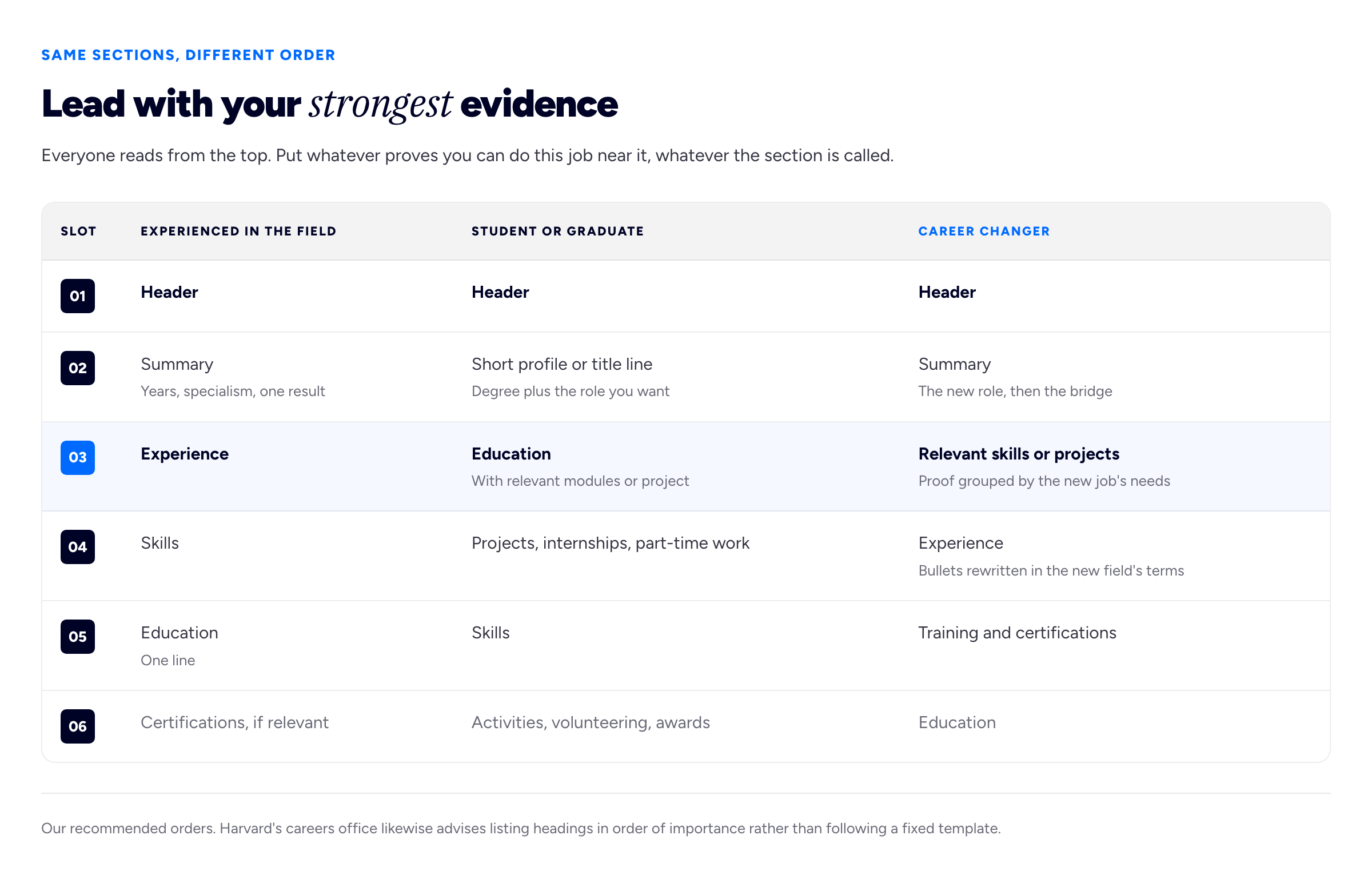
The third slot is where the decision is made: put your best proof there.
If you have experience in the field
Header, summary, experience, skills, education. This is the standard reverse-chronological resume, and it is what most readers and most applicant tracking systems expect. Education drops to one line at the bottom because your work now says more than your degree.
If you are a student or recent graduate
Header, a short profile or title line, education, then projects, internships and part-time work, then skills and activities. Education goes high because it is your most recent and most relevant achievement; you can add a capstone project, relevant modules or a dissertation title under it. Part-time jobs in retail or hospitality still count, written as results. Our guide to making a resume for your first job walks through the student version in full.
If you are changing careers
Header, a summary that names the new role and builds the bridge, then a "Relevant skills" or "Projects" section grouped by what the new job needs, then your experience with the bullets rewritten in the new field's language, then training and education.
Take Owen Hartley, an invented warehouse supervisor applying for an operations coordinator role. His old summary described the job he has. His new one describes the job he wants and points at the overlap:
Warehouse supervisor with six years running shifts of up to 20 people, moving into operations coordination. I plan rotas, track throughput against targets each day and have rebuilt two site processes that cut late orders. Completed an operations management certificate in 2026.
And his bullets are rewritten from warehouse language into operations language, without changing what is true:
| Warehouse wording | Operations wording |
|---|---|
| Ran the night shift. | Planned rotas and daily targets for a shift of 18, and reported throughput to the site manager each morning. |
| Sorted out the picking layout. | Redesigned the slotting plan using six months of order data; late orders fell from about 30 a week to under 10. |
| Trained new starters. | Wrote the induction checklist now used for every new hire on site, and trained 25 people with it. |
We do not recommend the fully functional resume, which drops dates and job titles for skill headings: it looks as if it is hiding something, and the hybrid order above gets the same benefit with your history visible.
How to start a resume: begin with a master list, not a template
The usual way to start a resume is to open a template and fill in the boxes. That is the wrong way round. A template decides what you say before you know what you have, and it pushes you towards whatever its designer imagined. Start with everything, then cut.
- Write a master list. In a plain document, list every job, internship, volunteer role, course, project and qualification you have had, with dates. Do not edit yet. This is never sent to anyone, so it can be long.
- Under each role, write everything you achieved. Use these prompts: What did I make, fix, start or improve? What did I do that my predecessor did not? What numbers changed while I was there (time, money, volume, errors, complaints)? What was I trusted with? What did someone thank me for?
- Collect the proof. Old appraisals, emails of thanks, reports you wrote, dashboards and portfolio pieces will remind you of results you have forgotten and give you real numbers.
- Pick one real advert. Print it or paste it next to the master list, and highlight the skills and duties it mentions more than once.
- Choose your order from the three situations above.
- Copy across only what matches the advert, turning each item into a result bullet. Most of the master list stays behind, which is the point.
- Write the summary last. It is much easier once you can see your best three bullets.
- Then pour it into a clean layout. This is where a template or builder helps. If you would rather not fight with Word's formatting, our free resume builder gives you a plain, single-column layout and a PDF without an account.
Keep the master list. Next time you apply, you start at step four. If you draft with an AI assistant, the master list is also what to give it; our ChatGPT resume prompts start from your own notes rather than a blank request.
A full example resume, annotated
Here is the whole thing put together. Priyanka Desai is an invented marketing coordinator at an invented company, Larkspur Analytics, applying for a marketing manager role. The diagram shows the skeleton of her resume on the left and why each part is there on the right.
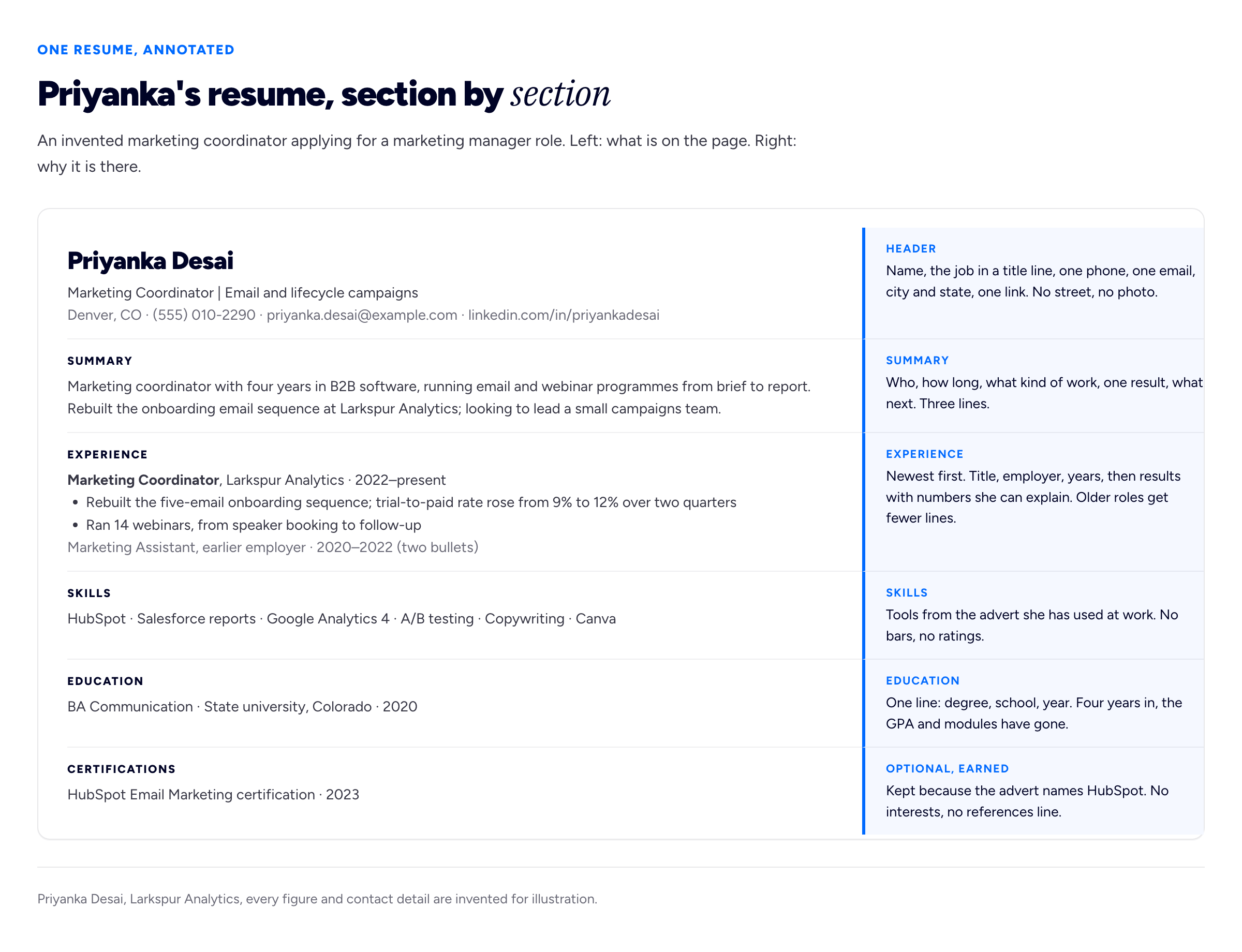
Every line on the left has a reason on the right; anything without one came off.
Her full experience section, written out, looks like this. Notice that every bullet starts with a verb, most carry a result, and the older role is shorter:
Marketing Coordinator, Larkspur Analytics, Denver, CO · March 2022 – present
- Rebuilt the five-email onboarding sequence for free-trial users; trial-to-paid conversion rose from 9% to 12% over the following two quarters.
- Ran 14 customer webinars end to end, from booking speakers to the next-day follow-up email, and turned the recordings into a monthly resource page.
- Set up a weekly campaign report in Salesforce that replaced three separate spreadsheets for the sales team.
Marketing Assistant, a regional events company, Denver, CO · June 2020 – February 2022
- Managed the email list and booking pages for around 40 events a year.
- Drafted social posts and event copy, approved by the marketing manager before publishing.
What is not there matters as much: no photo, no birthday, no street address, no references line, no interests line and no list of every tool she has ever opened.
Final checks before you send it
- Length: one page for most early-career resumes, two for most people with several relevant roles. Length should follow content, not the other way round; see how long a resume should be.
- Format for software: a single column, standard headings ("Experience", not "My journey"), real text rather than text inside images, and dates in a consistent format. Our ATS resume format guide has the details.
- The advert test: highlight every skill in the advert, then find it on your resume. If something central is missing and true, add it.
- The interview test: read every bullet and ask whether you could talk about it for two minutes. If not, rewrite or remove it.
- Proofread aloud, then have someone else read it.
Once the basics are right, our guide to making a resume stand out covers the extra mile. The cover letter that travels with it has a different job; cover letter vs resume explains what goes in each.
Frequently asked questions
What should you not put on a resume?
In the US and UK, leave off a photo, your age or date of birth, marital status, nationality, religion and your full street address. Also leave off referees' contact details, salary history, reasons for leaving jobs, an objective statement and anything you could not back up in an interview.
What order should resume sections go in?
Header and summary first, then whichever section best proves you can do the job. For experienced candidates that is work experience; for students it is usually education and projects; for career changers it is a relevant skills or projects section, with experience after it.
Should I put a summary or an objective on my resume?
A summary. An objective describes what you want from the employer; a summary describes what you offer and what you want next, in two to four lines. Students with little experience can use a single title line instead.
Is it OK to leave a job off my resume?
Yes. A resume is a selection, not a complete record. It is usual to drop short, unrelated or very old roles. Be ready to explain any gap if asked, and never leave a job off an application form that asks for your complete employment history.
How do I start writing a resume if I have no experience?
Start with a master list of everything you have done: courses, projects, part-time and volunteer work, clubs, caring responsibilities. Then pick one advert, choose the items that match it, and put education and projects near the top. Our guide to a resume for your first job has a full example.
Should I write "references available on request"?
In the US, generally no; employers assume it. In the UK it is acceptable, and the National Careers Service mentions it as an option, but it is still the first line to cut if you need space.
How we put this guide together
The five-section checklist, the verdicts on optional sections, the three section orders, the master-list method, the bullet formula and the final checks are our recommendations, based on comparing the guidance below; they are not rules from any official body. Where we report what a career service or regulator says, we have linked the page.
Sources, all read on 26 November 2026: Harvard's Mignone Center for Career Success, Harvard College guide to creating a strong resume (its section templates, ordering headings by importance, reverse chronological order, and its advice not to include a picture, age or gender, or references); Ohio State's career guide, what to include on a resume (contact information, the optional summary, education, experience, skills and optional activities and honours); the National Careers Service page on CV sections (the sections of a UK CV, the personal details to leave out and the references line); the US Equal Employment Opportunity Commission's pages on prohibited employment policies and practices (photographs and age-related questions) and what employers should not ask when hiring; GOV.UK on discrimination: your rights (the protected characteristics); and section 39 of the Equality Act 2010.
We have deliberately left out the figures that usually appear in articles like this one: how many seconds a recruiter spends on a resume, the percentage of resumes "rejected by ATS", and the share of hiring managers who say they prefer one section order or another. We could not trace any of them to a published method, sample and date we were willing to stand behind, so we do not repeat them.
Priyanka Desai, Owen Hartley and Larkspur Analytics are invented for illustration, as are every bullet, summary, figure and contact detail in the examples and diagrams.
Related reading: how to write a resume header, how to write a professional summary, the resume skills section, the resume education section, ATS resume format and CV vs resume.
More from the blog

September 12, 2026 · 22 min read
What to Put in the Skills Section of a Resume
Put roughly eight to fifteen named, job-relevant skills in your resume skills section: the tools, technical skills, languages and certifications the advert asks for and you have really used, grouped u...

September 18, 2026 · 23 min read
How to Put Freelance Work on a Resume
Nobody rejects a resume because the applicant freelanced. They reject it because they could not work out what they were looking at. The one decision that sets your layout, what to call yourself, and h...

September 16, 2026 · 20 min read
How to Put Your Portfolio Link on a Resume
Everyone tells you to put the link in your header and label it clearly. Nobody tells you what happens next — that the hyperlink often dies in the PDF export, that an applicant tracking system may neve...