
November 27, 2026 · 19 min read
Hard Skills vs Soft Skills: The Difference, Examples and How to Prove Them
Hard skills are specific abilities you can learn and someone can test, such as bookkeeping, welding or writing React code. Soft skills are how you work with people and the job itself, such as communication, reliability and judgement, and they carry over between jobs. Prove hard skills with named tools, credentials and work samples; prove soft skills with results in your bullet points, not adjectives.
Hard skills are specific abilities you can learn and someone else can test, such as bookkeeping, welding, Spanish or writing React code. Soft skills are the ways you work with people and with the job itself, such as communicating clearly, staying reliable under pressure and making sound decisions, and they carry over from one job to the next. Most roles need both: hard skills get you shortlisted for the work, and soft skills decide how well you do it alongside other people.
That difference takes one paragraph to explain, and most pages stop there or add a long list. This guide covers the difference properly, gives a large list of hard skills examples by field and soft skills examples you can check yourself against, and then spends most of its length on the part other pages skip: how to prove each kind on a resume (a CV, in the UK) and in an interview, with before-and-after rewrites you can copy the shape of.
The difference between hard skills and soft skills
The cleanest way to tell them apart is to ask how you would check whether someone has the skill.
A hard skill can be checked directly. You can set a test, look at a piece of work, read a certificate or a licence, or watch someone do the task for twenty minutes. Next Steps Idaho, the careers programme of the Idaho State Board of Education, defines hard skills as "measurable abilities and knowledge that come through learning" that "can be job or task-specific". Its examples are computer-aided design, social media, Microsoft Office, welding and French.
A soft skill cannot be checked that way. Nobody can hand you a quiz in reliability. The same Idaho page describes soft skills as "competencies and abilities associated with your personality" that "help build a good dynamic with others", and the UK's National Careers Service puts it more simply: "Soft skills are traits and behaviours needed for most jobs." It adds that employers sometimes call them transferable skills or employability skills, which is the same idea under another name.
The University of Georgia's career centre has the shortest version we have found: "Developing a hard skill helps you to complete a task", while "Developing a soft skill helps all the areas around the completion of tasks." An accounts assistant's hard skill is reconciling a bank account. Their soft skills are noticing the odd figure, raising it with the right person without causing panic, and doing it on time every month.
What O*NET calls them
The US Department of Labor's O*NET database, which describes the work of more than 900 occupations, does not use the words "hard" and "soft" at all, but its structure maps onto them well and is a better place to start than a listicle. Every occupation profile lists:
- Software skills (shown as technology skills on some pages): the named tools of the job. The profile for bookkeeping, accounting and auditing clerks lists QuickBooks, Sage 50, Microsoft Excel, ERP systems and payroll software among others. The web developers profile lists Git, React, TypeScript, Jest and Figma. These are hard skills in their purest form.
- Essential skills, such as reading comprehension, writing, mathematics, active listening and critical thinking. O*NET describes these as areas that support learning and applying skills across many types of work.
- Transferable skills, grouped into social skills (coordination, negotiation, persuasion, service orientation), resource management (time management, managing money and people), systems skills (judgement and decision making) and technical skills (programming, troubleshooting, repairing, quality control analysis).
- Work styles, such as dependability, attention to detail, integrity, adaptability and stress tolerance. These are closest to what most people mean by soft skills.
O*NET files programming and repairing under "transferable" skills, a reminder that the line is not desks versus workshops. Some skills also sit on the boundary: writing is general enough to travel anywhere, yet an editor can mark it. We treat a skill as hard when the version you claim could be tested: "copy-edits to AP style" is hard; "writes clearly" is soft.
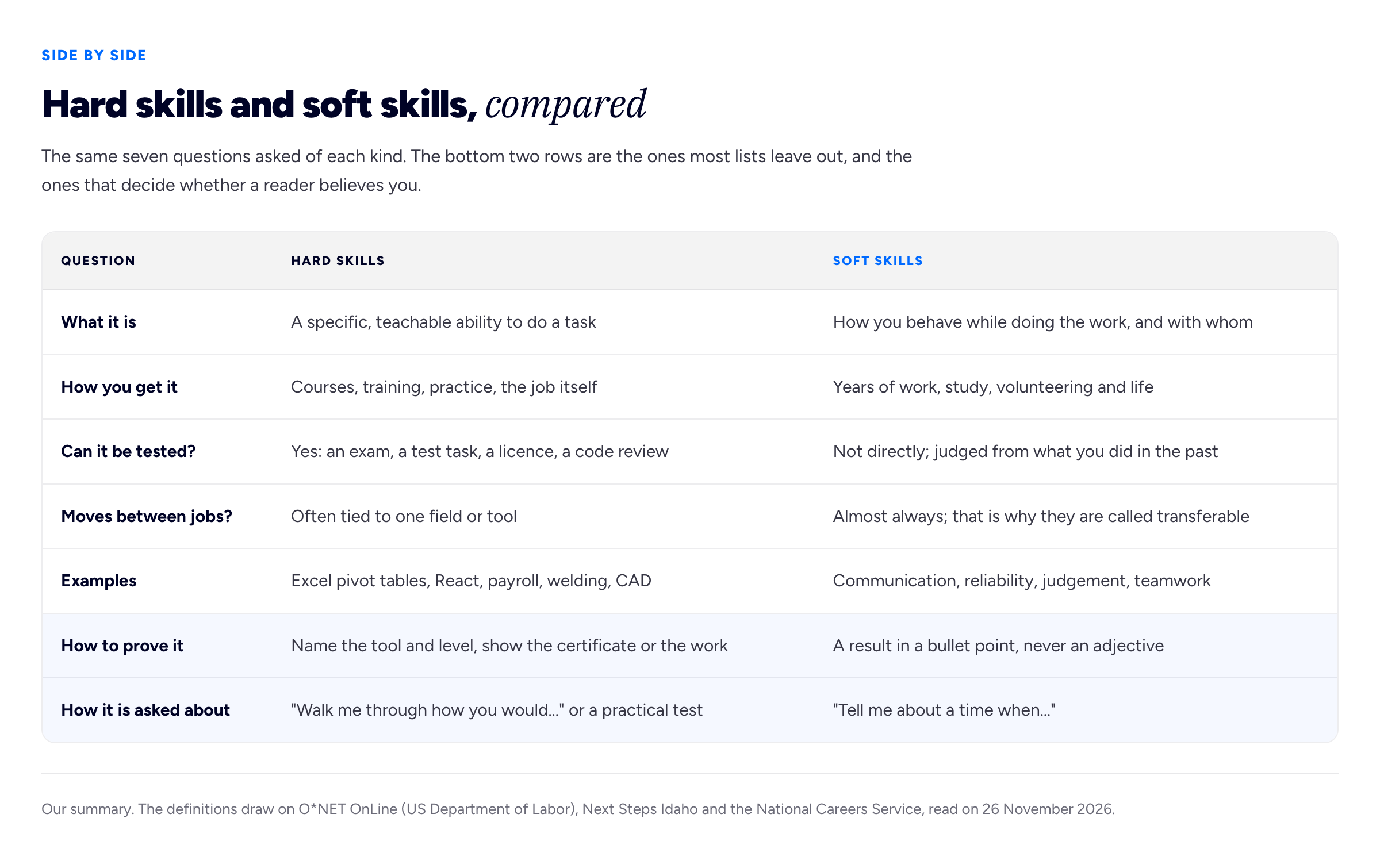
The first five rows are the usual comparison; the last two are what change how you write and talk about each kind.
Which matters more?
The honest answer is that the question is badly framed. Hard skills are usually the entry ticket: a payroll role that requires payroll software experience will not shortlist someone who has never run a pay cycle, however pleasant they are. Soft skills are usually the tiebreaker between people who all cleared that bar, and the reason someone is or is not trusted with more once they are in.
The weighting also shifts with seniority: a junior advert is often a list of tools, a team lead advert mostly judgement and people. Rather than ranking them in the abstract, read the advert you are answering and count which kind it spends more words on.
Hard skills examples by field
Below are hard skills examples for seven broad fields. They were chosen to be specific enough to test, and cross-checked against the software and skill lists on O*NET occupation profiles. Treat them as a menu for spotting what you already have, not a list to paste: a skill you cannot back up costs you more in an interview than it gains on paper.
Tech and software
- Languages: JavaScript, TypeScript, Python, SQL, PHP, Java
- Frameworks and libraries: React, Vue, Laravel, Django, Node.js
- Version control and delivery: Git, pull request review, CI pipelines
- Testing: unit tests with Jest or PHPUnit, end-to-end tests, accessibility audits
- Data and infrastructure: PostgreSQL, REST and GraphQL APIs, cloud hosting, Linux command line
Design
- Figma (components, auto layout, prototyping), Adobe Illustrator, Photoshop, InDesign
- Typography, grid systems, colour for accessibility contrast
- Wireframing, user flows, usability testing, design systems
- Print preparation: bleed, colour profiles, preflight checks
Marketing
- Google Ads, Meta ads, campaign budgeting and bid strategies
- Google Analytics, tag setup, conversion tracking, reporting dashboards
- SEO: keyword research, on-page optimisation, technical audits
- Email automation, segmentation and A/B testing
- Copywriting for ads, landing pages and email
Finance and administration
- Bookkeeping, bank reconciliation, accounts payable and receivable
- Accounting software such as QuickBooks, Sage or Xero; ERP systems
- Excel: pivot tables, XLOOKUP, conditional formatting, month-end templates
- Payroll processing, expense auditing, VAT or sales tax returns
- Minute-taking, diary management, document management systems
Skilled trades
- Welding (named processes, such as MIG or TIG), electrical installation, plumbing
- Reading blueprints and technical drawings
- Operating forklifts, plant or specific machinery, with the relevant licence or ticket
- Equipment maintenance, fault-finding, quality inspection
Healthcare
- Taking and recording vital signs, phlebotomy, wound care
- CPR and first aid, with the certificate and its expiry date
- Electronic health record systems; medical coding
- Infection control procedures, medication administration within your scope of practice
Writing and editing
- Copy-editing and proofreading to a named style guide (AP, Chicago, a house style)
- Technical writing: API docs, user guides, standard operating procedures
- Grant and bid writing
- Publishing in a content management system, basic HTML, SEO-aware headings
Languages have a public scale: rather than "fluent", give a level on the Common European Framework of Reference (A1 to C2) or a named test result. The guide to the resume skills section covers language levels and certifications in detail.
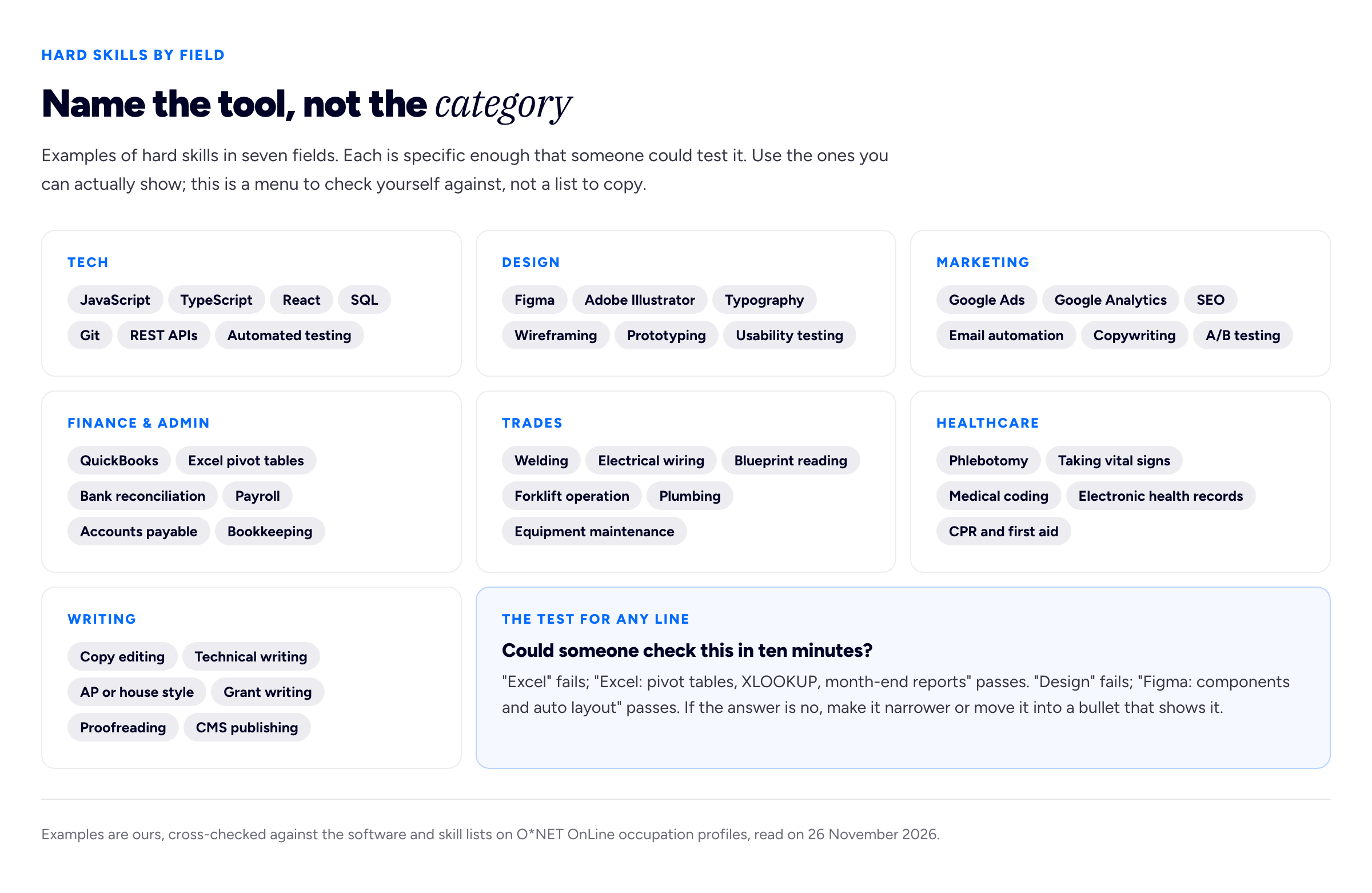
The highlighted card is the useful part: a hard skill earns its line when it is narrow enough to check.
Soft skills examples
Soft skills lists tend to be long and vague. It helps to group them by what they are about, roughly following O*NET's work styles and social skills:
- Working with people: communication (spoken and written), active listening, teamwork, negotiation, persuasion, giving and taking feedback, customer service, empathy.
- Managing yourself: reliability, time management, organisation, self-control under criticism, stress tolerance, integrity.
- Thinking: problem solving, critical thinking, judgement and decision making, attention to detail, learning quickly.
- Change and initiative: adaptability, initiative, resilience, comfort with ambiguity.
- Leading: delegating, coaching, motivating others, running a meeting, setting priorities for a group.
The National Association of Colleges and Employers, a US body that works with university careers services and employers, publishes eight "career readiness" competencies: career and self-development, communication, critical thinking, equity and inclusion, leadership, professionalism, teamwork, and technology. Seven of the eight are soft skills by any definition, which tells you how much of graduate hiring is really about them.
For more words, see words to describe yourself. But the word alone persuades nobody, which is the subject of the rest of this guide.
How to prove a hard skill
Hard skills have an advantage: the evidence can exist outside your own description of it. Use as many of these as apply, roughly in order of strength.
1. Name the exact tool and what you did with it
"Accounting software" is a category. "Sage 50: purchase ledger, VAT returns, month-end close" is a claim someone can test with three questions. The more precisely you name the tool and the tasks, the more believable the line, and the more likely it matches the words a recruiter searches for. Use the name the advert uses, not an abbreviation of your own. Our guide to ATS resume format covers the rest of what lets those words be read by a screening system.
2. Show a level honestly
Skip star ratings; nobody knows what "four stars in Python" means. Words that describe use are clearer: "used daily for two years", "one project, comfortable with the basics". Modest and specific beats vague and grand, because hard skills get tested.
3. Point to a certificate, licence or test result
Some hard skills come with a credential: a trade licence, a CPR certificate, a vendor exam for a software product, a language test score. List the full name, the issuing body and the date or expiry. A credential that has lapsed is still worth stating with its date, but do not let it read as current.
4. Link to the work itself
For anything that produces a visible result, the work is better evidence than any description. A developer can link a repository or a live project; a designer a case study; a writer published pieces; a marketer a campaign write-up with the numbers they are allowed to share. Even an accounts assistant can describe a template or process they built. A career portfolio gathers this in one place, and a single link on your resume to it does more for a hard-skill claim than another line in the skills section. If you need somewhere to host one, Bunfolio gives you a free portfolio site on your own subdomain.
For developers in particular, the guide to what hiring managers look for in a developer portfolio explains which projects actually count as evidence and which are tutorial clones a reviewer will skip.
5. Put the skill inside a bullet too
A skill that appears only in the skills list is a claim with nothing under it. The same skill appearing in a bullet under a job, with an employer's name above it, is a claim with a witness. Luis Ferreira, a junior front-end developer, lists React and TypeScript in his skills line, and then backs them up under his current job: "Built the order-tracking screens in React and TypeScript, used by 40 warehouse staff at Brightwater Logistics." The second line is the one a reader believes.
How to prove a soft skill: show, don't claim
Soft skills have the opposite problem. There is no certificate in teamwork, and every resume claims it. "Excellent communication skills" is also self-defeating: if you communicated excellently, you would have written something more specific.
The fix is to stop naming the soft skill and start showing it through what happened. The University of Georgia's career centre recommends exactly this: embed soft skills "in the bullet points of your experiences", so the reader sees them in use. In practice, a soft skill is proved by a result that could only have come from it.
The method, which is our own, takes three steps:
- Pick the soft skill the job asks for. Read the advert and underline the behaviours: "works closely with operations", "manages competing deadlines", "explains technical issues to non-technical colleagues".
- Find one occasion where you used it and something changed. A deadline kept, an error caught, a complaint resolved, a process other people adopted, a number that moved.
- Write the bullet as the action and the result, and leave the adjective out. If the result needs the skill to have happened, the reader will infer it.
Hannah's rewrites
Hannah Sato is an accounts assistant at Brightwater Logistics, applying for a senior accounts assistant role elsewhere. Her first draft opened with a profile full of adjectives: "Highly detail-oriented accounts assistant with excellent communication skills, a great team player who is dependable and hard-working." Every word was true, and none of it was evidence.
Here is what she replaced it with, under her current job:
Brightwater Logistics, Accounts Assistant, March 2023 to present
- Reconcile six bank accounts monthly in Sage 50; found and cleared a duplicated supplier payment before it went out a second time.
- Rewrote the overdue-invoice reminder emails in plainer language; invoices more than 60 days old fell from 41 to 17 over the following quarter.
- Closed the month-end ledger by working day three every month for a year, including covering a colleague's accounts for six weeks in the summer.
The first bullet shows attention to detail and a hard skill at once; the second, written communication; the third, reliability and teamwork without either word. A reader finishes the block thinking "careful, dependable, writes well", which is exactly what the adjectives were trying to say.
Notice also what she did not do: invent a percentage, or take credit for the whole team's collections figure. Interviewers ask "how did you measure that?", and a number you can explain is worth more than a bigger one you cannot.
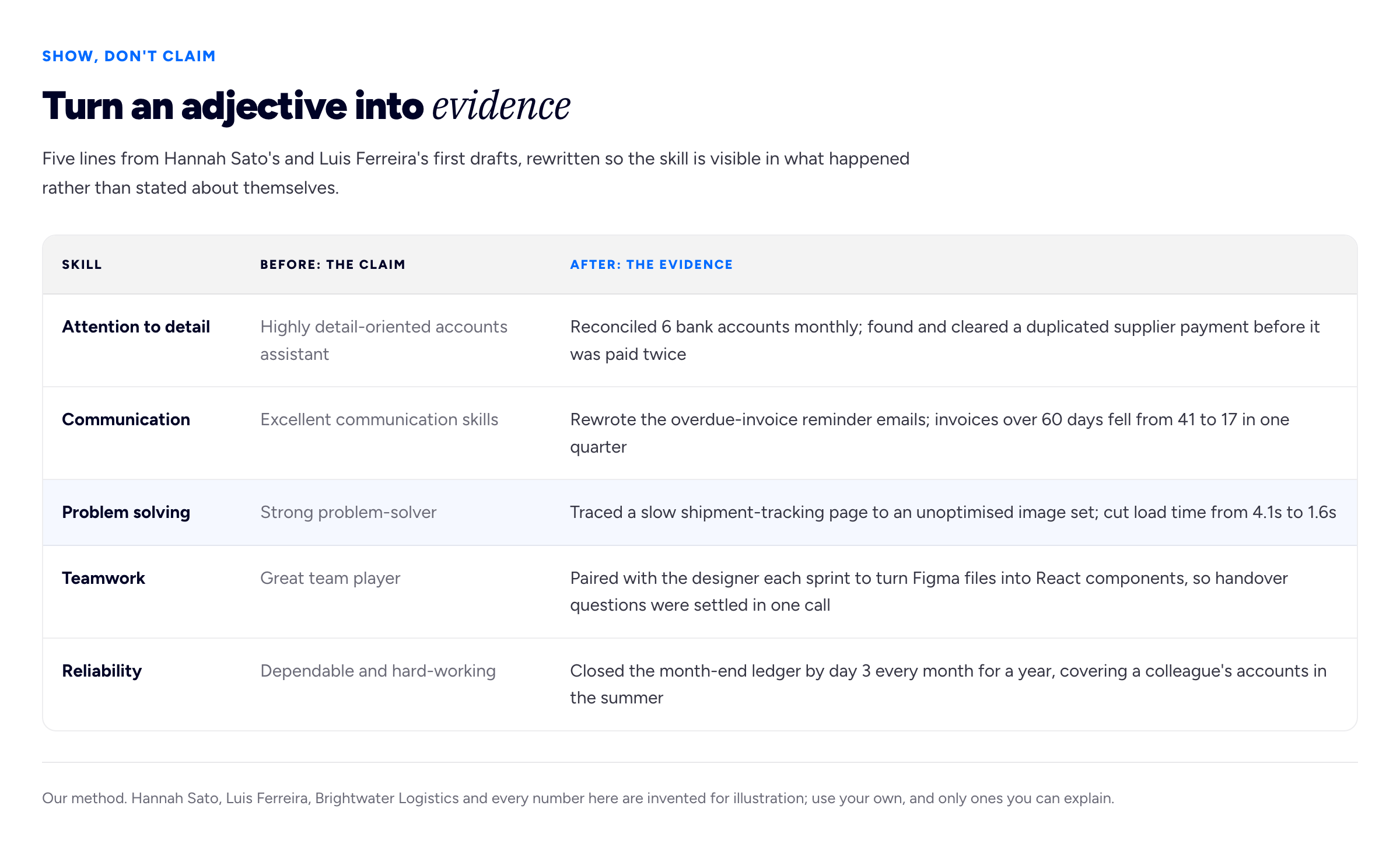
Each rewrite drops the adjective and keeps the result; the reader supplies the adjective for you.
Luis's rewrites
Luis Ferreira's draft said "strong problem-solver and great team player". His rewrites, under his current junior front-end role:
- Traced a slow shipment-tracking page to an unoptimised image set and moved it to responsive images, cutting load time on our test device from 4.1 seconds to 1.6.
- Paired with the product designer at the start of each sprint to turn Figma files into React components, so handover questions were settled in one call rather than a week of comments.
Each bullet carries a hard skill and a soft skill in the same line. That pairing is the strongest form of evidence, because it shows not just that you can do the task but how you behave while doing it.
Where soft skills belong on the page
Mostly in your experience bullets, as above, and in a sentence of your summary at most. A soft skill in the skills list, on its own, adds very little. If you want a short line in your professional summary, attach it to a fact: "accounts assistant known for a clean month-end close" beats "detail-oriented accounts assistant". For how to lay out the skills section itself, how many skills to list and how to group them, see the resume skills section guide; we will not repeat it here.
The same principle runs through every part of a resume that gets noticed. The guide to making a resume stand out applies it to the whole document, and what to put on a resume covers which sections earn their space.
How to talk about each kind in an interview
Interviewers test the two kinds differently.
Hard skills: explain, then demonstrate
Hard skills are tested by asking you to do or explain the thing. Expect questions like "Walk me through how you would reconcile a bank account that is out by a small amount", "How would you structure this component?" or a short practical test. Good answers:
- Are concrete: the steps and tools, in order.
- Admit the edges: "I've used XLOOKUP daily; I've only used Power Query on one project, so I'd be slower there" is a strong answer. It tells them exactly how far to trust the rest.
- Point to the work: "There's an example of this in the project I linked; happy to share my screen."
Here is Hannah answering "How comfortable are you with Excel?":
"Very, for the things this role uses. I built our month-end reconciliation workbook at Brightwater: it pulls the bank export, matches transactions with XLOOKUP and flags anything unmatched with conditional formatting, and a pivot table summarises it by account. I'm less experienced with macros. I can read them and make small changes, but I haven't written one from scratch."
Specific functions, a thing she built, and an honest boundary: far more convincing than "I'm advanced in Excel".
Soft skills: tell one true story
Soft skills are tested with behavioural questions: "Tell me about a time you had to explain something technical to a non-technical colleague", "Describe a time you missed a deadline." The interviewer is not asking whether you have the skill; they are asking for evidence of it. Answer with one real occasion, structured as Situation, Task, Action and Result, and spend most of the time on what you did and what changed. The full method, with worked answers, is in the guide to behavioral interview questions.
Luis, asked "Tell me about a time you worked closely with someone in a different role":
"At my current job, design handovers used to go wrong. The designer would finish a screen in Figma, I'd build it, and then we'd spend days going back and forth in comments about spacing and states we'd each assumed. I suggested we spend thirty minutes together at the start of each sprint going through the new screens before I wrote any code. After a couple of sprints, the comment threads more or less disappeared. Most questions got settled in that one call, and she started marking reused components in the file herself, which saved me time too."
He never says "I'm a great team player". The interviewer writes down "collaborative" on their own.
The question that tests both at once
"What's your biggest strength?" and "Why should we hire you?" invite a list of adjectives, which is the weakest answer. Pick one hard skill and one soft skill the job needs, and give a line of evidence for each.
How to build the skill you are missing
For a hard skill, take a course or follow the tool's own documentation, then make one real thing with it, however small: a spreadsheet that solves a real problem at work, a small app, a set of edited articles. A finished small project is better evidence than a half-finished course certificate.
For a soft skill, put yourself where the behaviour is needed and keep a record. Offer to run the weekly meeting, write the process guide or take the escalation nobody wants, then note the same week what happened and what changed. Early in your career, a part-time job or a society you helped run can supply a true story too.
Frequently asked questions
What are 5 examples of hard skills?
Five common hard skills are bookkeeping in accounting software such as QuickBooks or Sage, writing code in a language such as JavaScript or Python, designing in Figma, running Google Ads campaigns, and a licensed trade skill such as welding or electrical installation. What makes each one hard is that someone could test it directly.
What are 5 examples of soft skills?
Communication, teamwork, problem solving, time management and adaptability are the five most often listed. Others include reliability, attention to detail, negotiation, leadership and customer service. On a resume, show them through results in your bullet points rather than listing the words.
Is communication a hard skill or a soft skill?
Communication in general is a soft skill. Some specific, testable forms of it are closer to hard skills: copy-editing to a style guide, technical writing, or a language at a stated level. If someone could set you a test in it and mark the answer, treat it as a hard skill and name it precisely.
Is Microsoft Excel a hard skill?
Yes. It is a named tool you can be tested on. Because nearly everyone lists it, name the features you actually use, such as pivot tables, XLOOKUP or building reporting templates, rather than writing "Excel" or "advanced Excel".
Should I list soft skills in my resume skills section?
You can include one or two that the advert names, but on their own they add little because anyone can write them. They work much harder inside your experience bullets, where a result shows the skill in use. Keep the skills section mainly for hard skills: tools, methods, languages and certifications.
Can soft skills be learned?
Yes, though more slowly than hard skills and mostly through practice: taking on situations that need the behaviour, getting feedback and adjusting. Note what happened each time, so you have evidence later.
How we put this guide together
Much of this guide is our own recommendation rather than sourced fact: the "could someone check this" test, the five ways to prove a hard skill and their order, the three-step show-don't-claim method, the grouping of soft skills, the field-by-field example lists and the advice on interview answers are ours. The example lists were cross-checked against O*NET occupation profiles but are not an official taxonomy.
The sourced facts come from pages we read on 26 November 2026: O*NET OnLine's essential skills, transferable skills and work styles browse pages, its occupation profiles for bookkeeping, accounting and auditing clerks and web developers (the software lists quoted), and its about page (more than 900 occupation profiles); Next Steps Idaho's page on hard (technical) versus soft (professional) skills; the National Careers Service guide on how to develop your soft skills; the University of Georgia Career Center's article on listing hard and soft skills on a resume; and NACE's career readiness competencies.
We have deliberately left out the figures that usually decorate articles on this subject, such as the share of hiring managers said to value soft skills over hard skills, the claim that a fixed percentage of job success comes from soft skills, and lists of "the most in-demand skills this year". We could not trace them to a published method, sample and date we were willing to stand behind, so we have not repeated them.
Hannah Sato, Luis Ferreira and Brightwater Logistics are invented for illustration, as are their resume lines, interview answers and every number in them and in the third diagram.
Related reading: how to write the resume skills section, behavioral interview questions and STAR answers, how to write a professional summary, words to describe yourself and how to build a career portfolio.
More from the blog
August 12, 2026 · 22 min read
Marketing Portfolio Examples: How to Show Results You Can Prove
A marketing portfolio is an evidence problem, not a gallery problem. The five parts of a single entry, how to write a result an experienced reader believes, and what to do about the numbers you are no...
July 18, 2026 · 20 min read
Personal Website Examples, and the Decisions Behind Them
Not another gallery of screenshots. The four jobs a personal website quietly does, the six patterns the good ones share, the failures that recur just as reliably, and how the right answer changes with...
November 24, 2026 · 19 min read
What Is a Letter of Interest? Template and 3 Full Examples
A letter of interest is a short letter to an employer that has not advertised a job, saying you would like to work there, what you could bring, and asking for a conversation. In the UK it is a specula...