
September 3, 2026 · 21 min read · Updated October 5, 2026
How to Make a Fashion Design Portfolio
Ten unrelated garments answer a question nobody asked. Brands hire the ability to develop a range, so the unit is the collection: research through to flats, a spec sheet and a fitting page. Plus the three portfolios this discipline needs and why flats separate a designer from a hobbyist.
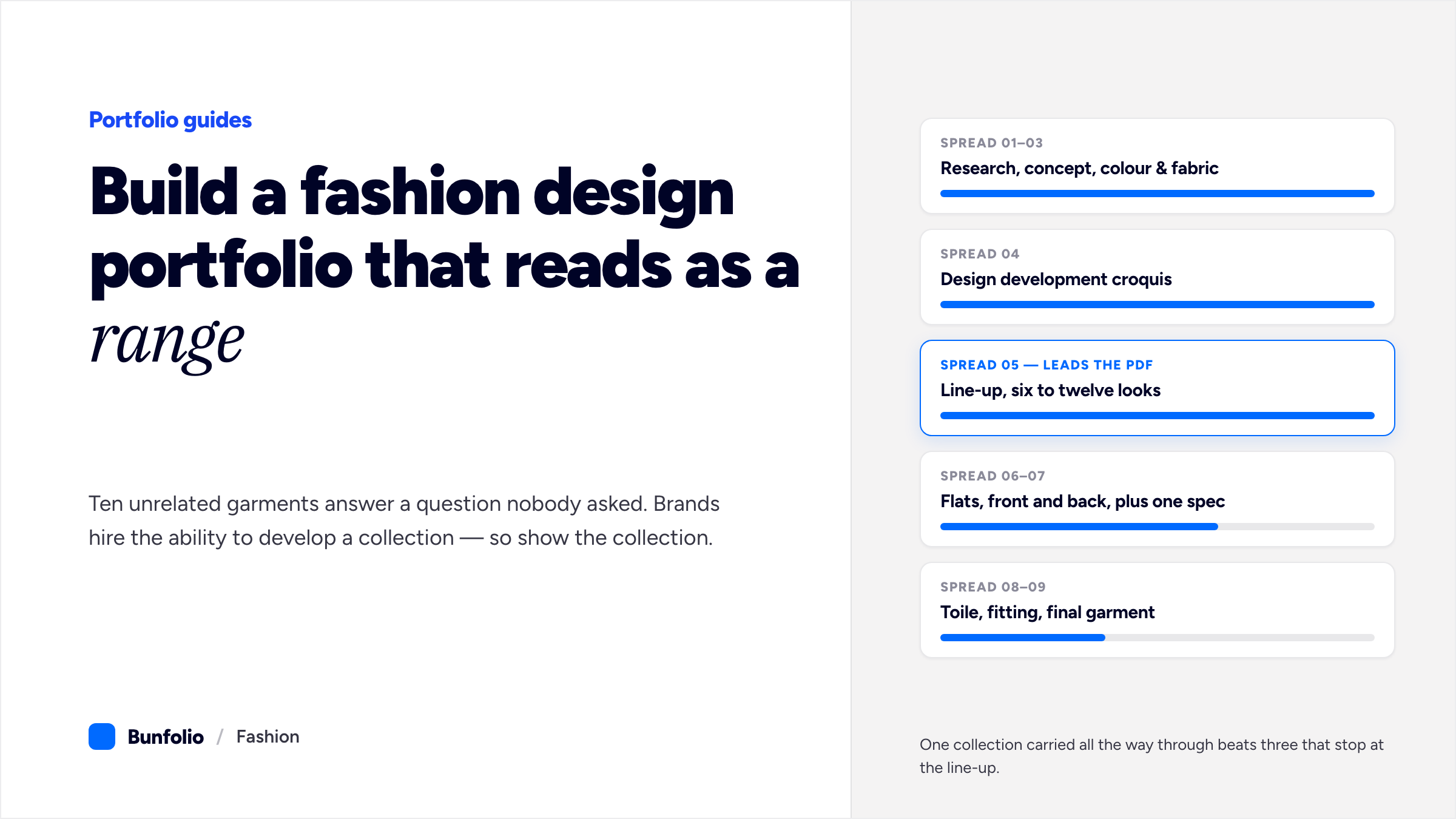
Most rejected fashion portfolios are not rejected for the clothes. They are rejected because the reader could not tell whether the person who made them can develop a range — and developing a range is the actual job. A designer at a brand is not asked to produce a beautiful jacket. They are asked to produce fourteen pieces that hang together, sit inside a price architecture, share a fabric package, and arrive as specifications a factory can cut without ringing you up.
So a portfolio of ten unrelated garments, each photographed nicely, reads as ten one-off achievements and no evidence at all. It answers a question nobody asked. The portfolio that gets a reply shows fewer garments and much more of the thinking that turned research into a line-up, and the line-up into something manufacturable.
To make a fashion portfolio that gets a reply, build it around collections rather than garments, show the development and technical work behind at least one of them, and make three versions for the three ways it will be read. This guide covers each part: a step-by-step overview, what belongs in a collection spread and in what order, what the three separate portfolios in this discipline are for, how to photograph a garment when you have no budget, how much of the technical package to show, how to credit work you did at a brand without breaching anything, and what changes if you are in knitwear, print, accessories or costume rather than womenswear. The general skeleton of a portfolio site — hero, work, about, contact — sits in our guide to a freelance portfolio website that wins clients, and this post does not repeat it.
You need three portfolios, and they are not the same document
Almost every problem people bring to a fashion portfolio comes from trying to make one file do three incompatible jobs. Architecture has the same disease, which we covered in the architecture portfolio; fashion has it worse, because the physical book still matters here in a way it does not in most creative fields.
The three are:
- The book. The full portfolio, twenty to forty spreads, that you carry into an interview and turn while someone watches. It is paced for a person sitting next to you, so it can afford research pages, development sheets and a fabric swatch card stapled in. Its job is depth.
- The sample. A short PDF, ten to fifteen spreads, that goes into an application portal or an email. It is read alone, at speed, often on a laptop, and very often behind a hard file-size cap. Its job is to earn the interview where the book gets seen.
- The website. A URL that outlives both, that a recruiter can find without asking, and that you can update the week you finish something. Its job is to exist when nobody has requested anything.
They share material and they are edited completely differently. The book can open on six pages of research; the sample cannot, because the reader deciding whether to open your file has not agreed to spend six pages with you yet.
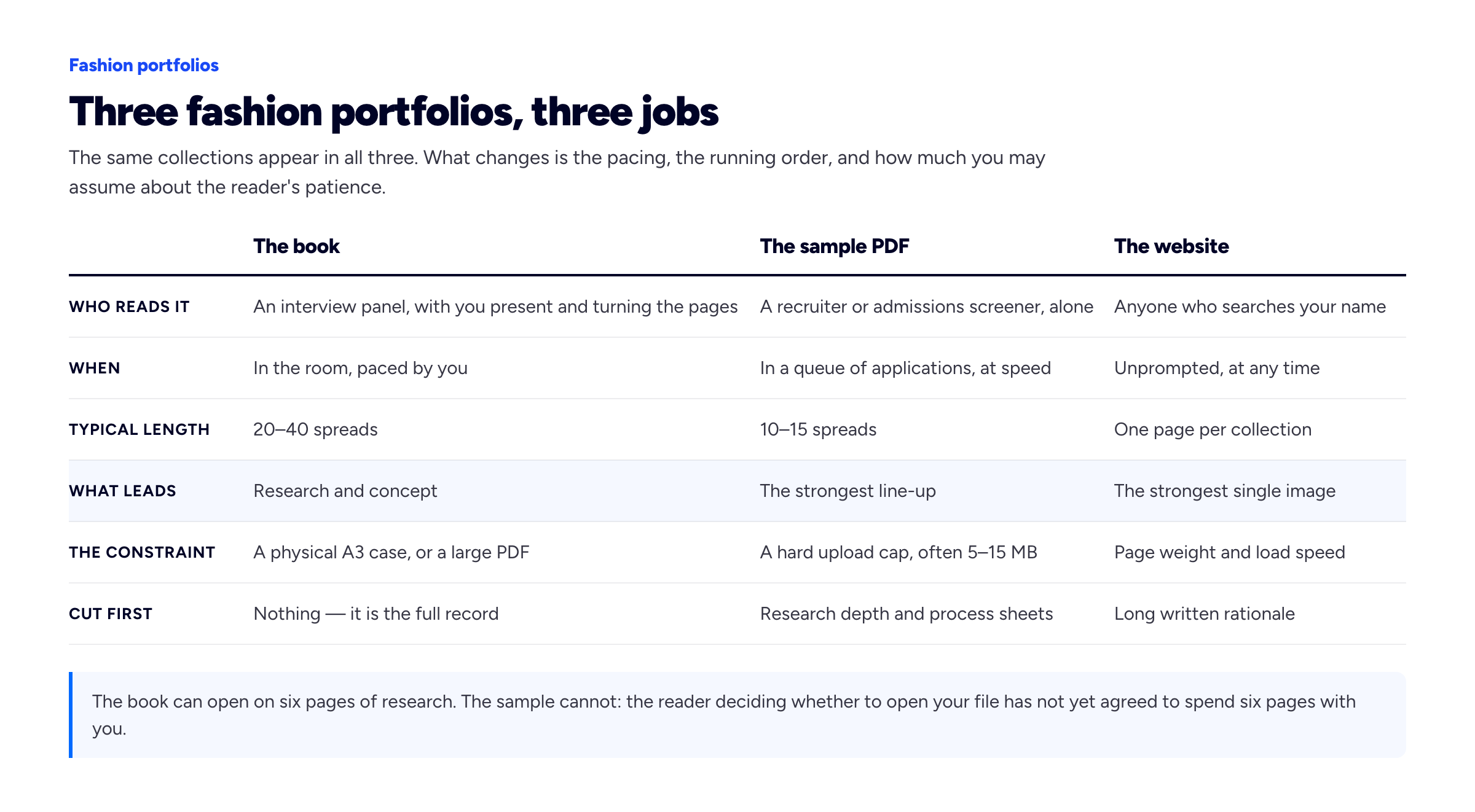
The same collection appears in all three. What changes is the pacing, the running order and how much you are allowed to assume about the reader's patience.
How to make a fashion portfolio, step by step
If you want the whole job in order before the detail, this is it. Each step is explained properly in a section further down.
- Find out who will read it and in what format. A brand's application portal, a recruiter's inbox, an interview panel and a university admissions team want different documents. Read the application page before you start, and note any page count, file size or format it sets. That cap overrides every general guideline, including ours.
- Choose two to four collections. Pick the projects that best fit the job or course, not the ones that took longest. Organise by collection rather than by garment; the reasons are in the next section.
- Carry one collection all the way through. Research, concept and customer, colour and fabric, development, line-up, flats, a specification page, a fitting page and the finished piece. The others can stop at the line-up.
- Draw the flats. Front and back for every look in each line-up, at consistent line weight. If your portfolio has no flats yet, this is the highest-value afternoon you can spend on it.
- Photograph what you made. Steamed, on a stand, against one background, front, back and a detail. The no-budget method is below.
- Write the words. Three or four sentences of concept per collection that name the customer and price level, and a credit line on any work done at a brand stating the brand, season, your role and your contribution.
- Build the three versions. The full book for interviews, a ten-to-fifteen-spread sample PDF under the upload cap, and a website with one page per collection. Put the URL on the front page of the PDF.
- Audit it as a stranger. Run the pre-send checklist at the end of this guide, then send it to someone who has not seen the work and ask what each collection is for. If they cannot tell you, the concept page needs rewriting.
If the portfolio is for a fashion course rather than a job
An admissions portfolio is judged on potential rather than readiness for production, so the balance shifts. Admissions tutors want to see how you think, which means development matters more than finish. University of the Arts London's advice on fashion portfolios for university, for example, asks applicants to include some unfinished work to show how they research and develop ideas, and to include only pieces they can explain. Flats and spec sheets are welcome if you have them, but nobody expects them from a school leaver. Sketchbook pages, experiments with materials and a clear thread from research to outcome do the work instead. As with a job application, the course's own brief is the rule: if it gives a page limit or asks for particular work, follow it exactly.
The collection is the unit, not the garment
Organise everything around collections, ranges or projects — never a gallery of individual pieces. Three well-developed collections beat thirty garments, and this is the single edit that most improves a portfolio in one afternoon.
A collection in a portfolio is a run of spreads that takes the reader from a starting point to made objects without a gap they have to jump. The order below is close to how the work actually happens, which is why it reads as coherent rather than reverse-engineered:
- Research. Primary where you can — things you photographed, went to, took apart — rather than a wall of pictures collected from other people's mood boards. Primary research is the fastest way to look like a designer rather than a curator.
- Concept and direction. A short written statement, three or four sentences, that says what the collection is and who it is for. This is where you name the customer and the price level, and it is the page most students skip.
- Colour and fabric. A palette with real references, and a fabric story with swatches, weights and compositions. Physical swatches in the book; scanned swatches with the composition written beside them in the PDF.
- Design development. Croquis sheets showing the ideas that did not survive. A reader wants to see the range of options you generated and the judgement you used to cut them, which is exactly what a portfolio of finished pieces conceals.
- The line-up. Six to twelve looks, drawn to a consistent figure, at a consistent scale, in colourway. This is usually the strongest single page in a fashion portfolio and it is the one to lead the sample PDF with.
- Technical flats. Front and back, drawn to proportion, at consistent line weight, for every look in the line-up. Not a sketch — a flat.
- Specification. At least one worked example: measurements, construction notes, trims, stitch types, labelling. It does not need to be a full tech pack for every piece; it needs to prove you can produce one.
- Toile and fitting. Calico on a stand, with the corrections marked. Two photographs of a fitting, with a line about what changed, does more for your credibility than a fourth styled image of the finished garment.
- The made piece. Photographed properly, front, back and one detail. What you actually made, not what you designed.
You will not have all nine for every collection. Have them for one. A single collection carried the whole way through, with a fitting page and a spec sheet, tells a reader more than three collections that stop at the pretty line-up.
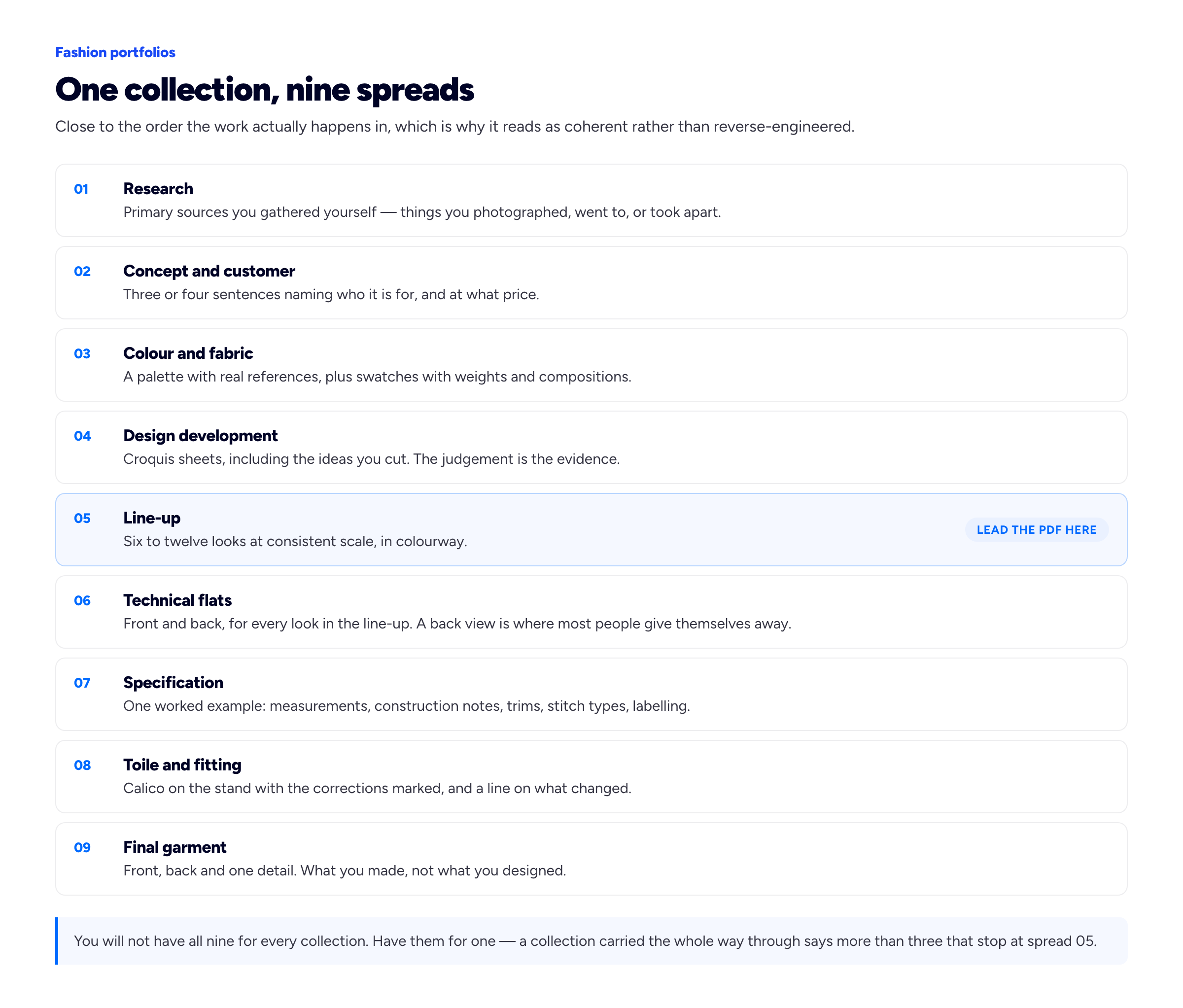
Not every collection needs all nine spreads. One collection that runs the whole distance is worth more than three that stop at the line-up.
Flats and specs are what separate a designer from a hobbyist
This is the most common gap in a self-taught or career-changing fashion portfolio, and it is also the easiest to close. Illustration is welcome; a beautiful figure drawing shows taste. But a brand cannot cut a garment from a fashion illustration, and the person reviewing your portfolio knows it. Flats show you understand construction. Specs show you can hand the idea to somebody else.
What good flats look like in a portfolio:
- Drawn digitally, with a consistent line weight, on a consistent figure proportion — a 1:8 croquis for illustration, but flats drawn to real garment proportion.
- Front and back for every piece. A back view is where most people give themselves away.
- Stitch detail indicated: topstitching, seam type, closures, trims called out.
- Laid out as a range sheet — the whole collection on one page, in colourway, so a merchandiser can read the offer at a glance.
If you work in 3D — CLO 3D or Browzwear — include it, and include the flat pattern alongside the render. Digital product creation is a live hiring signal at the moment, and a portfolio that shows a garment simulated on an avatar plus its pattern pieces answers a question a lot of brands are currently asking.
Photographing a garment with no budget
The most expensive-looking pages in a student portfolio usually cost nothing. They cost care.
- Use a dress form, not a friend. A stand holds the garment in the shape you designed. A friend in a bedroom introduces posture, expression and a bed. If you must use a model, book a plain wall and light from a window at ninety degrees to the garment.
- Steam everything. Creases read as an unfinished garment. This is the single largest quality difference between a first-year and a final-year portfolio page.
- Pin at the back. Fit the piece to the stand so the front reads clean, and never photograph the pinned side.
- One light source, no flash. A large window with a white sheet as diffusion beats any on-camera flash you own.
- Shoot front, back, and two details. The detail shots are where the making is visible: a bound buttonhole, a bagged-out lining, a knit transfer, a bound hem.
- Keep the background identical across a collection. Consistency is what makes nine photographs read as one range. The same argument applies to the grid on a website, which we covered in choosing portfolio thumbnails.
For knitwear and jersey, add a flat lay. Hanging a heavy knit on a stand distorts it, and a flat lay on a clean surface shows the stitch structure, which is the whole point of a knit piece.
Your specialism changes the portfolio more than you think
"Fashion design portfolio" is a phrase that covers at least six different documents:
- Womenswear and menswear. The nine-spread structure above, straight down the line. Menswear portfolios are judged harder on fit, proportion and detail, and lighter on silhouette drama.
- Knitwear. Stitch swatches are the portfolio. Show a swatch library with yarn composition, gauge and needle, and photograph swatches flat and large. A knitwear portfolio without a swatch page is missing its evidence.
- Print and textiles. Show the repeat, not just the artwork — the tile, the repeat in situ, the colourways, and the placement on a garment. A print portfolio that never shows a repeat has not shown the technical skill.
- Accessories and footwear. Construction and hardware carry the work. Include lasts, sole units, exploded views, material call-outs and, if you can, a made prototype in any material at all.
- Costume. A different discipline wearing the same name. Lead with a script or character breakdown, period research with sources, and the design's relationship to a scene. Fabric and making pages come after.
- Sustainability and circularity. If this is your position, evidence it rather than claiming it: a materials rationale with compositions, a pattern-cutting approach to waste, an end-of-life plan for the piece. A page that says "sustainable" and shows nothing is worse than not raising it.
Showing work you did at a brand
This gets people into genuine trouble, so treat it carefully. Two separate things are at stake: confidentiality and ownership.
On confidentiality, the safe default is that unreleased seasons are confidential until they are on the shop floor. Once a product has been sold publicly, showing that product is usually uncontroversial; showing the internal documents that produced it usually is not. Tech packs, costings, supplier names, factory names and range plans are commercially sensitive and are not yours to publish, regardless of who drew them.
On ownership, work made in the course of employment generally belongs to the employer, and in the UK a garment design may also attract design right that sits with the brand rather than with you. That does not stop you describing what you did; it stops you presenting the brand's assets as your portfolio.
The practical answer is a credit line on every professional page that states the brand, the season, your role and your contribution, in that order — "Autumn/Winter, [brand], assistant designer, womenswear outerwear: developed six of the fourteen outerwear options, owned the fit process on two". A reader is far more impressed by a precise small claim than a vague large one. Our guide to showing confidential work in a portfolio covers the permission conversation in more detail, and it is worth having that conversation while you still work there.
If you have no industry experience yet
Nobody expects a first portfolio to contain shipped product. They expect it to contain evidence of the same skills, obtained honestly. In descending order of usefulness:
- A self-directed collection with a real brief you wrote. Name a real brand, a real price point and a real season, and design into that constraint. "A six-look capsule for a British mid-market retailer, spring, retailing between £45 and £120" is a portfolio project. "Nature-inspired" is not.
- A competition or live brief. Industry competitions and live briefs set by brands give you an external constraint and a defensible outcome, whether or not you won.
- A rework of an existing product. Take a garment on sale now, produce the flats and a spec for it, then redesign it for a different customer. This shows technical literacy without pretending to a client.
- Making, plainly. Sewn, patterned, knitted, printed. In a discipline full of renders, evidence of hands is scarce and valuable.
Label the invented brief as an invented brief. Presenting a self-set project as a client engagement is the fastest way to lose a reader who recognises the brand. The same principle covers the wider case in building a portfolio with no experience.
File size, and the application portal that will not take your PDF
Fashion applications are frequently submitted through portals with hard upload limits, and a portfolio that will not upload is a portfolio that was not read. Two habits fix it permanently:
- Keep the master at full quality and export a compressed submission copy. Export images at around 150 dpi at final placed size for a screen-read PDF; nothing in a submission PDF needs 300 dpi.
- Name the file so it survives a folder of two hundred applications:
Surname-Firstname-Portfolio-Womenswear.pdf. Notportfolio-final-v7.pdf.
Keep a one-page PDF too — the line-up, three finished images and your contact details — for the moment somebody asks for "a couple of pages" before agreeing to look properly.
The website version
The book is linear and you control the pace. A website is not, and cannot. Two things follow.
First, each collection becomes one page you can send as a link, and that page runs top to bottom in the same nine-step order. Do not fragment a collection into a gallery of thumbnails; the sequence is the argument. Second, the images have to load. Large fashion photographs on a slow page are the most common reason a portfolio site fails its first visit, so export at sensible dimensions and let the site serve modern formats — Google's guidance on Largest Contentful Paint is the plain version of why the first image matters more than the rest, and their image best practices cover the alt text and filenames that make garment images findable at all.
Write real alt text on every image. "Navy wool overcoat, front view, on stand" is useful to a screen reader, to Google Images, and to you in two years when you cannot remember which file was which.
A pre-send audit
Before it goes anywhere, read it as a stranger with four minutes:
- Can a reader name the customer for each collection from the page itself?
- Is there a line-up page, at consistent scale, in colourway?
- Are there front and back flats for every look in that line-up?
- Is there at least one specification page and one fitting page in the whole document?
- Is every professional page credited with brand, season, role and your actual contribution?
- Is every self-set brief labelled as self-set?
- Are all the garment photographs steamed, on the same background, and free of pins?
- Does the PDF open under the portal's cap, and is it named with your surname?
- Is there a URL on the front page that still works when the PDF is forwarded?
Frequently asked questions
What should a fashion design portfolio include?
Two to four collections, each shown as a sequence rather than a gallery: research, concept and customer, colour and fabric with swatches, design development sheets, a line-up of six to twelve looks, technical flats front and back, at least one specification page, a fitting or toile page, and properly photographed final garments. Plus a contact page and, for professional work, a credit line naming brand, season, role and contribution.
How do I make a fashion portfolio?
Check what the reader has asked for, then choose two to four collections and present each as a sequence from research to finished garment. Carry at least one all the way through to flats, a specification page and a fitting page, photograph the made pieces consistently, write a short concept for each, and produce three versions: an interview book, a short PDF under the upload limit, and a website. The step-by-step list above has the detail.
How do I create a fashion design portfolio with no experience?
Set yourself a real brief with real constraints — a named retailer, a price bracket, a season — and design into it, then carry one collection all the way through to flats, a spec and a made or toiled piece. Add a competition or live brief if you can get one, and a technical rework of an existing garment. Label self-set projects as self-set. Depth on one project beats breadth across four.
How many pages should a fashion design portfolio be?
The interview book runs roughly twenty to forty spreads; the PDF you submit or email runs ten to fifteen. If you are over, cut whole collections rather than thinning every collection, because a half-shown collection proves less than no collection.
Should a fashion design portfolio be a PDF or a website?
Both, for different moments. The PDF is what an application portal and a recruiter's inbox will accept, and it is what gets forwarded. The website is what someone finds when they search your name, what you can update the day you finish something, and what you put on the front page of the PDF so a forwarded file still leads back to you.
How do I make a digital portfolio for fashion design?
Lay the collections out as pages rather than a mixed gallery, keep each collection's sequence intact, export images at screen-appropriate sizes so the pages load quickly, and write descriptive alt text on every image. Then put the URL on your CV, your PDF cover and your email signature. A digital portfolio nobody can find is a folder.
Do you need a portfolio to get a fashion design job?
Yes, effectively always, at every level including internships — and the portfolio, not the CV, is what the decision is made on. What varies is the format expected: some employers want a PDF up front, some want a link, some want the physical book at interview. Have all three ready rather than guessing.
Can I include work I did at a fashion brand?
Usually yes for product that has already been sold publicly, and usually no for unreleased seasons, tech packs, costings, range plans and supplier information. Employed work generally belongs to the employer, so present it with a credit line stating the brand, the season, your role and your specific contribution rather than as your own asset — and ask before you publish, ideally while you still work there.
Do I need to include technical flats and tech packs?
Flats, yes — front and back for everything in your line-up, in every portfolio, at every level. A full tech pack for every piece, no; one worked specification example is enough to show you can produce them. The absence of flats is the most reliable signal that a portfolio came from someone who has not worked with a factory.
How we put this guide together
Bunfolio builds portfolio sites, so we spend our time reading what designers publish and watching where a page loses its reader. The structure recommended here is our own judgement rather than an industry standard, and you should weigh it as such: the nine-spread collection sequence and its ordering, the three-portfolio split between book, sample and website, the argument that flats and one specification page do more for credibility than additional finished garments, the "one collection carried all the way through" rule, and the four-item ladder for a portfolio without industry experience. They come from the pattern in what makes a reviewer keep turning pages — evidence of development and of manufacturability — and what makes them stop, which is a run of finished pieces with no visible thinking behind them.
We have deliberately cited no statistics about hiring rates, review times, or how many portfolios a recruiter opens. The fashion careers space circulates a lot of confident numbers of that kind and we could not trace them to a primary study we would stand behind, so they are absent rather than borrowed. Page counts, spread counts and file sizes here are described as ranges we consider workable, not as requirements — the only cap that binds you is the one printed on the application form in front of you, and you should read that rather than us.
Where a factual claim is made it points at a primary source. The position on design ownership refers to the UK Intellectual Property Office's guidance on design right, which is the document itself rather than a summary; readers outside the UK should check their own jurisdiction rather than assuming it transfers, and nothing here is legal advice. The technical points about image weight and findability refer to web.dev on Largest Contentful Paint and Google's image best practices. The point about admissions portfolios refers to University of the Arts London's article how to create a fashion portfolio for university, read on 5 October 2026; individual courses set their own requirements, which take precedence. Software names are current at the time of writing and change; the underlying skill they evidence does not.
Every brand, brief, season, price point and credit line used as an example above is invented for illustration, including the outerwear credit and the mid-market capsule brief. They exist to show the shape of a well-evidenced page. They do not describe real work, and no example copy here should be reused as a claim about anything you did.
Related reading: the graphic design portfolio guide for the neighbouring visual discipline, the architecture portfolio for the same book-versus-sample-versus-web problem solved differently, how to write a portfolio case study for turning one collection into long-form, choosing portfolio thumbnails for the grid your collections sit in, and showing confidential work in a portfolio for the permission conversation.
More from the blog
October 3, 2026 · 16 min read
How to Make a Resume Stand Out: What to Change on the Page
A resume stands out by being the easiest one in the pile to say yes to, not by looking different. Here is how to rebuild the top of page one, turn duties into results (even without numbers), tailor ho...
September 15, 2026 · 16 min read
How to Make an Art Portfolio for School, Studios, Galleries and Clients
The same artist needs a different portfolio for an art school, a studio, an open call and a commission client. How to choose and cut pieces for each, photograph and caption the work, and build a portf...
September 9, 2026 · 19 min read
Motion Design Portfolio: What Studios Look At Before the Reel
A showreel proves something moved well. It cannot prove you designed it, timed it, or built any of it — and on a five-craft job the silence reads as a claim to all of it. Why style frames outrank the...